

 From the Delta Protection Commission:
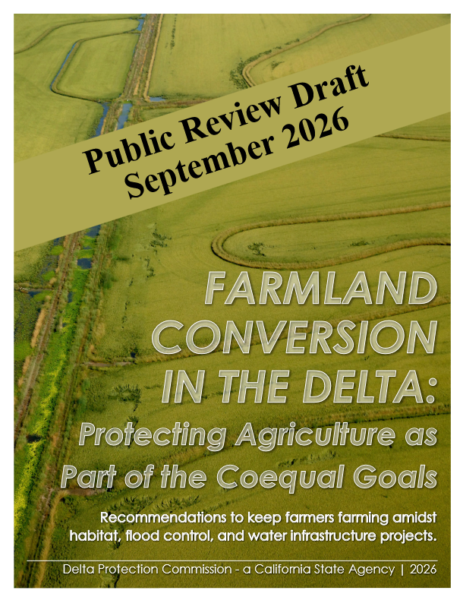
Public comment opens today on the Delta Protection Commission’s draft report, “Farmland Conversion in the Delta: Protecting Agriculture as Part of the Coequal Goals.”
The deadline to comment is Dec. 1, and a final report incorporating public comment will be presented to the Commission in January. The draft report can be found here (PDF), and comments may be emailed to the Delta Protection Commission at submit@delta.ca.gov.
Findings
The draft report highlights a public policy gap inherent in implementation of the “coequal goals” established by the 2009 Delta Reform Act.
The coequal goals call for a more reliable water supply for California and protection, restoration, and enhancement of the Delta ecosystem, while requiring that the goals be achieved in a manner that protects and enhances the Delta’s agricultural values. Implementation of those goals is guided by the Delta Plan, which was adopted in 2013.
Agriculture remains the Delta’s dominant land use, covering approximately 416,700 acres, or about 56 percent of the Delta’s total area. The draft report finds that since 2013, completed, underway and in-planning habitat and flood control projects have converted and are expected to convert approximately 17,000 acres of Delta farmland. In addition, 3,800 acres of Important Farmland would be temporarily or permanently converted if the proposed Delta Conveyance Project is built, followed by additional conversions to comply with as yet undefined habitat mitigation requirements for the project.
The Delta Reform Act states that “the coequal goals shall be achieved in a manner that protects and enhances the unique cultural, recreational, natural resource, and agricultural values of the Delta as an evolving place” (emphasis added).
But that provision of the law lacks a comprehensive enforcement mechanism. The Delta Protection Commission has some land-use authority in the Delta that can be used to protect agriculture, but it extends only to projects in the Delta’s Primary Zone that require local government approval. Many restoration projects do not meet that criteria; nor does the Delta Conveyance Project.
Why It Matters
The draft report does not argue against habitat restoration or flood protection. It focuses on how these projects can be planned, sited, designed, mitigated, and maintained in ways that avoid or reduce impacts to Delta agriculture.
Farmland conversion affects Delta agriculture in multiple ways:
Productive farmland is assessed to support reclamation districts that provide drainage and maintain levees that protect not only the land, but the water supply for 27 million Californians whose water comes through the Delta. When land is taken out of production, those assessments are typically lost, weakening districts that already struggle to maintain levees.
As farmland acreage shrinks, it becomes less economical to provide the services farms depend on in the Delta. Losing services would raise costs on farmers who are already on the precipice, stressed by low commodity prices, high input costs, and the growing costs of regulatory compliance.
Farmers consulted during the research phase of the draft report generally made clear they do not oppose habitat restoration on principle. In some cases, farmland has subsided so deeply that it cannot be farmed productively. But only 18% of acreage within the completed, underway, or in-planning projects is on deeply subsided lands – 15 feet or more below sea level.
Recommendations
Habitat restoration efforts are driven by real problems: a stressed ecosystem, substantial carbon emissions, and subsidence that result from non-flooded farming of peat soils. But the shrinking footprint of agriculture in the Delta is also a real problem that threatens the region’s economy, contributes to broader statewide economic impacts, affects levee and water-management systems that help protect the State’s water supply, and puts the Delta’s way of life at risk.
The draft report makes 22 specific recommendations to strengthen protections and put the state on track to comply with the Delta Reform Act’s requirement to achieve the coequal goals in a manner that protects the Delta’s agricultural values. Generally, they call for:
- A commitment to agriculture in the Delta commensurate with the State’s focus on restoration.
- A deliberate strategy for supporting agriculture.
- A region-wide planning approach to restoration projects that can recognize and avoid unnecessary loss of agricultural land, minimize impacts to adjacent farms, and ensure that neighboring projects do not undermine farmland productivity, water management, or long-term agricultural viability.
- Enforceable regulations that require protections for farms, rather than policies that simply recommend protections.
- Mechanisms to offset losses in reclamation district assessments, county tax revenues, and other local fiscal resources when farmland is converted, and to ensure that projects providing statewide or regional benefits do not shift long-term levee and water-management costs onto remaining farmers and landowners.
- Continued and expanded support for farms to bolster their viability and foster practices that address concerns about carbon emissions and subsidence.
The draft report concludes that the future of the Delta should not be framed as a choice between agriculture, ecosystem health, and water supply reliability. With thoughtful planning and meaningful support, restoration, water supply reliability, and agriculture can coexist and, in some cases, provide complementary benefits.

