New findings prompt regulators to reconsider the program’s 2030 deadline and mercury allocations.
At a September 3 workshop, Central Valley Water Board staff outlined proposed changes to the Delta Mercury Control Program following the completion of Phase One studies and an ongoing review of the program. New data indicate that the current TMDL allocations and 2030 attainment date are not achievable under the existing approach, prompting staff to consider extending the timeline and revising allocations to better reflect the sources of methylmercury entering the Delta.
MERCURY’S LASTING IMPACT ON THE DELTA
Methylmercury poses serious risks to human health and wildlife. This potent neurotoxin can damage the brain and central nervous system and impair reproductive and immune functions. It forms when environmental conditions convert inorganic mercury and then bioaccumulates and biomagnifies through aquatic food webs, reaching harmful levels in fish and prompting consumption advisories.
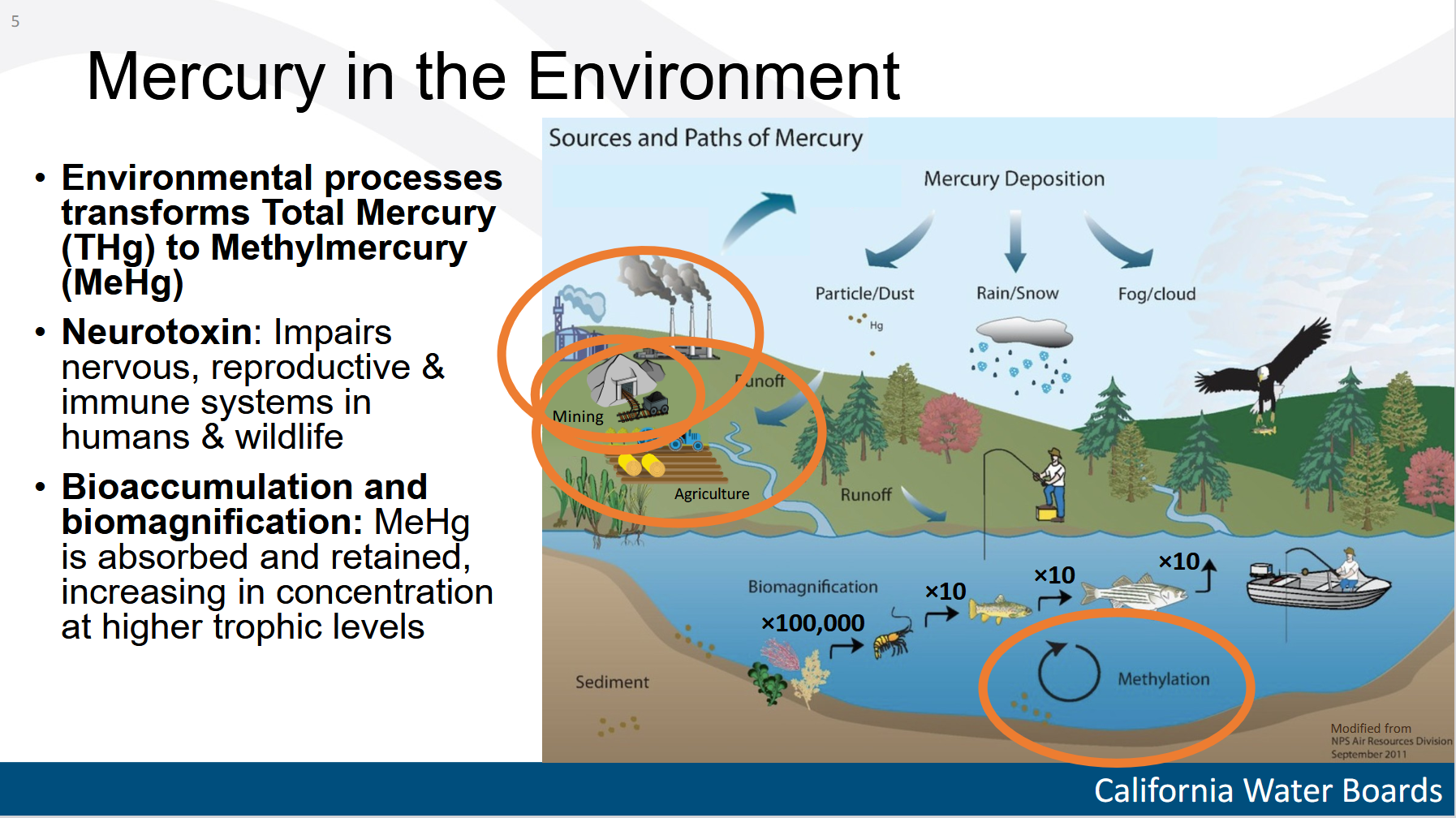
Mercury enters the environment through natural processes and human activities. Sources include weathering and erosion, volcanic activity, fossil fuel combustion, mining, industrial processes, wastewater, and stormwater. Once released into the atmosphere, mercury can circulate globally before returning to land or water through deposition. In California, it also occurs naturally in Coast Range soils and springs.
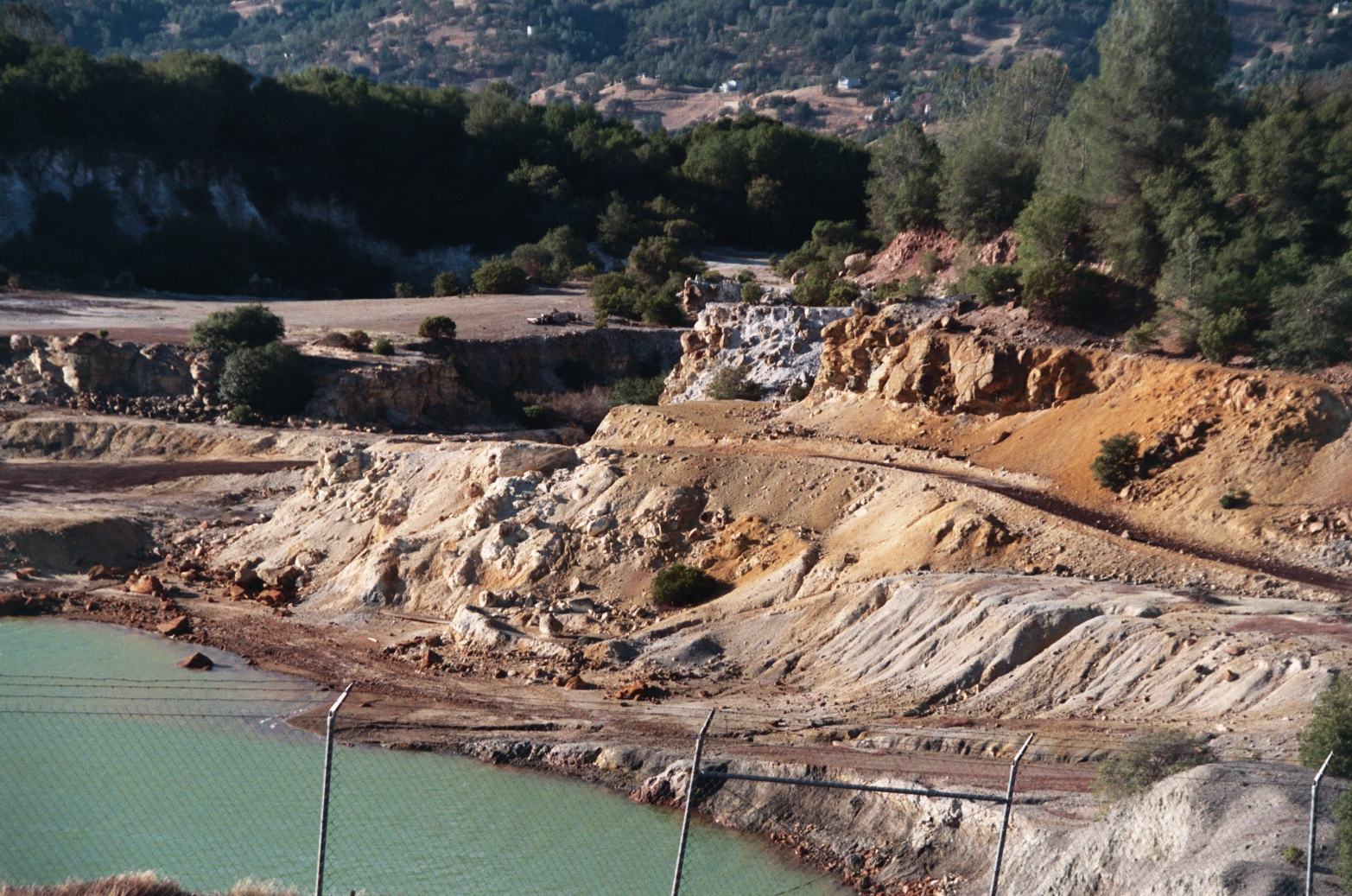
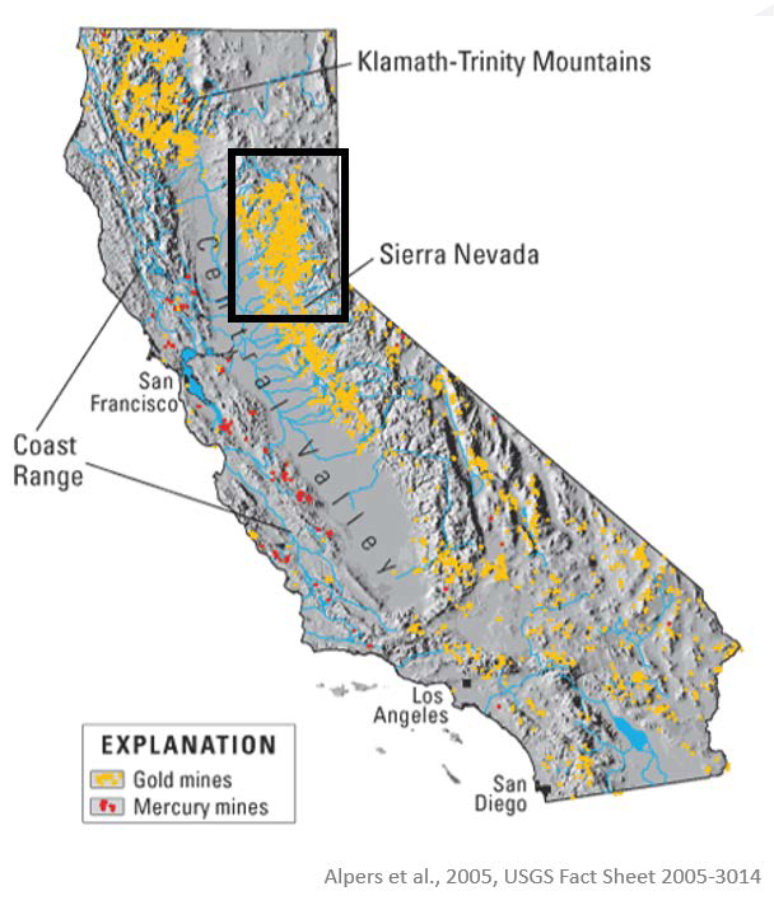 California’s severe mercury contamination is largely a Gold Rush legacy. Coast Range cinnabar mines supplied mercury that miners used to extract gold, while hydraulic mining washed contaminated sediment into major Northern California rivers. An estimated 26 million pounds of mercury were used, primarily in the Sierra Nevada and Klamath-Trinity regions, and the USGS estimates that 10% to 30% was released during processing. Many of California’s 47,000 abandoned gold and mercury mines remain inadequately cleaned up and continue to produce toxic runoff.
Storms and floods erode mine tailings and carry mercury-contaminated sediment through Northern California rivers into the Delta and San Francisco Bay, where elevated concentrations occur in sediment and wildlife. Urban stormwater, wastewater treatment, and agricultural drainage also contribute mercury, but Gold Rush mining remains a major source of the Delta’s contamination.
Because mercury binds strongly to sediment, it can travel long distances and accumulate in riverbeds, floodplains, reservoirs, and the Delta. Storms and floods periodically remobilize these deposits, releasing legacy mercury over decades or centuries and prolonging waterway impairments long after mining ended.
UPDATING THE DELTA MERCURY CONTROL PROGRAM
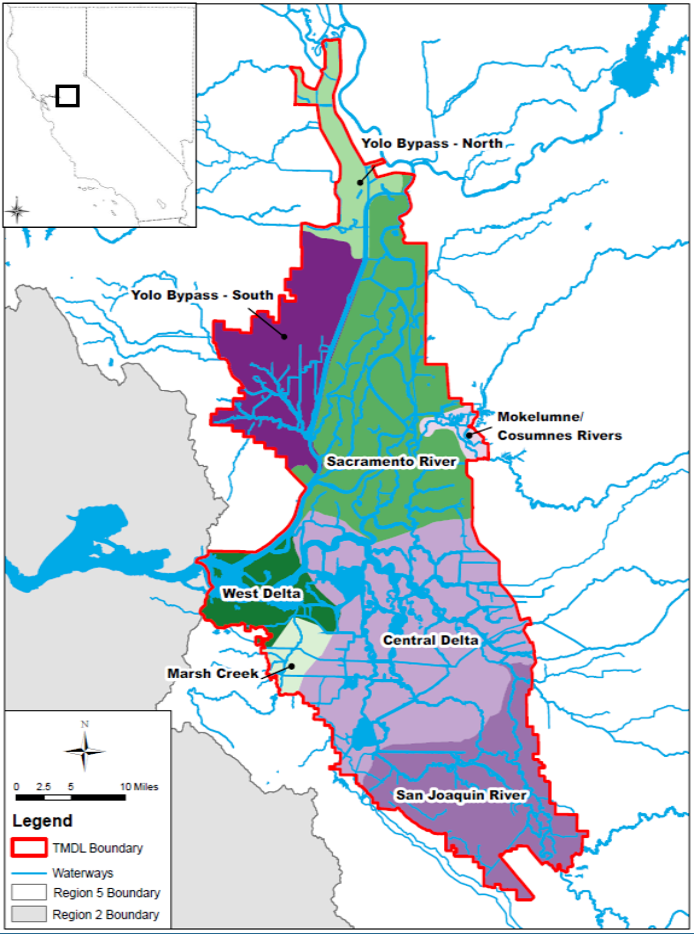 The Central Valley Regional Water Quality Control Board created the Delta Mercury Control Program (DMCP) to reduce mercury and methylmercury in the Sacramento–San Joaquin Delta. The Regional Board adopted the program in April 2010, and the U.S. Environmental Protection Agency approved it in October 2011.
The DMCP covers about 1,200 square miles across six counties, including roughly 150 named water bodies within the legal Delta and Yolo Bypass. It includes a methylmercury TMDL, which sets the maximum amount of the pollutant these waters can receive while still meeting water quality standards, along with an implementation plan for achieving those limits.
Elevated methylmercury in Delta fish can make them unsafe for people and wildlife to eat. The program established the Delta’s COMM beneficial use, which covers the commercial and recreational harvest of fish, including fish for human consumption. It also sets site-specific mercury objectives for water and fish tissue to protect human health and wildlife.
A PHASED APPROACH TO UPDATING THE PROGRAM
Because information about controlling methylmercury was limited when the DMCP began, the program was designed in phases. Phase One studies are complete, and staff are now reviewing the findings and developing proposed program changes.
Phase One ran from 2011 through 2021 and focused on studies of methylmercury sources and management strategies. The Delta Science Program coordinated an independent scientific peer review of the studies, which was completed in 2021. The findings indicated that regulated local discharges, such as wastewater and stormwater, generally contribute less to the impairment than tributary inflows and methylmercury released from open-water sediments.
Board staff then conducted the Phase One program review and prepared a staff report proposing technical changes to the DMCP. In March 2024, the draft report was released to the public and submitted for scientific peer review, followed by a public workshop in September 2024. After receiving the final peer-review report in June 2025, staff began revising the report. They updated supporting references, clarified methods and analysis, added context, acknowledged data limitations, identified areas for future study, and improved figures and tables.
The review also raised concerns about whether the proposed allocations could be met by 2030. “Our refinement efforts start with the understanding that, at the current trajectory, the 2024 load allocations and waste load allocations are not on track to be met by 2030,” said Araceli Serrano, Environmental Scientist. “Under these conditions, the TMDL implementation goal would not be attained, and it would also create compliance impacts and economic burdens on our Delta communities, whose regulated sources contribute a small portion of the overall methylmercury load.”
Based on control studies, scientific peer review, and discussions with agency partners, staff identified two potential adjustments: extend the timeline for meeting the TMDL and revise allocations to reduce compliance and economic burdens on in-Delta communities.
EXTENDING THE TIMELINE FOR MERCURY REDUCTION
Staff are considering extending the TMDL attainment date because meeting the load and waste load allocations will take longer than originally expected. The extension would also account for upstream legacy mercury that continues to affect methylmercury levels in the Delta.
To estimate a more realistic attainment date, staff began with tributary inflows, the Delta’s largest source of methylmercury and the source with the most extensive data.
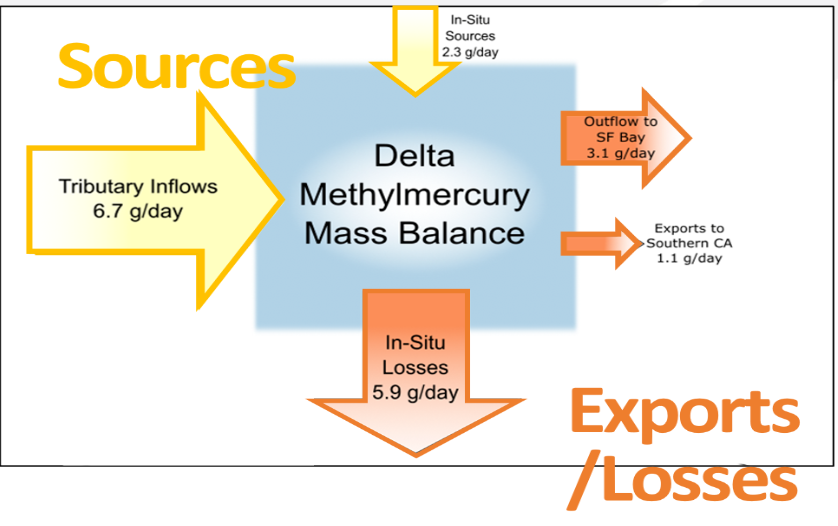 The 2024 staff report estimates that tributaries deliver about 2,460 grams of methylmercury to the Delta each year—roughly twice the proposed allocation of 1,220 grams. At current levels, the tributary allocation cannot be met by 2030.
Data from 2000 through 2019 suggest that tributary loads are declining by about 62.8 grams per year. However, the estimate has a 43% standard error, so the actual rate could differ substantially.
“So then we take this load reduction rate and use it to calculate how long it would take for the tributary loads to be attained, and the result is around 20 years, plus or minus 8 years. So, taking this uncertainty into account, board staff are considering a minimum 30-year extension to the TMDL final attainment date,” said Ms. Serrano.
This estimate is only a first step. It considers tributaries but not other sources, and it relies on aqueous methylmercury data that do not capture spatial and seasonal variation or mercury stored in sediment.
“Legacy mercury in sediment from historic mining is a long-term issue that has a Delta-wide impact,” she said. “Unfortunately, there isn’t enough data currently to calculate an accurate sediment recovery timeline.”
PROPOSED CHANGES TO MERCURY ALLOCATIONS
The second proposed adjustment would revise methylmercury allocations for irrigated agriculture, wetlands, wastewater treatment plants, urban stormwater, open water, and major tributaries to better align the TMDL with regulatory goals.
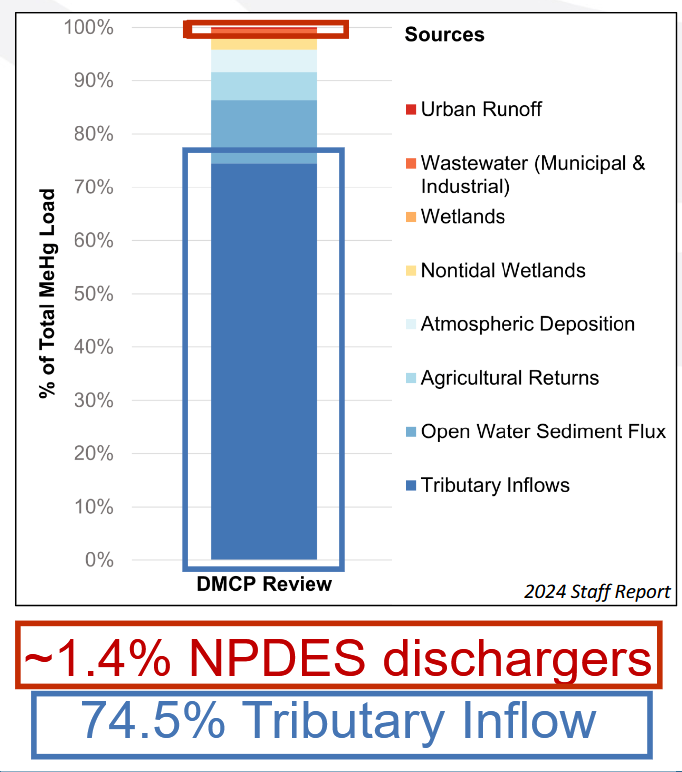 The bar graph compares each source’s share of the total methylmercury load. NPDES discharges contribute about 1.4%, while tributary inflows contribute about 75%. Because all regulated in-Delta sources together contribute less than 3%, staff are considering a more equitable allocation method.
Staff narrowed the options to four approaches.
- No allocation adjustment: Under this approach, allocations would remain as proposed in the 2024 staff report.
- Total net loss: The second approach would distribute methylmercury removed through open water, dredging, and tidal wetlands proportionally among sources in each subarea.
- Open water net loss: The third approach would apply only open-water losses from photodegradation to sources with waste load allocations. Any remaining loss would be assigned to the subarea’s future-growth allocation.
- Tributary distribution: The fourth approach would distribute part of the tributary load among applicable in-Delta sources. Staff did not advance this option because it would exceed the Delta’s assimilative capacity—the amount of a pollutant the system can receive without violating water quality standards.
“So it is the combination of both the allocation adjustment and a timeline extension that can achieve several important program goals, including recognizing in-Delta methylmercury reduction processes, achieving sustainable reductions, protecting the existing COMM beneficial use, reducing economic burdens on in-Delta communities, and recognizing that regulated sources contribute only a small portion of the overall load,” said Emma Lochner of the Central Valley Water Board. “The adjustments provide a clear and feasible path to meeting long-term expectations.”
COMPLETING THE PROGRAM REVIEW
Staff will further evaluate the proposed modifications, select options for inclusion in the staff report, draft the sections required by U.S. EPA TMDL rules, and prepare the CEQA documentation.
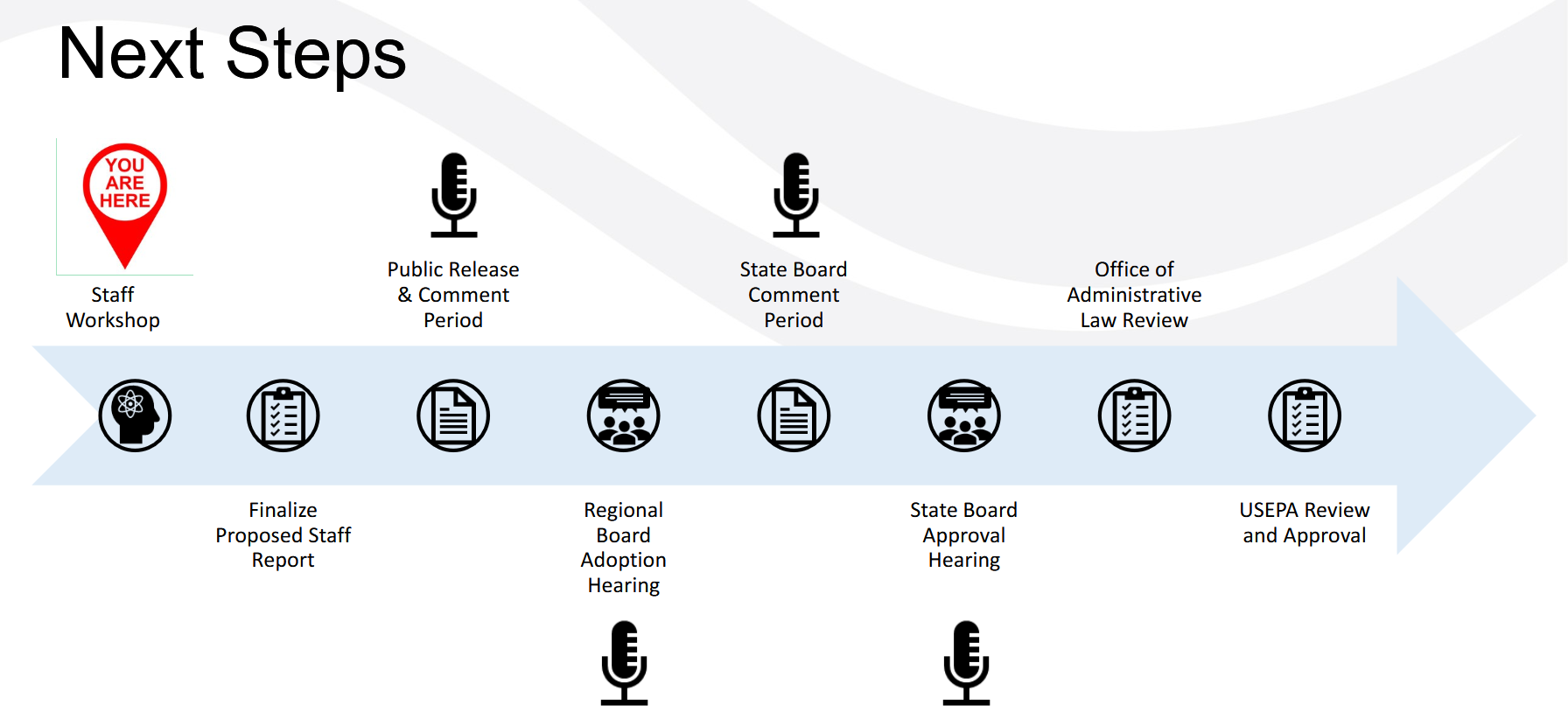
After the staff report is finalized, the reconsideration documents will be released for public review. The TMDL and Basin Plan amendment will then proceed through Regional Board adoption, State Board approval, Office of Administrative Law review, and U.S. EPA review and approval.
Lauren Leles, supervisor of the Mercury and Metals TMDL Unit, said board staff are committed to working with Tribes, the public, and partner agencies as they develop program-adjustment options for the Board’s consideration. Public input opportunities will include a comment period after the staff report is finalized, the Regional Board adoption hearing, the State Board public comment period, and the State Board approval hearing.
“I anticipate that there will be additional stakeholder workshops,” said Lauren Leles. “There could be a number of other next steps that we take, including releasing it beforehand, holding an informal comment period, and potentially conducting another scientific peer review, depending on the changes. But it’s to be decided as we select the different modifications and have these additional conversations.”