
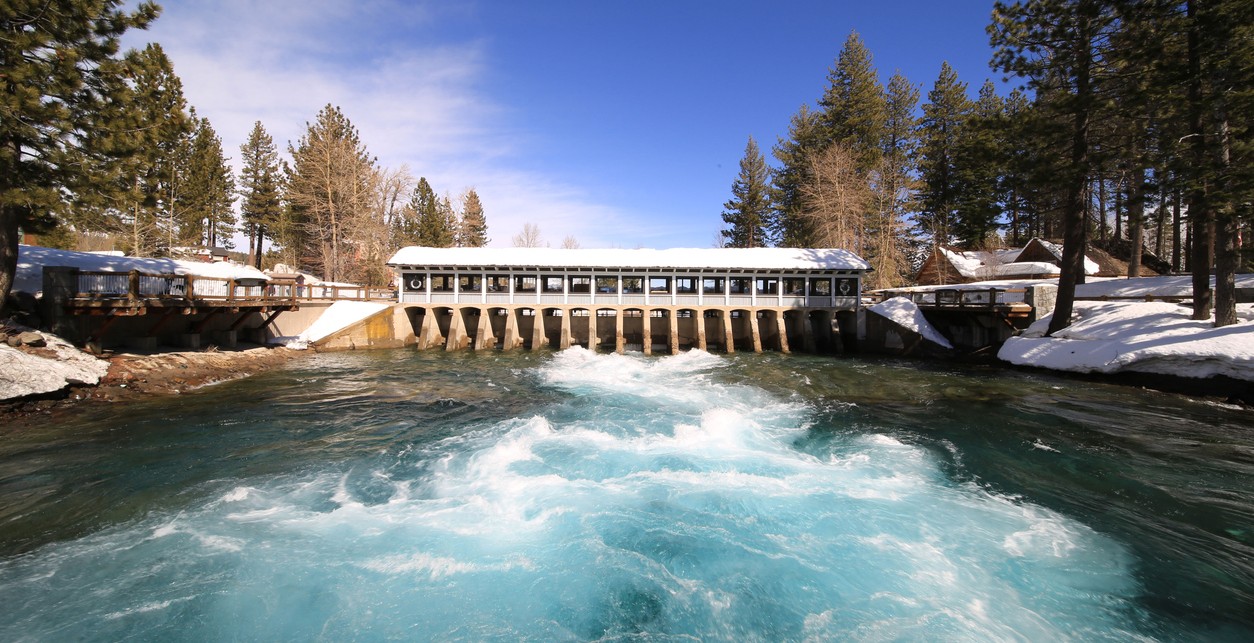
Microplastics are a pervasive contaminant in the Truckee River, with concentrations surging nearly ten-fold from the fall to spring seasons.
By Elyse DeFranco, Desert Research Institute
The ubiquitous plastics of modern life are degrading into tiny fragments and littering Earth’s landscapes and waterways. Scientists are starting to examine and measure this phenomenon to better understand how microplastics move through the environment and ultimately impact human and environmental health. A new study focuses on the Truckee River, which stems from the clear blue waters of Lake Tahoe and traverses through Reno and Sparks, Nevada, before reaching Pyramid Lake. The research sought to illuminate the concentrations and types of plastics accumulating throughout the river — which supplies drinking water to nearly half a million people.

Published September 15th in ACS EST Water, the research was led by Hannah Lukasik, former master’s student at DRI and the University of Nevada Reno. She was mentored by Monica Arienzo, Director of DRI’s Microplastics and Environmental Chemistry Lab. The group sampled microplastics at several sites upstream and downstream of Reno, Nevada, in fall 2022 and spring 2023. Microplastic concentrations were nearly ten-fold higher in spring (mean 3.7 microplastics/liter) than in fall (mean 0.4 microplastics/liter), when higher spring flows are likely flushing them from the landscape and river bottom. Polyethylene (used for things like plastic shopping bags, milk jugs, and plastic wrap) and polypropylene (a sturdier plastic used for things like medical equipment, storage totes, and automotive parts) were the dominant plastics identified. The research demonstrates that reducing single-use plastic throughout the Truckee River Basin is critical for protecting the river’s water quality.
“The Truckee River is such a critical artery for Northern Nevada,” Lukasik said. “It not only supplies drinking water to around half a million people in the Reno-Sparks area, it’s also a main water source for wildlife and is central to recreation in the region. Additionally, the river, terminating at Pyramid Lake, holds strong cultural and physical significance for the Pyramid Lake Paiute Tribe who has called the lake home for generations.”
Understanding microplastics concentrations in rivers is important because they serve as both sinks and transport systems that can further degrade plastic fragments into even smaller pieces. Changes in seasonal flows can also determine where microplastics are distributed and how they settle into the soft sediments at river bottoms. Identifying the interplay of these environmental factors is critical for informing modeling and remediation efforts.


Left: Hannah Lukasik, MSc sampling along the Truckee River. Right: Microplastic sampling along the Truckee River.
The research team selected nine sampling sites between the river’s headwaters at Lake Tahoe and downstream of the Reno-Sparks metro area. The sites were selected to capture both upstream and downstream locations of major population centers, wastewater treatment centers, and river confluences. Fourteen water samples were collected in total, with 6 sites in the fall and 8 in the spring. Water from the top surface of the river was filtered through stainless steel mesh that could capture microscopic particles as small as 50μm, barely large enough to be visible to the human eye. Once the fragments were cleaned of sediments, their chemical compositions were identified using specialized instrumentation known as Fourier Transform Infrared spectroscopy.

Figure 3 from Lukasik et al., 2026 shows microplastics concentration by site and season. (A) shows concentration by polymer type for fall 2022. (B) shows concentration by polymer type for spring 2023. Plastic polymer abbreviations are polycarbonate(PC), polyethylene(PE), poly(ethyleneterephthalate) (PET), polypropylene (PP), polystyrene (PS/EPS), polyurethane (PU), and polyvinyl chloride (PVC). Sites are arranged from upstream (left) to downstream (right).
Microplastics were identified at every site, with fall concentrations ranging from 0.1-1.0 microplastics/liter and spring concentrations ranging from 1.0-10 microplastics/liter. The highest concentrations were found at sites within the cities of Reno and Sparks. The lowest concentrations were found upstream of the Reno metro area and downstream of a river restoration site, the latter of which may be retaining microplastics in its meandering channel.
Microplastics in the Truckee River are three to four orders of magnitude greater than the concentrations found in Lake Tahoe, the river’s headwaters, which further demonstrates that the extra pollution is being drawn from the river’s surrounding landscape. The river’s concentrations are comparable, however, to those found by studies in other Western rivers.
“We hope our research helps water managers protect the Truckee River’s water quality by offering more information about where and when microplastics concentrations are highest,” said Arienzo. “It’s important to know that concentrations can vary dramatically from season to season, as it can help us find innovative ways to capture the litter before it makes its way to our waterways.”
————-
Can’t get enough DRI science in your life? Support DRI with a donation, attend one of our events, or sign up for our monthly newsletter.
More information: The full study, Large Seasonal Variation in Microplastic Concentration from the Truckee River, United States, is available from ACS ES&T Water at https://doi.org/10.1021/acsestwater.6c00609
Study authors include: Hannah Lukasik (DRI), Rachel Kozloski (DRI), Marin Monteith (DRI), and Monica M. Arienzo (DRI)
Media Contacts
Elyse DeFranco
Lead Science Writer & Public Information Officer
elyse.defranco@dri.edu

