Visit the Water Shelf main page
 First published on the To Know Water Is To Love Water blog February 10, 2026
By Jim Lauria
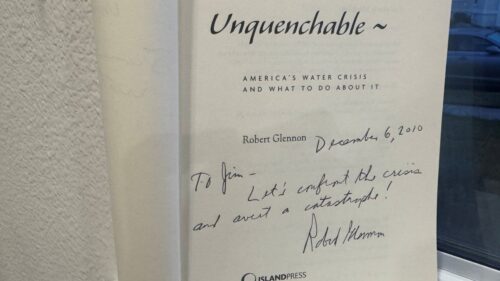
I’m looking at the photo of my signed copy of Unquenchable: America’s Water Crisis and What To Do About It (Island Press, 2010), inscribed by Robert Glennon in December 2010 (see below). The note reads, “Let’s confront the crisis and avert a catastrophe.” Fifteen years later, that line lands with even more weight than it did when the ink was fresh.
Rereading the book, what strikes me most is just how prescient Glennon was. Long before “water resilience” became a buzzword, he framed the problem in terms every real estate agent understands: location, location, location. For water, that reality translates into reallocation, reallocation, reallocation. The water is often in the wrong place, at the wrong time, serving the wrong uses, and Glennon never lets us look away from that uncomfortable truth.
One of the great strengths of Unquenchable is that it is not an abstract policy treatise. Glennon gets on planes and drives the back roads. He examines America’s water challenges by visiting them: Las Vegas and its desert ambitions; Lake Lanier in Georgia and the quiet interstate battles it represents; ethanol for fuel and the hidden water cost of energy independence; the tech sector’s early server farms — what we now call data centers — and their enormous, largely invisible water footprints.
He connects dots others were content to leave scattered. Algal blooms are not just environmental curiosities but downstream consequences of agricultural runoff and human and animal sewage. Invasive species in the Great Lakes are not just ecological annoyances but economic disruptors. Municipal privatization is not an ideological debate but a question of governance, accountability, and long-term stewardship.
Throughout the book, Glennon earns trust by examining each issue up, down, backwards, forwards, and sideways. He is skeptical without being cynical, urgent without being alarmist. He also resurrects one of the most iconic illustrations in the water world: the Hydro-Illogical Cycle, a simple but devastatingly accurate diagram that explains why we lurch from panic to complacency and back again.
Perhaps the most sobering — and still unresolved — insight is Glennon’s observation that the science of hydrology has advanced far faster than water policy, water law, and certainly water pricing. We know more than ever about how water moves through natural and engineered systems, yet we remain bound by outdated rules and incentives that reward overuse and defer consequences.
The final section, A New Approach, is where Unquenchable distinguishes itself from doom-laden prophecy. Glennon offers a clear, practical list of actions many of which ordinary citizens, utilities, businesses, and communities can actually participate in. He points toward water circularity, smarter reuse, and an honest reckoning with the fact that watersheds do not respect political boundaries. Water is shared across governmental, societal, and environmental lines whether we like it or not.
Reading Unquenchable today is a humbling experience. The book did not age; we did. Glennon told us what was coming, showed us where it was already happening, and sketched out what to do next. That signed inscription from 2010 now feels less like a hopeful plea and more like a standing assignment, one we are still, fifteen years later, struggling to complete.
If you care about water — not as an abstraction, but as the connective tissue of our economy, our environment, and our daily lives — Unquenchable remains essential reading.