

Proposition 1, approved by California voters in 2014, allocated $2.7 billion for water-storage investments administered by the California Water Commission through the Water Storage Investment Program (WSIP). Projects approved under the Water Storage Investment Program receive funding based on the public benefits they provide. One of those benefits is the delivery of pulse flows to the Feather River to support salmon. Three groundwater-storage projects in the South San Joaquin Valley and Southern California have committed to provide those flows as public benefits in exchange for WSIP funding.
When the California Department of Fish and Wildlife requests a pulse flow, the Department of Water Resources releases water from Lake Oroville into the Feather River’s low-flow channel, where the Feather River Fish Hatchery is located. Pulse flows can provide several ecological benefits, including moderating water temperatures, diluting pathogens, helping spring-run salmon migrate out of the low-flow channel, and attracting returning adult salmon to the hatchery for broodstock collection and tagging. Water released into the low-flow channel later rejoins the high-flow channel downstream.
To account for a pulse-flow release, DWR offsets the delivery by withholding an equivalent volume of Lake Oroville water that would otherwise go to the partner State Water Project contractor. The contractor receives its allocation from the groundwater bank instead.
For more background, see “How groundwater projects in Southern California provide pulse flows on the Feather River”
Two of the projects—the Kern Fan Project and the Willow Springs Water Bank—propose to capture excess State Water Project supplies, known as Article 21 water, and store them in groundwater aquifers. A portion of the stored water would be dedicated to providing pulse flows on the Feather River.
At the California Water Commission’s August meeting, DWR program engineer David Okita explained what Article 21 water is and how it could be delivered to the two projects. He also described the role of the California Aqueduct, the scheduling process, and the factors that could affect deliveries.
WATER SOURCES
The State Water Project, built in the 1960s, delivers water from Northern California to farms, businesses, and communities in the San Joaquin Valley, Southern California, and the Bay Area. The contract between the state and the agencies that receive project water was developed in the 1950s. It remains in effect today, though it has been amended many times. The contract is generally uniform across the 29 State Water Project contractors.
TABLE A
Table A is part of the State Water Project contract and identifies the maximum amount of project water each contractor may expect to receive in a given year. Across all contracts, total Table A amounts to 4.2 million acre-feet. Metropolitan Water District has the largest share, accounting for nearly half of the total. Kern County Water Agency has the next-largest share, while Littlerock Creek Irrigation District, a small agricultural contractor in the San Joaquin Valley, has 2,300 acre-feet.
When the contracts were developed in the 1950s, the expectation was that the project would be able to deliver full Table A amounts in most years. That has not proven to be the case.
State Water Project allocations depend on hydrology and the system’s physical ability to move water. Allocations are stated as a percentage of total Table A amounts. For example, the 2026 allocation is 45 percent. The most recent 100 percent allocation occurred in 2023, an unusually wet year; such full allocations are not expected to occur often in the future. DWR typically issues the first allocation in December and updates it monthly through May.
Table A was originally calculated using the firm-yield concept, which is no longer commonly used. That approach relied on a historic dry-year benchmark; for the State Water Project, the reference period was the severe drought of the 1930s. Current planning methods use exceedance curves, which estimate the likelihood of achieving a given level of delivery.
ARTICLE 21 WATER
Article 21 takes its name from a provision in the State Water Project contract shared by all contractors. It refers to excess water that may be available in wet years in addition to Table A supplies. Article 21 water is generally available during the winter and spring months. Availability varies widely: in some years little or no Article 21 water is offered, while in others it may be available for several months. Contractors pay only the power costs required to move the water, making it a valuable supply for those able to use or store it.
Several conditions must be met before Article 21 water can be made available. Delta environmental requirements must be satisfied, San Luis Reservoir and other State Water Project storage facilities must be full, and the project must have no additional need for the water.
The water is offered to the 29 State Water Project contractors, which may use it directly, store it in local reservoirs, or bank it in groundwater storage projects. Article 21 water cannot be stored within the State Water Project system because, by definition, project storage must already be full for the water to be available. In most cases, available Article 21 supplies exceed contractor demand, allowing contractors to take as much as they can use. If demand exceeds supply, the water is allocated proportionally based on Table A amounts.

Article 21 water is not available every year. Recent examples include the very wet year of 2023 and wetter years such as 2017 and 2019.
“You can see quite a bit of water is moved in these years. The contractors have developed facilities to convey and store this excess water because it is so valuable to them, but again, it does not happen all the time,” Mr. Okita said.
CA AQUEDUCT CAPACITY
Capacity in the California Aqueduct is allocated by section based on which contractors use each portion of the facility. Contractors pay capital and operations-and-maintenance costs according to proportional-use factors established for each section. Power costs are billed separately based on actual use. Together, those factors help define which contractors have contractual access to capacity in different parts of the aqueduct.
The aqueduct is a trapezoidal channel, and a single section may carry water for 20 or more contractors. As the aqueduct moves south from the Delta, it becomes smaller because water is delivered along the route. As a result, fewer contractors use the lower reaches of the system.
Contractors do not own capacity in the aqueduct; the facility is owned by DWR. Contractors instead hold contractual rights to use capacity, generally in proportion to their Table A amounts. DWR controls scheduling, which is largely allocated according to Table A, with some exceptions.
Mr. Okita said DWR and contractors have generally been able to accommodate requested deliveries because of operational flexibility. However, that could become more difficult over time as demands shift, subsidence affects the aqueduct’s capacity, and hydrologic conditions change. Interest in groundwater recharge also is increasing competition for use of the California Aqueduct.
“There is capacity in the aqueduct at times, not all times, but there certainly are times when there is capacity to move this water to the WSIP projects and other groundwater banking projects,” Mr. Okita said.
DELIVERING TO THE WSIP PROJECTS
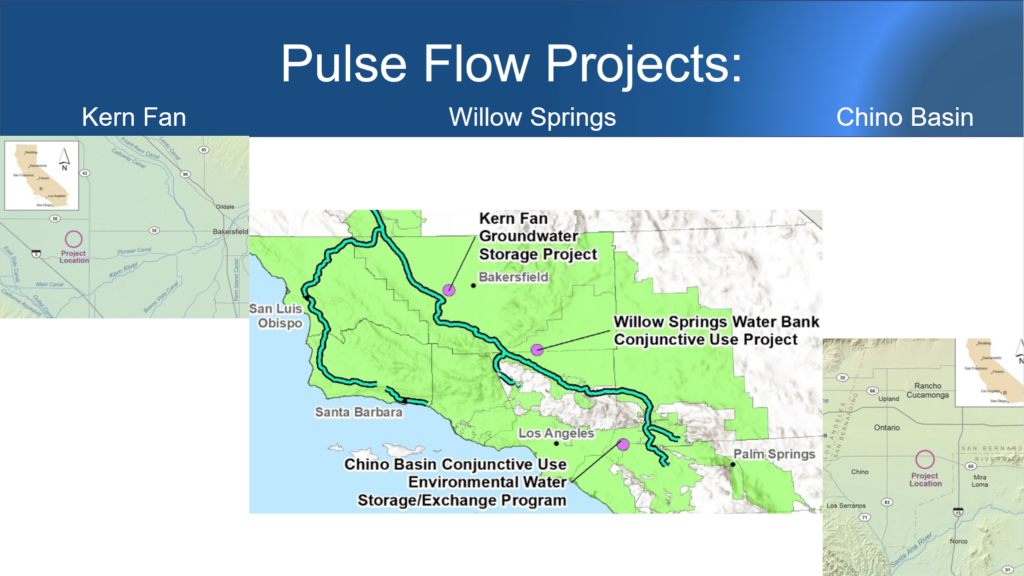
Kern Fan is located in the San Joaquin Valley along a section of the California Aqueduct designed to carry large summer irrigation deliveries. That portion of the system has enough capacity at certain times to move Article 21 water and other supplies. Water bound for Southern California also passes near the Kern Fan Project.
Willow Springs is located south of the Tehachapi Mountains on the East Branch of the California Aqueduct. After water is lifted over the Tehachapis, the aqueduct splits: the West Branch serves the Los Angeles area, while the East Branch runs through the Antelope Valley toward San Bernardino. Willow Springs is near the top of the East Branch, where aqueduct capacity is smaller than at Kern Fan because fewer users are served downstream. That location can make deliveries more difficult, although excess capacity is available at times.
Three broad categories of water move through the California Aqueduct: Table A water, Article 21 water, and non-project water. Non-project water may include Central Valley Project supplies, transfer water purchased from other sellers such as rice farmers or the Yuba County Water Agency, or water from the proposed Sites Reservoir.
The Kern Fan Project is expected to seek substantial Article 21 water, as well as federal Section 215 water, the Central Valley Project equivalent of Article 21, because some participating contractors also hold federal contracts. Article 21 deliveries to Willow Springs are expected to be more limited because of its location, but Table A water from partner contractors, as well as supplies from San Luis Reservoir, Sites Reservoir, or the Delta, could potentially be moved to the project.
SCHEDULING
All water moved through the California Aqueduct must be scheduled by State Water Project contractors. For that reason, each WSIP project has partnered with a State Water Project contractor. DWR would schedule deliveries to the WSIP projects through those partner contractors, and the water would be moved through the system to the project locations in the same way deliveries are arranged for other water banks or State Water Project contractors.
“There could be capacity restrictions during high-flow periods and sometimes when everyone wants Article 21 water,” Mr. Okita said. “But in the shoulder periods, there is excess capacity in the aqueduct.”
FACTORS DETERMINING HOW MUCH WATER PROJECTS COULD RECEIVE
Several tools can help estimate how much water the WSIP projects may be able to receive. CalSim modeling can be used to project diversions over time, while aqueduct-capacity modeling can identify physical constraints, such as water-surface limits within the aqueduct. Historical delivery data also can help show when capacity has typically been available to move water to these projects.
The feasibility of delivering water to the new water banks depends on several factors. Hydrology is a major variable, as are contractor demands, which can change depending on when contractors request deliveries. Physical constraints, including subsidence, also may affect the system’s ability to move water over time.
“DWR is not guaranteeing deliveries to these projects,” Mr. Okita said. “The projects have to take on the risk of whether or not they can get the water there. We are going to do the best we can to deliver the water, as we do for all the other contractors, but there are no guarantees.”

