
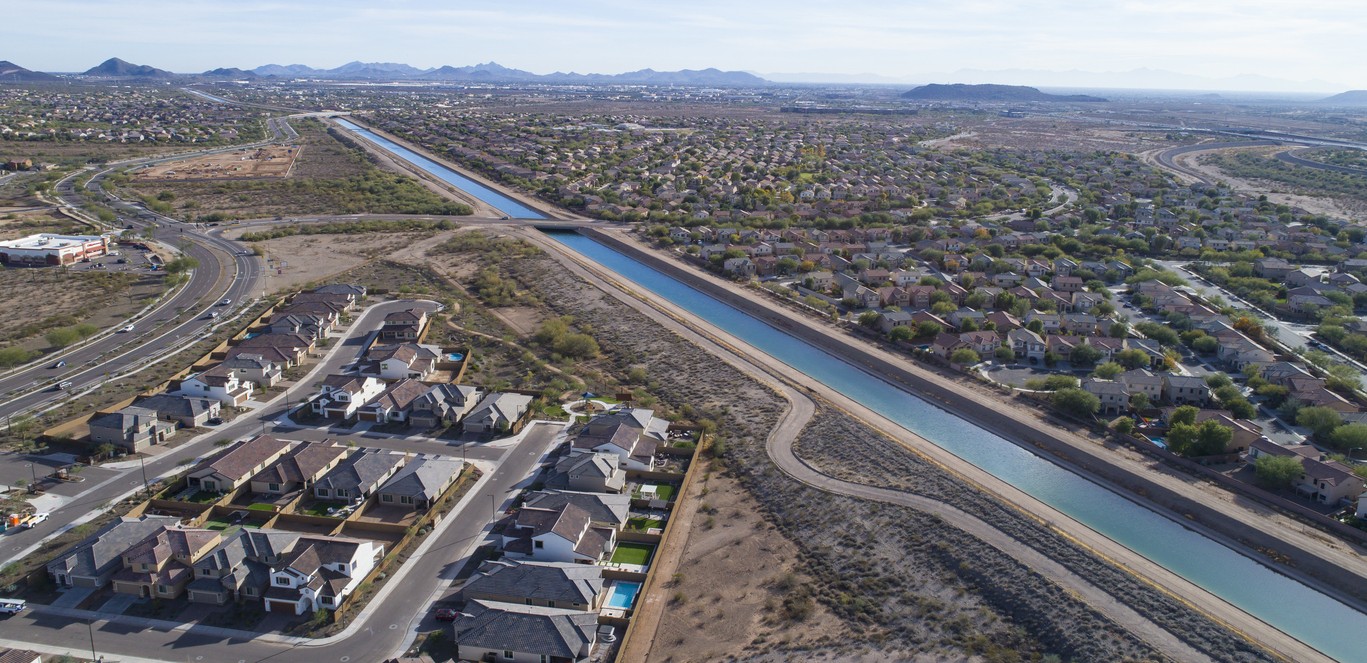
by Marcus Shields, Cronkite News
 The Central Arizona Project board voiced disagreement last week over whether federal water reclamation plans are fair to Arizona and other lower basin states.
The CAP board, also known as the Central Arizona Water Conservation District, argued that the new guidelines presented by the Federal Bureau of Reclamation unfairly targeted the three lower basin states: Arizona, California and Nevada.
The board met last week to discuss the federal guidelines and the 10-year plan to conserve and replenish water in the Colorado River, and both Lake Mead and Lake Powell.
General manager of the board Brenda Burman alleged in a public comment earlier this year that the mandates “disproportionately harm Arizona and are unacceptable,” and has urged the Bureau of Reclamation to have the guidelines reviewed and reconsidered.
In the meeting on Sept. 3, the water distributor noted that the decision is inconsistent with the 80-year-old compact agreement, does not provide reasonable alternatives for Arizona, ignores the consequences for Arizona’s economy and does not address the Upper Basin states or require any cuts from their bodies of water.

One particular area of concern is the system’s ability to save enough water every two years over a 10-year plan and raise Lake Mead’s water levels to 1,125 feet as the Federal Bureau of Reclamation ordered for all three Lower Basin states.
The guidelines require Lower Basin states to save 1.25 million acre-feet of water per year for the next two years, and another voluntary 700,000 million acre-feet by 2028 for a total of 3.2 million acre-feet of Colorado River water between the three Lower Basin states.
Vineetha Kartha, CAP’s director of water policy, said she doubts the system will be able to maintain Lake Mead’s water level at or above 1,125 feet by 2028.
“The two years–we probably won’t get there. I’m pretty sure we won’t get there. Maybe if we had four years of subsequent really good hydrology, possibly we could be above 1,125,” Kartha said.
Lake Mead currently sits around 1,040 feet in elevation, according to Nolie Templeton, who leads CAP’s river policy and analysis team..
CAP senior policy analyst Josh Randall said he also doubts the success of the two-year plan for the lakes. Even with a hypothetical wet season, he said, it would take more than two years to reach the goal considering past weather and future predictions.
Arizona, which receives the second-largest allocation of the river’s water of the Lower Basin states, will potentially receive the largest cut to its supply at 760,000 acre-feet.
Burman referred to CAP’s readiness to take legal action in an August press release just days before the official federal guidelines were announced. Nevada and its commission over Colorado River apportionment filed a suit against the government on Aug. 24, the same day the guidelines came out.

The Upper Basin states: Colorado, Wyoming, Utah and New Mexico, have no legal obligation to cut water use, and are only mandated to release specified amounts of water into Lake Mead and Lake Powell as per the original Colorado River Compact.
Alexandra Arboleda, vice president of the CAP board, said the burden of the water cuts should be shared between both Upper and Lower Basin states, not just one or the other.
“We are very upset that the reductions are not being shared equitably in this system. We think there needs to be shared sacrifice. We think that every water user in the Colorado River Basin needs to conserve, be more efficient,” Arboleda said, “We think that every state within the Colorado River Basin and both countries have to be part of the solution, and agree to reductions in their demand to leave more water in the system.”
Arboleda emphasized the importance of both the Upper and Lower Basins contributing together to preserve river levels and flow.
“We are looking for partners to cooperate, collaborate and work with us to reduce demands, leave more water in the system, and work towards long-term solutions,” Arboleda said, “and we just haven’t been able to get there with our partners in the Upper Basin states.”
Pressure from the decision by the federal government has left Lower Basin states searching for new solutions, while dealing with rising problems on the state level.
Max Wilson, the city of Phoenix water resource management advisor, agreed with Arboleda that they want to assure Phoenix residents they will not lose water from their taps, but the cost of water will increase, and the city plans to use all of its resources to make up for the loss of Colorado River water.
“These reductions are so large that they can’t fall on the back of one user and they can’t fall on the back of one state. We just won’t be able to meet the demands of the hydrology really…We’re gonna feel it in our water rates, and we’re going to feel it in the cost of food and other items that rely on local agriculture,” Arboleda said.
This article first appeared on Cronkite News and is republished here under a Creative Commons Attribution-NoDerivatives 4.0 International License.

