

By Ellis Preston, Cronkite News
 Most of the Colorado River water allocated to Arizona goes to agriculture. But for now, the 30% statewide cuts imposed by the federal government won’t affect Arizona farmers, who supply most of the nation’s lettuce and other leafy greens for half the year.
That’s because Yuma-area farms hold water rights that are senior to almost everyone else’s in the state, and Central Arizona farms already absorbed cuts a few years ago.
Still, the relief may not last long.
The federal Bureau of Reclamation will revisit the drought-era allocations for the seven states that share the river after next winter. If the Rocky Mountain snowpack is as bad as last winter’s, deeper cuts are likely and the pain will even spread to Yuma-area farmers like John Boelts.
Boelts, who is president of the Arizona Farm Bureau, farms 3,000 acres of assorted vegetables, melons, wheat, cotton and other crops. Like most Yuma farmers, he gets his water from the river but not through the Central Arizona Project, which supplies 80% of Arizona’s population.
CAP will bear much of the brunt of the cuts ordered Aug. 21, which reduce Arizona’s share of the river by 760,000 acre-feet annually through 2028.
“While we feel that there’s some certainty given by the two-year plan, agriculture still has plenty to worry about,” Boelts said.
Tom Buschatzke, director of the Arizona Department of Water Resources, also said he is concerned that much deeper cuts will be imposed after two years – or sooner if the drought worsens.
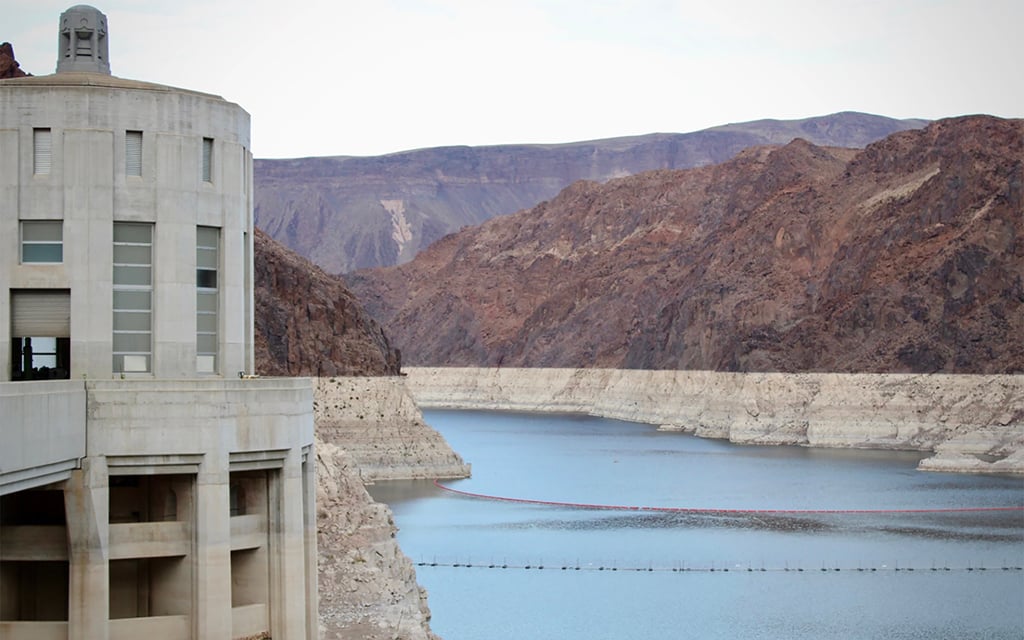
The federal government imposed the cuts because the seven states that share the river failed to reach an agreement earlier this year. The fight over the dwindling supply pits Upper Basin states – Colorado, Utah, New Mexico and Wyoming – against Arizona, California and Nevada.
The Aug. 21 order gives the Upper and Lower Basins another two years to try to find a consensus on how to divide the river. Nevada has already gone to court to block the order.
With the states deadlocked, the Bureau of Reclamation, part of the Department of the Interior, issued a draft proposal in January that called for cuts up to 3 million acre-feet in the Lower Basin.
Arizona could have seen cuts up to 77% under that draft because other states have higher priority rights to the river.
An acre-foot is the amount of water needed to cover an acre of land one foot deep. That’s 325,851 gallons, enough to supply three families for a year; 760,000 acre-feet can supply Phoenix for about four years.
The 30% statewide cut in Colorado River water translates to a 50% cut at CAP. But customers won’t see taps run dry or face mandatory conservation measures, thanks to a stockpile the state created in 1996 called the Arizona Water Banking Authority.
The stockpile will be used to offset lost river water for 2027, said Buschatzke, who chairs the water bank in addition to serving as director of the ADWR. He was unsure if the water bank will be able to offset cuts after that.
If the Bureau of Reclamation had proposed a 77% cut in Arizona, as it floated in January, the immediate pain would have reached downstream to Yuma.
Yuma area farms supply about 90% of the leafy greens consumed in the U.S. and Canada from October through April, according to the Yuma Fresh Vegetable Association, generating $1.5 billion in sales in 2022, according to U.S. Department of Agriculture data.
Agriculture is by far the biggest consumer of water in Arizona, using about 72% of the state’s total water use, according to University of Arizona’s Water Resource Center.
Buschatzke estimated that Yuma farmers could lose 30% of their river water if the drought continues and the Bureau of Reclamation strictly enforces water rights by seniority, because Arizona’s are lower than California and Nevada’s.
 “Those are draconian impacts to Arizonans,” he said. “That’s an unacceptable outcome to the state of Arizona.”
In that scenario, CAP’s share of the river will be cut further, potentially affecting municipal and industrial users, though users won’t see changes in 2027, Buschatzke said.
“We are greatly concerned that agriculture will see more cuts to ensure that urban areas have water and continue to grow,” said Patrick Bray, the executive vice president of the Arizona Farm and Ranch Group, which advocates for agriculture businesses. “After two years … it could get far worse.”
In central Arizona, most farmers supplied by CAP lost access to that water around 2023, leaving them to rely on groundwater. Some owners left half their land to fallow for lack of irrigation, Buschatzke said.
Brian Wong, president of BKW Farms in Marana, northwest of Tucson, was one of the farmers cut out of CAP’s “ag pool” about three years ago. He and some neighbors trade groundwater credits with municipalities in exchange for access to CAP water. The arrangement allows more water to stay in the ground while farms still get what they need.
Wong will be able to irrigate his mushroom and grain farm with CAP water through 2027. After that, he’s not sure.
Wong’s farm has wells but they haven’t been used in about 30 years. He sees tapping that groundwater as a last resort, because he needs more for irrigation than nature could replenish, especially during a drought.
He would also have to rework his irrigation system and refurbish the wells.
Before he takes those costly steps, Wong said he would reevaluate cropping patterns and might stop planting some of his 4,500 irrigated acres.
“The more time we get, you know, the easier it is to plan,” Wong said. “But … it’s a changing dynamic on the Colorado River.”
Boelts said Yuma-area farmers have been making changes for years to improve water efficiency – improving how they level land and prepare crop beds, installing water-saving and upgrading irrigation techniques.
“It’s quite a success story,” he said. “We know that there’s not an infinite supply.”
This article first appeared on Cronkite News and is republished here under a Creative Commons Attribution-NoDerivatives 4.0 International License.

