

California Farm Water Coalition welcomes the congressionally authorized plan and urges leaders at every level to fund it.
From the California Farm Water Coalition:
The California Farm Water Coalition welcomes the release of the Unified Water Plan for the San Joaquin Valley, a congressionally authorized report that gives federal, state, and local leaders a single roadmap for water investment in the region that grows much of the nation’s food.
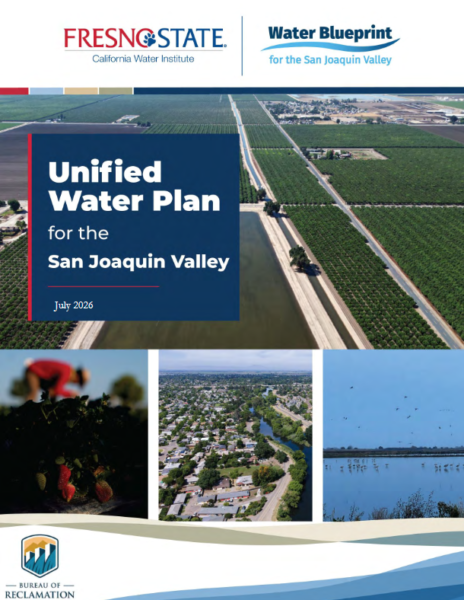 The plan projects a 2.4 million acre-foot annual water supply gap in the San Joaquin Valley by 2040, quantifying the immense challenge of achieving long-term groundwater sustainability under the Sustainable Groundwater Management Act (SGMA) passed in 2014. Prepared by the California Water Institute at Fresno State in coordination with the Water Blueprint for the San Joaquin Valley and funded by the U.S. Bureau of Reclamation, the plan brings the groundwater sustainability plans of all sixteen Valley subbasins into a single regional assessment.
“For the first time, we have a unified picture of the Valley’s water challenge and a roadmap to address it. Now we must ensure the projects and solutions identified in the Unified Water Plan receive the funding needed to protect communities, sustain food production and strengthen California’s water future,” said Michelle Paul, executive director of the California Farm Water Coalition. “Families across the nation who depend on California-grown food are counting on it.”
The plan describes the cost of doing nothing to mitigate the impact of SGMA compliance: up to one million acres out of production, along with about $7.2 billion in annual farm revenue and 85,000 jobs. It then lays out a three-part path forward: repair the canals the Valley already depends on, add local recharge and storage projects, and build the larger regional infrastructure that serves the whole system.
The stakes reach every grocery store in America. Seven of the nation’s ten highest-producing agricultural counties sit inside the plan’s eight-county study area, growing more than 250 crops worth about $24 billion a year. The same aquifers supply drinking water for more than 300 disadvantaged communities.
When water becomes unreliable or unaffordable, food production moves somewhere else. Fresh fruit imports into the United States have more than doubled since 1980, and fresh vegetable imports have more than quadrupled, according to the USDA Economic Research Service.
“Fixing canals, catching water in wet years and putting it back in the ground are common-sense steps. They cost real money, but losing the country’s most productive farmland would cost far more. As our hydrology changes, so must our approach,” Paul said.
The California Farm Water Coalition urges Congress and the state to fund the projects the plan identifies and to streamline the permitting that slows them down.
The full Unified Water Plan is available at waterblueprintca.com.

