
Mexico would keep the water, but Arizona’s investment in building desalination would allow the state to draw more Colorado River water.
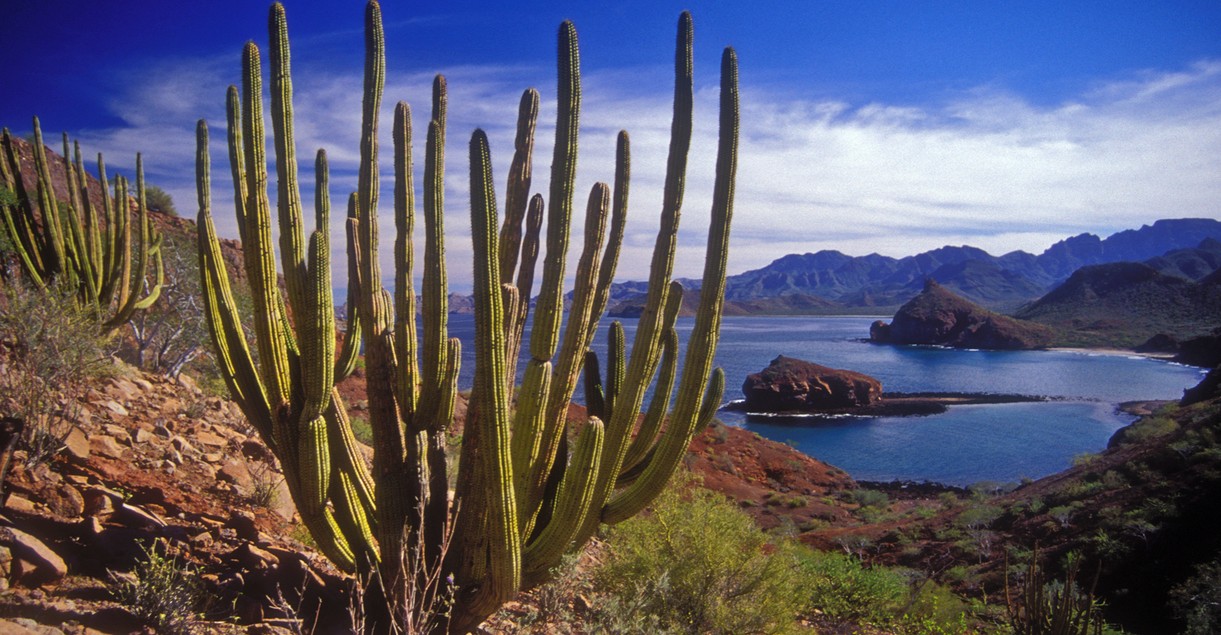
 Desalination companies are pitching new ways to pump water from the Sea of Cortez off Baja California in order to supply Arizona, which is facing massive cuts to its main water source, the Colorado River.
EPCOR Water Innovation Partners, a Canadian company, and Acciona, a Spanish company, have pitched Arizona’s Water Infrastructure Financing Authority two different projects that do the same thing: pull salt out of ocean water to make fresh water. Both companies want to keep that fresh water in Mexico, and in exchange, Arizona’s investment would earn the state the right to take more water from the Colorado River – by taking a portion of Mexico’s share.
It’s called a “paper water” exchange, similar to the water swap the San Diego County Water Authority is pursuing with its expensive desalinated water in Carlsbad. San Diego is talking to investors in the state of Arizona and Nevada about paying for that water so those states can take more from the river.
The plant proposed by EPCOR would be massive, twice the size of the largest desalination plant of its kind. The company wants to build the plant either off the coast of San Felipe or closer to the U.S.-Mexico border near a geothermal power plant in the state of Baja California. Either way, the plant would be big enough to draw 1.2 billion gallons of seawater daily from the Sea of Cortez, also known as the Gulf of California, in order to produce 446 million gallons of water “of the same or better quality as the Colorado River,” according to EPCOR documents.
That’s enough water to replace a third of what Mexico takes each year from the Colorado River which serves as the main water source for the agricultural industry of Mexicali and urban cities from Tijuana to Ensenada.
Desalination plants are very expensive to build and run because of the massive amounts of energy needed to remove the salt. EPCOR’s project documents suggest the plant could be powered primarily from renewable resources like geothermal energy from the existing power station called Cerro Prieto outside of Mexicali. Solar could be built to make up for the rest, the company suggests.
EPCOR’s plans describe the company’s approach would be very efficient and generate nominal planet-warming emissions because it would rely on geothermal energy over conventional fossil fuels.
EPCOR officials declined to comment.
Acciona’s desalination plant wouldn’t be quite as large. The project would produce up to 312 million gallons per day and hinge upon the same international exchange arrangement between the U.S. and Mexico as EPCOR. That company also wants to build water recycling projects in Tijuana and Denver, Colorado to help reduce those cities’ demand on the river in exchange for Arizona drawing more.
Acciona’s proposal is much less specific than EPCOR’s, but their basic plan would be to locate the plant somewhere along the north or eastern coast of the Sea of Cortez in the Mexican state of Sonora. The company also declined to comment.
The state of Arizona stands to lose the most Colorado River water supplies under a federal plan to deal with the river’s extraordinarily low levels. In anticipation of such a scenario, Arizona’s legislature granted $1 billion to the Water Infrastructure Finance Authority of Arizona, or WIFA, in 2022 to jumpstart projects that could make new water.
“These projects are very conceptual at this stage… there’s no shovels in the ground,” said Ben Alteneder, assistant director for external affairs at Arizona’s Water Infrastructure Finance Authority. “We’re asking all the hard questions that folks in Mexico would be asking.”
In a July interview, Alteneder said WIFA would be speaking with representatives in Mexico about the proposed projects over the next few months.
“There might be opportunities to work together to try and solve their issues and Arizona’s issues,” he said.
Desal in Sea of Cortez Is Typically Controversial
Neither idea has received much attention from the Mexican press to date. But similar projects have faced a lot of pushback in the past.
One reason is because Mexicans didn’t like that water made in Mexico would be shipped to the United States.
Two years ago, the state of Arizona and an Israeli company, called IDE Technologies, scrapped plans to build a $5.5 billion desal plant that would draw from the same sea from the Sonoran state shores. (IDE also runs and operates the Carlsbad desalination plant.) Except that project would have shipped treated ocean water along a 200-mile pipeline from Sonora to Phoenix, Arizona.
The Sonoran state governor threw cold water on the idea.
“My first reaction was: They’re going to take the water and leave us with the mess,” Sonora Governor Alfonso Durazo said at the time.
Both of these new proposals avoid that issue by keeping the desalinated water in Mexico. Instead, Arizona would be allowed to draw more water off the Colorado River than its currently allotted under agreements made decades ago. Arizona is first in line to shoulder cuts to its water deliveries from the river during extreme drought, which is the case unfolding currently.
Under an agreement with California, Arizona and Nevada agreed to lose a third of their normal supply. The federal government wants those states to reduce their use by 3 million acre feet (an acre foot is enough water to flood an acre of land, one foot deep) each year by 2036. That would amount to almost 1 million acre feet in water losses for Arizona.
The other reason is that many parts of the Sea of Cortez and its 244 islands are protected natural areas. Dubbed the “Aquarium of the World,” it’s home to over 890 species of fish and 695 species of plants, according to UNESCO. Sempra, a natural gas company, recently cancelled a liquified natural gas export terminal in the gulf after public pushback, according to the San Diego Union-Tribune.
The president of Mexico, Claudia Sheinbaum, a climate scientist, acknowledged the gulf’s unique natural value.
“The Gulf of California is very sensitive and has enormous biodiversity. So, we would have to determine what to do with the salt in the case of this proposal. The salt can be processed and can also be sold; it has different uses, not just for food,” Sheinbaum said referring to the salty brine that’s left over when ocean water is turned into fresher water.
She said there will need to be environmental studies to determine whether it’s a good idea.
New Treaty Agreement Needed to Make This Happen
San Diego is attempting to work with the U.S. federal government so states could sell water across state lines. Selling water across international boundaries is a whole different animal.
Both countries need to agree to make that happen.
EPCOR acknowledges in its proposal that accomplishing its project depends on the United States and Mexico agreeing to swap Colorado River water for desalination water under a new international agreement called a Minute.
Minute 323, signed by both countries in 2017, laid some of the groundwork by permitting Mexico to store some of its river water in Lake Mead behind Hoover Dam. Lake Mead acts like a kind of savings account on the Colorado River and those that store water there should be able to take that water back out eventually.
Those that hold such a savings account (Metropolitan Water District of Southern California in Los Angeles, is one example) could make these kinds of water trades, the companies suggest.
The International Boundary and Water Commission or IBWC, of which Mexico has an identical sister agency called CILA, would be tasked with the job of negotiating a new agreement that would make such water trades possible across national boundaries. Frank Fisher, a spokesperson for the IBWC, said it is “too early to say if or when” talks might happen.
“The timeline for developing a new Minute would depend on the timeline for identifying a specific project that both governments would want to implement,” he wrote in an email.

