Visit the Water Shelf main page
 First published on the To Know Water Is To Love Water blog January 20, 2026
By Jim Lauria
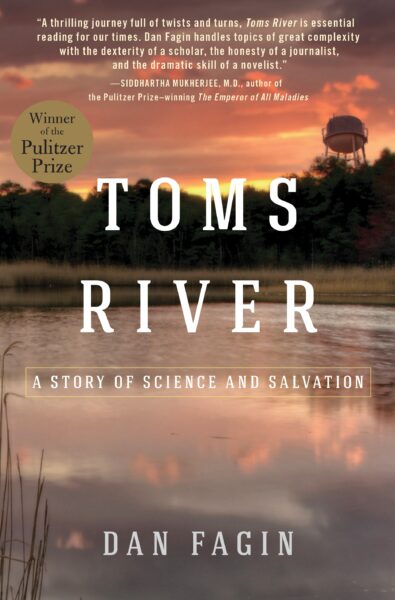
Toms River: A Story of Science and Salvation (Bantam, 2013) by Dan Fagin is one of those rare books that manages to be part detective story, part scientific case study, and part moral reckoning. It is no surprise that Fagin won the Pulitzer Prize for this work. This is investigative journalism at its absolute peak —meticulous, humane, and relentless.
The book resonated deeply with me because my early career ambition was shaped by chemistry and its promise. I became a chemical engineer believing in DuPont’s famous motto, “Better Living Through Chemistry.” As a kid at the 1964 World’s Fair in Queens, I stood mesmerized inside the DuPont pavilion. Forget the singing and dancing…the real magic was watching a man on stage make nylon before our eyes. In that moment, chemistry felt like pure wonder.
I declared to my parents that I was going to be a chemist when I grew up, locked myself in the bathroom, and mixed a formulation of iodine, hydrogen peroxide, and talcum powder. The blend produced a violent reaction…not chemically, but when I dropped it on my mother’s brand-new bath mat, her response was pretty reactive. After grounding me for two weeks, my parents wisely redirected my ambitions by giving me a chemistry set to focus my curiosity on more controlled experiments.
Toms River shows what happens when childhood wonder collides with adult reality, and when chemical companies bury their heads in the sand by outsourcing responsibility for their own waste. Fagin painstakingly documents how industrial effluent streams were shunted into so-called solutions: open lagoons — liquid landfills — and “containerized lagoons” of 55-gallon drums and tanks, all managed under the convenient assumption that dilution would take care of everything. But as every water professional knows, dilution is not the solution to pollution.
What Toms River ultimately reveals is not a failure of any single individual, but a systemic one. The contamination unfolded within a regulatory culture that was reactive rather than precautionary, constrained by high evidentiary thresholds and persistent deference to industry assurances. Scientific uncertainty became a convenient shield behind which responsibility could be deferred. Outsourced waste management blurred accountability, while institutional compartmentalization allowed pollution to persist long after community warning signs were visible.
Fagin brings scientific rigor to life by following pollution plumes through groundwater, tracking clusters of data, and showing how causality in environmental health is established not through a single smoking gun, but through accumulation: patterns, persistence, and proof over time. His work echoes the wisdom of Paracelsus, who reminded us centuries ago that “the dose is the poison.”
Equally compelling is the human story: a citizenry unwilling to accept reassurances from powerful institutions when lived experience tells them otherwise. Families, scientists, and advocates press forward not with certainty, but with questions refusing to be silenced by complexity, delay, or doubt.
In the end, Toms River is not anti-chemistry. It is anti-complacency. It is a reminder that science, when untethered from accountability, can quietly harm the very communities it claims to serve. For anyone who believes water professionals are health professionals and that data, courage, and persistence matter, this book is essential reading.