
With eradication out of reach, the Aquatic Invasive Plant Control Program focuses on keeping invasive aquatic vegetation from overwhelming Delta waterways
Invasive aquatic vegetation has become one of the Sacramento-San Joaquin Delta’s most persistent challenges, affecting ecosystems, navigation, water operations, and public safety. The Delta’s mild climate, altered waterways, high nutrient levels, and complex network of sloughs and rivers create ideal conditions for non-native aquatic plants to spread rapidly and become difficult to control.
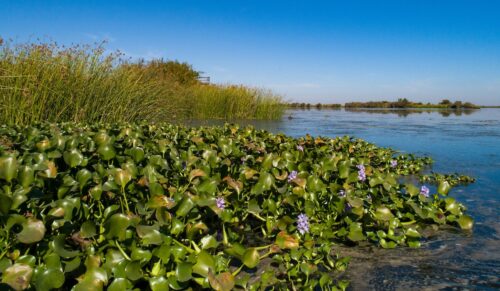
The extent of the problem varies widely from year to year, driven by seasonal temperatures, drought conditions, and river flows. Historical estimates for water hyacinth alone have ranged from fewer than 500 acres to more than 2,500 acres, while submerged weeds such as Brazilian waterweed can cover even larger areas. During recent drought periods, including 2013–2015 and 2021–2023, remote sensing data showed sharp increases in submerged aquatic vegetation as warm, slow-moving water created especially favorable growing conditions.
As these invasive plants expand, they can transform the Delta’s marsh habitats by slowing water velocities, increasing water clarity, providing cover for invasive fish, and reducing the open, turbid-water habitat needed by native pelagic species such as Delta smelt. Dense vegetation can also obstruct waterways, interfere with navigation, and clog agricultural and municipal water intakes. Left unchecked, invasive aquatic vegetation poses risks not only to native species and habitat, but also to boaters, agriculture, water supply operations, and public safety.
At the State Water Contractors Science Symposium, Jeffrey Caudhill of the Aquatic Invasive Plant Control Program at California State Parks’ Division of Boating and Waterways outlined the state’s efforts to manage aquatic invasive vegetation in the Delta.
A program built for control, not eradication
The Aquatic Invasive Plant Control Program controls and manages aquatic invasive vegetation in the Sacramento-San Joaquin Delta to protect the environment, public health, and the economy. The program is authorized under Harbors and Navigation Code sections 64 and 64.5, which designate the Division of Boating and Waterways as the lead agency for controlling aquatic invasive plants across the Delta’s approximately 101,000 water acres.
Mr. Caudhill emphasized that the program is designed for control, not eradication. Eradicating invasive aquatic plants throughout the Delta would require a far larger and likely unsustainable budget. It would also be impractical because the Delta receives continual inputs from the Sacramento and San Joaquin rivers, tributaries, and San Francisco Bay. Even if invasive plants were fully controlled in one area, new material could be introduced again almost immediately.
The program is also permissive rather than mandatory. Because it does not have its own dedicated budget line item, it is funded through the Harbors and Watercraft Revolving Fund, a special fund supported by California voters. As a result, the program must direct many of its benefits toward the public while operating within the limits of available funding and statutory authority.
Budget cuts narrow the program’s toolbox
The slide below summarizes the number of acres treated since 1990 and identifies the ten invasive plant species targeted by the program.
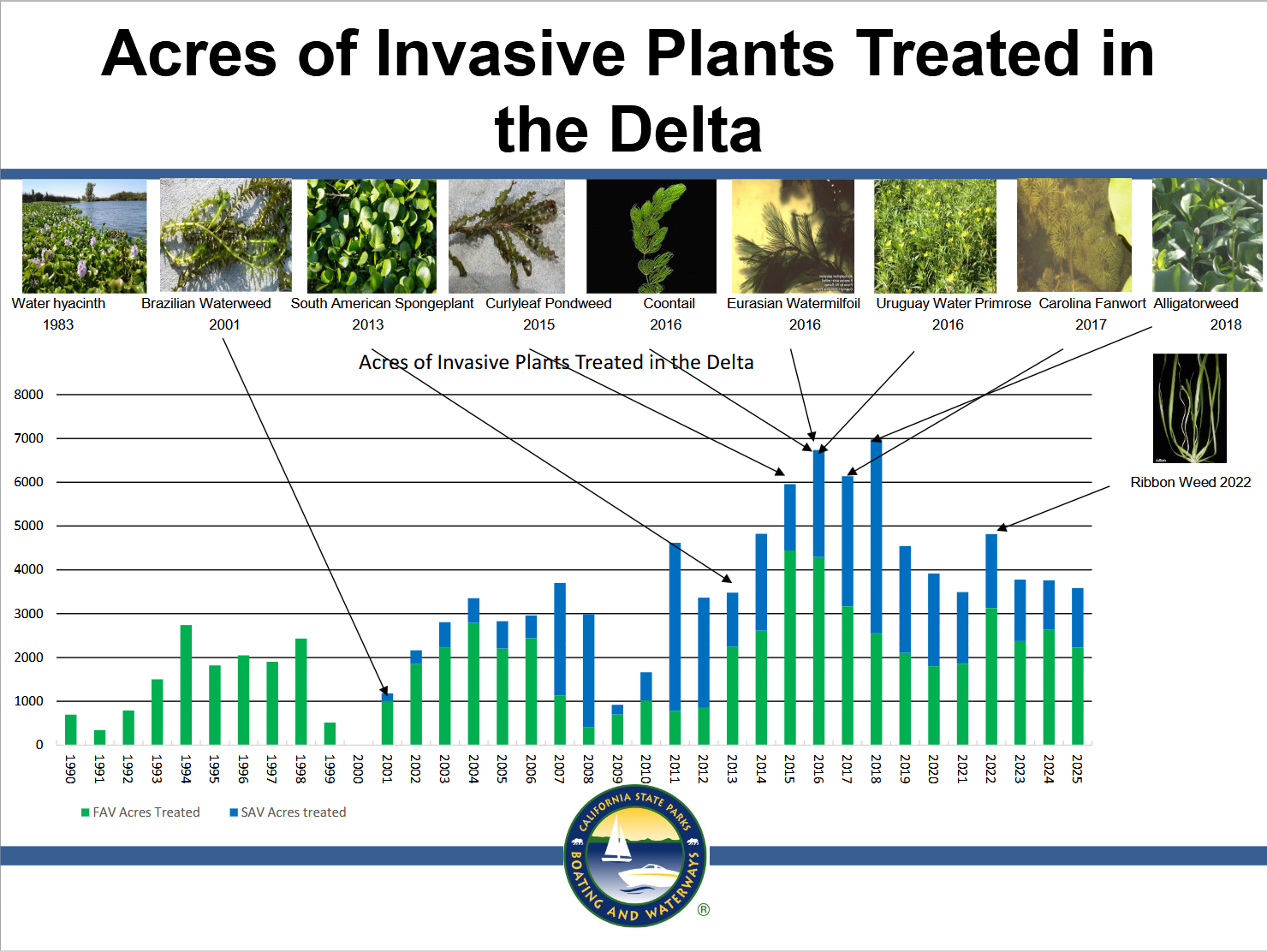
No control work occurred in 2000 after legal action was filed against the Department of Boating and Waterways over compliance with the Endangered Species Act. That process ultimately led to an annual biological opinion, or Section 7 informal consultation process, which Mr. Caudhill described as challenging for both the federal services and the program.
The program received a budget increase in 2016 through drought funding, which allowed it to expand staffing. That funding ended in 2019, reducing the program’s budget, and in 2023, the budget was cut in half. The current strategy involves a lot of different tools, and many of them are restricted based on budget considerations.
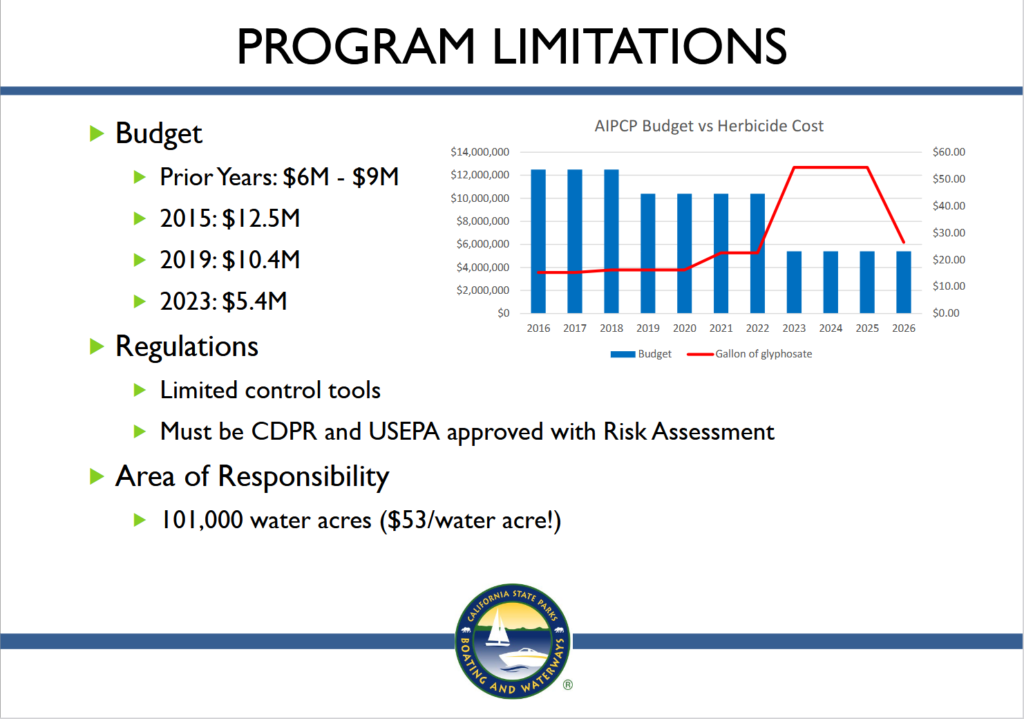
The program primarily uses herbicides, and that’s primarily budget driven. At the same time the budget is being reduced, the costs of herbicides is going up. “So, even though right now temporarily it looks like the budget has maybe matched the price of the herbicides or the operating costs of our program, that’s probably going to change, but the budget for our program probably won’t,” said Mr. Caudhill. “As much as we would like to use all these different tools that I’ve talked about, the budget is a very restrictive factor for our program.”
Mr. Caudhill said fluctuating budgets are another major reason aquatic vegetation is difficult to control in the Delta. When funding is reduced, the program has to scale back higher-cost control tools, making it harder to maintain operational effectiveness across the Delta. To address the problem, funding needs to be substantial and long-term.
He pointed out that even if you were to drain the Delta and get rid of everything, there would be a resurgence. “There are tubers and seed banks for these plants that can last 10 or 20 years, which will just pop right up again as long as there’s water,” he said. “So you have to successfully control some of these overgrown sites for up to 20 years or so, in order to finally eradicate what’s actually there,” he said.
How invasive vegetation changes Delta waterways
Aquatic invasive vegetation can affect Delta waterways in several ways, including altering hydrodynamics and water conveyance. Dense mats of submerged aquatic vegetation and floating aquatic vegetation can slow water movement, increase residence time, affect conveyance to the federal and state pumps in the South Delta, disrupt agricultural operations, and reduce habitat for native fish.
Invasive aquatic vegetation also increases habitat for predators, which can increase predation on native fish. Floating mats such as water hyacinth and dense submerged mats such as Brazilian waterweed expand the areas where fish may be preyed upon and can increase both the density and abundance of predator fish. These vegetation mats can also alter the food web by reducing phytoplankton and shifting production toward bacteria- and sediment-driven pathways that are less beneficial for pelagic fishes such as longfin smelt and Delta smelt.
Water quality can also be affected. Dense submerged aquatic vegetation can trap sediment and reduce turbidity, making the water clearer. Clearer water can promote additional submerged aquatic vegetation growth, while reduced turbidity can make it harder for small pelagic fish, including Delta smelt, to avoid predators.
Dissolved oxygen presents another challenge. Program staff test dissolved oxygen levels frequently to help avoid fish kills. Dense vegetation can consume large amounts of oxygen, especially overnight and in the early morning, and low dissolved oxygen levels are more likely when water flow is limited or temperatures are warmer.
The control toolbox
Chemical controls
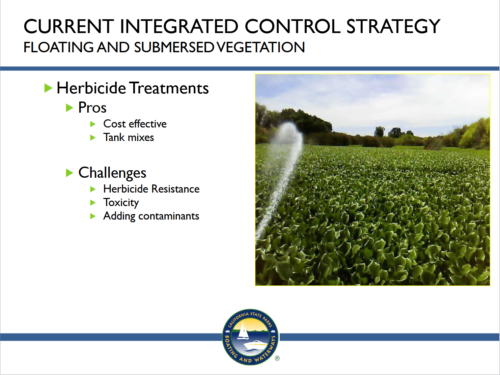
Chemical controls include herbicides, adjuvants, glyphosate, and other treatment products. Some products used elsewhere in the United States cannot be used in California because of environmental concerns. The program must account for endangered species and ensure that all products are approved by the U.S. Environmental Protection Agency or the California Department of Pesticide Regulation.
Mr. Caudhill said herbicides are the program’s primary control tool because of budget constraints. Herbicide treatments are cost-effective, and the program must rely on the most efficient tools available. Without herbicides, more expensive methods would allow the program to treat—and not necessarily control—only a fraction of the acres controlled today.
Mr. Caudhill said spreading the $5.4 million budget across 101,000 acres amounts to about $53 per acre. “That gives me one gallon of glyphosate, which is used only for floating aquatic plants, and probably about 10 minutes of crew time without putting fuel in that boat or maintaining the boat,” Mr. Caudhill said. “So if we needed to control all 101,000 acres, the budget is unfortunately not going to support that—data suggests that we could probably control about 3,000 to 4,000 acres realistically with the budget that we have.”
The program periodically conducts dye studies when funding is available to better understand hydrodynamics, water flow, and potential herbicide movement. Constant water movement in the Delta, including two tidal cycles each day, creates a major treatment challenge by increasing exchange rates and making it difficult to maintain the contact time and concentration needed for effective herbicide treatment.
“The dyes are going to help us understand where the water flows,” Mr. Caudhill said. “We might want to find out, do we want to spread the chemical evenly within the site to try and get the best efficacy, or do we need to put it somewhere else, or target certain areas to try and get the best efficacy we can, while following all the label regulations and the permits that we have.”
Herbicide resistance remains a key challenge. Multiple modes of action allow the program to continue controlling invasive plants successfully. If one chemical, such as glyphosate, becomes ineffective over time, continued use would add chemicals to the water without providing meaningful control. Additional concerns include herbicide resistance, toxicity, and the potential addition of contaminants.
Physical and mechanical controls
Physical controls include curtains, screens, booms, and floating barriers designed to reduce water exchange during herbicide treatments.
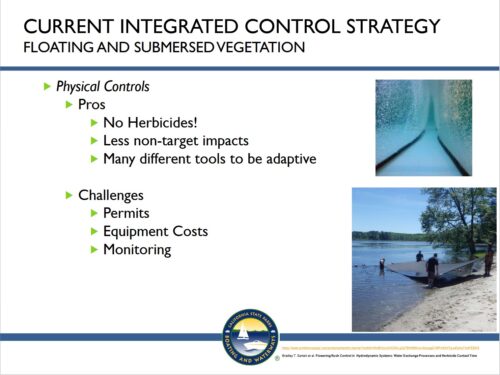 Bubble curtains are one adaptive tool that may slow water exchange and increase residence time, although effectiveness in the Delta remains uncertain. Longer residence time can improve the contact time and concentration needed for herbicide treatments, potentially reducing the amount of herbicide and number of treatments required. However, bubble curtains also involve permitting requirements, costs, and constant monitoring.
Benthic mats function like weed mats placed along the bottom of a watercourse. These mats can be effective but tend to be costly and resource intensive because of monitoring needs. Benthic mats also do not work well in dense vegetation, so an area generally must be controlled before the mats can be useful.
A Section 10 permit under the Rivers and Harbors Act provides a regional general permit for physical controls such as benthic mats or air bladders. These permits can be time consuming and costly because soil and sediment impacts must be evaluated carefully, and cultural resources must be researched.
Physical removal is used during periods when herbicide spraying does not occur. Herbicide treatments are suspended in December, January, and February to avoid winter-run Chinook salmon and Delta smelt spawning habitats.
“This is the favorite of our crew because you get in a boat with pitchforks and nets, and you try and haul heavy weeds out, and then you call in sick the next two days because of back problems,” Mr. Caudhill said. “It is an option, and we’ve used it from time to time, but unfortunately it’s not a long-term sustainable solution.”
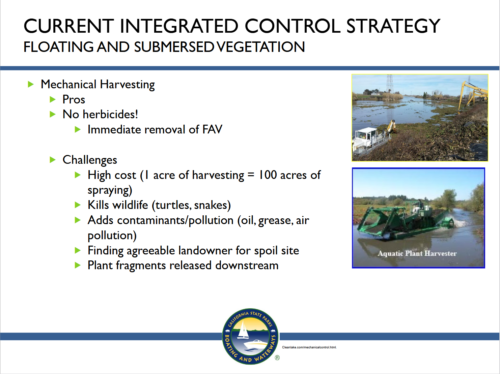
Mechanical harvesting provides immediate plant removal without herbicides. However, chopped plant fragments can move downstream and become new plants because most invasive plants managed by the program reproduce through fragmentation. The process can add contaminants, such as oil and grease, and requires finding an agreeable landowner for spoil site.
Mechanical harvesting can also harm turtles, snakes, and other wildlife unable to escape dense vegetation mats before harvesting equipment passes through. The method is also expensive; according to Mr. Caudhill, every acre mechanically harvested costs roughly as much as treating 100 acres with herbicides.
Mechanical harvesting also requires coordination with the U.S. Coast Guard for permits and permissions. The Coast Guard notifies boaters of potential navigational hazards and possible detours.
Biological controls
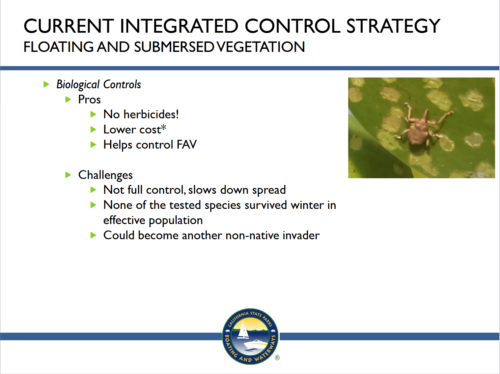 The program has worked with the USDA Agricultural Research Service to evaluate biological controls. Two weevils and a planthopper showed promise, but the insects could not overwinter in the Delta at population levels needed to provide effective control.
Biological controls can provide ongoing benefits without recurring treatment costs, but results from successful tests in warmer states such as Florida and Texas have not translated well to the Delta. Delta winters appear to stress biological control agents enough to limit survival and effectiveness. The program is evaluating a different weevil species that may be more winter hardy, and Mr. Caudhill indicated that future results may be more promising.
The cost of doing nothing
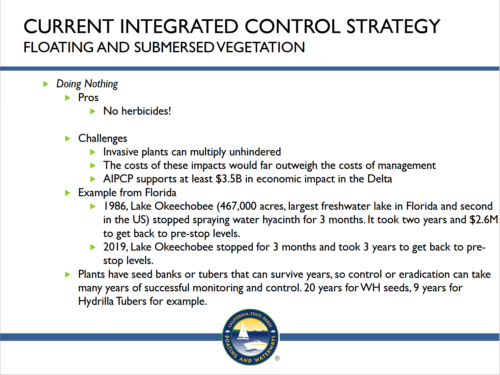 Mr. Caudhill said doing nothing is one possible management option, but experience from other states demonstrates the cost of delayed control. In Florida, where managers face similar freshwater invasive vegetation challenges, Lake Okeechobee provides a useful comparison. The lake is roughly four and a half times the size of the Delta area managed by the program. In 1986, a three-month suspension of water hyacinth spraying required two years and $2.6 million to regain control—nearly $6 million in today’s dollars.
A second suspension occurred in 2019 after pressure from anglers. Regaining control took three years without additional funding, forcing managers to reduce work on other programs while focusing on Lake Okeechobee. As a result, other lakes fell behind and later required tens of millions of dollars in additional work to bring invasive vegetation back under control.
Going forward …
The program uses NASA imagery to locate floating aquatic vegetation and track trends across years, tides, warm seasons, and drought periods. This information helps the program remain as proactive as possible. Hydroacoustic mapping provides additional information about submerged vegetation in turbid water by estimating how much of a water body is filled with weeds. Rake sampling with a 20-foot rope helps identify which plants are present and whether vegetation is mostly invasive, mostly native, or limited in extent.
“We’re trying our best on limited budgets to be adaptive, deal with integrated pest management, increase our monitoring tools to work smarter and not harder, and we collaborate with a lot of local, state, and federal entities the best we can,” Mr. Caudhill said.

