
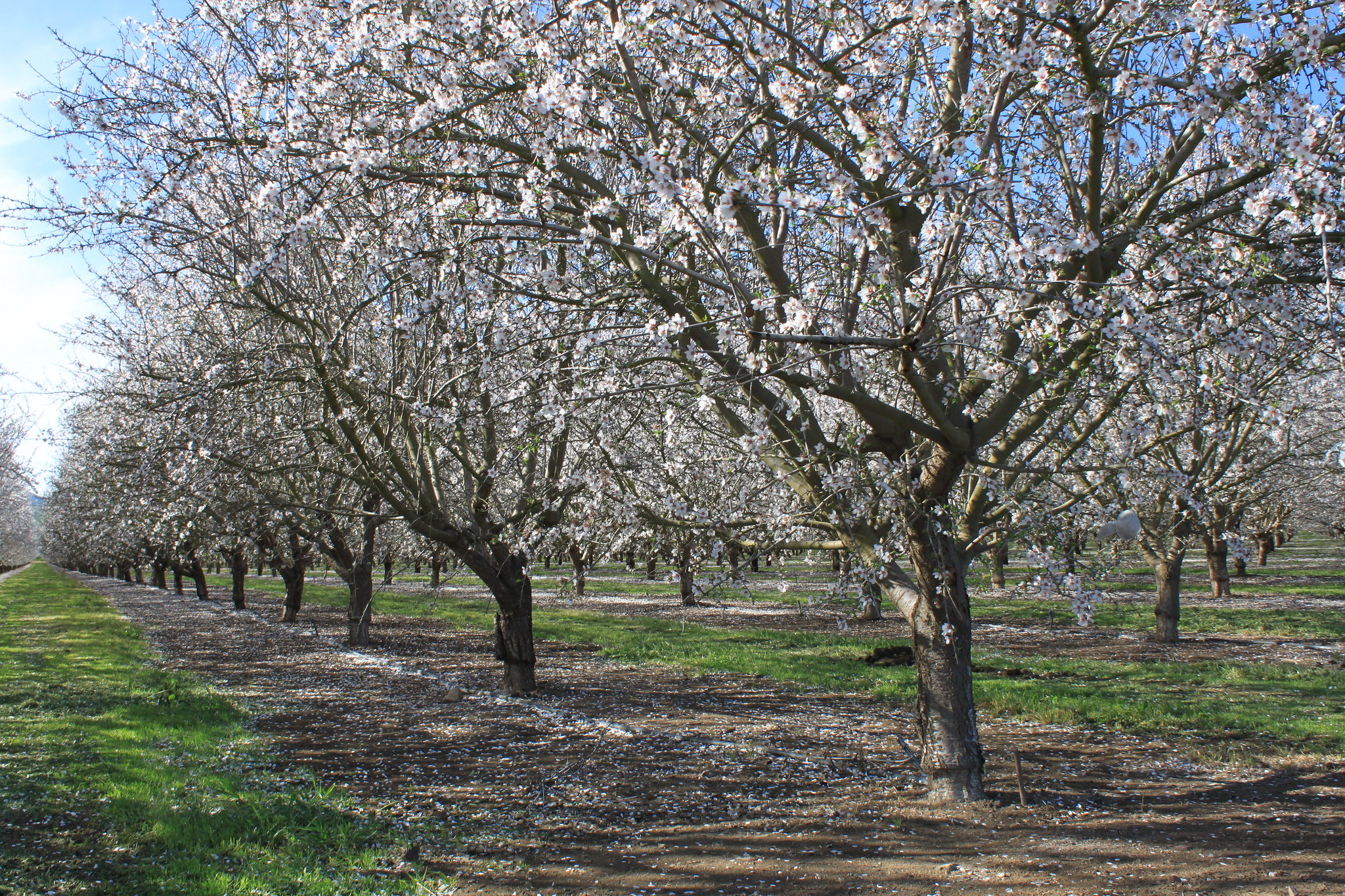
A community-led project in California shows how collaboration can reshape farmland to improve water resources, restore native plants, and create recreational space.
By Claire Beveridge, EOS
California is experiencing major changes in how farmland is used as recent policies seek to protect groundwater resources. These changes are reshaping both the landscape and the lives of rural residents, especially in communities like Fairmead in Madera County, which is surrounded by water-intensive almond orchards.
In Community Science’s special collection on Transdisciplinary Collaboration for Sustainable Agriculture, Katrak-Adefowora et al. [2026] describe a project that engaged Fairmead residents and farmers in redesigning a small almond farm into a landscape that reflects multiple community priorities. The new landscape includes a basin that captures stormwater to reduce flooding and help replenish groundwater, native plants that improve habitat, and a walking path for community recreational use. Community members and farmers were engaged through workshops, outreach, and educational activities, with the project team remaining flexible and responsive to local input.
This paper shows how involving communities in landscape decisions from the beginning can lead to solutions that are both environmentally beneficial and responsive to local priorities. It also offers a practical collaborative model for other regions facing similar land-use and water challenges, demonstrating how partnerships among residents, farmers, nonprofits, businesses, local governments, and scientists can support more resilient communities.
RESEARCH ARTICLE: Transdisciplinary Collaboration for Sustainable Agriculture
By Roshni Katrak‐Adefowora, Aysha Massell, Vickie Ortiz, Allen Vizcarra, Barbara Nelson, and Angel S. Fernandez‐Bou
 Abstract: Groundwater is a critical resource for agriculture, ecosystems, and communities in California. However, unsustainable large‐scale agricultural pumping has depleted aquifers in many areas, causing well failure in disadvantaged communities and for small farmers, threatening habitat, and causing subsidence. Fairmead—an unincorporated disadvantaged community in California’s San Joaquin Valley—exemplifies how excessive groundwater pumping impacts vulnerable communities.
California is currently incentivizing the strategic repurposing of irrigated cropland to less water‐intensive uses, a process known as multibenefit land repurposing that aims to produce multiple social and ecological benefits. New land uses can include less water‐demanding crops such as agave and pasture, and alternative uses such as groundwater recharge basins and community parks. This study presents the Fairmead Groundwater Resilience Project, which engages residents and farmers to codevelop sustainable water management solutions. Our team facilitated discussions between the community residents and farmers to collaboratively identify the most pressing community issues, the best uses for the land to achieve multibenefit solutions, and landowners willing to change their land use practices.
Our collaborative process resulted in a partnership with a willing farming family to transition their completely groundwater‐dependent high‐water‐use crop (almonds) into a multibenefit project. This project will include a stormwater basin to provide flood risk reduction and incidental groundwater recharge, native vegetation for habitat improvement, and a walking path to create recreational space for the community. This community‐centered approach offers a replicable model for promoting groundwater sustainability across California while advancing environmental justice.

