
New federal guidelines could determine how Southern California manages dry-year reliability after 2026.
The Colorado River is under increasing pressure after more than two decades of drought, hotter and drier conditions, and continued demands from cities, agriculture, tribes, and ecosystems across the West. Lake Mead and Lake Powell—the system’s two largest reservoirs—remain at historically low levels, leaving less stored water available to buffer dry years and increasing the stakes for how the river is managed. The seven basin states have struggled for years to find a path forward with little success.
Against that backdrop, the federal government is developing new operating guidelines to replace the 2007 interim rules, which expire at the end of 2026. What gets decided in the coming weeks will shape Colorado River supplies for Metropolitan and other users across the Basin over the next decade.
At the July meeting of Metropolitan’s One Water and Adaptation Committee, Shanti Rosset, Colorado River Policy Manager, updated committee members on the status of the post-2026 operating guidelines and what the emerging federal approach could mean for Southern California’s water reliability.
WHERE THE FEDERAL PROCESS IS AT
The U.S. Bureau of Reclamation, part of the Interior Department, operates the Colorado River System reservoirs. Before any new federal agency action—such as adopting new guidelines—can move forward, it must go through a federal environmental review. The draft Environmental Impact Statement, or EIS, was released in January. It outlined five possible approaches and drew more than 18,000 public comments before the comment period closed in March.
Since then, the Interior Department has been narrowing its focus toward a single approach, which it has called the preliminary preferred alternative. The final EIS is expected later this month, followed by the Secretary of the Interior signing the Record of Decision, or ROD, in late July.
On Friday, July 10, the seven basin states received a working copy of a document that includes operational provisions for power releases and Lower Basin operations, including how access to banked water would be managed in 2027 and 2028. Metropolitan staff are reviewing those provisions and planning meetings with the Lower Basin and Reclamation over the next two weeks to work through issues with the proposal.
A NEW APPROACH
Reclamation’s proposal marks a significant departure from how the Colorado River has been managed in the past. The previous approach set detailed operating rules that remained in place for 20 years. For the post-2026 guidelines, Reclamation is instead proposing a 10-year framework that is relatively spare. It lays out a set of principles and “sideboards”—the outer limits within which the system would operate.
That 10-year framework would become the Record of Decision. Reclamation would then adopt guidelines within that framework every two years, with annual operating plans used to implement them each year. The proposed alternative is a federally structured framework, rather than a negotiated consensus among the seven Basin states.
LOWER BASIN PROPOSAL
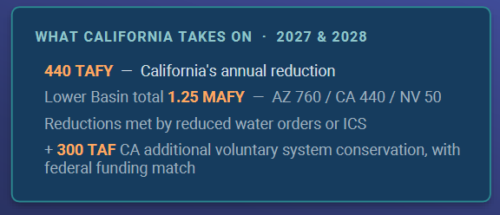 In the absence of a seven-state agreement, the three Lower Basin states—California, Arizona, and Nevada—put forward their own workable plan for operating rules in 2027 and 2028.
Together, the three states agreed to address evaporation and system losses in the Lower Basin by taking 1.25 million acre-feet of annual reductions. California’s share would be 440,000 acre-feet annually, Arizona’s would be 760,000 acre-feet, and Nevada’s would be 50,000 acre-feet.
California could meet its share of the reduction in one of two ways: by ordering less water from the river or by drawing on water that has previously been banked as intentionally created surplus, or ICS. California would also commit to an additional 300,000 acre-feet of voluntary conservation, with federal funding expected to help pay for it.
“California’s willingness to take these reductions, including reductions that we are not legally first in line to bear, was offered as a condition,” said Ms. Rosset. “That condition is on the access terms to our banked water, which are still being negotiated. The reduction and access question are a single package. Pull them apart, and the deal doesn’t hold.”
ACCESS TO ICS SUPPLIES IS KEY
Access to stored water is Metropolitan’s central interest at this stage of the negotiations. Under the 2007 interim guidelines and the 2019 Drought Contingency Plan, Metropolitan has been able to conserve water in Lake Mead and draw on it later. The intentionally created surplus, or ICS, program functions like a savings account inside the reservoir and is one of Metropolitan’s most important dry-year tools.
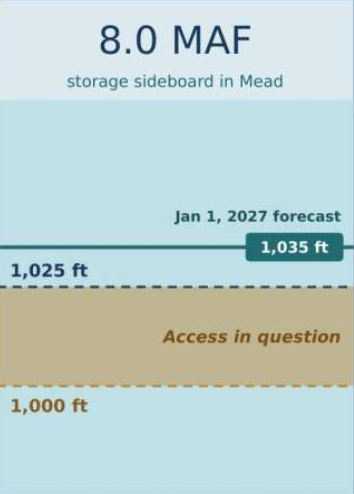 However, a savings account is only useful if the owner can withdraw from it. As Lake Mead falls, Metropolitan’s ability to recover all of its stored water becomes more restricted. The graphic to the left shows reservoir elevation, with the forecast for the start of 2027 at about 1,035 feet—slightly above the level where restrictions begin. The band below that, between elevations 1,025 and 1,000 feet, is where Metropolitan is negotiating whether it can access its stored water and under what terms. In that zone, the Interior Secretary is asserting authority to deny or reduce deliveries because of low reservoir elevations.
“What Metropolitan is pushing for is straightforward,” said Ms. Rosset. “A process to get our stored water out below 1,025 feet that is predictable, has firm timelines, and runs on objective criteria, not on open-ended federal discretion. We need to know when we can get our water—and that when we need our water, we can actually get it.”
This question is not hypothetical. Reclamation publishes monthly forecasts of reservoir elevations. Even Reclamation’s most-probable forecast puts Lake Mead below 1,025 feet through 2027—the zone where ICS access is restricted—and below that threshold on January 1, 2028, when access for 2028 is set.
Metropolitan’s access to stored water would be unrestricted in calendar year 2027. But Lake Mead is projected to decline through 2027, reaching about 1,015 feet by January 1, 2028—below the 1,025-foot threshold and within the restricted band.
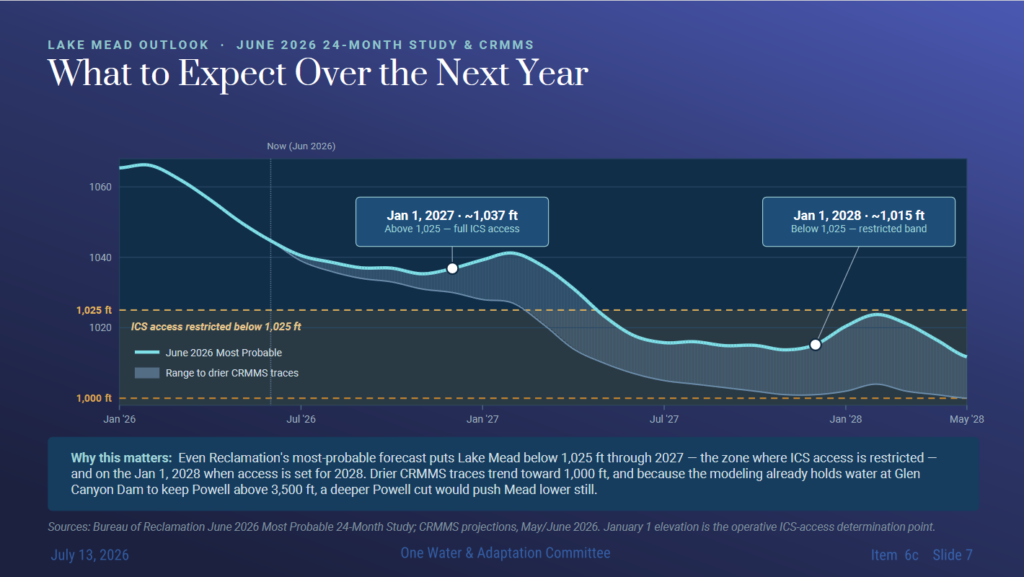
Drier conditions would pull Lake Mead closer to 1,000 feet. The shaded area shows modeling runs in which Reclamation holds additional water back in the upstream reservoir, Lake Powell, to keep it above elevation 3,500 feet. If protecting that infrastructure requires holding back more water, less water would reach Lake Mead, pushing it even lower. That means the restrictions now under discussion are likely to apply in 2028, which is why the access terms being negotiated are so consequential.
 “Metropolitan’s support for California’s reductions depends on one thing: reliable, rules-based access to our stored water in that 1,025-foot to 1,000-foot band,” said Ms. Rosset. “If that access is firm, our water is there when we need it. Our cost to replace supply stays bounded, and our reliability planning tools hold. If access is discretionary, we’re counting on water we might not be able to get back when conditions are at their worst. That’s the crux. Without a firm right to recover our stored water, dry-year reliability risk grows, and that’s exactly why access to 1,025 feet matters so much to us.”
“ICS is not our first choice,” said Bill Hasencamp, Manager of Colorado River Resources. “We’ve told the feds that we would only take ICS in a dry year on the State Water Project. We wouldn’t just take it out to take it out. So it’s going to be part of our overall supply, just like it’s been as part of our WSDM [Water Supply/Demand Management] decisions. If if next year’s a super El Nino on the State Water Project, and we have a lot of water, we won’t need ICS next year. But if it’s dry, we’ll need a lot of access to it. So it really, as always, it depends on our own conditions here in California.”
Ms. Rosset noted that two variables define Metropolitan’s exposure. The first is the size of the reduction and how California divides its share among contractors, which is still being worked out. The second is the firmness of Metropolitan’s access to stored water, which affects the cost of replacing supply and how confidently the agency can plan.
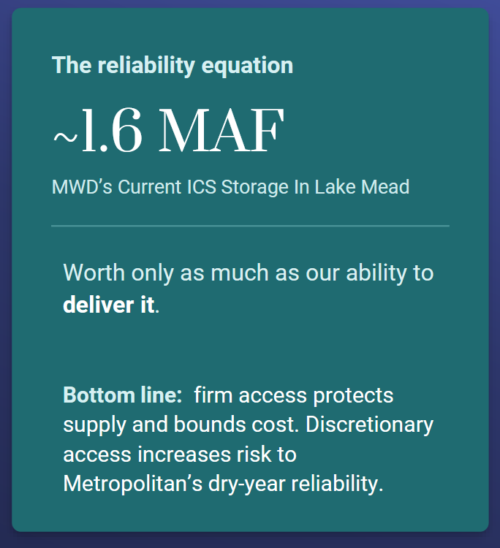
Metropolitan currently holds roughly 1.6 million acre-feet of stored water in Lake Mead, a significant dry-year asset. But it is valuable only if Metropolitan can deliver it. “The bottom line is simple: firm access protects supply and balances costs; discretionary access increases risks to our dry-year reliability,” she said. “Still open are access terms, the final distribution within California, and surplus rules.”
NEXT STEPS
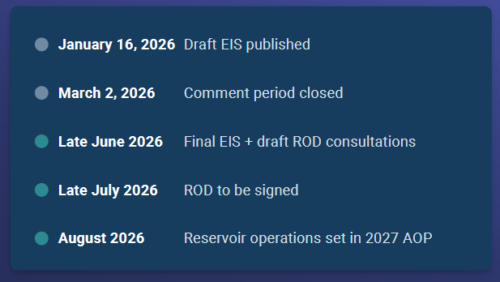 The federal decision is expected to be signed in late July. The 2027 Annual Operations Plan is expected to follow in August. Tentatively, the Board will be asked in the fall to authorize the implementation agreements.
Ms. Rosset closed by noting that staff is tracking how the federal government sequences actions to protect Glen Canyon Dam infrastructure at Lake Powell, which is nearing historically low elevations. That sequencing affects Lake Mead’s levels and, in turn, the size of Lower Basin shortages. She also noted that a successor to the current treaty minute with Mexico is being negotiated on a separate diplomatic track. The Lower Division states are asking Mexico to take reductions in parity with domestic cuts in the Lower Basin.

