Visit the Water Shelf main page
 First published on the To Know Water Is To Love Water blog March 3, 2026
By Jim Lauria
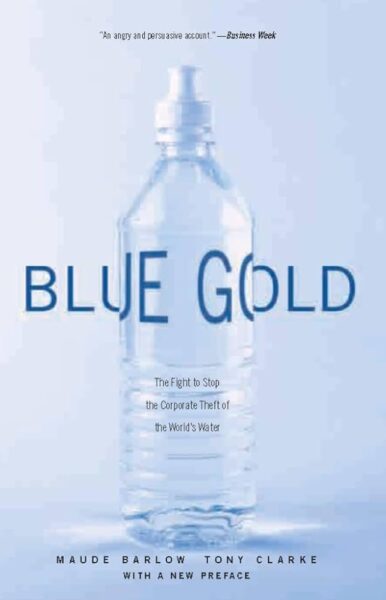
When Maude Barlow and Tony Clarke published Blue Gold: The Fight to Stop the Corporate Theft of the World’s Water (The New Press) in 2002, the idea that water could become the next oil seemed provocative, maybe even alarmist. More than two decades later, with water futures trading on the Chicago Mercantile Exchange under the ticker NQH2O, with aquifers collapsing under cities from Phoenix to Chennai, and with the global bottled water market surging past $350 billion a year, the book reads less like a warning and more like a prophecy. The uncomfortable truth is that nearly every crisis Barlow and Clarke identified in 2002 has not only persisted, it has intensified.
Blue Gold opens with a stark accounting of the overdraft of the world’s fresh water…the systematic withdrawal from aquifers, rivers, and lakes at rates that far exceed nature’s ability to replenish them. In 2002, this was an emerging concern. Today, it is a documented emergency. NASA’s GRACE satellite missions have confirmed that major aquifer systems on every inhabited continent are being depleted faster than they recharge. The Ogallala Aquifer, which underwrites much of American agriculture, continues its steady decline. India’s groundwater, which feeds hundreds of millions of people, is being pumped at rates that would have alarmed Barlow and Clarke even more had they seen the data we have now. The overdraft hasn’t slowed. In many places, it has accelerated.
From overdraft, the authors turn to water contamination and degradation: industrial discharge, agricultural runoff, and the chemical cocktails of modern manufacturing rendering vast quantities of remaining fresh water unusable or dangerous. Again, 2002 was just a preview. The PFAS issue, which has since revealed “forever chemicals” in drinking water systems across the United States and around the world, has added an entirely new dimension to the contamination story Barlow and Clarke were telling. Flint, Michigan. Jackson, Mississippi. The list of American cities that have suffered water quality failures reads like a roll call that vindicates every concern in this book. For anyone in the water treatment business, these pages feel like reading about our daily battles writ large across the globe and recognizing that the battles have only grown fiercer.
Blue Gold also traces how water strife escalates into water conflict. When communities don’t have enough clean water — or when it’s diverted, degraded, or sold to the highest bidder — the tensions don’t stay local for long. Peter Gleick’s Water Conflict Chronology has now documented over a thousand instances of water-related violence, from the Syrian drought that preceded civil war to tensions over the Nile triggered by the Grand Ethiopian Renaissance Dam. The vice president of the World Bank was quoted on Blue Gold’s jacket stating that the wars of the next century would be about water. We’re a quarter of the way through that century, and the prediction is holding up.
What sets Blue Gold apart from the purely environmental water books of its era is its unflinching examination of the commoditization of water. Barlow and Clarke laid out how water was being transformed from a shared commons into a tradeable commodity, subject to the same market forces as petroleum. They traced this trajectory through the boardrooms of transnational water companies like Suez and Vivendi, through the World Bank and WTO, and through the fine print of trade agreements quietly rewriting the rules of who owns water and who gets to drink it. In December 2020, when CME Group launched the Nasdaq Veles California Water Index Futures making water officially tradeable on a financial exchange for the first time, the book’s central thesis moved from argument to reality.
One of Blue Gold’s most compelling arguments is the distinction between what the authors call “speculative investment” and “productive investment” in water. Productive investment repairs infrastructure, builds treatment systems, and protects watersheds; it puts money to work improving the actual delivery and quality of water. Speculative investment treats water as a financial instrument, a vehicle for profit disconnected from turning on the tap. It’s the difference between investing in a farm and betting on crop futures from a trading desk. The authors warned that the speculative approach was gaining the upper hand. Today, with hedge funds and financial players actively trading water derivatives, that warning has become our operating environment.
One of the more provocative moments in Blue Gold comes from an unlikely source. The authors cite Canadian journalist Terence Corcoran, the Financial Post’s free-market champion, predicting there would be an OPEC of Water by 2010 (what I refer to as OWEN, the Organization of Water Exporting Nations). Corcoran floated this not as a warning but almost with admiration for the market logic that would make such a water cartel inevitable. The year 2010 came and went without OWEN setting up shop, but was the prediction really that far off? Today, nations are increasingly guarding their water resources, restricting exports, and treating freshwater as a strategic asset. China controls the headwaters of rivers that feed Southeast Asia. Turkey’s dam projects reshape water politics across the Middle East. The water cartel may not have a formal name or a headquarters in Geneva, but the behavior Corcoran described — hoarding and leveraging water like petroleum — is playing out in slow motion all around us.
The book’s treatment of privatization is among its most powerful sections. From Cochabamba, Bolivia, where water privatization sparked a revolt, to England and France, where private companies slashed workforces and raised rates while service declined, Barlow and Clarke presented a damning indictment. Their argument isn’t anti-business, it’s that water is fundamentally different from other commodities because there is no substitute and there is no choice. You can switch from oil to natural gas. You cannot switch from water. The privatization debates of the early 2000s may have cooled in some regions, but the underlying tensions haven’t disappeared. They’ve simply taken new forms — public-private partnerships, infrastructure investment funds, and the quiet acquisition of water rights by entities whose names most consumers would never recognize.
Blue Gold’s examination of bottled water reads as an early strike in what has become a massive front in the water conversation. In 2002, the bottled water industry was already large. Today, it is staggering, a global market valued at roughly $350 billion and projected to nearly double within a decade. The same players Barlow and Clarke called out — Coca-Cola, PepsiCo, Nestlé, Danone — remain dominant, still buying up freshwater rights, still selling a product that in many cases is no better than what comes out of the tap, still generating mountains of plastic waste. A United Nations University report noted that global annual bottled water sales could reach $500 billion this decade and that the cost of providing safe drinking water to everyone on Earth would be less than half that figure. The commoditization of water in its purest and most visible form hasn’t just survived Barlow and Clarke’s critique. It has thrived.
Is Blue Gold a perfect book? No. The authors wear their activism on their sleeves, and there are moments where the prose tilts from passionate to assertive. But those are minor quibbles against the book’s larger achievement. Blue Gold gave the water conversation a political and economic vocabulary it desperately needed. It connected environmental degradation, corporate consolidation, and human rights in a way that was ahead of its time. And it asked a question we still haven’t adequately answered: Who owns the water?
For water professionals, policymakers, or anyone who wants to understand how we arrived at a moment when water is simultaneously undervalued and over-exploited, Blue Gold remains essential reading arguably more essential now than when it was first published. Barlow and Clarke didn’t just write a book about water. They wrote a book about power. And in the water business, those two things are never far apart.