
From the San Francisco Estuary Institute:
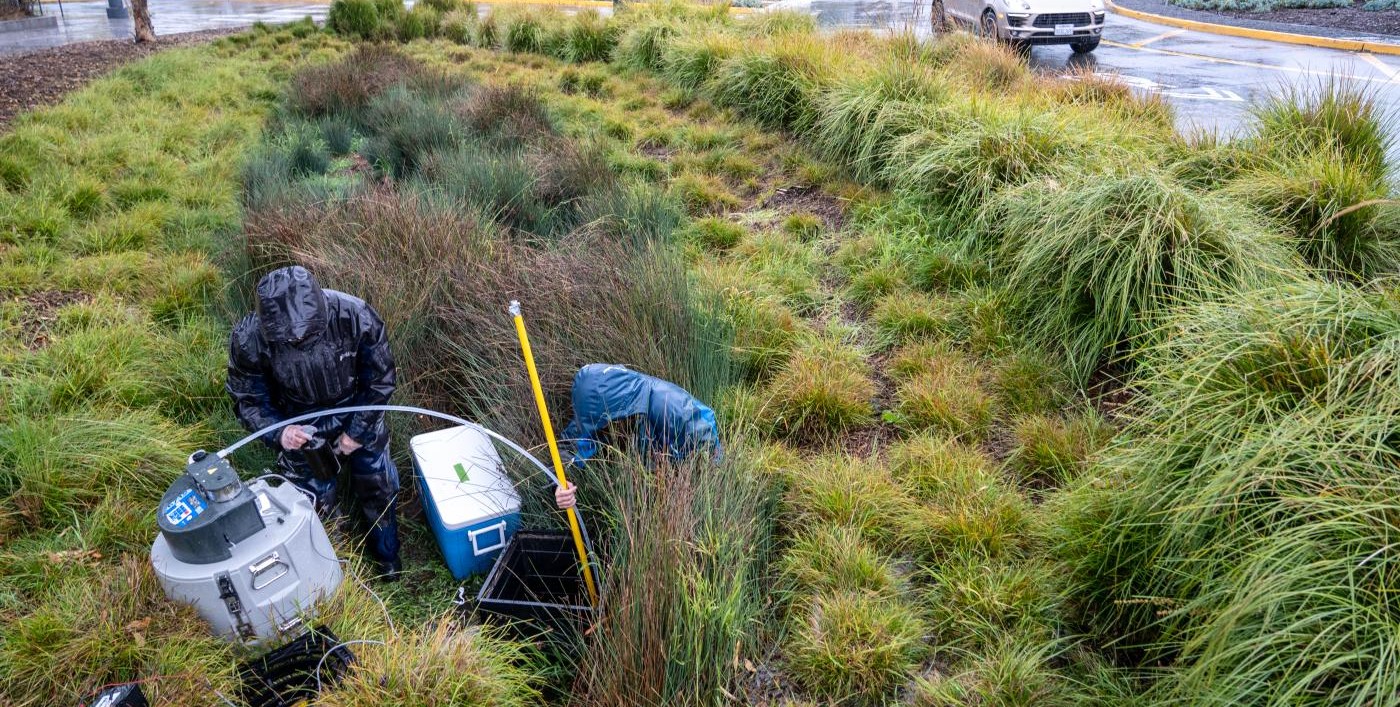
 San Francisco’s rain gardens—the unassuming patches of greenery and mulch designed to soak up rainwater alongside urban roadways—may improve the environment in more ways than realized. A new SFEI-led study shows that rain gardens substantially reduce levels of 21 contaminants in stormwater before that water ends up in San Francisco Bay.
The paper published in the journal Environmental Science: Water Research & Technology investigated how rain gardens trapped pesticides, preservatives, pharmaceuticals, chemicals from vehicles and tires, and certain microplastics. The research is among the first to examine so many groups of chemicals across multiple rain gardens and storms.
“With a broader dataset, you can examine and even challenge some assumptions that folks might make about the performance of these rain gardens,” says Rebecca Sutton, a study coauthor and lead scientist for emerging contaminants at SFEI.
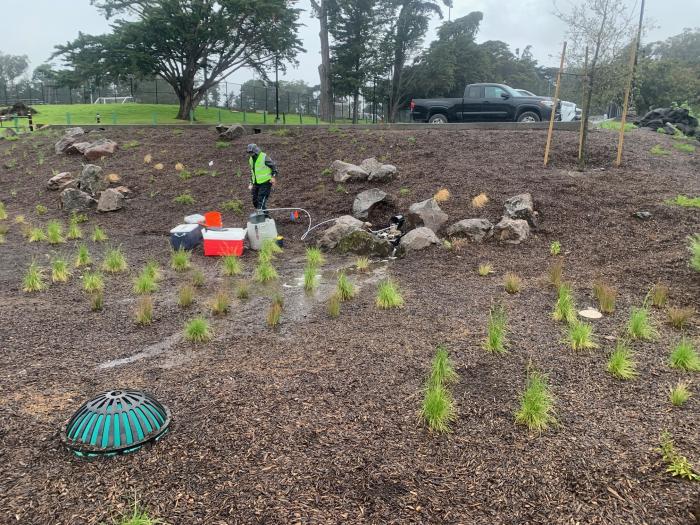
Over a year and a half, SFEI scientists sampled stormwater flowing into and out of four San Francisco rain gardens. Many cities use rain gardens to reduce flooding and filter out pollutants like toxic metals from stormwater. But few studies have examined how rain gardens work for “emerging contaminants,” which have limited regulations—if any—to protect rivers, lakes, and coastal waters.
“Because they weren’t designed to treat emerging contaminants, we were unsure how well rain gardens would do,” says Melissa Foley, SFEI’s lead scientist on green infrastructure projects.
Quite well, it turns out. In the Visitacion Valley neighborhood, where stormwater from an area larger than a football field drained to a rain garden with the footprint of a small house, the soil and plants filtered out at least three-quarters of every contaminant tested in the study. Most were reduced by 90% or more. Overall, the rain gardens were even better at removing most of the emerging contaminants than they were at removing better-studied water quality pollutants like toxic metals.
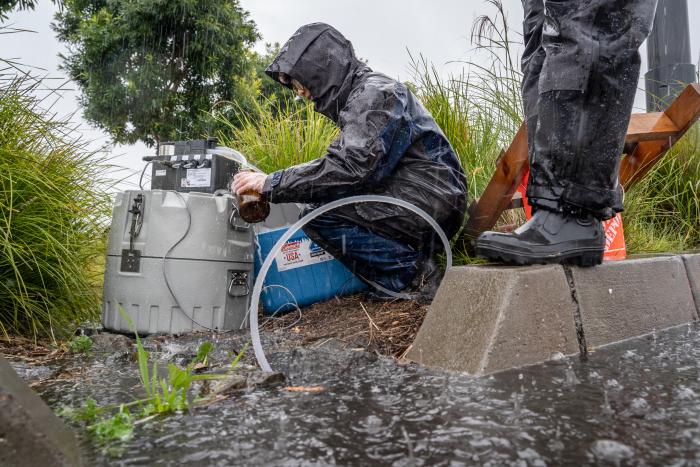
The rain gardens could also remove up to 99% of tire wear particles, which vehicles shed on the road as tires wear down. Modern tires are a concoction of hundreds of ingredients, and their fragments are considered a type of microplastic. In fact, tire particles are estimated to be the most common microplastics in San Francisco Bay, with trillions entering it each year. The study also tested for several chemicals that leach into the environment from tires and vehicles, and found that the rain gardens absorbed large portions of these chemicals.
“The results give us real data around the water quality benefits of these rain gardens,” says Willis Logsdon, a senior watershed planner with the San Francisco Public Utilities Commission (SFPUC) that manages the city’s combined sewer system. To date, SFPUC has built or initiated 575 green infrastructure projects that will capture more than 333 million gallons of stormwater each year when completed, and aims to expand that to a billion gallons annually by 2050. Logsdon notes that even when it isn’t raining, green infrastructure like rain gardens in cities still benefits native wildlife, keeps urban areas cooler in hot weather, and improves public health and safety.
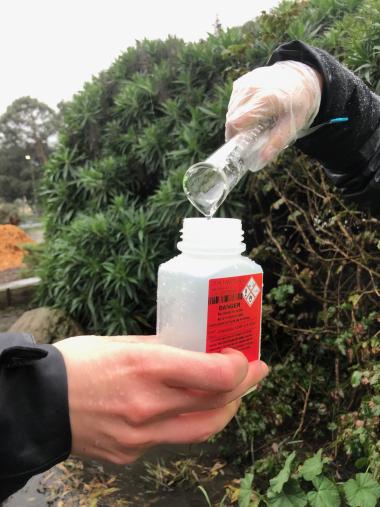
Despite the encouraging results, rain gardens alone won’t entirely protect the Bay from the chemicals in urban runoff. That’s true for a chemical called 6PPD-quinone, which comes from a tire additive. The chemical is toxic to coho salmon, which are extinct in the Bay, and can also impact related species in the Bay like threatened steelhead trout. Although the rain gardens filtered out upwards of 95% of 6PPD-quinone from stormwater, the amount remaining was often higher than the Environmental Protection Agency recommendation to protect aquatic life.
“Even with really high removals, we still have concentrations of 6PPDQ in outlet samples that exceed the EPA threshold,” says Jennifer Dougherty, an SFEI scientist and the study’s lead author. “And that means that we’re going to need some sort of source control in addition to rain gardens, if we’re talking about protection for sensitive species.”
Source control is a common refrain from water quality scientists that calls for stopping new pollution over focusing on downstream cleanup. Most source control requires state or federal action—for example, California has already passed a regulation to phase out the tire additive that leads to salmon deaths once a substitute is identified. But with most chemicals detected in stormwater still unregulated, rain gardens can lighten the load heading to the Bay on a local scale.
This study was funded through an EPA Water Quality Improvement Fund grant with the San Francisco Public Utilities Commission and San Francisco Recreation and Parks as part of the SFEI-led Next Generation Urban Greening partnership.

