
By Jane Sooby
The work of California’s Second Agricultural Expert Panel ended June 16, 2026, when panel chair Daniel Geisseler presented the panel’s findings to the State Water Resources Control Board (State Water Board). (Click here for video of the presentation.)
The expert panel, convened by the State Water Board to advise it on regulating nitrogen (N) discharges through the Irrigated Lands Regulatory Program, began its work in August 2025. When introducing chair Geisseler’s presentation, State Water Board staff reported that the expert panel held 21 meetings and heard over 60 presentations from experts. (For coverage of these meetings and presentations, visit the archive of Maven’s Notebook articles.) Staff also reported that 80-100 members of the public attended each meeting, demonstrating strong stakeholder interest in the expert panel’s work. Public comment was taken at every meeting and two listening sessions were devoted to public comment.
Geisseler, University of California Cooperative Extension nutrient management specialist at UC Davis, provided an overview of the expert panel report and process. Geisseler noted that all of the panel members are affiliated with the University of California and that each one brought different expertise to panel discussions.

Geisseler said that the panel didn’t cut corners or take shortcuts but instead developed solid recommendations for all the questions they were tasked with answering. He noted that the panel carefully considered public comments in their responses.
Geisseler explained that N cycling in cropping systems is complex and it’s not feasible for a regulatory program to include all N fluxes and transformations, so simplified metrics are needed to estimate risk of N loss in agricultural fields. The basic measurements used in the ILRP are A–applied N through irrigation water, mineral fertilizers, and organic amendments—and R—removed N via harvest and sequestration in woody tissue.
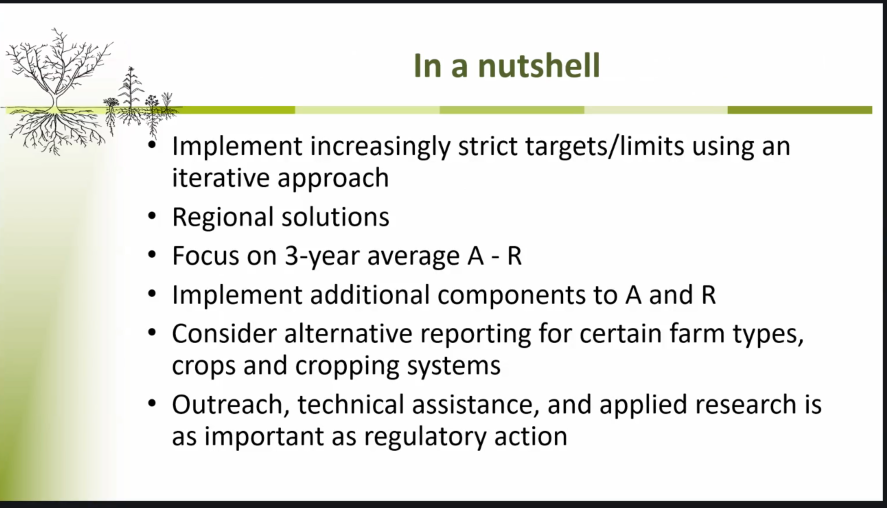
While the first expert panel in 2014 recommended that the key metric be A/R, the second expert panel determined that the preferred measure of potential N discharge is the metric A-R. Geisseler pointed out that A/R is a measure of nutrient management efficiency and a useful metric for growers producing the same crop, but isn’t directly correlated to N discharge. He also emphasized that because of year-to-year variation, rolling 3-year averages of A and R values should be used for regulatory purposes.
Geisseler touched on the second expert panel’s discussion of the use of computer modeling to estimate N loading to groundwater, noting that models can be valuable tools but gathering sufficient data to develop and calibrate a model can be difficult. Ultimately, the panel concluded that whether modeling is used in ILRP is a decision that should be left to the regions to determine.
Geisseler then turned his attention to one of the expert panel’s key “charge questions”: whether sufficient data exist to set crop-specific N-related limits or targets that are protective of groundwater quality. He said that the second expert panel found that there are sufficient data in some regions to establish limits based on N discharges that are excessive compared to the majority of growers in a region, suggesting they could be established at the 80th or 90th percentile of reported A-R values.
The expert panel also determined that targets can be a useful tool for moving growers toward lower A-R values. The panel emphasized that targets or limits should be developed on a regional basis based on 3-year rolling averages and that any targets or limits be accompanied by education and technical assistance to help growers meet these goals. The expert panel suggested an iterative process be used to set increasingly stricter targets or limits for A-R over time.
In considering whether N contained in irrigation water (AIRR) should be included in the calculation of A, the expert panel supported the principle of “pump and fertilize” using high-N irrigation water. The panel determined that AIRR should be included in calculating A because the N is plant-available, with the value of AIRR limited to the amount of N in the volume of water applied to grow the crop measured either by crop evapotranspiration (ET) or total water applied, whichever is smaller, with an initial cap of 200 lb N/acre until growers become more experienced with pump and fertilize accounting.
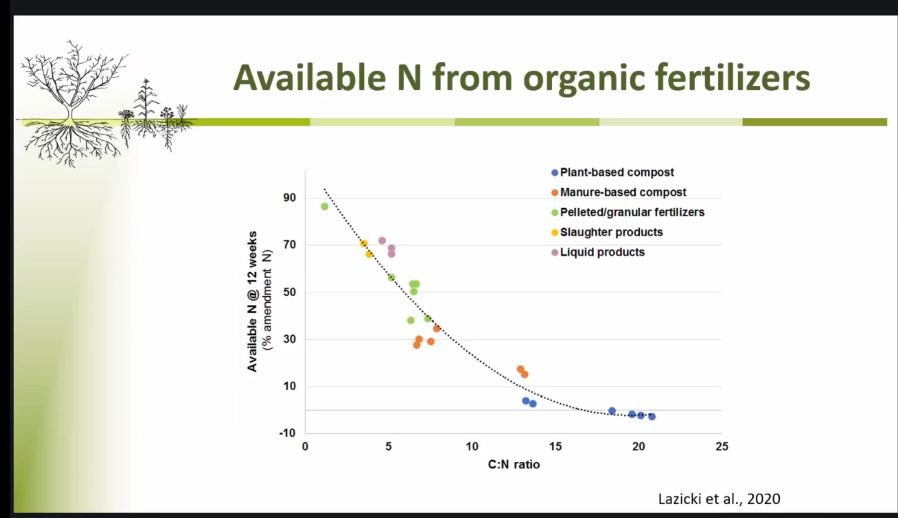
In response to the charge question on whether N discount and credit factors included in the Central Coast Region’s Ag Order 4.0 allow for full accounting of the potential for N discharge to groundwater, the panel determined that the answer is yes and recommended that adoption of these factors be determined by regional boards. Specifically, the expert panel supports the discount factors for compost [ACOMP] and organic fertilizer [AORG] applications because most of the N in these materials is not plant-available in the first year because it is sequestered by soil microbes. The panel also found that the carbon to nitrogen ratio (C:N) of an organic fertilizer is a good estimate of how much N becomes available after application. The narrower C:N, the more N is available and the wider the C:N, the less N is available.
Geisseler also emphasized that the expert panel strongly recommends that growers use soil nitrate tests to measure how much plant-available N is in the soil and determine their N application rates based on these data.
The expert panel also considered the credit RSCAVENGE to account for N scavenged by cover crops or high-carbon amendments and found that the credit is scientifically justified and can reduce nitrate leaching by motivating growers to use these practices.
On the question of whether small-scale farms pose a lower risk to N leaching and should be subject to alternative reporting requirements, the expert panel found that there is great variation between small farms and that farm scale does not necessarily correlate with N leaching risk. The panel suggested that an alternative reporting pathway could be developed for low-risk small farms and that regions could develop specific criteria to determine what farms would qualify for this.
Nurseries are another category of farms that have challenges in reporting accurate R data and may warrant an alternative reporting pathway. Other candidates the expert panel identified for alternative reporting pathways include low-N input winegrape vineyards, alfalfa fields, diversified farms, sod and turfgrass production, and farms including organic farms that use “demonstratable regenerative practices” that pose a low risk to groundwater quality.
Geisseler said that the expert panel devoted an entire chapter to best management practices that will reduce losses of N to groundwater, noting that they should be promoted regionally but not mandated by regulations.
Following Geisseler’s presentation, Karen Mogus, Chief Deputy Director at the State Water Board, noted three categories of follow-up actions: those that can be done now under current regulations, such as standardizing data reporting; those that can be implemented immediately through an informational order, such as reporting soil test data; and those that require additional regulatory action, including allowing regions to set their own targets and limits, implementing N credit and discount factors, and possible alternative reporting requirements.
Mogus made two additional suggestions: convening a workshop during which all regional boards could provide input on the expert panel’s recommendations directly to the State Water Board, and to initiate a public process of workshops to develop a proposal to the Board for implementing other recommendations by the expert panel.
State Water Board Chair E. Joaquin Esquivel expressed appreciation to Mogus and the expert panel for their work, noting that California is decades ahead of other states in regulating N discharges from agriculture and that reducing nitrates in groundwater is a crucial public health issue, particularly in the context of a warming climate. Esquivel said that the realignment study conducted with the California Dept. of Food and Agriculture complements the ILRP work because many of those recommendations also focus on data collection. (The final Regulatory Alignment study was released June 4, 2026; click here to read it.)
A notable development at this State Water Board meeting was Laurel Firestone’s announcement that she is resigning from the board to pursue other opportunities. Firestone, co-founder and co-director of the Community Water Center prior to her appointment to the Board in 2019, has distinguished herself as an advocate on the Board to move more quickly in implementing regulations that mitigate drinking water contamination and provide impacted communities with interim drinking water supplies. Commenting on the panel’s work, Firestone said, “I could not be more thrilled with how this came out,” characterizing the panel’s output as an “incredibly thoughtful and helpful report.” Firestone clarified a number of points raised in the report, and she received many statements of appreciation from public commenters.
The text of the second expert panel’s report is available now at https://ftp.waterboards.ca.gov/; enter Username: agpaneldocs-ftp and Password: AgriculturalExpertPanel2! .
A formatted and accessible version of the report will be posted on the expert panel website in July.

