
IEUA says the project’s dependable Table A and recycled water supplies set it apart from other WSIP projects and justify a higher valuation.
The Chino Basin Program (CBP) was one of the topics discussed at the California Water Commission’s May meeting, where staff from the Inland Empire Utilities Agency outlined the project’s progress toward meeting Water Storage Investment Program requirements. General Manager Kevin Alexander and Program Manager Elizabeth Hurst delivered the update.
 The Chino Basin Program is one of five projects selected for the Water Storage Investment Program (WSIP), which allocates $2.7 billion from Proposition 1 of 2014 to support the public benefits of those projects. Proposition 4 of 2024 added another $75 million for existing WSIP projects.
The CBP is a group of water treatment and storage projects designed to strengthen regional water supply, storage, and delivery systems. The CBP includes a state-of-the-art Advanced Water Purification Facility and aquifer replenishment wells that will produce and store up to 15,000 acre-feet of water annually in the Chino Basin. Over 25 years, that amounts to as much as 375,000 acre-feet. By storing advanced purified recycled water in the Chino Groundwater Basin, the facility will utilize capacity in the existing groundwater aquifer to create a dependable local supply for emergencies and prolonged droughts, reducing reliance on imported water and strengthening regional resilience.
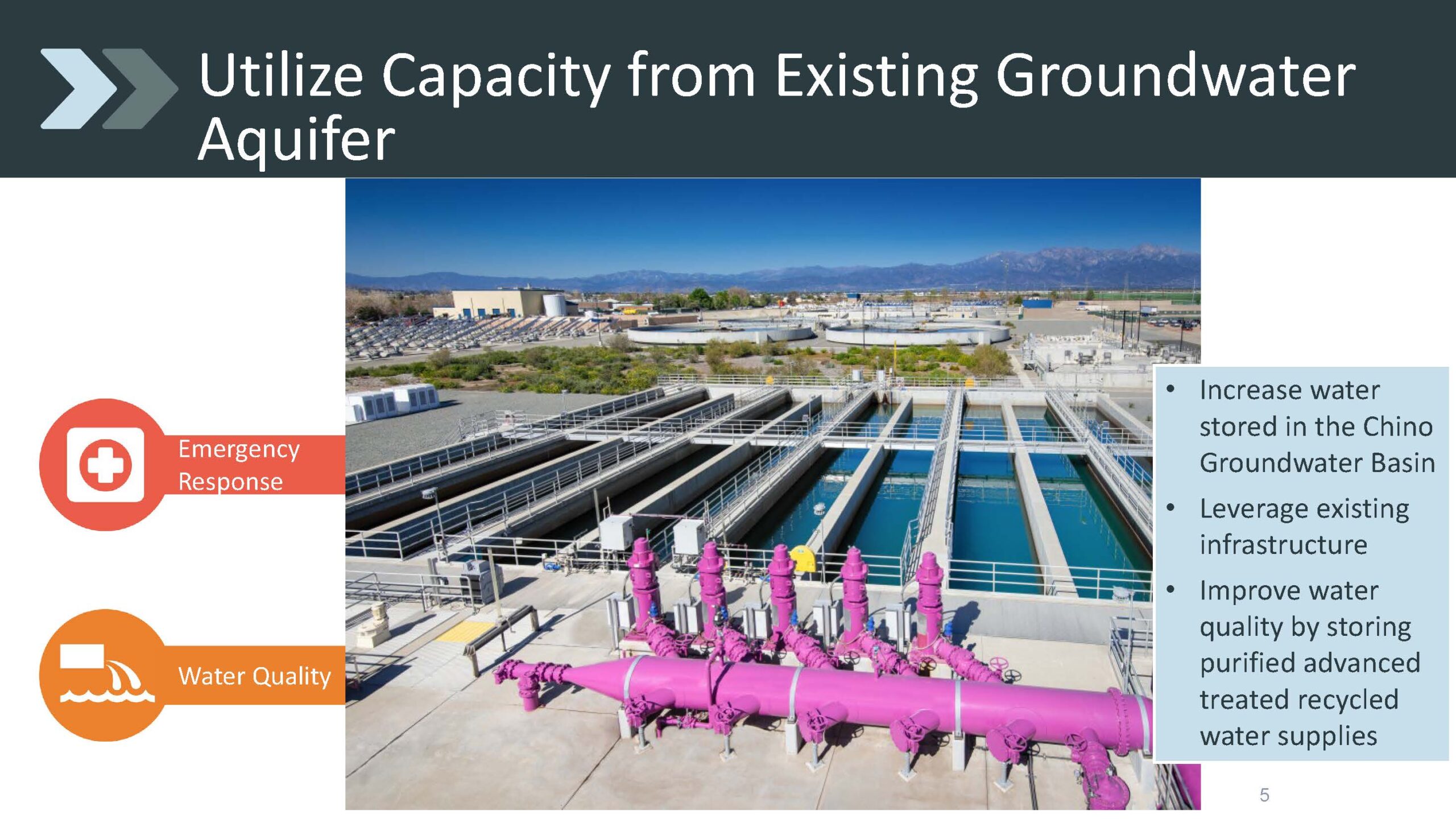 The CBP will improve groundwater quality in the basin. Its advanced purification technology will reduce total dissolved solids (TDS), lowering salt concentrations in the treated water by an average of 500 milligrams per liter. Over time, injecting this high-purity water will help dilute and manage legacy salts, nitrates, and other contaminants in the basin. The CBP includes a dedicated 50,000 acre-feet emergency water supply benefit designed to protect local communities if a natural disaster or major event cuts off Southern California’s water infrastructure. The program will expand existing conveyance pipelines, build new ones, and add production facilities to increase recycled water use across the region.
“Every year, we have the water coming that, right now, is being wasted to the ocean, and we’re going to take that water and make a new, reliable, dedicated water supply for our region,” said Kevin Alexander.
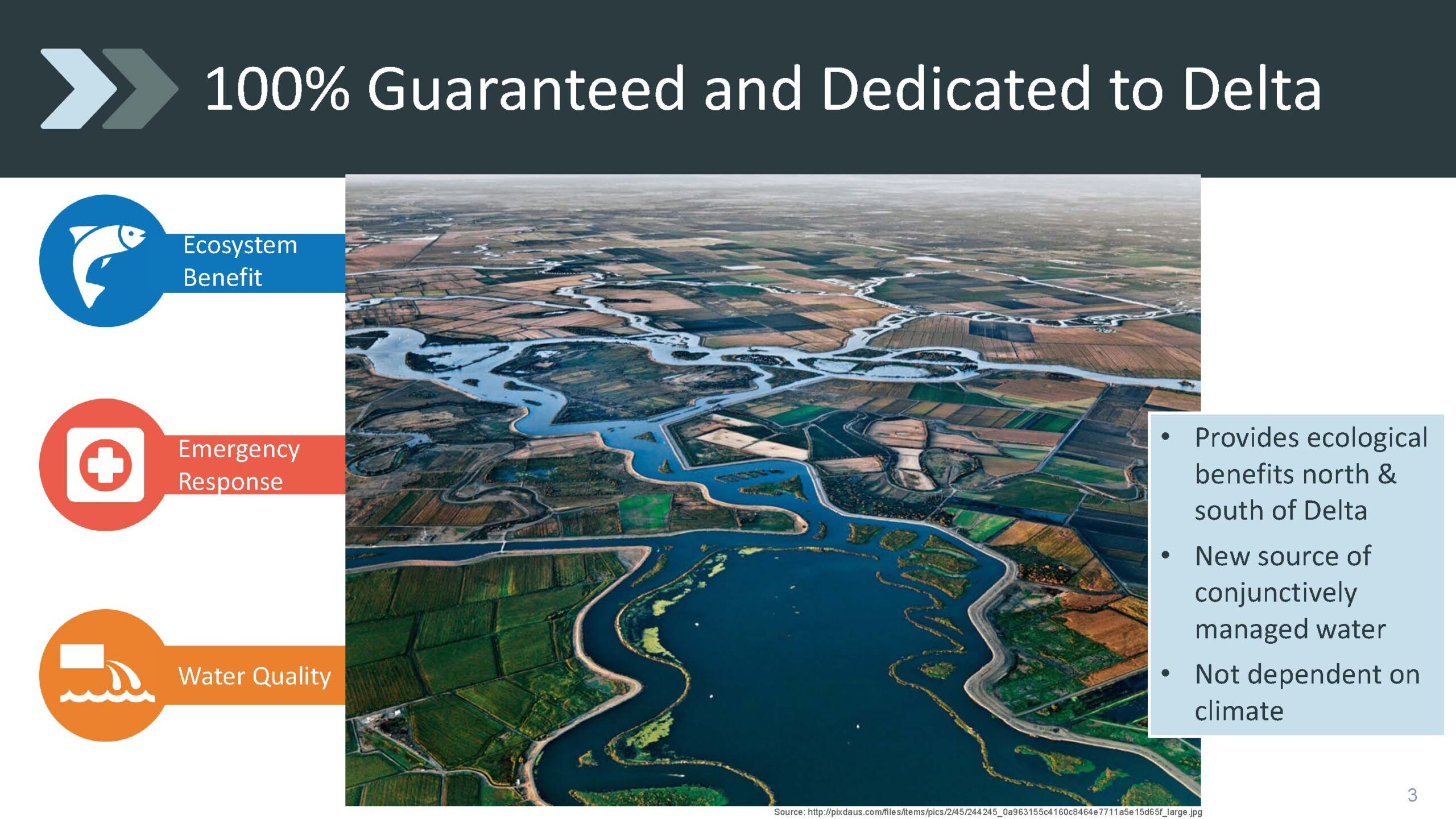
In addition, the Chino Basin Program will support environmental and ecosystem health through a water exchange that helps provide pulse flows in the Feather River. When the California Department of Fish and Wildlife (CDFW) requests an environmental pulse flow, the CBP will extract stored water from the Chino Basin to serve local consumers. That local supply reduces demand for State Water Project (SWP) deliveries, allowing an equivalent volume of water to be released from Lake Oroville as a pulse flow into the Feather River to benefit salmon.
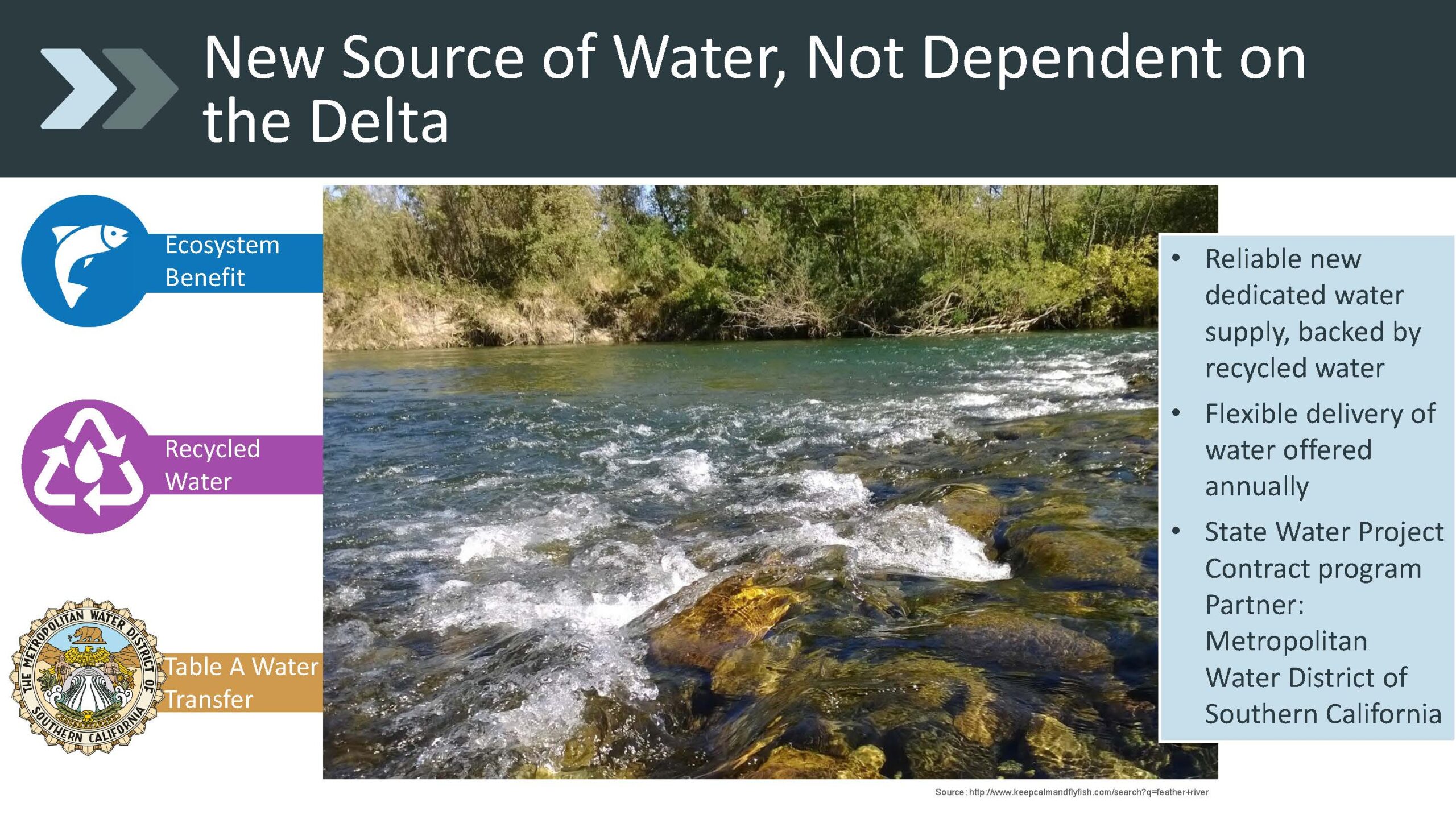 Mr. Alexander pointed out that the Chino Basin Program is unique among the pulse flow projects because the water is guaranteed. “The water that we’re using is Table A water, which is a guaranteed water, which is a very high value water in comparison to the other supply waters. So there is a value difference.”
He also noted that Metropolitan is very supportive of the project. “Metropolitan does not make agreements without much assurance behind these programs,” he said. “They are very supportive of this type of program. They know that this technology is the technology of the future for being able to take these local water supplies and create a water supply for Southern California.”
How the Pulse Flow Benefits Work
The Chino Basin Program team worked with the Department of Fish and Wildlife, Metropolitan, and the Department of Water Resources to develop simulations showing how pulse flows would operate and to stress-test those scenarios in real time. These simulations helped clarify how the exchange would work with the state.
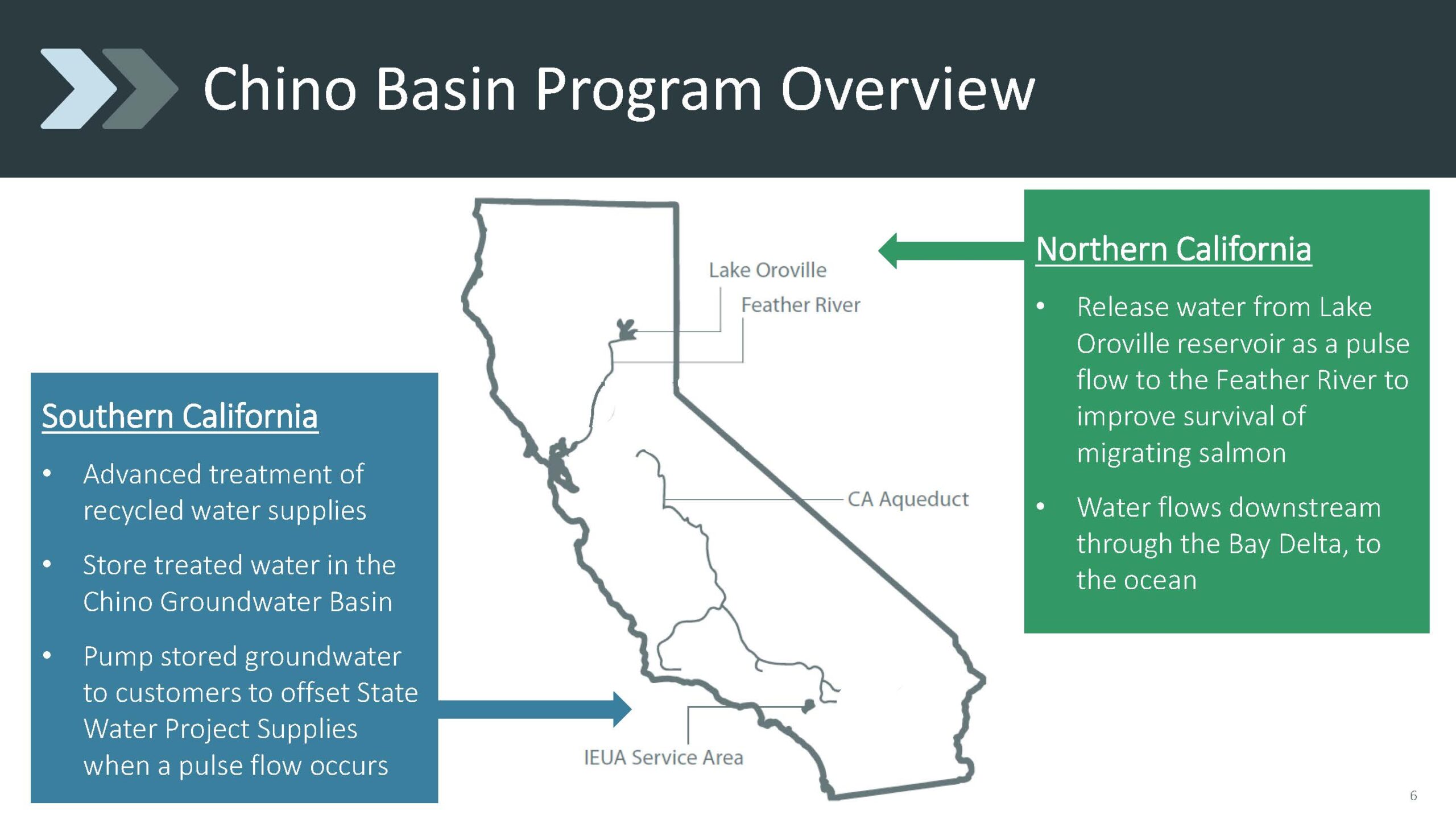
Because ecosystem supplies are backed by recycled water, the CBP can make water available for pulse flows every year. The CBP storage account grows by 15,000 acre-feet annually. During call years, participating agencies reduce imported water purchases and replace up to 50,000 acre-feet of imported water with CBP water. If DFW does not request a pulse flow, the water carries over and remains available the following year, allowing Fish and Wildlife to use a smaller amount each year or build toward a larger release.
“This was really a proof of concept,” said Ms. Hurst. “If this water and these agreements had been in place, Fish and Wildlife would have received all of its water—375,000 acre-feet—and could have released between eight and 17 pulse flows, depending on its strategy. So when you’re looking at the different types of pulse flow projects, ours is pretty much a guarantee because we’re backing it with our own local supply. Article 21 water is more hydrologically dependent; it depends on having more flashy water in the system. But because of our partnership with Metropolitan and our local investments in Southern California, we’re able to be pretty much a sure thing.”
Agreements Needed to Meet WSIP Requirements
To receive the funding award, the project must secure all federal, state, and local approvals, certifications, and agreements needed to begin construction; complete final state and federal environmental documentation; enter into contracts with the state agencies administering the public benefits; and finalize agreements with other parties to cover the remaining funding.
The slide below outlines the contracts and agreements needed to move the program forward. The public benefit contracts with the Department of Fish and Wildlife and the Department of Water Resources are essentially ready for finalization. The team is still working with the State Water Resources Control Board on the water quality benefit and expects to return later this summer with the full set of public benefit contracts.
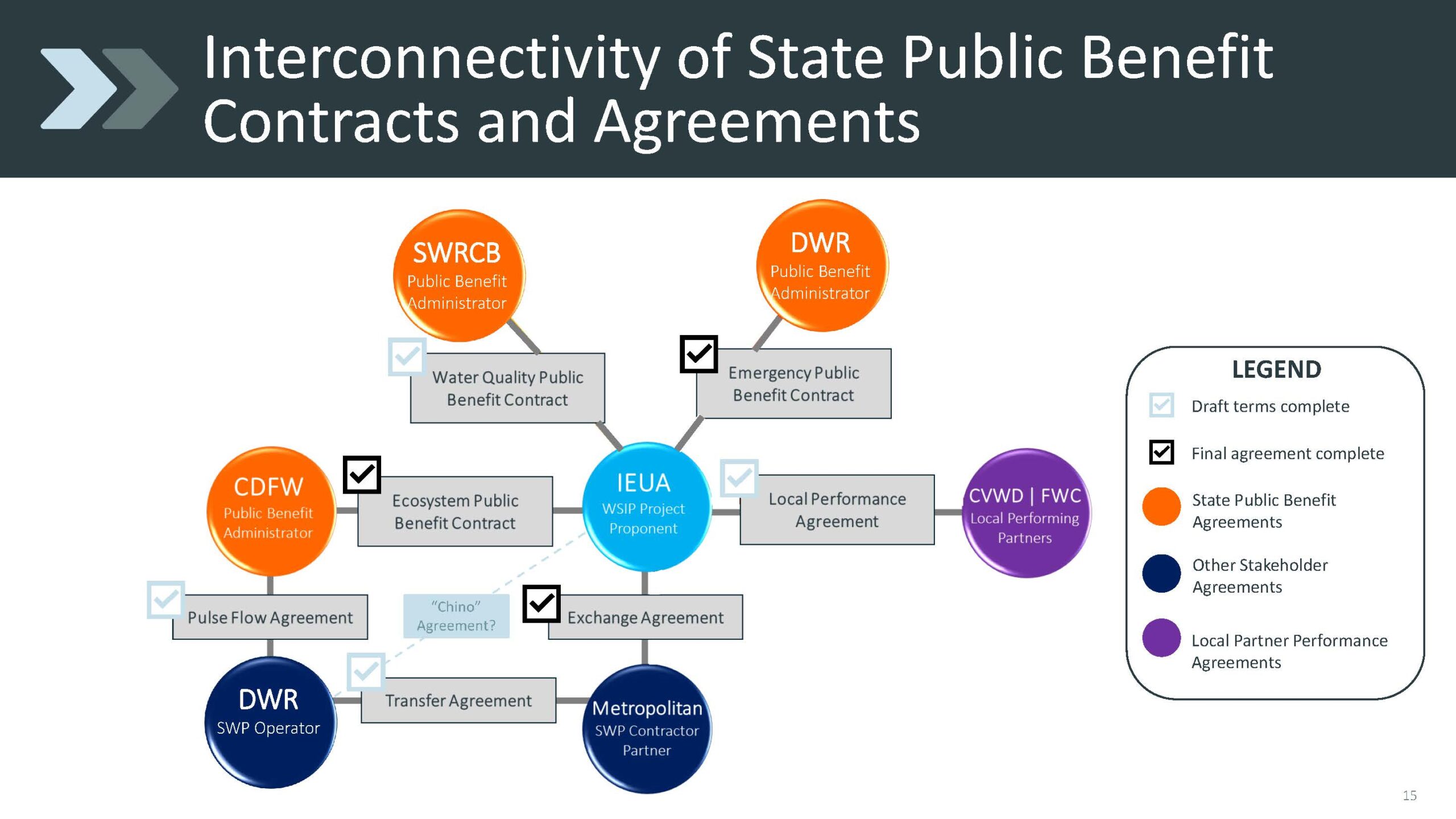
The exchange agreement with Metropolitan is in place, and the transfer agreement between Metropolitan and DWR is under legal review. The contract between Fish and Wildlife and DWR is also nearing completion.
A separate contract between DWR, the State Water Project operator, and IEUA is also being developed outside the public benefit contract. It addresses cost recovery and coordination between DWR and IEUA and is still being worked through with the state.
The project’s EIR is being recirculated and is expected to be approved in July. The DWR pulse flow SEIR is scheduled for adoption at the same time. Wastewater petitions for both IEUA and the City of Rialto have been filed and are now moving through the review process.
How Construction and Implementation Are Advancing
Significant construction work is underway in Southern California. Preliminary design reports for the take facilities have been completed, providing updated cost estimates, and construction of the demonstration facility is now in progress. Take facilities preliminary design work is complete, including the Metropolitan interconnection and South-North Pipeline reports. The draft preliminary design report for the extraction well facilities is under review.
 The Advanced Water Purification Facility (AWPF) has a progressive design-build team in place, and early field investigations are underway. Construction of the AWPF demonstration facility is in progress.
The facility remains on schedule for construction completion in December 2026, with operations expected to begin in February 2027, followed by a ribbon-cutting ceremony.
The Rialto Alignment project has completed geotechnical investigations and is now evaluating the preferred alignment.
Testing completed last year showed that the area recharges well, allowing the number of aquifer replenishment wells to be reduced from 16 to nine. The team is now negotiating property purchases and easements for the well sites.
Partners at Cucamonga Valley Water District, Fontana Water Company, and Metropolitan are reviewing the completed take-facility preliminary design reports and exploring additional value-engineering opportunities to reduce costs.
Project Costs Continue to Rise
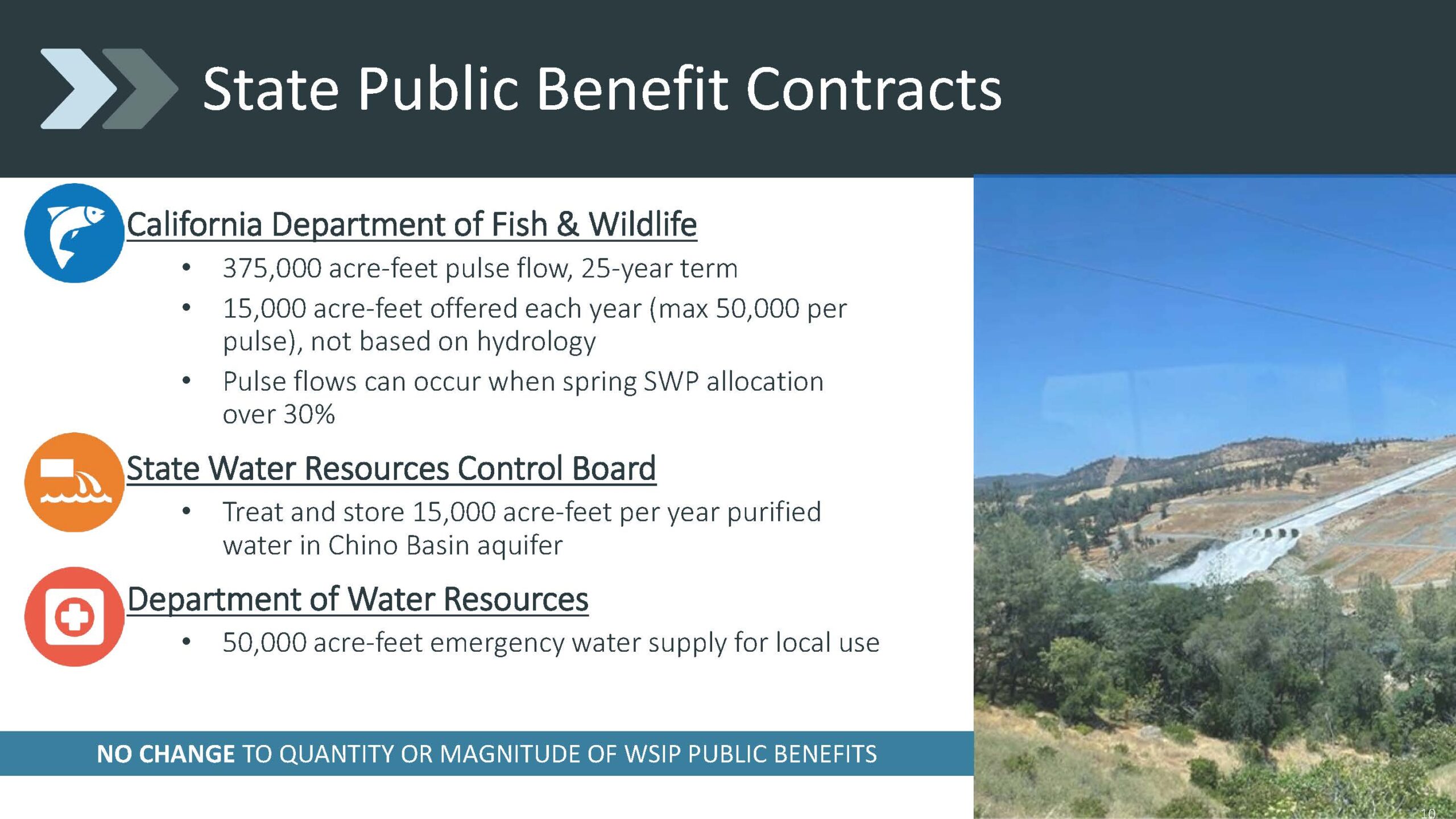 The Chino Basin Program has preserved all of the public benefits identified in the original application. As Ms. Hurst noted, some details have been refined as the exchange structure became clearer, but the core benefits remain the same: 375,000 acre-feet for ecosystem use over 25 years, 15,000 acre-feet of purified water stored annually in the groundwater basin, and a 50,000 acre-feet emergency water supply for local use.
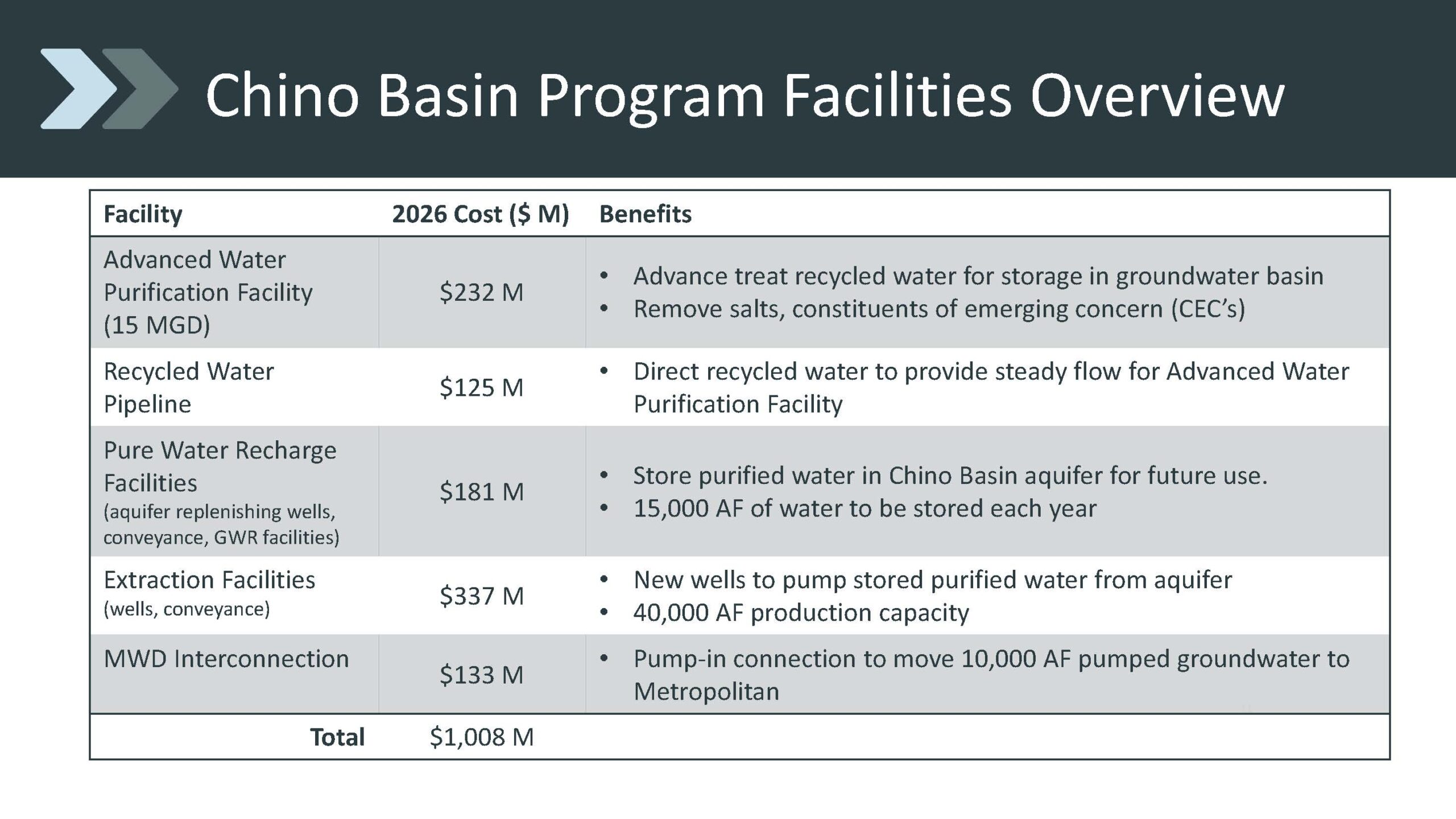
Delivering those benefits requires substantial new infrastructure, including a 15 MGD advanced water purification facility, recycled water pipelines, pure water recharge facilities to store treated water underground, extraction facilities, and the Metropolitan interconnection needed to provide the emergency supply benefit. The program now has an estimated cost of about $1 billion with project costs split evenly between the take facilities and the put facilities.
“In combination, all of these are what enable that pulse flow to happen,” said Ms. Hurst. “It takes all of the different pieces, it’s the treating, the storing, and then upsizing our extraction capability, so that we can roll off that release of the water in Northern California.”
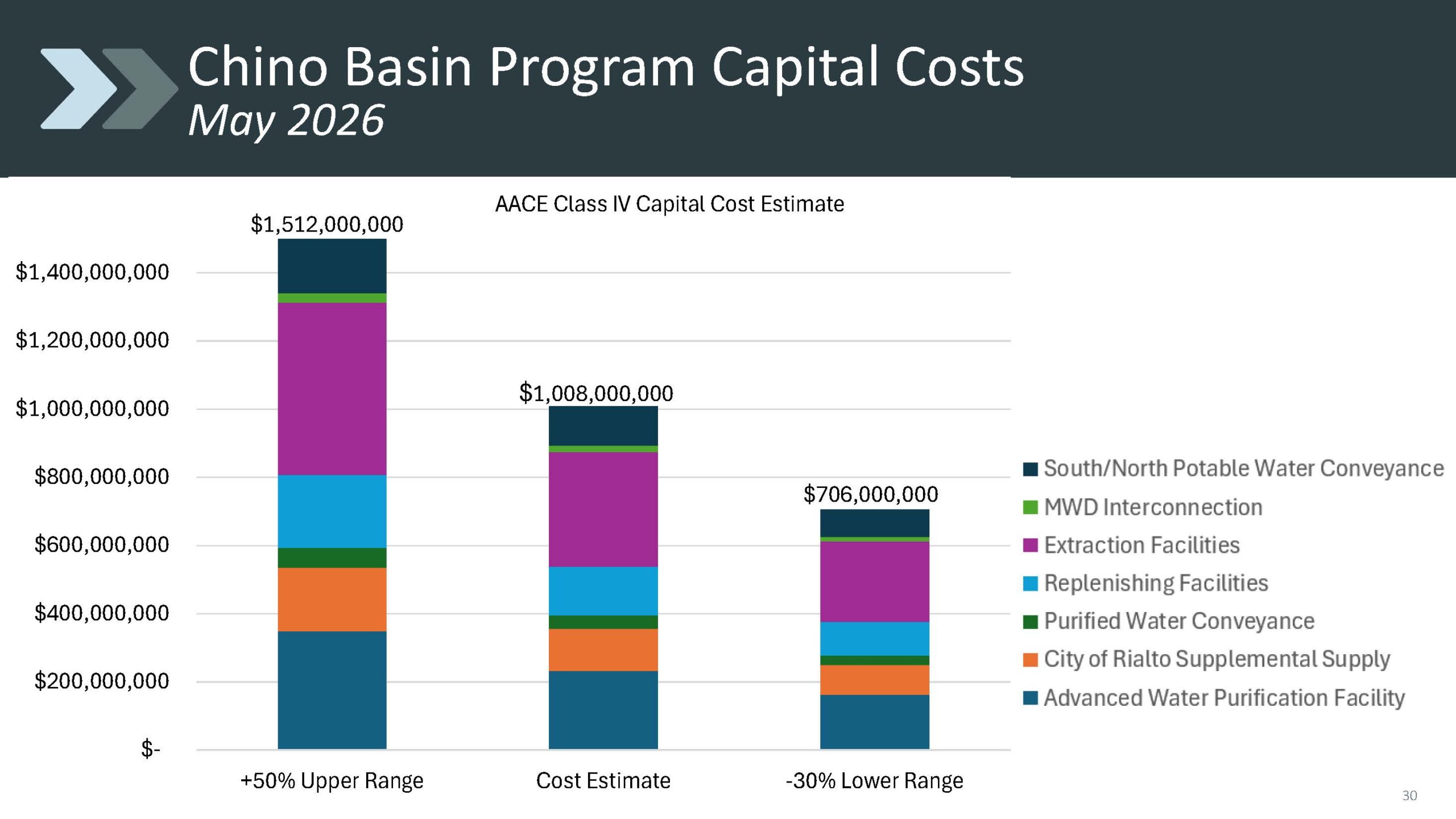
Although the project team has reduced and streamlined the infrastructure scope, overall costs have still increased. In 2017, the plan called for 52 miles of pipeline; that total has since been reduced to 28 miles. The expected number of wells has also dropped, from 33 to 24.
“We’re hopeful that we can continue to do a little bit more of that value engineering, but it’s getting pretty tight,” said Elizabeth Hurst. “The cost increases are really due to the prices for materials, labor, and tariff impacts, so we’re currently pursuing as many other grant opportunities as possible.”
Project proponents argue the project’s reliable water should be valued more highly
With the increased project costs, IEUA is looking to increase the value of the public benefits of the project. Ms. Hurst said the Chino Basin Program has $129.5 M in unfunded public benefits, as the water is currently awarded 40% less than the market rate.
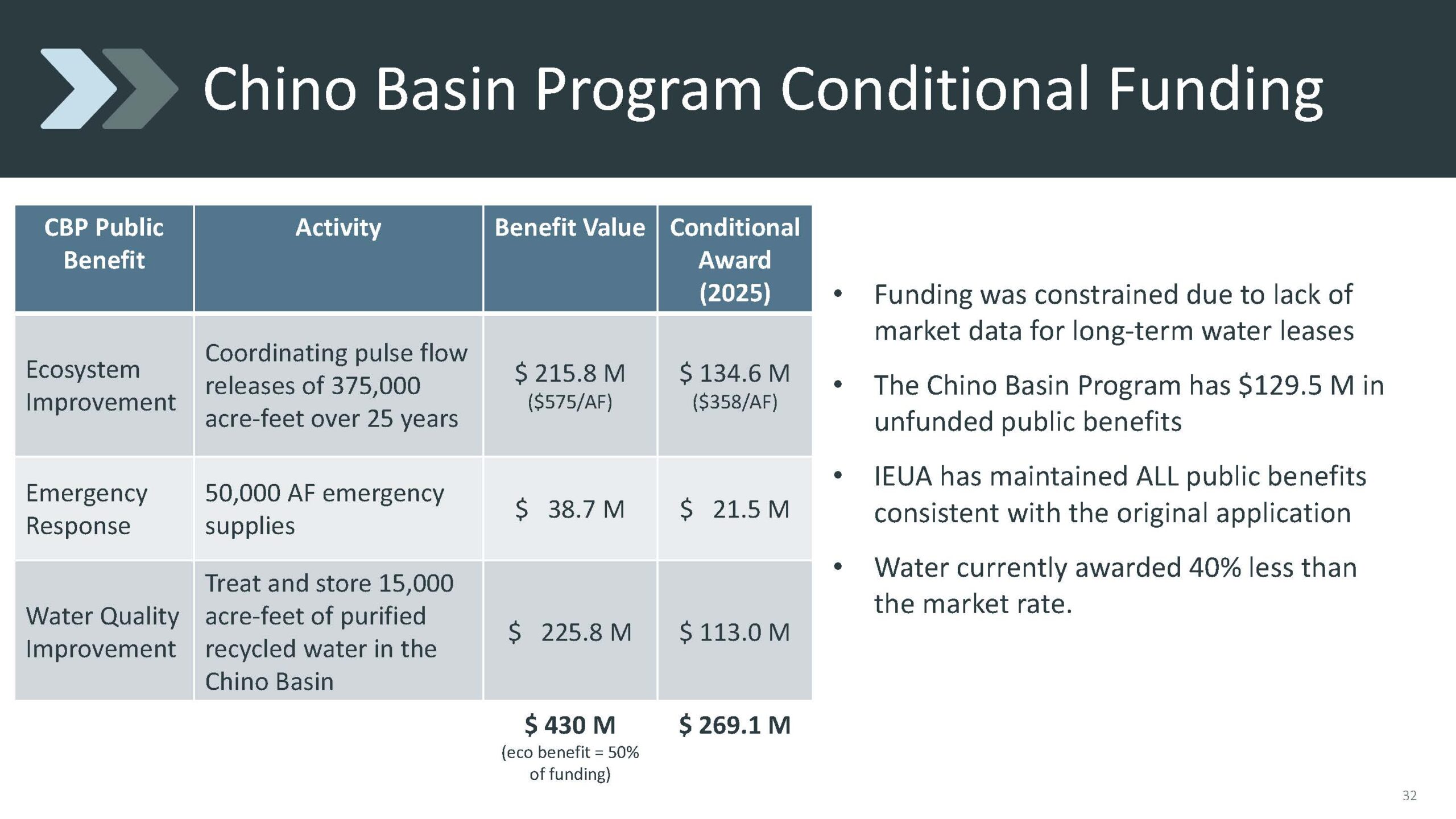
They emphasized that the project’s use of Table A water and recycled water provides a guarantee of supplies that other projects relying on Article 21 (only available when excess supplies are in the system) water cannot provide.
“We’re in a little bit of a unique position, compared to the other projects, where we have more unfunded public benefits because our ecosystem value is tied to a lower cost for that water. So for us this has been a sticking point from the beginning. That Table A water is so reliable; the same with our recycled water. It started out at about $275 an acre foot in 2017; today, we’re up to $385 an acre foot, and that’s about 40% less than the market rate for water in Northern California.”
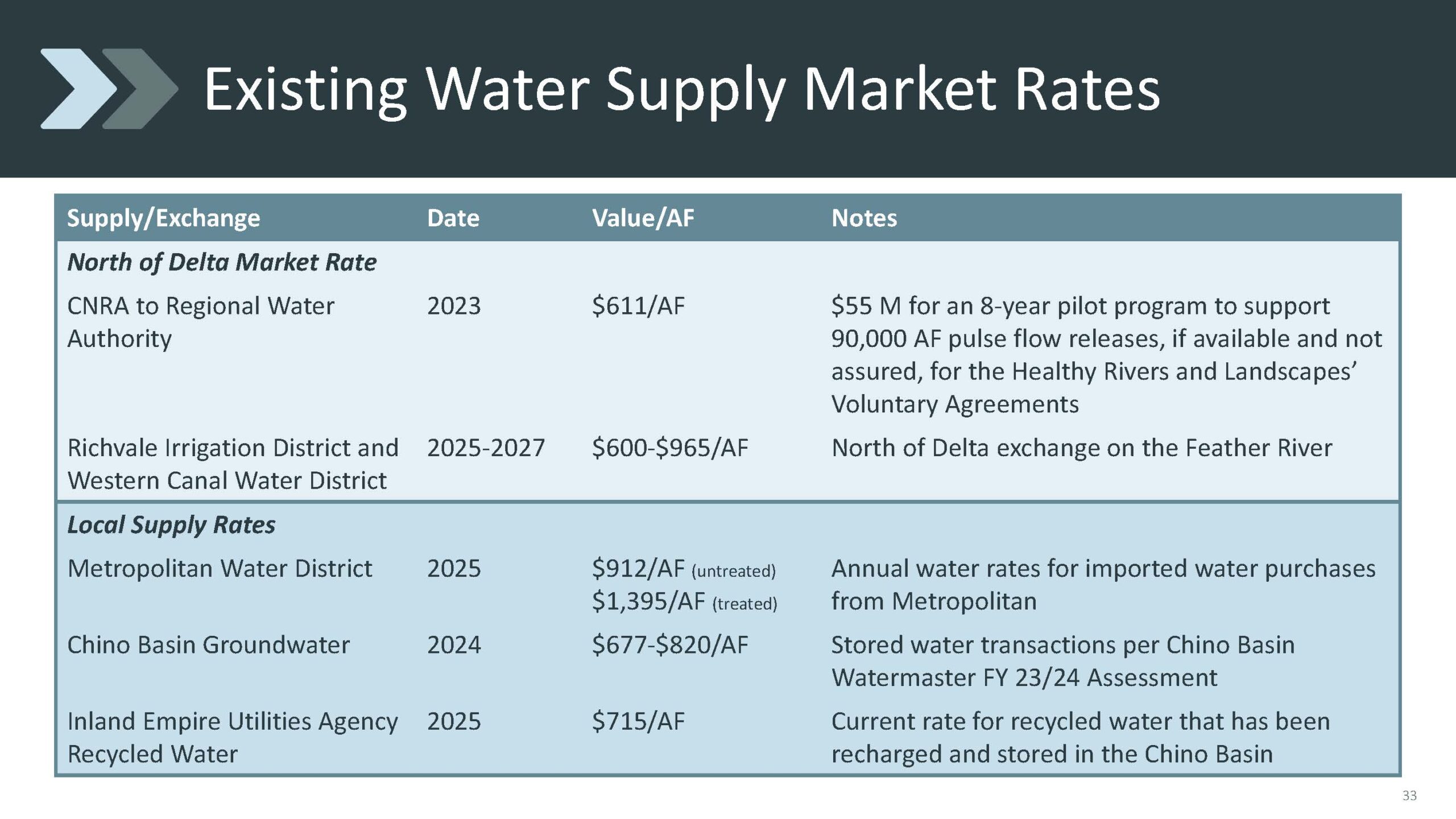
Ms. Hurst presented current market rates, noting that IEUA customers pay about $700 to $1,000 per acre-foot, while short-term exchanges north of the Delta are priced at about $600 per acre-foot. She emphasized that the Chino Basin Program is offering a 25-year lease and said the agency looks forward to working with staff on that valuation.
“As you can see, we’re making tremendous progress,” said Kevin Alexander. “We do have the support from our board to continue that progress for that through the next year. We are in the middle of our rate studies as we speak, in terms of how to financially handle this program on our on our rate on our rate payers.”
“What’s important to us is trying to resolve this value issue for our water,” he continued. “There’s a definite value to the reliability of the water we can provide. I know you’ve been asked for more money from probably everybody that remains in the WSIP program, but there is a value difference, and we would very much like to have you consider that when you do the funding considerations for us.”

