Visit the Water Shelf main page
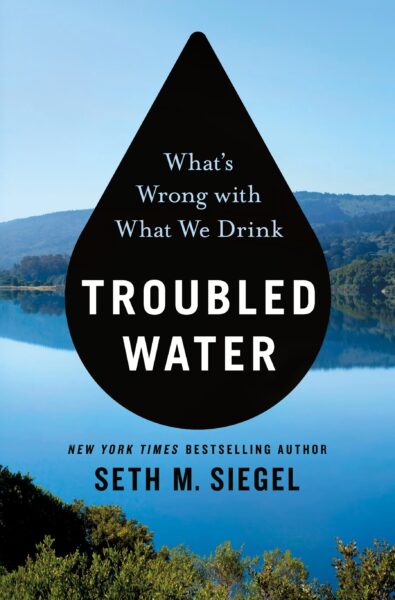
First published on the To Know Water Is To Love Water blog December 2, 2025
By Jim Lauria
Seth Siegel’s Troubled Water: What’s Wrong with What We Drink (Macmillan, 2019) is one of those rare water books that doesn’t just diagnose the problem…it hands us a moral mirror and asks: What are we willing to tolerate in the water we drink? With the precision of an investigative reporter and the heart of a public advocate, Siegel exposes the fractured state of America’s drinking water system, reminding us that the pipes beneath our feet carry not only water, but the values, priorities, and imagination of the communities they serve.
One of Siegel’s most powerful insights is deceptively simple: when we eat imported foods, we’re also consuming the drinking-water health codes of those countries. In a global supply chain, water quality is no longer a local issue. It’s a worldwide relay, one that depends on science, regulation, and the political backbone to enforce both.
But Troubled Water goes deeper, examining the continuum of emerging contaminants that now define the modern water landscape: PFAS, perchlorate, pharmaceuticals flushed down household drains, and a chemical alphabet threatening to outpace our testing capabilities. Siegel makes it clear — the old adage “the solution to pollution is dilution” doesn’t hold up in a world where molecules are persistent, bioaccumulative, and measured in parts per trillion.
Still, what lifts the book above mere exposé is Siegel’s optimism. He argues that Americans want better drinking water. Sometimes it’s not the will we lack but the imagination. Imagination to rethink outdated regulations. Imagination to replace crumbling pipes. Imagination to invest in systems that don’t just meet minimum standards but protect public health for generations.
In this sense, Troubled Water presents a challenge to how we view our essential workforce. Water professionals are, in every meaningful way, health professionals. The operators, engineers, scientists, and utility managers who keep our systems running are as integral to public safety as doctors and nurses. Siegel’s narrative honors their role while urging us to empower them with resources, training, and modern tools.
And here’s where the book hits home for utilities: technology alone isn’t enough. Water providers must market their stories as effectively as they operate their treatment plants. Public trust isn’t built in a lab…it’s built through transparency, communication, and connection. Siegel reminds us that utilities that proactively tell their story win support for rate increases, capital upgrades, and long-term resilience. Those who stay silent risk misunderstanding and mistrust, two contaminants no filter can remove.
Troubled Water is essential reading for every water pro, policymaker, and community leader who believes safe drinking water is a right, not a privilege. Siegel gives us a roadmap forward and the nudge to imagine boldly enough to follow it.