
Findings from a weight-of-evidence review of summer-fall habitat actions in the San Francisco Estuary
Delta smelt are a small open-water fish found only in the San Francisco Estuary. The species was listed under the federal and state Endangered Species Acts in 1993 and 2009. As populations have continued to plummet, it has become a major focus of California water management.
Studies in the early 2000s showed that summer and fall are especially difficult periods for Delta smelt and that the amount of suitable fall habitat had declined. Those findings led to management actions aimed at improving conditions during this critical period.
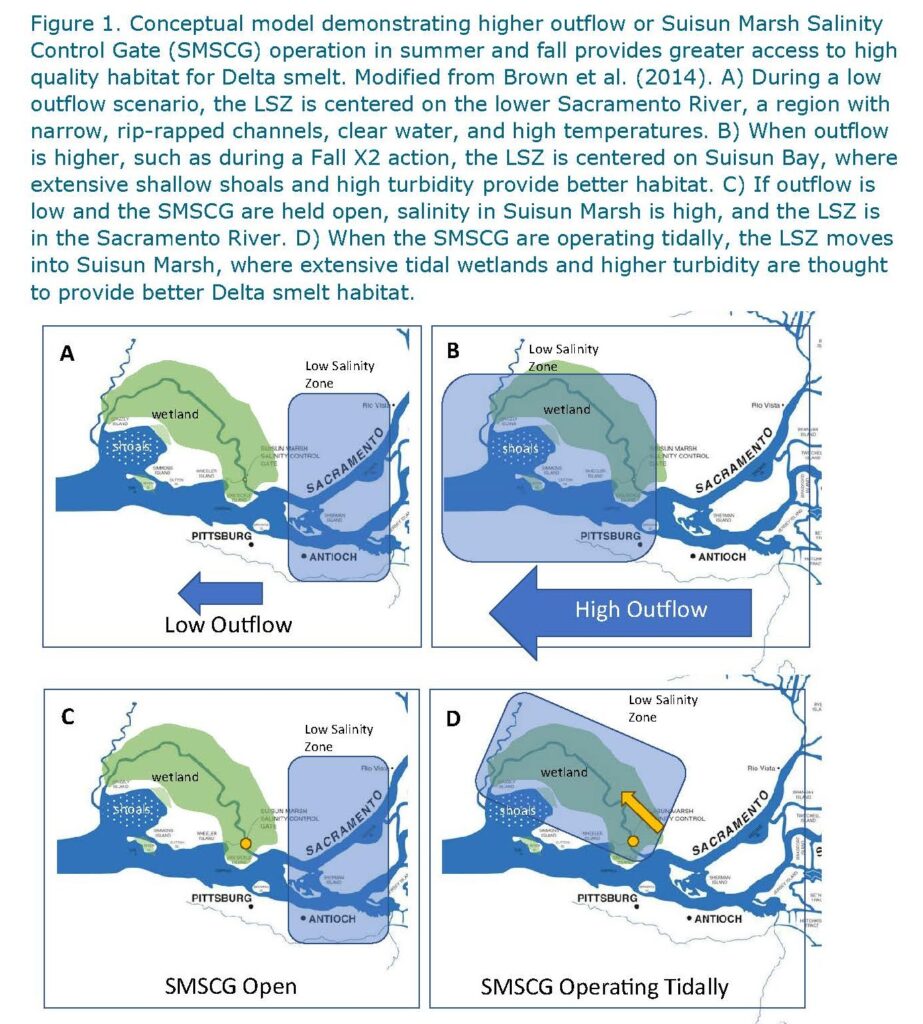
In 2008, the biological opinion for State Water Project and Central Valley Project operations required the Department of Water Resources and the U.S. Bureau of Reclamation to keep Fall X2—where salt concentration is 2 parts per thousand—at 74 km or less from the Golden Gate in September and October of Above Normal and Wet years. updated permits issued by the U.S. Fish and Wildlife Service and CDFW in 2019 and 2020 changed the Fall X2 standard to 80 km and added operation of the Suisun Marsh Salinity Control Gates to move freshwater from the Sacramento River into Montezuma Slough.
Fall X2 and operation of the Suisun Marsh Salinity Control Gates, together with food subsidy actions, make up the Delta Smelt Summer-Fall Habitat Action (SFHA). The SFHA is intended to improve summer and fall conditions by bringing salinity, turbidity, and food resources into better alignment in places where Delta smelt can use them. Because habitat for juvenile and subadult Delta smelt is limited during this period, the SFHA focuses on a key seasonal bottleneck.
Against that background, the report, Summer-Fall Habitat Actions for Delta Smelt – Report on Effectiveness of Actions Taken Between 2011 and 2024, prepared by the Delta Coordination Group Science and Monitoring Work Group, evaluates the Delta Smelt Summer-Fall Habitat Action, including Fall X2 and operation of the Suisun Marsh Salinity Control Gates, using a weight-of-evidence approach that considers several sources of information together to assess effects on habitat, survival, and recruitment.
Since 2008, DWR and Reclamation have carried out Fall X2 actions five times and Salinity Control Gates actions four times. Because each action occurred under different water-year conditions and was not part of a controlled experiment, results should be interpreted with caution. Even so, the overall pattern matches recent U.S. Fish and Wildlife Service life cycle modeling: higher summer outflow and lower salinity in Suisun Bay and Suisun Marsh were more strongly linked to better Delta smelt condition and survival than similar fall conditions.
Findings include:
- Lower X2 and Suisun Marsh Salinity Control Gates operation increased Delta smelt physical habitat availability in both summer and fall. Suisun Bay and Grizzly Bay provide higher turbidity and cooler temperatures than upstream regions and become most accessible to Delta smelt at lower X2 values.
- Suisun Marsh provides higher turbidity than upstream regions, though temperatures may be either warmer or cooler, depending on the year. Low Salinity Zone (LSZ) habitat in Suisun Marsh can be increased with either lower X2 or Suisun Marsh Salinity Control Gates operations, though gate operations are more effective when salinity is not already low.
- Lower X2 and Suisun Marsh Salinity Control Gates operations also increase Delta smelt food supply in the Low Salinity Zone, though this effect is greater in summer than in fall.
- Delta smelt growth rates were generally higher with lower X2 in summer, but there was no relationship in fall, and the relationship between smelt condition and X2 was mixed.
- Limitations on growth rate potential varied between seasons and from year to year, but changes in zooplankton drove most of the differences between years in summer, with higher growth rates associated with higher zooplankton density.
Taken together, these findings are consistent with Polansky et al. (2024), which found that higher summer outflow was the strongest predictor of summer survival and population growth in Delta smelt. Using more recent data, this report suggests that improved food availability in summer may help explain that pattern and may matter more for smelt condition and growth than the amount of suitable habitat alone.
More broadly, the best outcomes for Delta smelt occurred in years when several favorable conditions aligned, including cool temperatures, abundant zooplankton, and high summer outflow. In 2011, that combination coincided with high smelt condition, growth, and survival. As the climate continues to change, years with that mix of conditions are likely to become less common.
