
By Robin Meadows
About a decade ago, researchers at the University of California, Davis made a surprising discovery while teaching a class in Suisun Marsh, the largest contiguous brackish wetland on the west coast of North America. While most of the Bay-Delta is a food desert for fish, the marsh offers a smorgasbord of zooplankton, the tiny creatures that fish eat.

“They said, ‘There’s crazy amounts of plankton in here, what’s up with that?” says Kyle Phillips, a UC Davis Center for Watershed Sciences researcher.
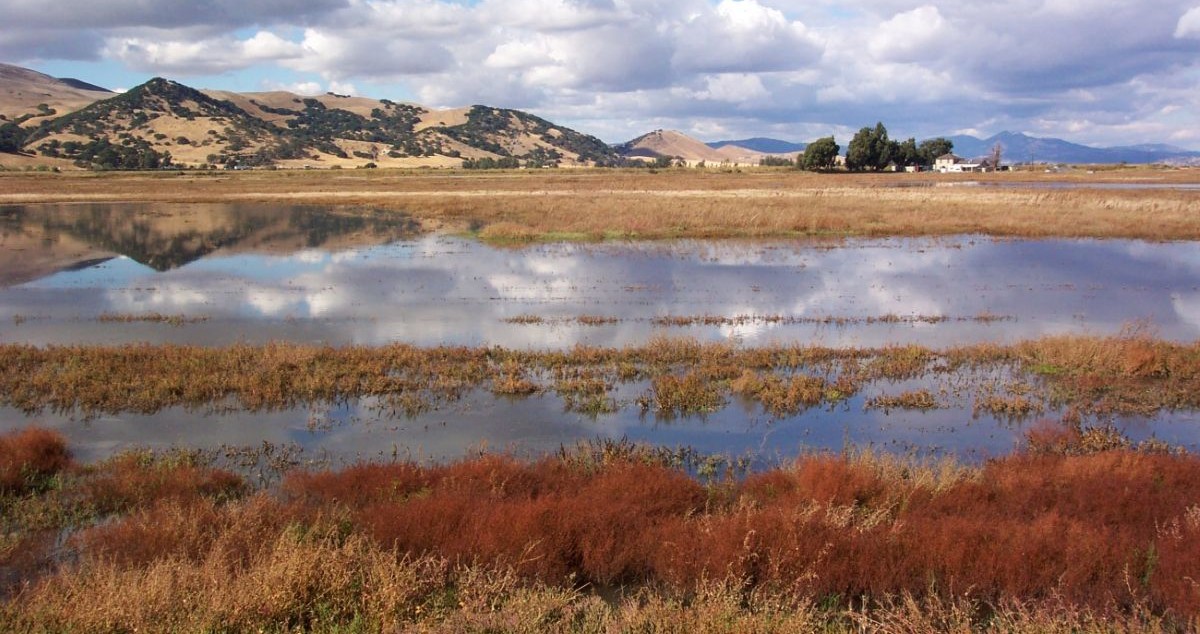
Phillips found that the answer lies in the wetlands managed by duck clubs in Suisun Marsh. Duck clubs account for about half of the 115,000-acre marsh, which also includes tidal wetlands, bays and sloughs. Managed wetlands are diked, shallow ponds with mechanisms that control water flows to and from neighboring waterways.
A new study Phillips led shows that when these managed wetlands are flooded for migrating waterfowl, they produce far more zooplankton than nearby tidal wetlands. This fish food peaks in the winter, which is perfect timing for baby Chinook salmon migrating towards the ocean.
Now Phillips is part of a California Department of Water Resources-led project to see if duck clubs can also produce fish food in the marsh during the summer, when the critically endangered Delta smelt need it.
MANAGED WETLANDS MIMIC FLOODPLAINS
Phillips and colleagues compared zooplankton in winter-flooded managed wetlands and tidal wetlands, including restoration sites, in Suisun Marsh and found that the former made an average of 22 times more fish food than the latter. “Productivity just booms,” he says, adding that flooding also connects sloughs and bays to the managed wetlands, so fish can swim onto them or near their outfalls to eat.

Why do managed wetlands make so much more fish food? A likely reason is their similarity to the river floodplains that are ideal nurseries for baby fish. Both habitats are shallow and relatively warm, favoring the phytoplankton that zooplankton eat, and both also have slow flows that let fish food build up rather than being washed away.
Another likely factor is that managed wetlands lack the non-native clams that have invaded the rest of the Bay-Delta. Clams graze phytoplankton down to almost nothing, thereby suppressing the zooplankton that fish eat. “Draining managed wetlands strands clams so they can’t survive,” Phillips says.
LESSONS FOR TIDAL RESTORATION
Phillips’ study has implications for policies to conserve native fish in the Bay-Delta. The region was once rich in tidal marshes but most of the wetlands are long gone. California now aims to restore 30,000 acres of wetlands by 2050, a move intended in large part to boost the fish food that is in such short supply in the Bay-Delta.
But reestablishing tidal flows often entails knocking out levees on ponds. “We need to think about what we’re removing in restoration,” says Jake Sousa, a UC Davis graduate student who spent five years as an environmental consultant and is now determining how close baby salmon need to be to managed wetland outfalls for optimum feeding. “It turns out that these managed wetlands are very valuable to native fish.”

Instead of breaching levees on ponds, these restoration projects could keep managed wetlands intact and connect them with restored marshes via tide gates. This would let land managers flush fish food from their ponds into the new tidal wetlands.
Rosemary Hartman, Environmental Program Manager at the Department of Water Resources, has an alternate point of view on restoration in Suisun Marsh. “Managed wetlands are definitely an important part of the Suisun Marsh landscape but don’t provide anything for fish when they’re dry, which is a significant part of the year,” she says. “Tidal wetlands provide fish habitat and food year-round.”
FOOD FOR DELTA SMELT

Delta smelt are born in the Delta in the spring and typically migrate to Suisun Marsh in the summer and fall. One of their biggest threats is the dearth of fish food during the summer. Making the marsh a better home for Delta smelt is key to the success of the U.S. Fish and Wildlife-led effort to supplement the wild population with hatchery fish. More than 160,000 Delta smelt were released this past winter, primarily into Suisun marsh.
Now the Department of Water Resources (DWR) must boost the summer supply of zooplankton, also called bugs, in the marsh. This requirement is mitigation for the recent suspension of an action called Fall X2, which entailed releasing fresh water to keep the marsh from getting too salty for Delta smelt.
“The requirement is 6,000 kilograms of zooplankton over the course of the summer and fall,” says DWR’s Hartman. “That’s billions and billions of bugs!”
The most cost-effective way to produce that much fish food is in managed wetlands, and Hartman estimates it would take several thousand acres to meet the mitigation requirement. DWR plans to launch a study of zooplankton production in summer-flooded ponds in Suisun Marsh. “Can we tweak the operation of managed wetlands to provide food for Delta smelt?” she asks.

The three-year pilot will begin in June at four sites in the marsh, each of which will be flooded during a different period in the summer or fall to provide a continuous supply of fish food. Goals include assessing the duration of flooding that maximizes fish food as well as how much food is exported from managed wetlands to the marsh’s waterways.
Besides making more fish food than tidal marshes, managed wetlands offer more options for boosting production. “What’s neat about this system is that, unlike tidal marsh, there are a lot of knobs we can turn,” UC Davis researcher Phillips says. “In managed wetlands, you can tweak things like how long they’re flooded and how quickly water runs through them―it gives us a lot of control.”
INCENTIVES FOR DUCK CLUBS

But there’s a catch to DWR’s plan. “Summer flooding is incompatible with most managed wetland schedules in the marsh,” says Steve Chappell, executive director of the Suisun Resource Conservation District, which helps private landowners sustain wetlands and wildlife in Suisun Marsh.
Duck clubs flood their wetlands in the fall and winter for waterbirds, drain and flood them in the spring to rinse salt from the soil, and drain them again in the summer for plants that produce seeds that many ducks eat.
Even so, there’s hope. “We need to find sweet spots that meet managed wetland needs and provide fish food,” Chappell says. These sweet spots likely include duck clubs infested with invasive Russian thistles, also known as tumbleweeds. Flooding ponds for a year may be a promising option for eradicating the thistles and presumably would also provide fish food during the summer.
Private landowners will also need compensation for the extra management and costs of additional flooding. The Audubon BirdReturns program pays Central Valley farmers to flood fields for migrating shorebirds and, likewise, Hartman says DWR will also offer cash incentives for duck clubs to flood ponds during the summer.
Suisun Marsh is already among the best spots for native fish in the Bay-Delta. “It’s much more natural,” Chappell says. The marsh is not developed or farmed, and its waterways are lined with tules and cattails rather than large rocks called riprap. Moreover, while the Delta is managed to keep water fresh for exports, the marsh’s brackish water helps keep non-native species from dominating.
Plentiful fish food during the summer would make Suisun Marsh even better for Delta smelt and other native fish. “It’s an exciting opportunity,” Chappell says.

Fred Greaves/California Department of Water Resources

