
Press release from Cramer Fish Sciences:
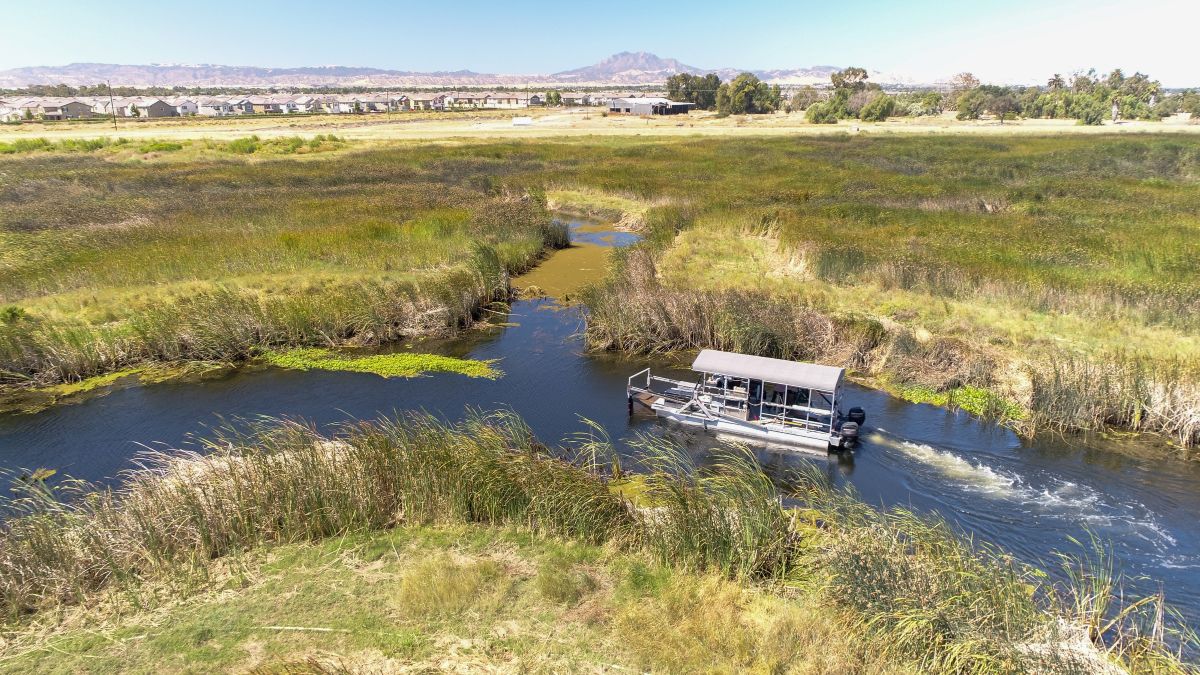
A newly published study from the Dutch Slough Restoration Project in the San Francisco Estuary shows that restored tidal habitat can begin functioning ecologically within just two years of reconnection and demonstrates the promise of combining low-impact monitoring with artificial intelligence – specifically, computer vision(CV) – to evaluate restoration outcomes.
The study found that channel length, habitat complexity, and connectivity strongly influenced early ecological recovery. Following levee breaching, restored habitats shifted toward reference conditions, with greater water-quality complexity, stronger food-web development, and increased fish use, likely supported by diverse habitat conditions and the establishment of native vegetation.
The research is especially notable for its monitoring approach. Rather than relying on traditional high-disturbance sampling alone, the team integrated environmental DNA (eDNA), underwater video, in situ zooplankton imaging, and water-quality sensors, supported by CV-assisted image analysis. Together, these tools provided a detailed picture of ecological change while minimizing disturbance to the restored habitat.
This study represents one of the first field-based assessments of tidal habitat restoration to combine multiple low-impact monitoring technologies with CV to evaluate early ecological performance across water quality, food webs, and fish communities.
The findings also offer practical guidance for future restoration design. Longer and more structurally complex channels supported greater habitat heterogeneity, higher zooplankton density, more juvenile fish, and greater species richness, suggesting that restoration design can strongly shape ecological outcomes from the earliest stages.
As large-scale tidal wetland restoration expands in California and beyond, the study provides a model for how managers and scientists can assess restoration progress more effectively, with tools that are both scientifically powerful and less disruptive to sensitive habitats.
Funded by the California Department of Water Resources and supported by technology developed with the U.S. Bureau of Reclamation, the project reflects a strong collaboration among state, federal, and private partners, with Cramer Fish Sciences serving as the private research partner. The study was published this month in the scientific journal Restoration Ecology and is available at https://onlinelibrary.wiley.com/doi/10.1111/rec.70422.
RESEARCH PAPER: Multitrophic responses to tidal marsh restoration: early effects of channel configuration on water quality, aquatic food web structure, and fish communities
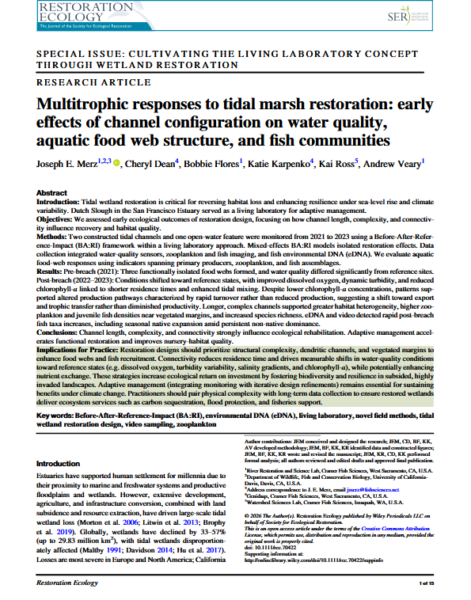 By Joseph E. Merz, Cheryl Dean, Bobbie Flores, Katie Karpenko, Kai Ross, Andrew Veary
Introduction
Tidal wetland restoration is critical for reversing habitat loss and enhancing resilience under sea-level rise and climate variability. Dutch Slough in the San Francisco Estuary served as a living laboratory for adaptive management.
Objectives
We assessed early ecological outcomes of restoration design, focusing on how channel length, complexity, and connectivity influence recovery and habitat quality.
Methods
Two constructed tidal channels and one open-water feature were monitored from 2021 to 2023 using a Before-After-Reference-Impact (BA:RI) framework within a living laboratory approach. Mixed-effects BA:RI models isolated restoration effects. Data collection integrated water-quality sensors, zooplankton and fish imaging, and fish environmental DNA (eDNA). We evaluate aquatic food-web responses using indicators spanning primary producers, zooplankton, and fish assemblages.
Results
Pre-breach (2021): Three functionally isolated food webs formed, and water quality differed significantly from reference sites. Post-breach (2022–2023): Conditions shifted toward reference states, with improved dissolved oxygen, dynamic turbidity, and reduced chlorophyll-a linked to shorter residence times and enhanced tidal mixing. Despite lower chlorophyll-a concentrations, patterns supported altered production pathways characterized by rapid turnover rather than reduced production, suggesting a shift toward export and trophic transfer rather than diminished productivity. Longer, complex channels supported greater habitat heterogeneity, higher zooplankton and juvenile fish densities near vegetated margins, and increased species richness. eDNA and video detected rapid post-breach fish taxa increases, including seasonal native expansion amid persistent non-native dominance.
Conclusions
Channel length, complexity, and connectivity strongly influence ecological rehabilitation. Adaptive management accelerates functional restoration and improves nursery-habitat quality.

