
From the County of Placer, Community Development Resource Agency:
For more than 80 years, salmon were rarely seen above the Hemphill Diversion Dam in Placer County’s Auburn Ravine. But that changed in 2022 when local organizations worked with the Nevada Irrigation District to remove the concrete dam and replace it with a fish-friendly design. It didn’t take long for the fish to find the newly accessible stream. Recent survey data released by Friends of Auburn Ravine and ECORP show the presence of salmon, steelhead and Pacific lamprey above the new structure, indicating success of the habitat restoration project.
“With the old structure, only about 10 percent of the fish could get upstream. Now, we get 90 percent passage rather than 90 percent blockage,” said James Haufler, president of Friends of Auburn Ravine.
Built in the 1930s, the Hemphill Diversion Dam pooled water coming down the Auburn Ravine and funneled flows into a canal system that delivered water to farmers, ranchers and other local users. The structure served as a critical piece of water delivery infrastructure, but it also stopped local fish migration. Few salmon could breach the 8-foot concrete wall.
“The dam was the most significant barrier to salmon and steelhead in Placer County,” said Gregg McKenzie, executive director of the Placer County Conservation Program. “This habitat restoration project was identified early on as a priority for us because of its potential to benefit multiple species and improve instream flows.”
The Placer County Conservation Program is working to conserve more than 47,000 acres of important wildlife habitat, including rivers and streams, in western Placer County to balance urban growth. Replacing the Hemphill Diversion Dam with a fish-friendly structure supported the Program’s conservation goals.
Habitat restoration projects of this size take significant planning to complete. The Nevada Irrigation District (NID), who owned the dam, worked with the City of Lincoln, the Placer County Conservation Program, ECORP, Friends of Auburn Ravine, Save Auburn Ravine Salmon and Steelhead, California Department of Fish and Wildlife, NOAA Fisheries and other organizations to develop a plan. The dam would be removed and replaced with a structure that fish could swim over while maintaining water delivery commitments to farms, ranches and other users.
But even habitat restoration projects need permits. The removal of the dam and construction of the new diversion would temporarily impact the waterway and wildlife in the stream, so permits from the California Department of Fish and Wildlife and the U.S. Fish and Wildlife Service would be required. The project was able to use the Placer County Conservation Program’s streamlined environmental permitting process and secured all necessary permits in a matter of months instead of years.
“The Placer County Conservation Program provides a consolidated, simplified and accelerated process for securing environmental permits,” said Haufler. “Without the program, the project might not have been completed until 2023.”
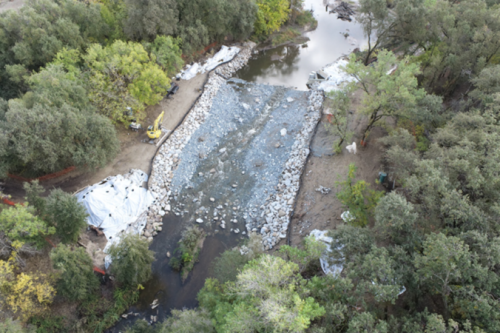
Construction was completed in the fall of 2022. The dam was removed and replaced with a roughened rock ramp—a fish-friendly water diversion structure that blends in with the natural landscape. The roughened rock ramp is like a speed bump in the stream; slightly elevating the stream channel so water can still be diverted into the delivery canals, but keeping the incline low enough so fish can continue to swim upstream. The ramp includes gravel, boulders and other features that mimic a natural streambed.
“We don’t need to have battles between fish and farms. The new structure allows for total fish passage and continued water deliveries to users,” Haufler stated.
Fish now have access to an additional 6 miles of prime spawning habitat in the Auburn Ravine. This is good news for California’s salmon and steelhead whose numbers have been declining due to fish passage obstacles, drought, early snowmelt and warmer in-stream waters that make their journey to and from the Pacific Ocean challenging.
“Good partnerships and regional cooperation between government agencies and local stakeholders resulted in a project that’s good for fish, future water deliveries and our community,” said McKenzie.
Since 2016, Friends of Auburn Ravine has tracked the number salmon and other migratory fish swimming up the Auburn Ravine using video cameras and visual surveys conducted by volunteers. With the removal of the Hemphill Diversion Dam, the group expanded its visual surveys to include stream sections above the new roughened rock ramp. The group’s survey on November 22, 2025, recorded 42 living salmon and four egg nests (known as redds) in the newly accessible reaches of the Auburn Ravine.
“Some of the fish we saw this year could be the offspring of the first fish to make it beyond Hemphill in late 2022,” Haufler said.
The group’s survey results add to the environmental DNA (eDNA) testing conducted by ECORP in 2023 and 2024 that were released in a report to the Nevada Irrigation District. In those years, water samples were collected in four locations along the Auburn Ravine, two of which were upstream from the new diversion and one at the diversion. The samples were analyzed for the presence of DNA from salmon and Pacific lamprey. Testing in 2024 detected Chinook salmon DNA at two of the four testing locations and Pacific lamprey DNA detections at three of the four locations.
The Hemphill Diversion Structure removal is the first of many habitat restoration projects that will support the Placer County Conservation Program’s conservation priorities.
“Overall, this habitat restoration project and those that come after, will improve the quality of life for the people living in western Placer County,” said McKenzie. “By conserving and restoring unique habitats, the Placer County Conservation Program helps protect our clean air and water, wildlife and open spaces for generations to come.”

