
Two years ago, the Lower Basin states proposed post-2026 operating guidelines in hopes of building a seven-state agreement. But after more than two years of talks between the Lower and Upper Basin states, no consensus emerged. On May 1, Arizona, California, and Nevada submitted a joint proposal to the Bureau of Reclamation describing how the Lower Basin should operate through 2028. Reclamation is now considering which parts of that proposal to include in the federal preferred alternative for post-2026 operations.
At Metropolitan’s May One Water and Adaptation Committee meeting, Colorado River policy manager Shanti Rosset briefed members on the proposal and said both the federal review process and the negotiations needed to turn it into binding agreements are expected to move much faster.
The 2007 interim guidelines that have governed Lake Powell and Lake Mead operations for nearly two decades are set to expire this year, setting the stage for a major shift in how the system is managed.
“Replacing them is not a routine policy update; it is a fundamental reset of how the system may be operated going forward,” said Ms. Rosset. “The backdrop for all of this could hardly be more serious. Both Lake Powell and Lake Mead are forecast to decline to historically low elevations later this year. Hydrology across the basin continues to be challenging, and the decisions being made right now about how much water moves through the system, when it moves, and who bears the reductions directly affect Southern California’s water reliability.”
Key provisions of the proposal
The proposal applies to the 2026–2028 period and is intended as an interim bridge rather than a permanent operating regime. Its purpose is to stabilize conditions in the near term while the longer-term post-2028 framework is developed. Key commitments include 1.25 million acre-feet of Lower Basin reductions beginning in 2027, a scheduled 6 million acre-foot release from Lake Powell this year, and at least 700,000 acre-feet of additional Lower Basin conservation, with a target of reaching 1 million acre-feet if conditions permit.
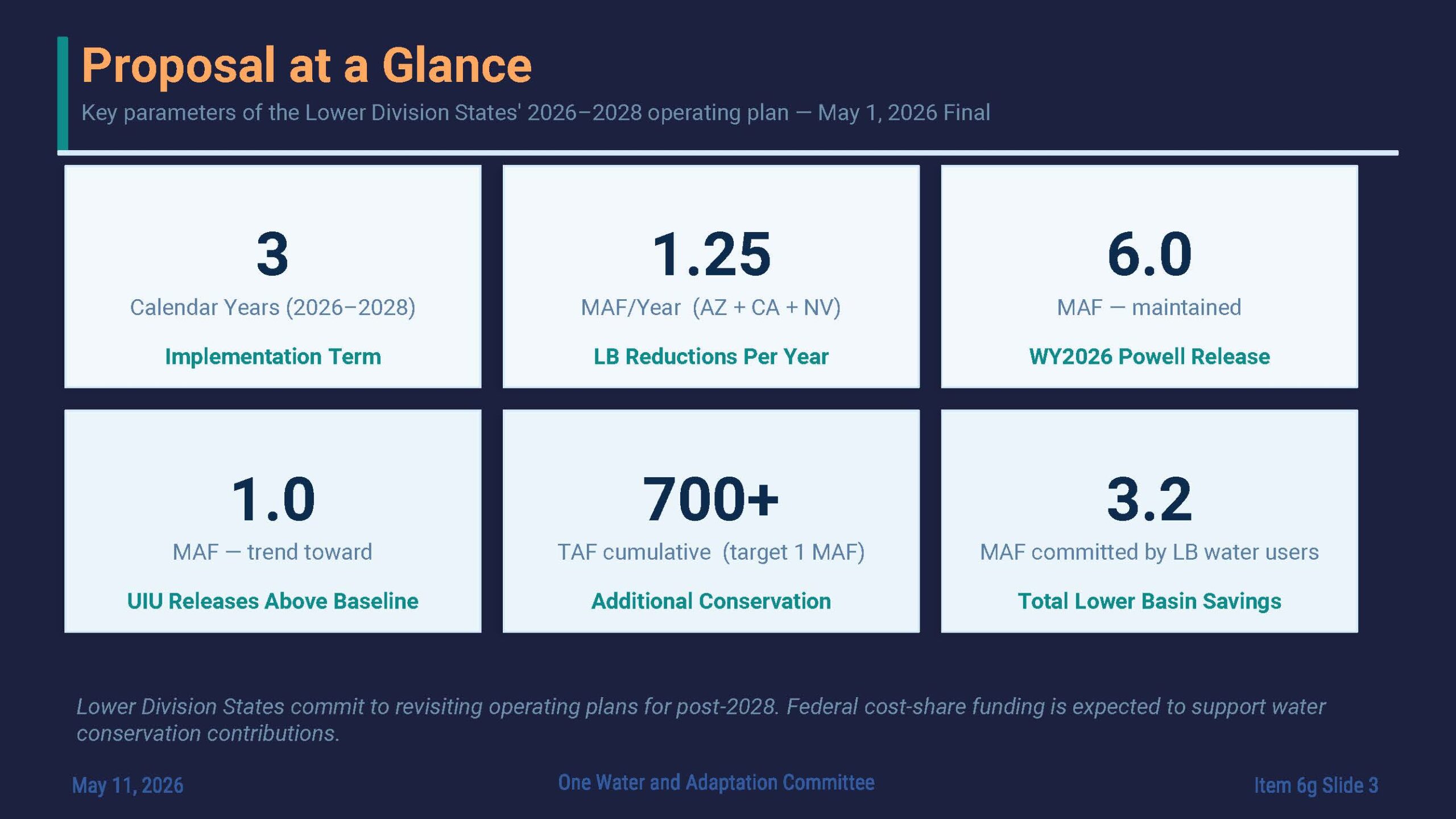
“Taken together, the proposal produces approximately 3.2 million acre-feet of Lower Basin savings over a three-year period,” said Ms. Rosset. “The proposal also commits the states to revisit operating plans for the post 2028 period with a federal cost share funding expected to support portions of the conservation effort.”
The 1.25 million acre-feet of Lower Basin reductions are intended to address the structural deficit—the evaporative and system losses that have long contributed to lower Lake Mead elevations. The reductions are allocated among the states as follows: Arizona, 760,000 acre-feet (about 61%); California, 440,000 acre-feet (roughly 35%); and Nevada, 50,000 acre-feet (about 4%). The proposal also gives contractors flexibility in how they meet those obligations. They can either reduce water orders directly or use intentionally created surplus (ICS) stored in Lake Mead from prior years, though the amount of ICS that can be used declines as Lake Mead drops.
“In other words, the lower Lake Mead gets, the harder it becomes to rely on stored ICS instead of actual conservation,” Ms. Rosset said. “That structure is intentional: it creates an incentive to preserve reservoir elevations rather than continue drawing the system down.”
The proposal also contains an important safety trigger. If any 24-month study projects Lake Mead dropping below elevation 1010, Reclamation would be required to consult with the Lower Division states on additional protective measures, effectively establishing an early warning mechanism tied to reservoir elevation risk.
Proposed changes to the ICS framework
The proposal would modify and extend the ICS framework established under the 2019 drought contingency plan, with several changes that Ms. Rosset said are especially significant for Metropolitan. Beginning in 2027, ICS balances would be subject to a 3% annual evaporation assessment. The proposal would also create a pathway for the Imperial Irrigation District to access the DCP ICS framework for the first time, subject to additional agreements. Ms. Rosset noted that IID’s exclusion was one of the principal fault lines in the 2019 DCP negotiations.
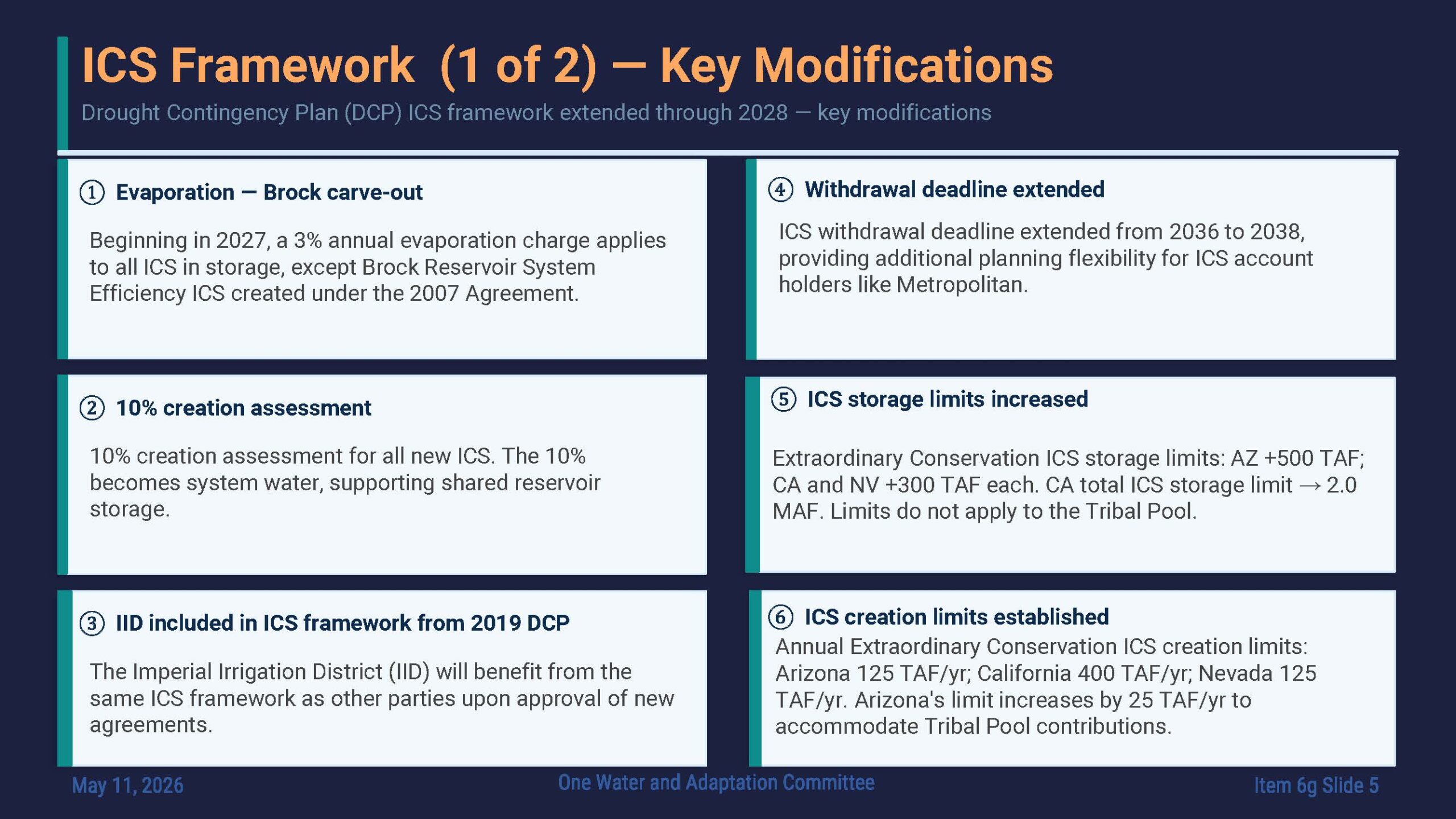
In addition, the proposal would extend the deadline for withdrawing ICS from 2036 to 2038—an important added planning horizon for Metropolitan, which maintains a large ICS balance. It would also expand each state’s ICS storage capacity, increasing Arizona’s by 500,000 acre-feet and California’s and Nevada’s by 300,000 acre-feet each, bringing California’s total storage limit to 2 million acre-feet. Finally, contractors would be permitted to use ICS to offset inadvertent overruns, subject to a 25,000 acre-foot annual state cap.
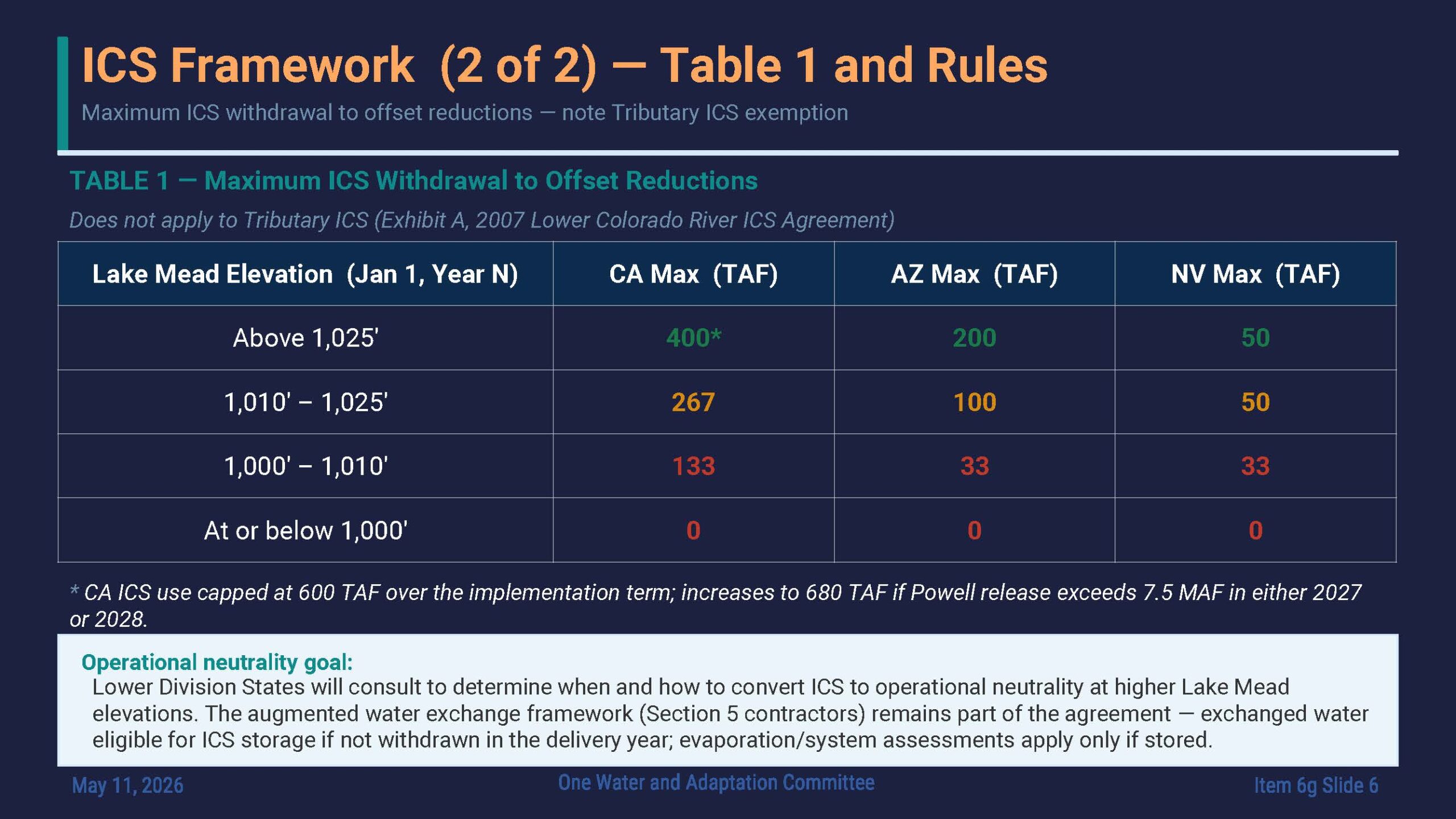
The slide above shows how ICS can be used to offset reductions when Lake Mead falls below elevation 1025, while also illustrating how that flexibility narrows as reservoir levels continues to decline.
“At or below elevation 1000 feet, ICS falls to zero for every state,” Ms. Rosset said. “The practical effect of that is ICS cannot become a complete substitute for actual conservation when the system is under the greatest stress.”
In addition to the core reductions, the proposal commits the three states to at least 700,000 acre-feet of additional conservation over the three-year period, with a target of reaching 1 million acre-feet if conditions permit. California and Arizona would each voluntarily conserve 300,000 acre-feet of new water, while Nevada would conserve an additional 100,000 acre-feet. Each state would be required to submit a detailed conservation plan by August 2026. Ms. Rosset noted that these commitments are contingent on federal cost-share funding. Potential sources of conservation include expanded water-efficiency programs, binational conservation projects, and initiatives such as the current system conservation implementation agreements.
“Conceptually, the states are trying to create a reserve account of conserved water that can be deployed strategically during periods of extreme system stress,” she said. “The goal is to slow reservoir decline and potentially avoid deeper reductions later.”
Upper Basin operations and Lake Powell releases
How Lake Powell and the upper basin reservoirs above it will be operated is also a part of the federal process. “Reclamation has made it very clear that it wanted the lower division states to reach agreement among themselves regarding how the lower basin reductions would be structured and allocated; this proposal is a direct response to that request,” said Ms. Rosset. “What remains less clear is the extent to which Reclamation will incorporate the lower division states positions regarding upper basin operations into their preferred alternative.”
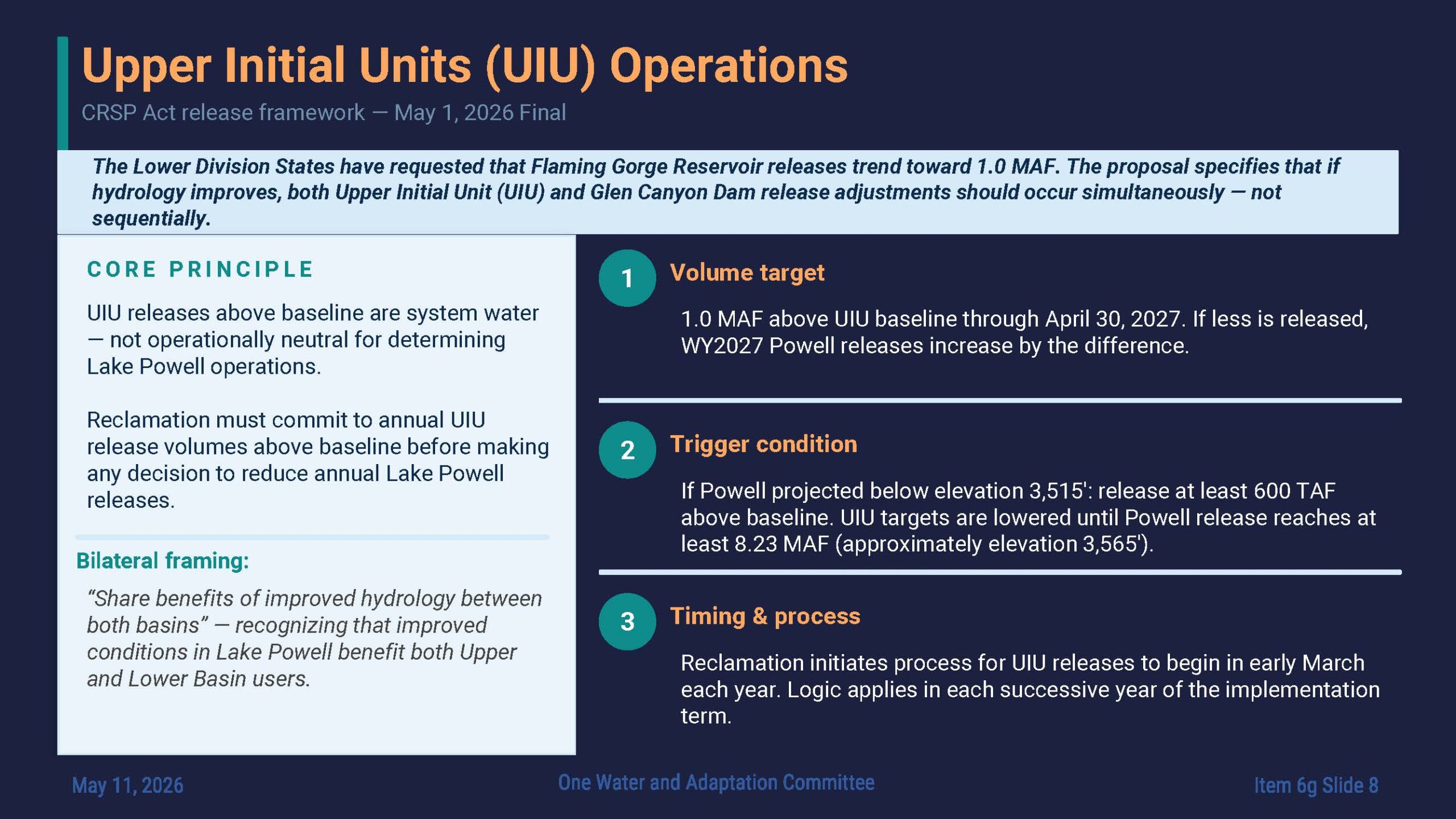
The Lower Basin proposal also addresses operations at Upper Basin reservoirs, which play an important role in determining how much water ultimately reaches Lake Mead and Mexico. These reservoirs, located above Lake Powell and collectively known as the Upper Initial Units (UIUs), include Flaming Gorge in Utah, the largest among them. Their operation is significant to the Lower Basin because releases from the UIUs directly influence downstream water supplies. The proposal therefore provides that releases above historic baselines should be treated as system water, benefiting the overall system rather than being credited exclusively to the Upper Basin.
The proposal also asks Reclamation to move Flaming Gorge releases toward approximately 1 million acre-feet this year. Ms. Rosset said the rationale is practical: additional releases from the UIUs help maintain Lake Powell at a higher elevation. That is important because once Powell approaches elevation 3500, protecting Glen Canyon Dam infrastructure becomes Reclamation’s dominant operational priority. The Lower Basin’s objective is to reduce the likelihood of reaching that threshold. The proposal further states that if hydrology improves enough to allow lower UIU releases, adjustments to Flaming Gorge and Glen Canyon Dam releases should occur simultaneously, rather than sequentially, to avoid disadvantaging the Lower Basin.
“The broader concept here is shared benefit,” Ms. Rosset said. “If conditions improve, both basins should benefit from the improvement.”
Lake Powell releases are at the heart of the proposal because the volume of water moving from Powell to Mead influences nearly every downstream consequence in the system. For water year 2026, the scheduled release from Powell is 6 million acre-feet, with additional releases if Powell is projected to end the year above elevation 3530. The proposal also calls for Reclamation to conduct a river outlet works pilot this year to test Glen Canyon Dam infrastructure during extended release operations.
For water years 2027 and 2028, release volumes would be tied directly to Powell’s elevation on October 1 of the preceding year: 8 million acre-feet if Powell is at or above elevation 3540, and 7 million acre-feet if it is below 3540.
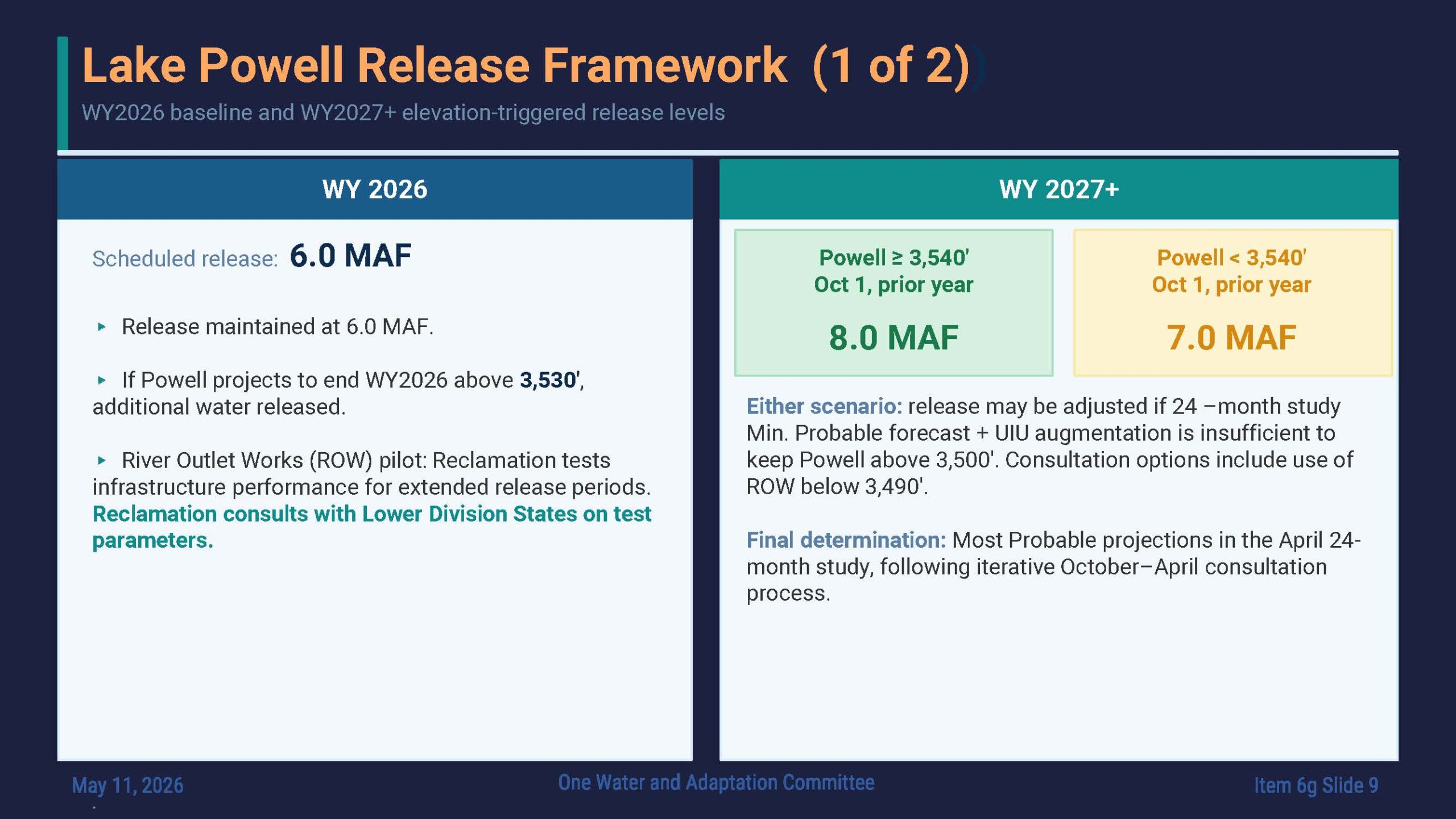 “Either way, those releases are meaningfully higher than the 2026 level,” Ms. Rosset noted. “The expectation is that if conditions stabilize, additional water begins to move to Lake Mead.”
The proposal also addresses wetter hydrology conditions. If Lake Powell is projected to end the year above elevation 3565, releases would rise to at least 8.23 million acre-feet, allowing recovery of prior reduced releases and earlier infrastructure protection releases from the UIUs. The core principle is that improved hydrology should benefit both basins, not just one.
The proposal also includes an important governance provision related to Glen Canyon Dam. “By the end of 2027, Interior would be required to publish a long-term plan addressing operational and structural risks at Glen Canyon Dam. That’s because the volume of water in Powell below Power Pool is roughly the size of Lake Shasta, and currently, Reclamations policy is to avoid operating Glen Canyon Dam below Power Pool, leaving a large volume of water potentially inaccessible when it might be needed most. And notably, that plan would require written approval from the lower division states – not mere consultation, but approval.”
What comes next
The pace of the process is expected to accelerate substantially. Reclamation has already begun preliminary consultations on the preferred alternative, first with the seven basin states, then with tribes, and finally with Mexico. Analysis for the final environmental impact statement is expected to begin in early June. The Final EIS notice of availability is anticipated in late July, and the Record of Decision is currently targeted for the same time frame—roughly 10 weeks away. The Lower Basin hopes the proposal will be reflected in Reclamation’s preferred alternative. It submitted the proposal as an integrated package and asked that it not be cherry-picked.
“It is important to be precise about what the federal preferred alternative actually is,” said Ms. Rosset. “There is no seven states consensus on the post 2026 operations. The Upper and Lower Basins have not agreed on a single operational approach. What Reclamation is developing is effectively a federal approach with Lower Basin operations informed by this proposal. Importantly, the central issue Reclamation needs resolved, how lower basin reductions are structured and allocated, is exactly what the lower division states proposal addresses.”
The most difficult stage of the process now begins converting these concepts into binding agreements among Arizona, California, and Nevada, and then into intrastate agreements within California. Ms. Rosset said the task will be extraordinarily complex and will unfold rapidly.
“The federal process is accelerating,” she said. “The State negotiations are accelerating, and the period ahead is likely to be one of the most active and consequential periods in the history of Colorado River negotiations. Metropolitan will be directly involved in these discussions, and staff will continue providing frequent updates to your board as events unfold. As we are in the middle of a historically significant moment for the Colorado River staff will make sure this board remains closely informed and engaged throughout the process.”
“The Rockies and the Colorado River flows are 13% of normal is what’s projected, which is really just beyond comprehension,” said Director Mark Gold (Santa Monica). “That leads to the question of, as enormous as these cuts are, there’s a significant likelihood it’s not going to be enough. The Lower Basin states may agree, but the river may not agree … In the presentation where you were talking about the Powell releases for 2027, it would go from 6 million acre-feet to 7 million acre-feet release? Did I mishear that?”
“The target is for 7 million acre-feet, but this is all contingent on Lake Powell staying above that 24-month study projection of 3500,” said Ms. Rosset. “Reclamation has the authority and they will take action to reduce releases. But this is the starting place for what the lower division states are saying that should be the target in part, so that it’s not all on the lower division states to bear the burden of Glen Canyon Dam Infrastructure Protection.
“We’re just talking about water that is has a very severe likelihood of not existing,” said Director Gold. “I guess that falls to the US Bureau of Reclamation as part of the consultation process to try to determine what happens next. Because my bet is we will be moving a consultation by the end of the year in light of the dire circumstances in which we’re in.”
“I’m assuming that the bureau is have not given up on the possibility of a seven-state solution,” said Director Gloria Cordero (Long Beach). “Is that correct?”
“I think they have given up,” said Ms. Rosset. “There’s not enough time. They basically gave us until next week as a basin to have pencils down on everything as they’re going to be finishing up their preferred alternative. So, the input that we provided and that the upper division states provided last week – That’s it. They’re not really accepting any new substantive changes.”

