
From the US Forest Service:
 Imagine you’re a program manager seeking funding for a project—you identify a funding opportunity, ensure the money can be used for the project, navigate the complex reporting requirements, and successfully implement work on the ground.
Then, you learn a neighboring landowner has a similar project working with a different program manager—and so does another landowner across the ridge. Now imagine that instead of these three managers working separately, each short on time, they formed a partnership to share technical, administrative and financial resources?
That defines successful partnership, and you can see that in California’s Sierra to Sea Watershed Outcomes Bank. In the Central Sierra region, the Eldorado National Forest and The Freshwater Trust (a partner within the Healthy Eldorado Landscape Partnership) recently signed a new master partnership agreement formalizing the watershed outcomes bank. The bank will cost-effectively fund, finance and implement priority projects that reduce wildfire risk and protect drinking water across the region’s Cosumnes River watershed.
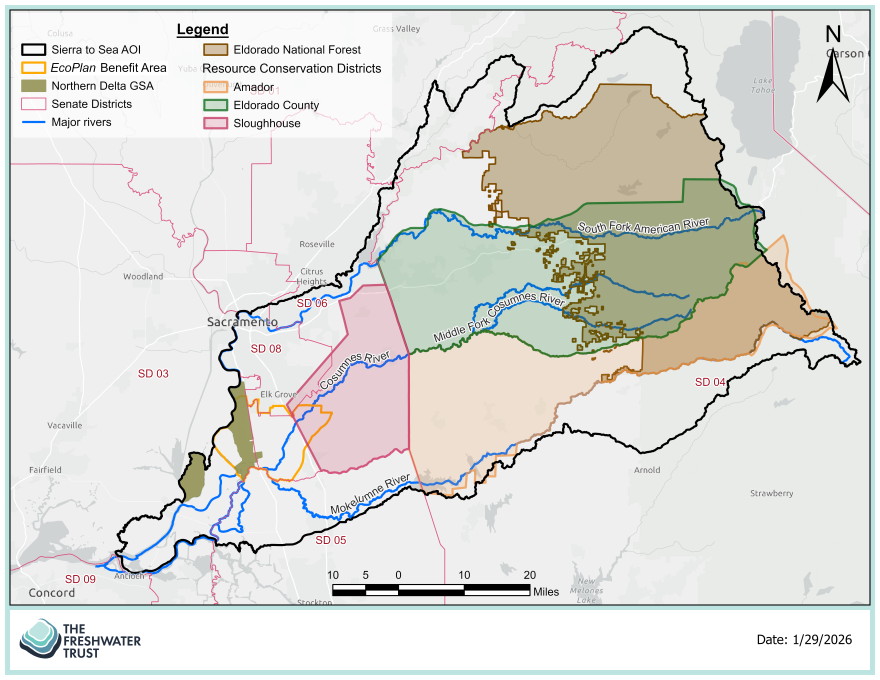
The Cosumnes River watershed occupies around 900 square miles and supports agriculture, rural-to-urban communities and drinking water sources. Michelle Wolfgang, partnership coordinator for the Eldorado National Forest, has been leading agency efforts with partners to restore and reforest the watershed. Wolfgang notes, “The Eldorado National Forest is excited to launch the watershed outcomes bank as it will provide a more efficient way for us to work with our partners and achieve outcomes at scale.”
Stitching together partners and funding across a watershed
The watershed outcomes bank has 10 additional organizations formally involved in the partnership. These 10 partners provide representation from up and down the watershed, bringing together a regional coalition of managers who don’t often work together.
In the past, these organizations worked independently to make improvements within their own boundaries, piecing together small amounts of money for projects on their own lands. That fragmentation is time-consuming and causes a patchwork of results across a region, delaying important outcomes for the local and downstream communities who benefit from them.
The bank addresses this problem by attracting, mixing, matching and delivering funds from federal, state, nonprofit and private sources to a set of high-impact projects and organizations across the watershed, no matter who owns the land.
Through the watershed outcomes bank partnership, implementation projects are already underway:
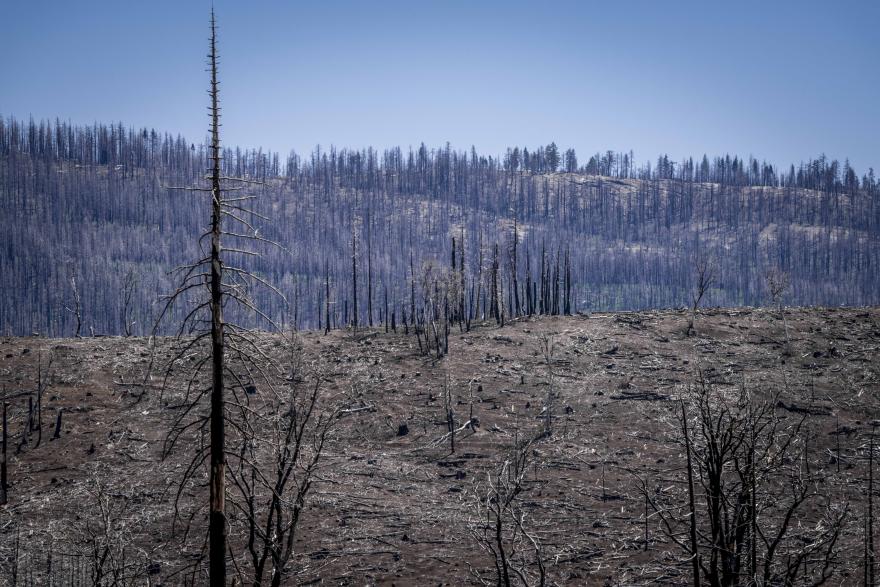
- For the headwaters of the Cosumnes River, partners have secured $43M to restore the Eldorado National Forest and surrounding areas burned by the Caldor Fire. In 2021, this severe wildfire lasted 69 days and scorched over 220,000 acres of land. An additional $29M has been secured to reduce future wildfire severity in land adjacent to the fire footprint.
- In the lower watershed, as part of the agriculture-rich region of the Sacramento-San Joaquin Valley, partners have secured $300M to implement a Harvest Water Program with the local sewer district. This program addresses regional groundwater depletion by recycling wastewater and targeted watershed restoration work to sustain agricultural and community needs.
Reducing wildfire risk in the headwaters provides cleaner, safer and more reliable water supply for downstream users. Similarly, improving groundwater levels ensures rivers have sufficient cold water flow during drought for agriculture use and species habitat.
This landscape-level partnership framework is a new way to get work done—it offers a powerful opportunity to efficiently share resources when and where they’re needed most.
Achieving more together
This work began in 2022 with partners in the region and has gained momentum since signing the master agreement in 2025. The watershed outcomes bank area encompasses multiple legislative districts, counties, special districts and project boundaries, each managed by different organizations. There are two critical next steps. The bank aims to secure more funding at the regional scale for project implementation and continue building a menu of high-impact projects ready to absorb that funding.
The watershed outcomes bank models the ways partnership and cooperative federalism allow us to collectively achieve work. Wolfgang notes that the “framework helps us formalize our partnerships, more efficiently leverage partners’ efforts, and secure more funding. Ultimately, we’re able to amplify our work to enhance forest resiliency, sustain water sources and protect our communities.”
Development of the watershed outcomes bank is supported by funding from the Innovative Finance for National Forests Program, managed in partnership between the U.S. Forest Service and the U.S. Endowment for Forestry & Communities.

