
The Colorado River Basin has been sliding toward a critically dry year since January—enough to put extraordinary federal action on the table. Although there were brief hopes that late-winter storms might turn things around in February, March, or April, these hopes have largely evaporated. As a result, the federal government has now signaled it will step in. At Metropolitan’s April meeting of the Imported Water Subcommittee, Shanti Rosset, Metropolitan’s Colorado River policy manager, outlined the Bureau of Reclamation’s proposed actions.
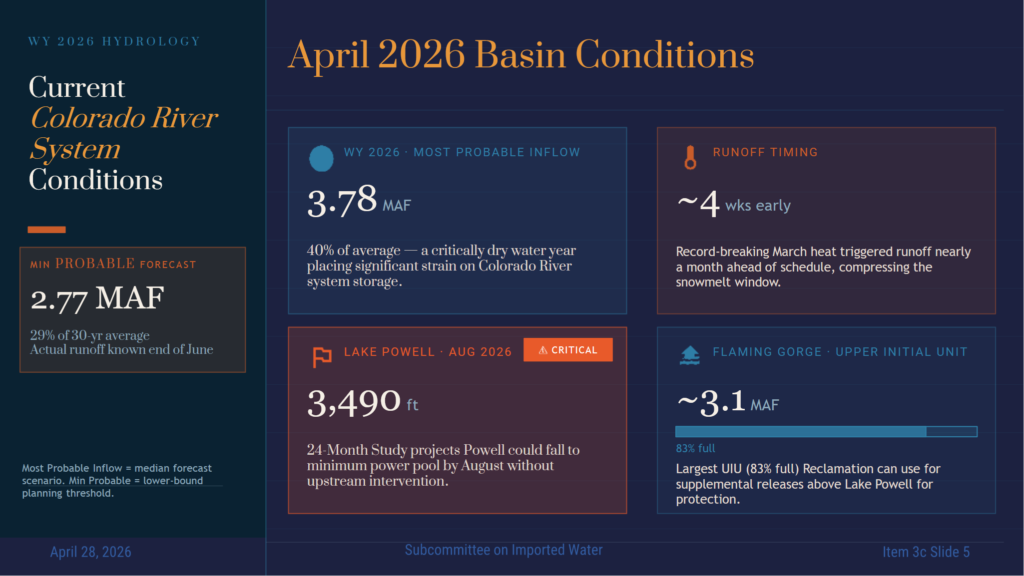
Conditions on the Colorado River have continued to worsen throughout the spring. Specifically, the most likely inflow forecast for water year 2026 is 3.7 million acre feet—just under 40% of the 30-year historical average—which would make it a critically dry year. This situation is further compounded by timing: record-breaking March heat triggered runoff nearly a month early, shortening the snowmelt period and reducing the system’s ability to store water. In Reclamation’s lowest probable inflow scenario, the projection falls to 2.77 million acre feet, about 29% of the average.
Against this worsening backdrop, last week, Interior Secretary Burgum released Reclamation’s drought response operations plan (DROP). These DROP actions are being implemented to protect Glen Canyon Dam infrastructure, as Lake Powell was projected to drop below the critical elevation of 3500 feet.
To manage the system going forward, Lake Powell’s Water Year 2026 release will be reduced from 7.48 million acre-feet to 6 million acre-feet, in accordance with section 6E of the 2024 SEIS Record of Decision. Meanwhile, Reclamation also plans to make supplemental releases from Flaming Gorge ranging from 666,000 to 1 million acre-feet. Currently, Flaming Gorge Reservoir holds about 3.1 million acre-feet, or 83% of its capacity, making it the largest upper basin reservoir available for supplemental releases above Powell. Therefore, it is central to Reclamation’s planned intervention. Taken together, reducing Lake Powell’s outflow to Lake Mead and releasing additional water from Flaming Gorge into Lake Powell are expected to increase Powell’s elevation by roughly 54 feet. By April 2027, this would raise the water level to at least 3,500 feet, maintaining it above the power pool threshold.
Ms. Rosset emphasized the importance of this threshold in the subsequent discussion: “The critical threshold to understand here is elevation 3490; that’s Powell’s minimum power pool,” she said. “Fall below that, and you lose hydropower generation at Glen Canyon Dam and risk damage to the penstocks. The 24-month study projects Powell could reach that level by August without these interventions.”
Following the release of the federal plan, the lower basin states—Arizona, California, and Nevada—submitted a formal comment letter regarding the DROP, outlining two major concerns. First, they contend that the drought response operations agreement included within the 2019 Drought Contingency Plan is no longer applicable, as it expired on December 31, 2025. Consequently, they argue that Reclamation should not rely on this authority when proposing releases from Flaming Gorge. The states have requested that Reclamation expedite releases from the upper initial units, but without invoking the expired drought framework.
Second, the states have expressly reserved their rights regarding any compact deficiency arising from this year’s 6 million-acre-foot Powell release. This language underscores that the issue remains unresolved and that the lower basin is maintaining its legal options.
Ms. Rosset outlined the key long-term issue: compliance with the Colorado River Compact. The compact sets a delivery threshold based on a rolling 10-year average of 82.5 million acre-feet. With only 6 million acre-feet to be released this year, the average will likely drop below the threshold for the first time, creating a deficiency under Articles 3c and 3d.
“The Lower Basin states have formally objected and have not waived any rights related to that deficiency,” she said. “Looking ahead, the structural risk only grows as higher flow rate years rotate out of the 10-year accounting window. A Compact deficiency becomes increasingly probable, even without future dry years. So we will be watching the water year 2027 outlook very closely.”
Director Mark Gold said from the standpoint of the Metropolitan Water District, what do we think needs to be done that’s consistent with the seven principles, but with much greater specificity, and making it clear that this is what we think needs to occur to have at least moderate term sustainability? “Obviously, these are all emergency responses that are being forwarded to us by the Bureau of Reclamation, and honestly, I can understand why they did what they did. So I understand the letter of objection, but that doesn’t mean I agree with it in light of the overall big picture of what needs to be done.”
“I think we ought to be very clear with the public on what we’re dealing with,” said Adan Ortega, Chairman of the Board of Metropolitan. “Because one thing is clear: you can win the political debate, you can win the court case, but you’re still going to lose if the River has its way, given the current trajectory that we’re in. The idea that the revised estimates of the river’s yield would be 12 to 13 million acre-feet, and this year, we’re only getting 4 million, should speak for itself about what this means. So I think the part that we miss by not being more transparent overall, not just Metropolitan, but the whole debate is about what’s at stake for the Southwest.”
“What’s at stake for the Southwest and suburban areas is that it’s a symptom,” he continued. “Some communities may become like other places around the world that can’t serve water, 24 hours a day, seven days a week, 365 days a year, so people have to get used to hours in the day when the taps won’t work, and where you need to take extra measures like putting a cistern by your house or up on your roof so that you can have a little water for those hours when the municipal system might not be operating. I know that some people might say that’s a doomsday scenario. It isn’t. That’s not the worst case. That’s not day zero, but it would impact the quality of life that people are used to in the Southwest, and that ought to be speaking volumes for why we need to rally at this time and do the right thing by the river.”

