
Several years ago, both the Southern Nevada Water Authority and entities in Arizona each invested $6 million in Pure Water Southern California, anticipating that successful implementation of the project would entitle them to a share of the water produced. Currently, no regulations allow for the long-term availability of this type of exchange. It was anticipated that interstate transfers and exchanges would be included in the post-2026 guidelines; however, the status of the guidelines remains uncertain. Nevertheless, there remains strong interest in advancing interstate exchanges.
At the April meeting of Metropolitan’s One Water and Adaptation Committee, Joe Vanderhorst, a retired annuitant working on Colorado River issues, briefed Committee members on a memorandum of understanding (MOU) that has been developed to initiate discussions on how to incorporate interstate transfers or exchanges to provide greater flexibility in Lower Colorado River operations.
Metropolitan’s historical approaches to managing Colorado River allocations
The law governing the Colorado River sets strict rules on how much water each state in the Lower Basin can use. Each state receives a fixed annual amount, which is further divided within each state according to priority systems. For example, California can use 4.4 million acre-feet of water per year. Of that, agricultural agencies have first rights to 3.85 million acre-feet, while the Metropolitan Water District only has junior priority rights to 550,000 acre-feet. To keep its Colorado River Aqueduct—capable of moving 1.25 million acre-feet—full, Metropolitan has historically needed to either secure extra water for California beyond its 4.4 million limit or find ways to transfer water within the state into the aqueduct.
Metropolitan has traditionally relied on two main methods for filling the aqueduct. First, it took advantage of unused apportionments from other states that were not utilizing their full share. For many years, Metropolitan and California exceeded their annual entitlements by using water that Arizona couldn’t access because of a lack of infrastructure. This approach continued until the Central Arizona Project was completed and operational, after which the pool of unused apportionment largely vanished.
Second, if the Secretary of the Interior declared surplus water supplies, and if those surpluses exceeded the amount required to meet existing water entitlements, then agencies with sufficient demand—like Metropolitan—could receive this extra water. Consequently, when there was no unused apportionment, Metropolitan was still able to keep its Aqueduct relatively full for several years by using surplus supplies.
But both of those options disappeared in the early 2000s. The unused apportionment disappeared when CAP came online, and by the mid-1990s, Arizona was using its full 2.8 MAF entitlement. The surplus supply basically disappeared when the Secretary adopted fixed rules for declaring surplus in any given year based on elevations in Lake Mead. Lake Mead has been dropping steadily since the drought began in 2000, so those rules have essentially meant there’s no longer surplus water available.
Legal innovations for Lower Basin water flexibility
However, the Lower Basin states have found ways to extend additional supplies using those two concepts. One method involves intentionally creating unused apportionment supplies. Regulations set by the Secretary in 1999 allow a state to deliberately not use all of its entitled water, then enter into an agreement with another state to use that surplus water for a year, on the condition that it will be returned later. This process amounts to a temporary interstate transfer under the framework of unused apportionment. In every instance, the location where the water is used remains unchanged—the delivery and return both count as unused apportionment. This legal mechanism enables agencies to access more water than their usual share.
For example, in 2004, Metropolitan entered into an agreement with the Southern Nevada Water Authority to implement this system. During the ramp-up phase of the QSA water transfers, Metropolitan used some of Southern Nevada’s allocated water that was made available for this arrangement. As a result, Metropolitan now has over 300,000 acre-feet of Nevada’s water in storage for future use, which must eventually be returned.
Another option is the Intentionally Created Surplus (ICS), implemented under the 2007 guidelines. These rules allow for water to be conserved and stored in Lake Mead, and for it to be tracked in an account that can be accessed in the future—even if its withdrawal would result in a state exceeding its annual entitlement. The ICS program does not impose a cap on entitlements, as this surplus water within the system remains available for delivery to participating entities.
“The Secretary’s rules were clear about how this water would be created, how it would be accounted for, and how it’d be delivered,” said Mr. Vanderhorst. “So those rules were in place, and Metropolitan took extensive advantage of that and has over a million acre feet of water in storage in Lake Mead right now. That water would then be available when Metropolitan needs it in future years.”
The path forward: Negotiating new rules for interstate water transfer
The regulations governing intentionally created surplus (ICS) were not permanent, unlike those for intentionally unused apportionment. ICS guidelines expired last year, so after this year, you cannot create new ICS unless the regulations are renewed. The purpose of the MOU is to collaborate with other Lower Basin stakeholders to address how to proceed now that the ICS rules have lapsed, and to increase flexibility by enabling interstate water transfers in addition to storage within the system or temporary transfers.
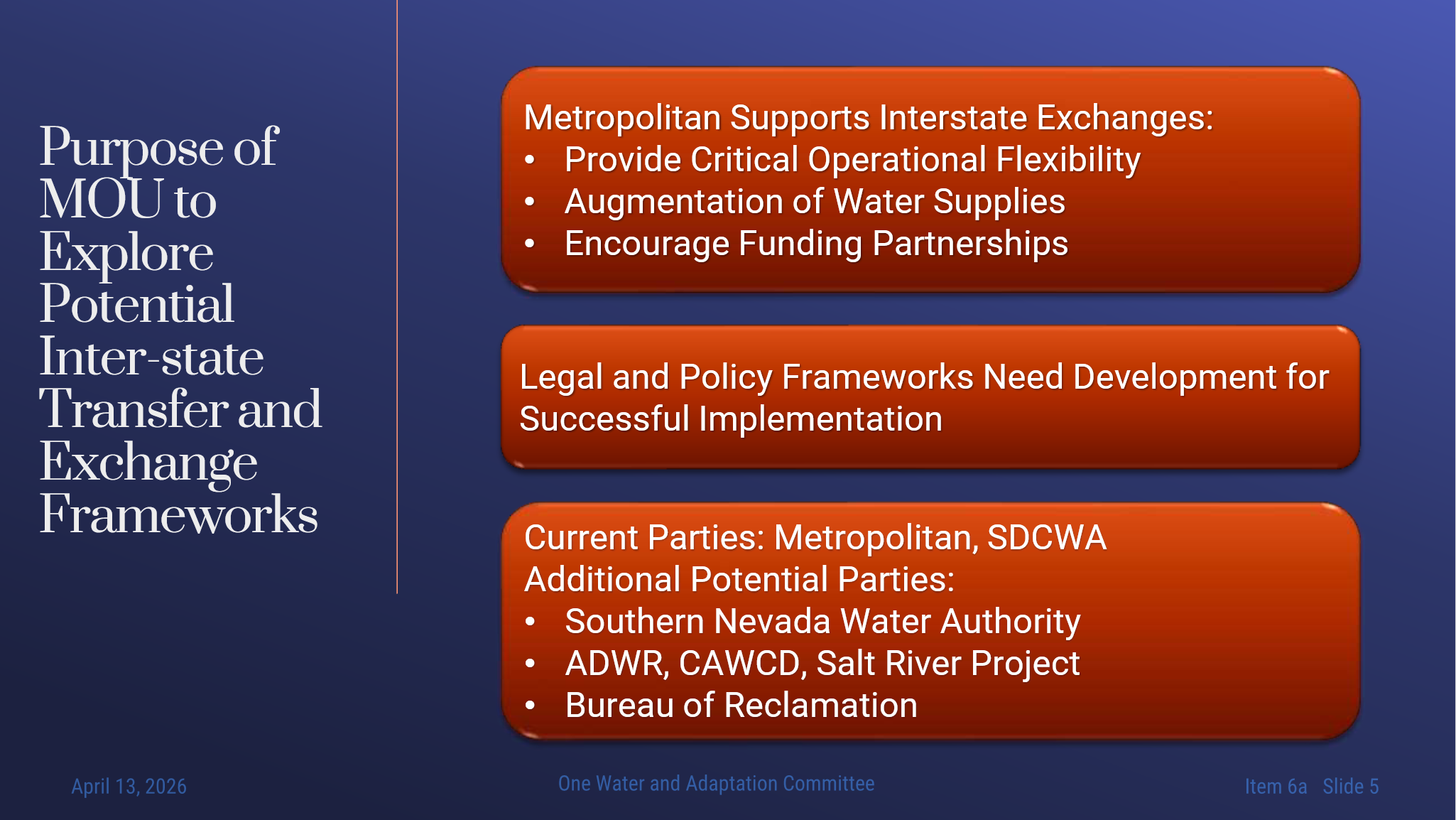 “Metropolitan has long supported having interstate exchanges,” said Mr. Vanderhorst. “It provides operational flexibility for Metropolitan as the junior priority user in California, it allows for augmentation of the water supplies that are available through additional infrastructure projects, and it encourages the funding to allow those projects to move forward, where you can have interstate partnerships to fund a particular program and then work out how the water will be shared.”
But he noted that there are many legal and policy issues that go into those rules and how they would be implemented. “It takes an extensive set of defined written down rules as to how those are going to operate, and even when we had defined rules, there were sometimes disputes, at least with the ICS program, as to when the water might be pulled out,” he said. “So there needs to be extensive discussions amongst all the parties involved to make sure that we have a proper set of rules that covers all of the appropriate issues and we can reach successful implementation without future fights.”
The current signatories to the Memorandum of Understanding (MOU) are the Metropolitan and the San Diego County Water Authority, both of which have projects that could be used for interstate water transfers. Metropolitan and San Diego are in ongoing discussions with the Southern Nevada Water Authority and stakeholders in Arizona. Given its role as water master in the Lower Basin, the Bureau of Reclamation is responsible for facilitating appropriate water distribution and ensuring that no other parties are adversely affected by these transfers. Accordingly, the Bureau of Reclamation will also participate in these negotiations.
Goals, challenges, and next steps for Lower Basin interstate transfers
So in summary, the goals of the MOU are to explore the legal and policy frameworks for Lower Basin interstate transfers; identify shared interests and responsibilities, explore potential for joint funding of projects, including federal funds, and to avoid or mitigate adverse impacts caused by transfers.
“We’re also hoping that there will be federal funding, in particular, because the federal government has obligations on the Lower Colorado River that it has neglected to fund in the past, and we’re hoping that this will be an opportunity to encourage the feds to come forward with money,” said Mr. Vanderhorst.
He noted that, as with any project, there will need to be environmental reviews, and negotiations among other water rights holders will likely be needed to ensure they’re protected against the adverse impacts of the transfers.
“Arizona and Nevada are very interested in going slow and making sure what type of projects are acceptable to move across state lines,” said Bill Hasencamp, Colorado River Resources Manager. “They’ve said we’re not open to ag-to-urban transfers across state lines, so this is not the Wild Wild West, where it’s a free market on the Colorado Basin. These would be specific projects that are probably rather capital-intensive and provide a new supply that can go to multiple states. Not all projects will fit into it … certainly, seawater desalination would fit into that.”
Board Chair Adan Ortega said several steps are needed now as we head into the summer months, which will certainly be extremely challenging for the Colorado River Basin states. “There needs to be an inventory of what it is that we could provide through offsets and these interstate transfers to mitigate some of the pain that will be suffered this summer, and then also in the long term, our own resiliency in the following years.”
“I think it’s critically important to ourselves, because the only thing people are going to be thinking this summer is California has the high priority and all the water – at least, that will be the perception as others are being cut,” he continued. “If we’re not doing something to demonstrate that we see this as a multi-regional challenge, then we’re going to have to reckon with that on our own.”

