
Over the past several years, the Colorado River Basin states have been working, with limited success, on guidelines that will take effect next year when the current guidelines expire. But given the deteriorating hydrology, basin states’ discussions now focus on how to survive the record dry conditions. At the April meeting of Metropolitan’s One Water and Adaptation Committee, Shanti Rosset, Metropolitan’s Colorado River policy manager, discussed how the dismal conditions are shaping the negotiating landscape in real time.
The graph below tells a stark story. The Upper Basin snowpack has been tracking below the 2002 level, which was the lowest unregulated inflow year into Lake Powell on record. Snowpack peaked several weeks ahead of time on March 9, and that early runoff means reduced runoff efficiency into the river.
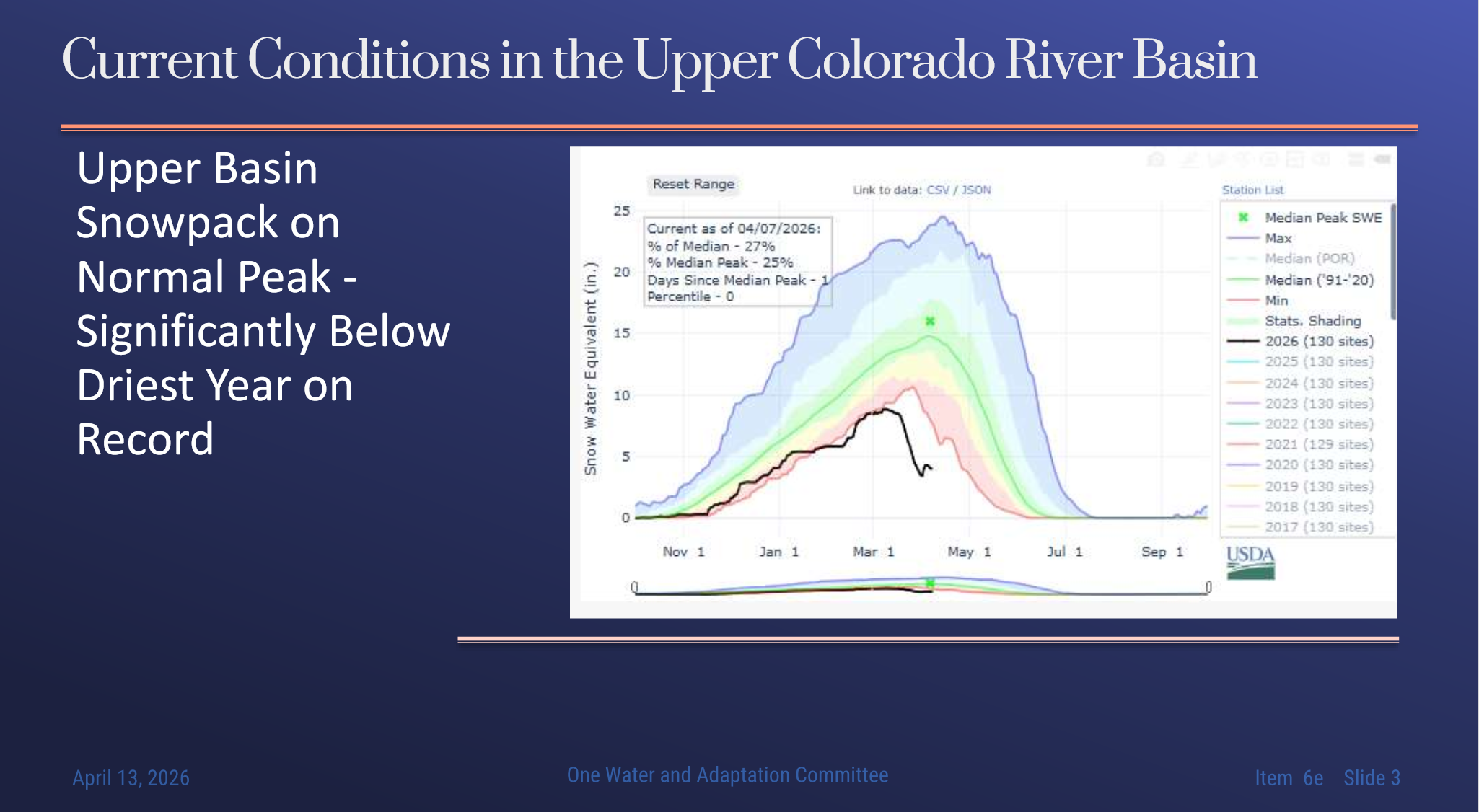
These conditions have severe implications for the Upper Colorado River Basin. She noted that the vast majority of Upper Basin water users take water directly from the river rather than through dam releases. When flows are this low, many of those users simply will not be able to divert their water. The effects on agriculture, recreation, municipal water supplies, and Tribal water providers are expected to become evident within the next month or two, and preparations are already underway among affected stakeholders.
Reclamation’s March 24-month study projected Lake Powell dropping to an elevation of 3500 feet by the end of this year, and since then, conditions have continued to worsen. Metropolitan staff have been told that the upcoming April 24-month study will show that the inflows projected from the March 24-month study have declined by over a million acre-feet. This means that elevation 3500, which triggers Reclamation to take emergency actions, will be reached much earlier this year than even anticipated.
Elevation 3500 is the trigger for a specific set of protections under Section 6e of the 2024 Short-term Actions SEIS, which authorizes Reclamation to take protective actions when Powell is forecast to be at or below 3500. It requires Reclamation to consider all available tools, including changes to Glen Canyon Dam release schedules, releases from Flaming Gorge, Navajo, and Blue Mesa Reservoirs, and reductions in Powell’s annual releases to as low as 6 million acre-feet.
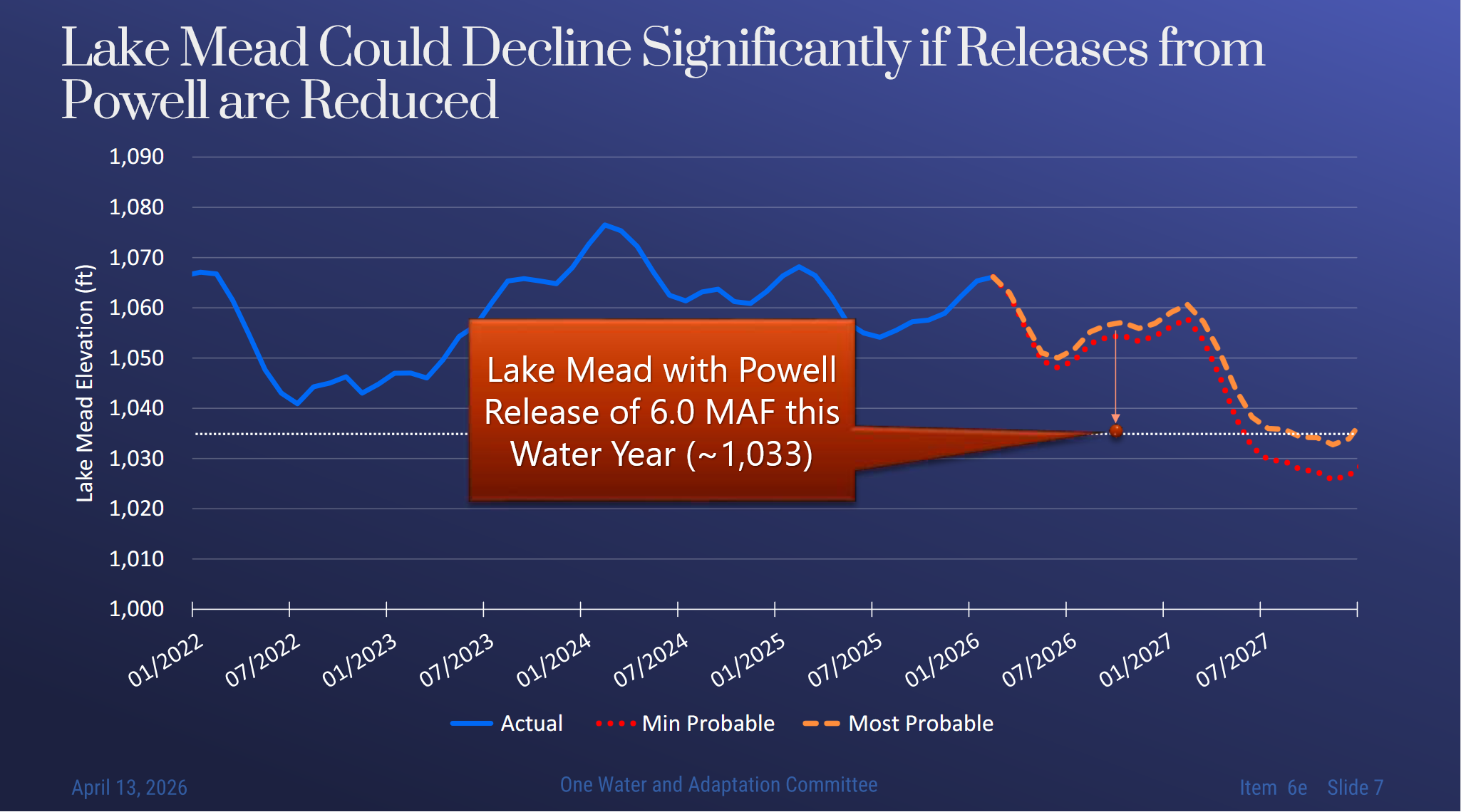
The drop to 6 MAF from Lake Powell is significant, Ms. Rosset noted. “The release from Powell has been set this year for 7.48 million acre-feet,” she said. “A cut to 6 million acre-feet means 1.48 million acre-feet less will be flowing downstream. And this is relevant because all of the current forecasts showing the probability of where Powell and Mead will be are based on an assumption that there will be a 7.4 million acre-feet release. I will warn you all to expect Mead’s forecast to be dropping very significantly in the very near term.”
Reclamation began section 6e consultations in October 2025, and the question is no longer whether Reclamation will act; it is how it will combine available tools, she said. “Reclamation is likely to require additional releases from Flaming Gorge of at least 500,000 acre feet, and this will provide a partial offset of the impacts to Mead, but they are not expected to fully compensate for what is likely coming: a Powell release reduction of potentially down to 6 million acre feet.”
Ms. Rosset said Reclamation will make a final determination by May; additional Flaming Gorge releases, while anticipated, have not been formally announced.
The chart below shows the consequence to Lake Mead potentially under a 6 million acre-foot Powell release scenario. Lake Mead is forecast to approach elevation 1033 this year; the Flaming Gorge release provides some offset, but does not reverse the overall decline. As Lake Mead approaches elevation 1035, Hoover Dam’s generation capacity drops by roughly 70%, which will affect peak capacity.
Despite the dire conditions, impacts to Metropolitan appear to be minimal. Lake Mead’s elevation on January 1, 2026, was above the DCP trigger for California shortage contributions. Under the DCP, shortage contributions are set by the January 1 elevation – this protection is locked in for WY 2026 regardless of in-year Mead levels. Metropolitan has full access to Priority 4 entitlement and ICS in Water Year 2026. So the reduced Lake Powell release does not trigger a shortage cut in WY 2026; shortage cut risk shifts to WY 2027 and will be based on the August 2026 Reclamation forecast.
“However, the trajectory is the connective tissue between the current operations and post 2026,” said Ms. Rosset. “We are entering the next set of operations from a position of very low reservoir elevation, and these limits operational flexibility from day one of the new framework. And it contributes to a broader sense across the basin that the stakes in these negotiations are exceptionally high.”
“Collaborating with everybody is the exact same way for three years hasn’t really amounted to much, and so it’s been this consensus or die approach, and we seem to have chosen death,” said Director Mark Gold. “Obviously, that’s not what we want to do. What are we doing to address that?”
The Lower Basin is continuing to have discussions about a potential Lower Basin-only plan; whether that is acceptable to the Feds or even to Metropolitan still has to be determined, said Bill Hasencamp, Colorado River Resources Manager. “The seven-state process seems to be on hold, but that hasn’t stopped discussions. But right now, the focus is on getting through this dry year. In the next couple of months, some key decisions will be made. We are chasing down a number of different leads and paths, but it does seem to be a road that has unexpected turns continuously.”
“We need to do an inventory of what we can do,” said Metropolitan Board Chair Adán Ortega. “We’re not the sole bearers of a solution. We can’t solve it on our own for everybody, but somebody’s got to show the goodwill, and somebody’s got to show the creativity, and I think California has been able to do that. We learned, because we had to, at the end of 2002, when we didn’t meet the Quantification Settlement Agreement deadlines, and we lost half of our supply. We’ve been through this before. We know what it feels like, and we know the enormity of the financial burden that it’s taken to keep that aqueduct full. … We really need to have another discussion about what we do when the hammer hits this summer, because I think the river is deciding everything for us already.”

