
In the 1970s and 1980s, Battles to Preserve Mono Lake Set New Protection Precedents
By Caroline Tracey, Zocalo Public Square
 During the summer of 1976, a group of undergraduate biology students moved to a campsite on the shores of Mono Lake. They “sang, recited verse, lived largely on granola, beans, rice, and were known to take in other nonstandard substances,” John Hart writes in the book Storm over Mono. The students had noticed that Mono was shrinking, and had gathered at the lake to conduct ecological research. The results of their study would make history.
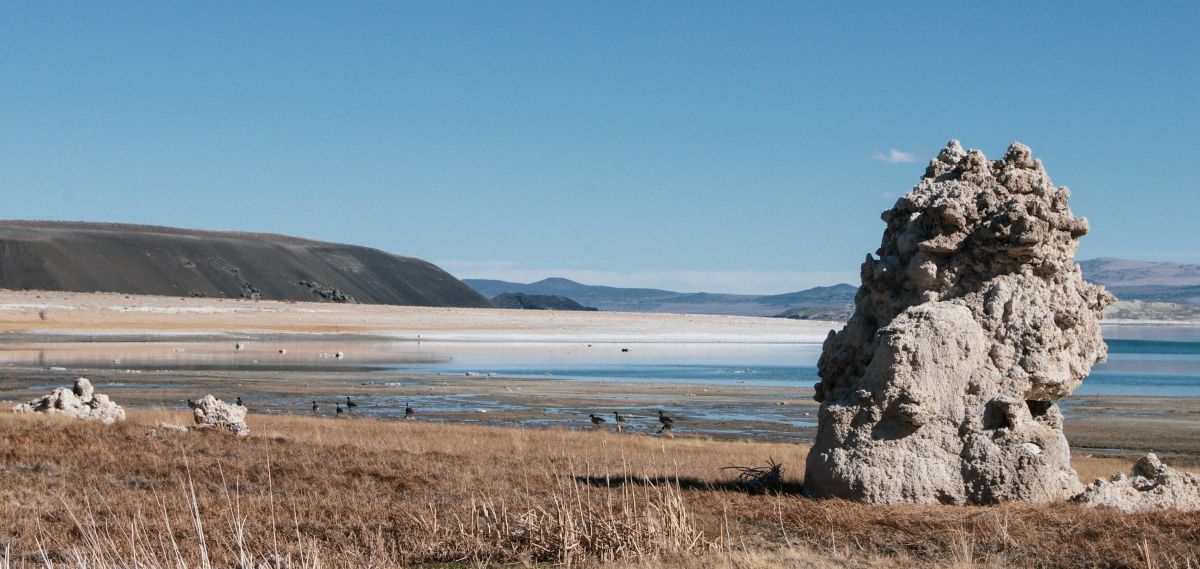
Mono is a round lake, 13 miles in diameter and 150 feet at its deepest, located in the high desert of eastern California. When you approach it by land, it stands out, a disc of blue amid a landscape of sagebrush and sandy soil. It’s a “triple water” lake, with three types of minerals—chlorides, carbonates, and sulfates—dissolved in its waters. It is two to three times saltier than the ocean. In 1872, Mark Twain called it “this lonely tenant of the loneliest spot on earth.”
But lonely as it may be, Mono has revolutionized environmental law in California, the American West, and the U.S., bringing about important changes to water use and air quality regulations in recent decades and showing the way ahead for tribal resource rights today.
In the early 20th century, the Los Angeles Department of Water and Power (LADWP) built the Los Angeles Aqueduct to capture snowmelt from the eastern face of the Sierra Nevada and channel water toward L.A. Within a decade, eastern California’s Owens Lake, where the water had naturally flowed and collected for thousands of years, dried up. In 1941, the L.A. utility added an extension that allowed them to drain water from the nearby Mono Basin as well, tapping rivers and streams that had long fed Mono Lake. Mono was best known for its abundant bird life, harboring up to 1 million birds of 300 different species.
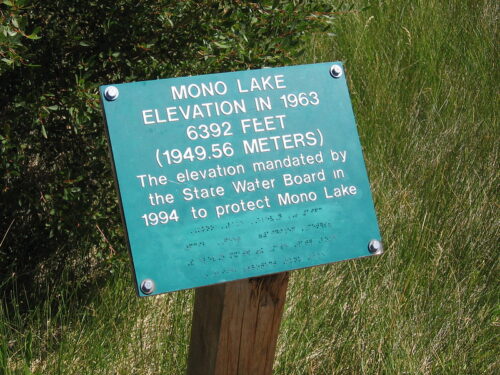 By the 1970s, the lake’s plants were dying and dust storms clouded its shoreline. People who loved the lake were worried—including the student researchers, who published their summer research as An Ecological Study of Mono Lake, California, a 200-page report distributed by UC Davis’s Institute of Ecology. The work showed that as the lake’s water level dropped and its salts became more concentrated, its brine shrimp and alkali flies—tiny invertebrates that fed the lake’s birds by the millions—struggled to reproduce. “The present populations of these animals will not be able to withstand the increasing salinity predicted for Mono Lake,” the students wrote. That spelled doom for the lake’s abundant gulls, grebes, and phalaropes.
Armed with these findings, in 1979 a group of environmental organizations sued LADWP over the aqueduct’s effects on Mono, seeking to stop the utility from diverting so much water. They based their argument on the public trust doctrine, a legal principle dating back to ancient Rome that holds that certain natural resources, like navigable waters and shorelands, are held in trust by the state for the benefit of the public. Historically, the doctrine had protected commerce and navigation, barring private landowners from blocking access to waterways below their shoreline’s high-water marks. In 1971, a legal battle over privately owned tidelands prompted California to expand the definition of “public trust” to include those waterways’ habitats and recreational uses. The Mono Lake lawsuit put this brand-new application to the test—successfully. In 1983, the California Supreme Court ruled that protecting Mono Lake’s ecosystem fell under the public trust doctrine. The court left the details to the state water board, who implemented cutbacks to L.A.’s water diversions so that more water would reach Mono and the lake could eventually return to a healthy water level.
A decade later, Mono led the way for more legal innovation—this time, a new application of the Clean Air Act, the federal law that regulates air emissions. The Great Basin Unified Air Quality Control District, responsible for regulating air pollution in eastern California, sought to curb dust storms that billowed off of the shorelines of Mono and Owens lakes—and to hold Los Angeles accountable for them. Caused by falling water levels from years of aqueduct siphoning, the storms were causing respiratory issues for local residents. Yet this required the agency to convince the courts that the Clean Air Act could regulate not just refinery or factory smokestack emissions, but also those from natural sites that had been altered by human impact.After a David-and-Goliath fight, the Ninth Circuit Court of Appeals decided that Los Angeles had to bring the Mono and Owens lakebeds into compliance with dust standards. Not only could they not divert as much water, but they had to clean up the damage that had already been done.
This article was first published at Zocalo Public Square.

