
Warming winters are reshaping runoff. With less snow to rely on, water managers are navigating a future defined by rain, risk, and uncertainty.
By Claire Carlson, Sierra Nevada Ally
This story was produced by the Sierra Nevada Ally, a nonprofit, nonpartisan news outlet focused on civics, climate, and culture.
 As average temperatures rise across the western United States, snowpack in the Sierra Nevada is dwindling. This year, Reno recorded its latest-ever frost date on November 19. When snow does fall, climate change has increased the likelihood of more extreme storms. This winter provided an example: in mid-February, a heavy snowstorm hit the Donner Pass region, triggering the deadliest avalanche in California’s modern history.
For the most part, however, warming temperatures mean precipitation falls as rain instead of snow, changing the decisions water managers make about storing runoff from the Sierras, which supplies drinking water to millions in both California and Nevada.
Reservoirs—the manmade lakes that store water—were originally designed with snowpack in mind. Snow would accumulate throughout the winter and melt slowly in spring and summer, filling reservoirs during the dry season. Each reservoir has flood space that water managers keep empty during winter in case a heavy storm fills the reservoir quickly.
Now, with more rain running off the mountains than snow, this flood space is filling earlier in the season. That requires water managers to release more water during winter, without the promise of snowmelt to replenish it in spring and summer.
“The challenge a lot of water managers are facing is how to change their operations to deal with runoff coming out of the mountains in the middle of winter, as opposed to most of it coming out in spring and summer at a slower rate,” said Dan McEvoy, a climatologist at the non-profit Desert Research Institute.
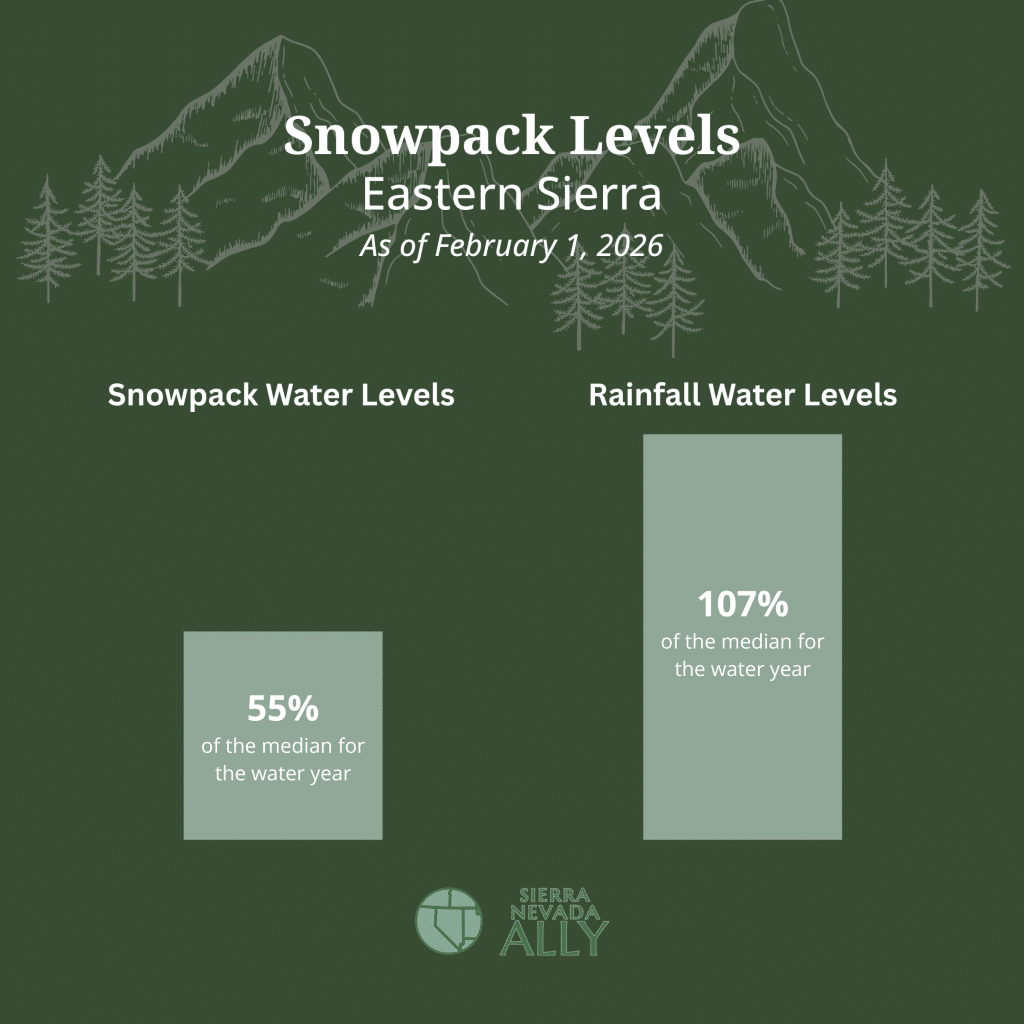
As of February 1, snowpack water levels in the eastern Sierra were 55% of the median for the water year to date, which runs from October 1 to September 30. Rainfall, by contrast, was higher than average, at 107% of the median, according to the most recent Nevada Drought Report.
To adapt to shrinking snowpack, some water managers are using a new strategy called Forecast-Informed Reservoir Operations. Rather than waiting for real-time runoff data that shows how much water is flowing into a reservoir, this new approach relies on weather forecasting to make water management decisions. Forecasts give water managers more flexibility and can help prevent flooding.
“If you have enough lead time [ahead of a storm], you can reposition that resource from the reservoir to another location,” said California State Climatologist Michael Anderson.
He said moving water downstream can help keep reservoirs full through the summer–but space is just one consideration.
“There’s a lot of work to sort through all the legal elements that go with water management to make that happen, but they’re at least exploring the space and having the conversations, and that’s a really good thing,” Anderson said.
He said navigating the downstream water rights of various users can complicate water management decisions, but collaborative conversations with stakeholders are a vital piece to the puzzle.
Ecosystem restoration in the Sierras could also solve these challenges and help offset a smaller snowpack. Scientists are focusing on wet meadows—meadows that remain wet for at least one month each year. Once abundant in the Sierras, many have dried out due to the way water has been managed in the region.
“[Water managers] once thought it was better to get the water out of the basin as quickly as possible, and so the meadows dried out,” Anderson said. “Now we recognize, boy, that’s another great storage place.”
Wet meadows are excellent at holding water in the soil, releasing it slowly like snowpack, rather than all at once as with heavy rain. While restoring these meadows could help make up for lost snowpack, Anderson said it must be paired with other strategies, like Forecast-Informed Reservoir Operations, to adequately prepare California and Nevada for a changing water future.
“It’s going to be a multi-pronged approach to fully offset what we expect to happen as the snowpack evolves through the rest of the century,” he said.
Climate models predict more variability in precipitation and temperature in coming decades, which could mean large year-to-year swings in how much rain or snow the Sierra receives. Anderson hopes water managers can use forecasting knowledge—knowing when it’s a dry year versus a wet year—when making water management decisions.
For this year, water supplies look strong: California’s reservoirs are at 120% of average levels, according to California Water Watch. Most of Nevada’s reservoirs are also above average, except for Lake Mead and Prosser Reservoir, per the Nevada Drought Report.
But warmer-than-normal temperatures at the start of 2026 (Nevada’s statewide January temperatures were 3.3°F above average) could signal a particularly dry summer, even if reservoirs remain full.
“The good news, of course, is that we still have some winter left and a lot of spring left, and the pattern can change very quickly, as we saw at the end of December,” said Nevada State Climatologist Baker Perry.
Perry and other climatologists and water managers will continue to monitor those ever-changing conditions, particularly as temperatures warm.
“But if we continue to have dry spells and above-normal temperatures, especially across northern Nevada in lower-elevation basins that typically have multiple feet of snow on the ground right now, that’s going to be a very concerning storyline moving into summer and especially the fire season,” he said.

