

At the January meeting of the California Water Commission, Joel Metzger, Deputy Director of Statewide Water Resources Planning at the Department of Water Resources (DWR), presented an overview of the proposed framework for organizing the 2028 California Water Plan, the rollout of Senate Bill 72, and coordination and consultation with the Commission.
The passage of Senate Bill 72 authorizes DWR to develop a data-driven playbook to guide and secure California’s water future. The legislation establishes a target to identify 9 million acre-feet of additional water supply by 2040 to address anticipated losses from rising temperatures.
Mr. Metzger shared early conceptual ideas for the 2028 Water Plan update and Senate Bill 72 implementation, emphasizing that these are preliminary concepts and that many decisions remain pending. Final decisions will need to be made quickly to initiate the process, as the legislation was only signed on October 1, and the water plan is due in a few years. With only about a year available for technical work, the process must begin immediately, with a statewide launch anticipated as early as mid-February.
Background
Over the years, the California Water Plan has evolved into a comprehensive inventory of water conditions across the state, providing a snapshot of current challenges and, in some cases, serving as the only source of statewide water data. Originally launched in 1957, the plan was designed to guide the development and management of California’s water resources. While it has become a valuable resource, its role has shifted over time, focusing more on monitoring and reporting than on proactive planning.
 Mr. Metzger highlighted the value of the California Water Plan, noting that over the years it has evolved into a vital resource, providing a comprehensive inventory of statewide conditions and, in some cases, the only available statewide data. He described it as a “great document” that is widely used and appreciated. However, he emphasized the need to adapt to the growing challenges posed by extreme weather and climate change.
“We need a new era of planning,” he said. “We need to take a different approach. One of the things I’m excited about through SB 72 implementation and the new water plan in 2028 is really making this plan as accessible and usable for water managers across the state, something they can reach for regularly. So I look forward to your help thinking about that and also how we can move the state forward.”
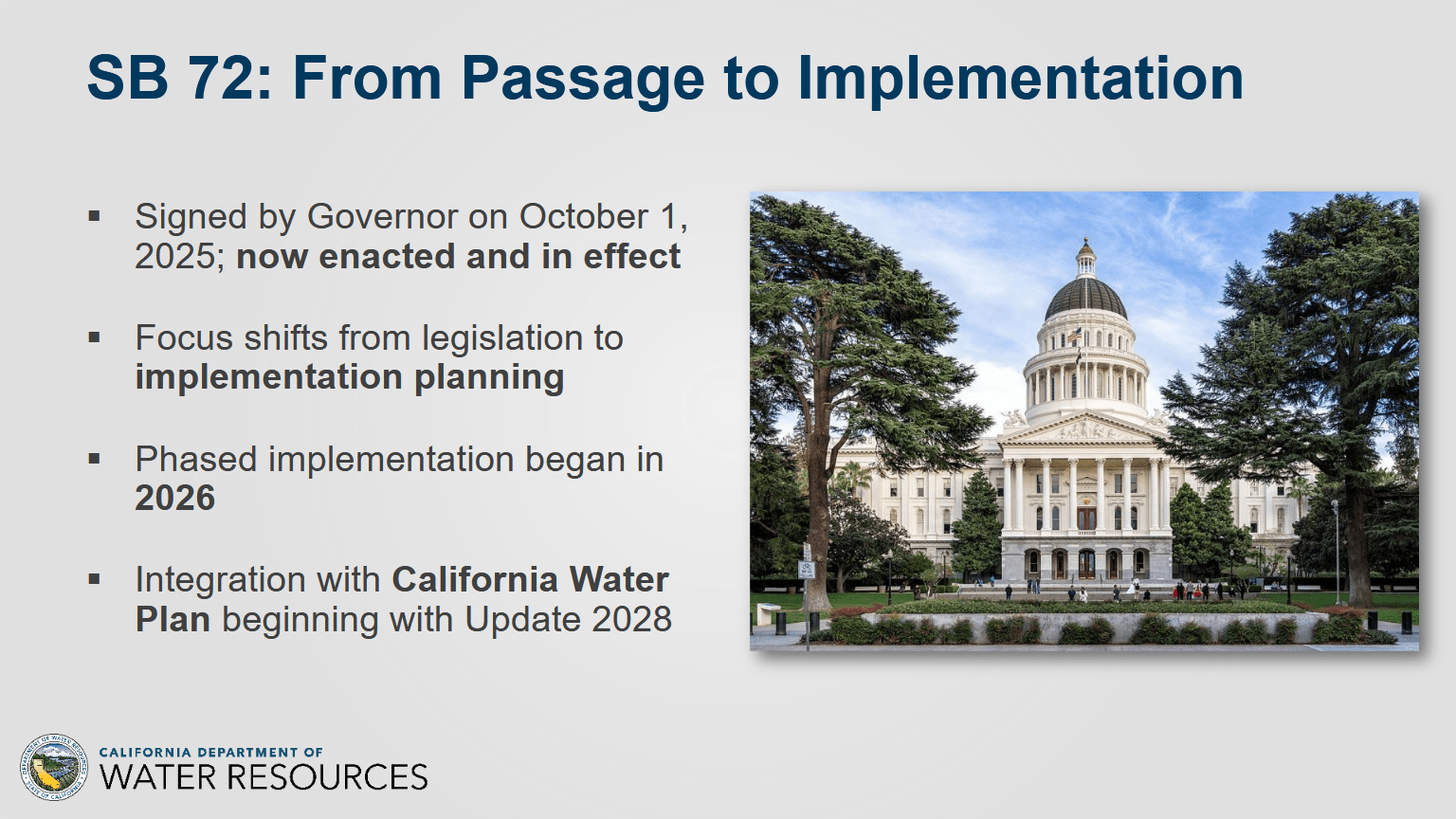
The legislative journey to SB 72 began two years ago when Senator Anna Caballero introduced SB 366. Although the bill passed both the Assembly and Senate, it was vetoed by the Governor due to budget concerns, not policy disagreements. The legislation was subsequently revised to reduce costs, and the reworked version, SB 72, successfully passed the legislature and was signed into law by the Governor on October 1.
SB 72: A Modernized California Water Plan – what the legislation directs
 SB 72 establishes the first-ever statewide water supply target, an interim target of 9 million acre-feet by 2040, and directs the Department of Water Resources (DWR) to determine a target for water supply for 2050. Specifically, the bill requires DWR to update the interim planning target for 2050 as part of the 2033 update to the California Water Plan.
“It’s an ambitious target that will be a driver of creativity and out-of-the-box thinking, so I’m excited that we have a lofty goal here that we can work toward,” Mr. Metzger said.
- The legislation transforms the California Water Plan from a source of advisory guidance into a clear, actionable implementation framework. It mandates a shift toward a modernized, assertive planning process that emphasizes statewide coordination and consultation. This includes expanding collaboration to involve the Water Commission and ensuring broad, inclusive engagement across the state. By bringing diverse voices to the table, the goal is to create a plan that not only reflects the needs of all stakeholders but also serves as a practical and effective roadmap for California’s water future.
- The legislation enhances coordination and consultation to ensure that planning aligns with both statewide priorities and regional realities. To achieve the 9 million acre-feet water supply target, it provides a range of tools, including the development of new surface and groundwater storage facilities, water conservation and recycling, stormwater capture, desalination, improved conveyance, water transfers, and demand management strategies.
- The legislation also emphasizes expanded collaboration by directing the Department of Water Resources (DWR) to involve the Water Commission, tribes, labor, environmental justice groups, and other stakeholders, fostering inclusivity and diverse input. Additionally, the legislation mandates public workshops to gather feedback and promote transparency throughout the planning process.
“There are lots of strong opinions about all of these, so I think we’ll have some robust conversations about what is in the mix that will make it into the plan to get us to 9 million acre-feet,” said Mr. Metzger. “There will be a strategy for this in the 2028 plan.”
Outreach and collaboration will be key
 DWR’s Division of Planning will lead the development of the California Water Plan, but the effort will not occur in isolation. Instead, it will be a collaborative, integrated initiative across multiple DWR departments, including the State Water Project, Sustainable Groundwater Management, Flood Management, and Multi-benefit Initiatives. This internal coordination will ensure a comprehensive approach to water planning.
Externally, DWR will work closely with state agency partners through a committee of representatives to align on key aspects of the Water Plan’s strategies. Public engagement will also play a critical role, with regional workshops held across the state to gather input, share updates, and ensure transparency. The Water Commission will be a key partner in this coordination and consultation process.
To ensure broad representation, DWR is carefully considering how to structure the advisory committee to include all interested parties identified in the legislation. The legislation specifically highlights the inclusion of urban and agricultural water suppliers, local governments, businesses, agriculture, environmental and environmental justice groups, tribes, labor, construction trades, public water infrastructure representatives, and other interested parties as appropriate. Meetings will be open to the public, and DWR is required to consult with and consider recommendations from these groups, with the flexibility to bring in additional expertise as needed.
The first advisory committee meeting could take place as early as March, with monthly meetings anticipated. The plan includes regional and issue-based caucuses, as well as a dedicated tribal advisory committee, which is being developed in collaboration with Anecita Augstinez, DWR’s Tribal Policy Advisor. Additionally, technical workgroups will provide guidance on modeling practices and methodologies.
The implementation plan
To achieve the mandates of SB 72, including the 9 million acre-feet target and the 2050 water supply goal, we are focusing on three key work streams:
- Data: Develop statewide, watershed-scale datasets using advanced technology to support planning models and activities. This includes improving water use and supply data, applying climate change scenarios, and identifying supply-demand gaps for each watershed over a 50-year horizon.
- Targets: Establish localized, credible targets for urban, agricultural, Tribal, and environmental water needs. These targets will focus on detailed watershed-level planning (HUC-8 scale) and align with the Governor’s 2022 Water Supply Strategy and SGMA, providing actionable insights for local water managers.
- Actions: Create place-specific strategies, including nature-based solutions, to close supply-demand gaps. This includes cost-benefit analyses, progress tracking, and integration across state, federal, and local planning efforts to ensure long-term water supply security.
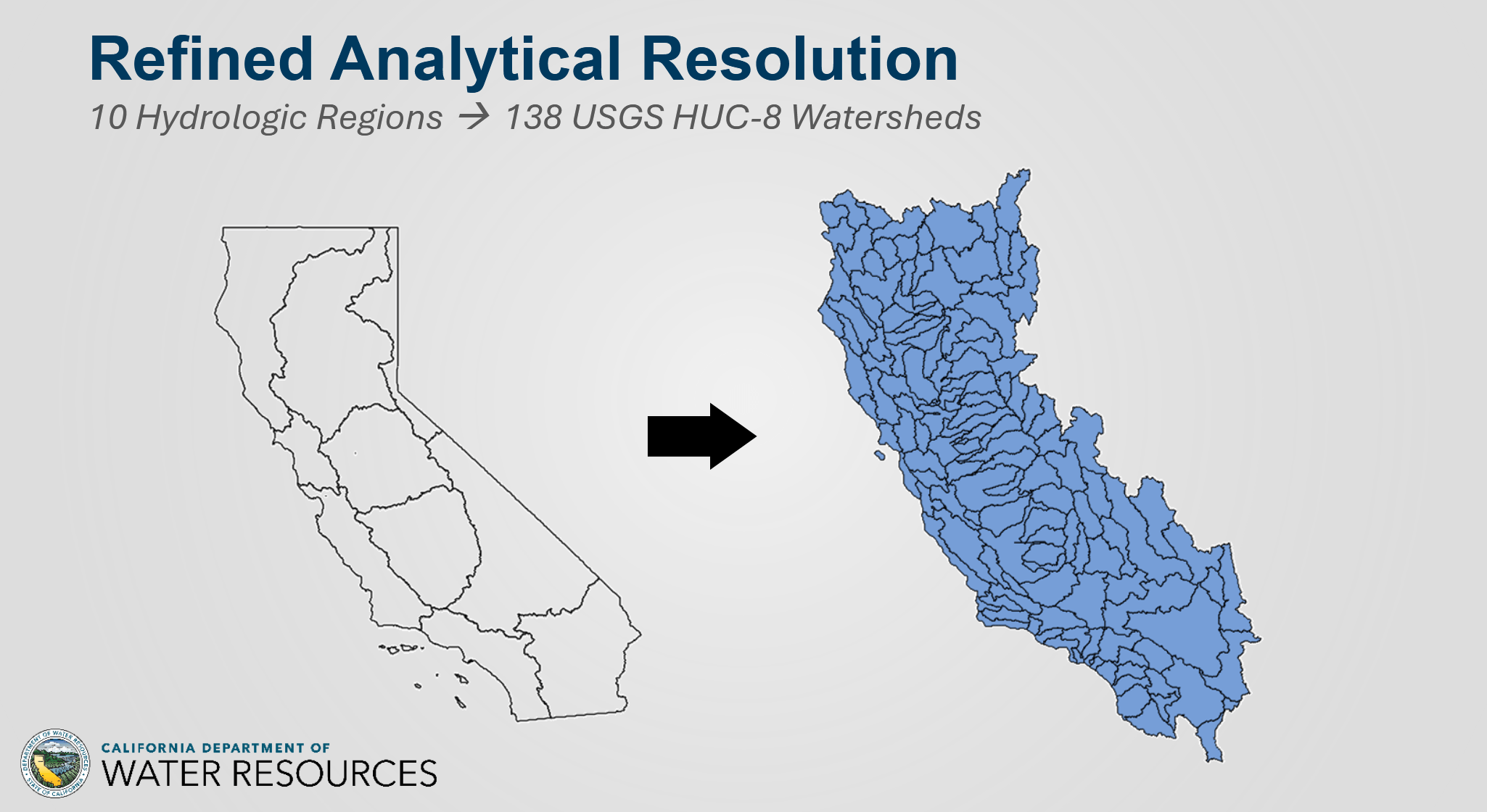 “We will provide adaptation strategies to all individual watersheds across the state,” Mr. Metzger said. “This really tracks with our push to move to a watershed level for water management. We want to look from the Sierra Crest down to the valley floor, to groundwater, out to the Delta, and into other watersheds, really looking at that holistically,” said Mr. Metzger. “Going from 10 to 138 is a huge, huge lift. But once we can get there, we feel like it’s going to be much more accessible to the average water managers across the state.”
Preliminary timeline
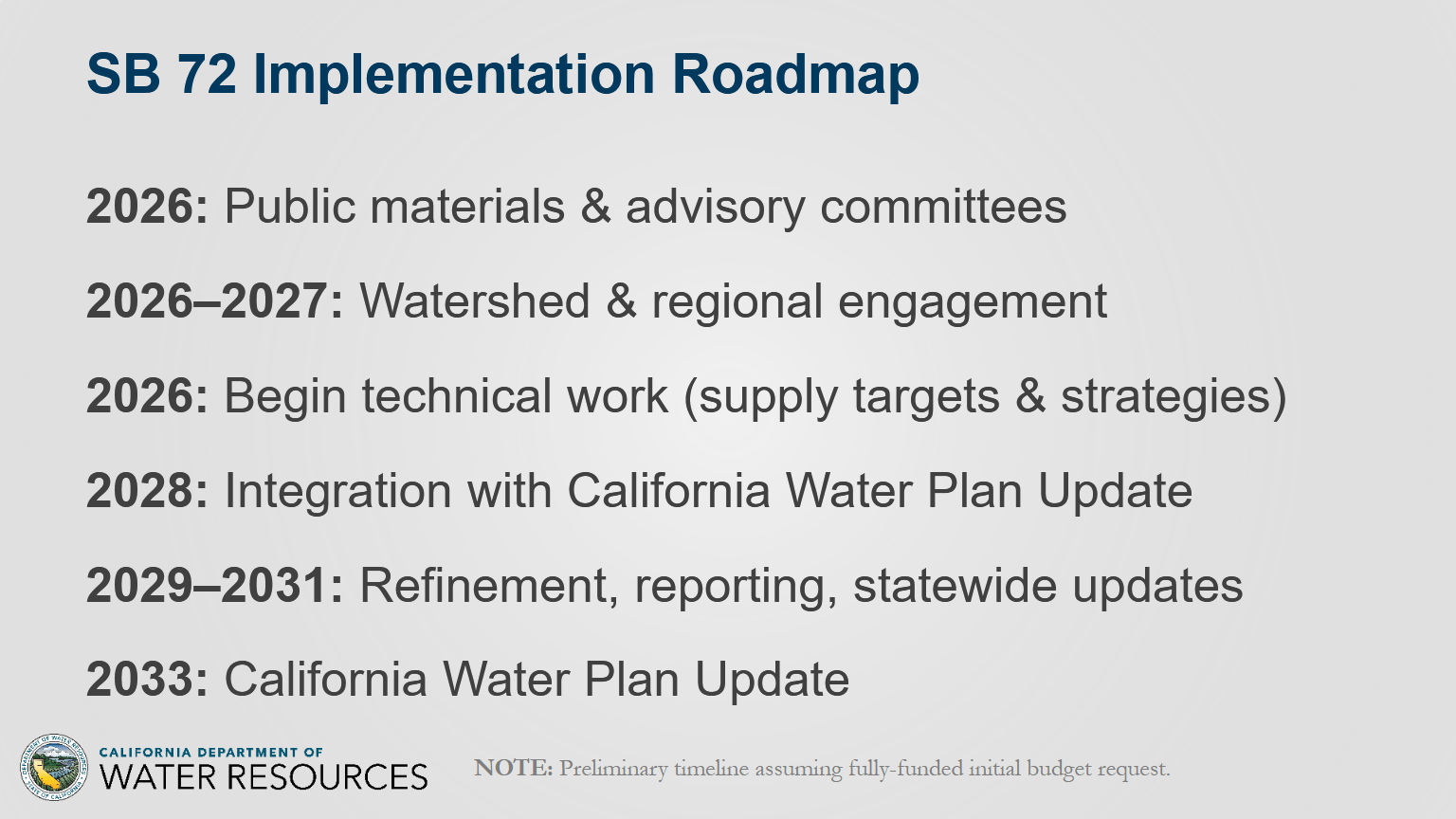 A statewide launch of public materials is planned for next month. The work required to develop the 2028 California Water Plan will roll out in 2026 and 2027, with the draft plan released a year in advance for public review. The finalized 2028 plan will be completed by the end of 2028. Following this, efforts will continue to refine the technical work required for the 2033 plan, as many of the mandates outlined in SB 72 are due by then.
Funding a concern
Mr. Metzger emphasized that funding remains a critical concern for meeting the mandates outlined in SB 72 by 2033. While there is appreciation for the funding included in the January 10 budget to support this work, securing adequate resources is essential to ensure successful implementation.
“Based on the funding level that ends up being approved when the budget’s finalized this year for next fiscal year, that’s going to have a direct impact on our ability to deliver these mandates in SB 72, so we just want to make sure that we are communicating about the impacts of that,” Mr. Metzger said.
Looking forward …
The Commissioners expressed strong support for the ambitious SB 72 effort, emphasizing its importance in addressing climate change and growing water needs. They highlighted the Commission’s expertise in public outreach, stakeholder engagement, and reporting.
“We have been a long-time arm of the department in doing the public outreach to the disadvantaged communities, the water community, the tribal communities, and we certainly are offering our assistance in that way, and hope that you’ll be calling us,” said Chair Fern Steiner.
Mr. Metzger said he was excited to really work on meaningful collaboration and coordination with the Commission that brings things forward, that actually make it into this plan, and that influence the process.
“I want to leave you with one more thing. One of my commitments as a former journalist, way back in my career, is all the way through this process; my goal is to talk in layman’s terms to everyone, not just water managers, but to everyone in our state, and make this very understandable and digestible. I want board members, council members, and people to understand what we’re talking about, even if they aren’t water experts. And I think that if we can’t do that, then nothing else we do is going to be successful. So that’s a huge priority for me and my team in this process, and I think it’s a big priority for DWR as a whole, is to be better translators of the technical to the everyday person.”

