

by Robin Meadows
Many of the great rivers that meet in the Sacramento-San Joaquin Delta begin high in the Sierra Nevada, where summer snowmelt feeds streams that start as trickles and then gush downslope toward the sea.
“These tiny, little streams add up to the Delta, “says Jeffrey Lauder, a forest ecologist and Executive Director of the Sierra Streams Institute, a Nevada City-based nonprofit that focuses on watersheds in the Northern Sierra Nevada. But, despite their vital role in the Delta’s water supply, the future of mountain streams under climate change is little known.
A new project, led by the Sierra Streams Institute and funded by the Delta Stewardship Council’s Delta Science Program, will gauge likely changes in mountain headwaters to the Delta as the world warms. In keeping with the Delta Science Program’s emphasis on co-producing knowledge with tribes, this project will also integrate Western science with Indigenous knowledge.
USING THE PAST TO SAFEGUARD THE FUTURE
“We’ve been monitoring tributaries to the Delta for more than 25 years,” Lauder says. “Our goal is to use this baseline to pick out climate impacts.”
This long-term monitoring has focused on 15 sites in Northern Sierra Nevada watersheds that feed into the Delta, and includes stream flow, water quality such as temperature and dissolved oxygen, and the diversity of bottom-dwelling insects or bugs.
“They live under rocks at the bottom of the creek and are the larvae of dragonflies and other insects you see flying over the creek,” says Helen Fitanides, Science Director of the Sierra Streams Institute and lead on its long-term monitoring program.

Bugs live in the water for about a year and are the foundation of stream food webs, making them indicators of stream health. “They’re the canary in the coal mine,” Lauder says.
But there’s a lot of variation in how bugs respond to climate extremes―from warmer air and water to faster snowmelt to more intense droughts and deluges―and the reasons for this variability are uncertain. Understanding how climate stress affects mountain headwaters is the first step to boosting resilience of these key contributors to the Delta’s water supply.
In particular, identifying the most climate-vulnerable sites will help land managers decide where to concentrate restoration efforts. In agricultural watersheds with excess nutrients, for example, higher temperatures or lower flows can make algal blooms more likely. In contrast, uncultivated watersheds where streams are shaded by riparian forests are more resilient to climate-driven changes in temperature and flow.
“Long-term monitoring isn’t sexy,” Fitanides says, adding that it can be hard to get funding. But while it may sound like an old-fashioned kind of science, tracking ecosystem health is more relevant than ever in these times of rapid change. As just one example of the value of long-term monitoring, researchers recently relied on surveys that UC Berkeley zoologist Joseph Grinnell began a century ago to document climate-driven bird extinctions in the Mojave Desert.
ENHANCING THE CLIMATE RESILIENCE OF DELTA HEADWATERS

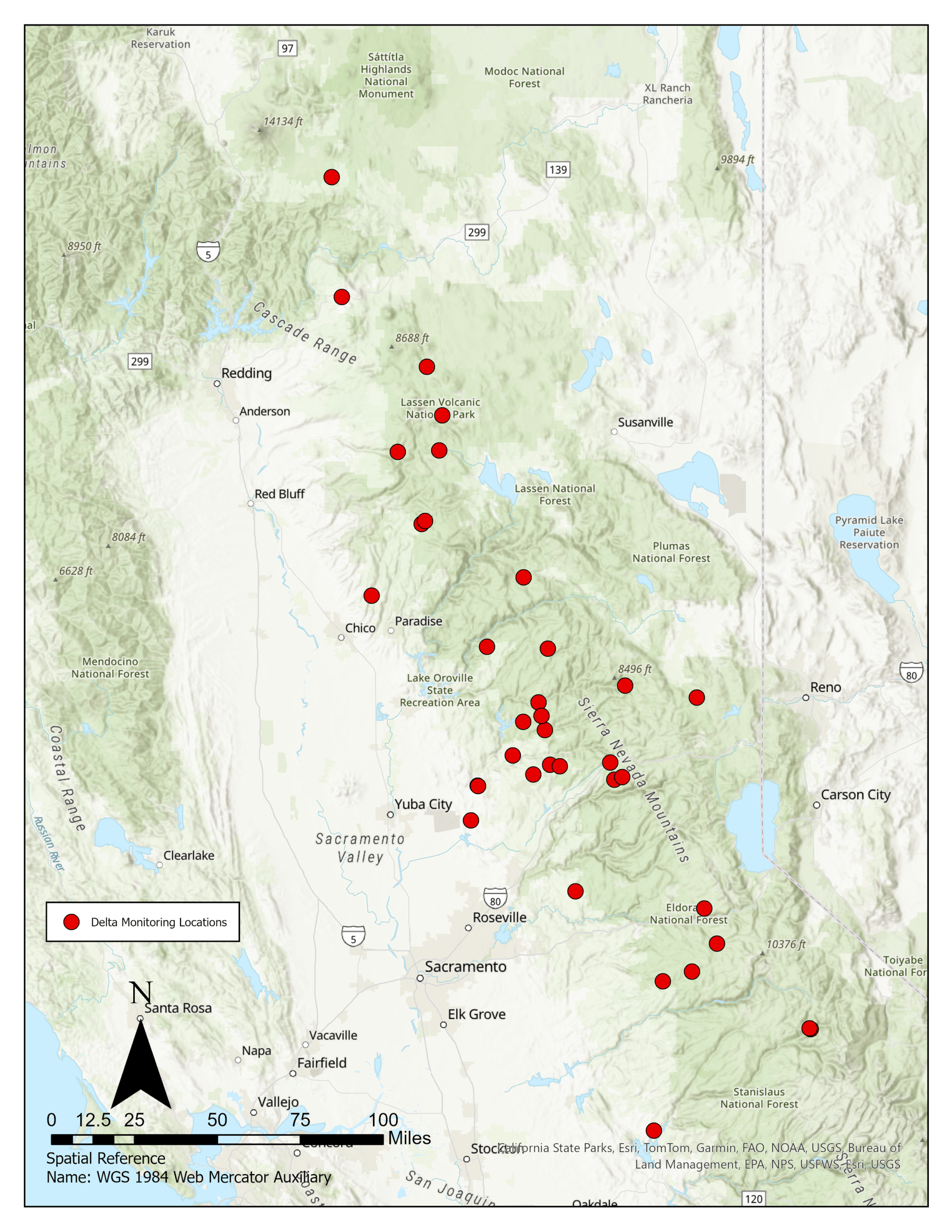
To model climate impacts on Delta headwaters, Lauder and Fitanides are combining their long-term mountain stream monitoring with several other data sets. These include publicly available land use data, such as forest cover, agriculture and residential, as well as historical climate data for the monitoring period, which includes both the hottest, driest and coldest, wettest years on record. The team is also expanding its headwater stream monitoring for two years, focusing on 36 sites where historical data is available.
The project launched in 2025 with its first field season. A crew of about a dozen spent June through September monitoring the 36 headwater stream sites, which spanned 335 miles as the crow flies. This coming summer, the team will conduct its second and final field season. Then the researchers will dive into the data and build their model of climate change impacts on Delta headwaters, with an expected project wrap up in the spring of 2028.
INTEGRATING WESTERN SCIENCE WITH INDIGENOUS KNOWLEDGE
Lauder and Fitanides are also working to incorporate Indigenous knowledge into their model. Many of the project headwater monitoring sites are in the ancestral homelands of the Nisenan Tribe, and the researchers are reaching out to their long-standing partners in the tribe. The Sierra Stream Institute’s collaboration with the Nisenan Tribe includes establishing a garden of culturally important native plants in Nevada City’s Deer Creek Tribute Trail system, which is in the tribe’s homelands. The Institute has also begun building a family education program that melds Western science with the Traditional Ecological Knowledge (TEK) that tribal members pass from generation to generation in songs and stories.

Likewise, Lauder and Fitanides will integrate TEK the Nisenan gather from their songs and stories into the model of the climate vulnerability and resilience of Delta headwaters in the Northern Sierra Nevada. The Nisenan have lived in the region far longer than descendants of European settlers, and the researchers see the tribe’s TEK as a form of long-term monitoring that predates the Sierra Stream Institute’s work.
The researchers also aim to incorporate the Nisenan’s spiritual and holistic values into their model. “We can model climate change and its impacts on ecological systems, but we are hoping to have scales of cultural value right next to scales of ecological health,” Lauder says. “What does it mean beyond what Western science looks at and cares about?”
“We’re really focusing on how science and Indigenous values can come together to improve management in the Delta,” Fitanides adds. “Our goal is to reduce uncertainty about the Delta’s water supply in the future, and to help land managers make locally calibrated decisions about restoration, conservation, and water delivery in the face of climate change.”

