

Science is an ongoing process, not a one-time study or a single definitive answer. It’s about building knowledge, testing ideas, and refining our understanding over time to inform better decisions. A presentation at the December meeting of the Delta Stewardship Council shows how Operation Baseline exemplifies this process in action.
 In the 2000s, the Delta’s aquatic food web collapsed, with populations of species such as the Delta smelt and longfin smelt plummeting during the pelagic organism decline (POD). Scientists pointed to potential causes, including water diversions, habitat loss, climate change, invasive species, and contaminants. Among the suspects was the Sacramento Area Sewer District’s wastewater treatment facility, which processed 135 million gallons daily. The ammonium in the discharge was hypothesized by some to disrupt the Delta food web.
In response, the Central Valley Regional Water Quality Control Board issued a 2010 mandate requiring advanced treatment to remove ammonium and nitrate, reduce pathogens by 2021, and add filtration and disinfection by 2023.
Recognizing the need for a clear “before” picture of Delta water quality, the Delta Science Program launched Operation Baseline nearly a decade ago. With $4.5 million in funding, the Council supported studies to develop tools and collect data beyond regulatory requirements to understand pre-upgrade conditions and enable meaningful post-upgrade comparisons. This collaborative effort, bolstered by additional funding and resources, aimed to establish baseline nutrient and phytoplankton levels, assess the ecological impacts of the $1.7 billion treatment plant upgrade, and modernize water quality monitoring to better capture changes over time and across the Delta.
 By 2021, SacSewer met its deadline, eliminating nearly all ammonium and reducing total dissolved inorganic nitrogen concentrations in treated wastewater by over 60%. While nitrate levels increased, overall nutrient levels declined significantly.
“We’re still learning from Operation Baseline today,” said Jessica Pearson, Delta Stewardship Council Executive Officer. “Those early studies give us a reference point we can keep coming back to so we can understand what’s changed, what hasn’t, and what it means for the Delta going forward.”
The Role of Nutrients and Phytoplankton in the Delta Food Web
 Phytoplankton, fueled by nutrients like nitrate, ammonium, and phosphate, form the base of the Delta’s food web, ultimately supporting native fish, especially pelagic species. Striking the right nutrient balance is essential: too few nutrients limit productivity, while excess nutrients can lead to harmful algal blooms, invasive plants, and disruptions to food webs. Without this balance, healthy phytoplankton communities decline, destabilizing the entire ecosystem.
The type of phytoplankton also matters. Beneficial diatoms support a healthy food web, while cyanobacteria can produce harmful toxins.
“So ideally, we want to find the right balance of nutrients to support a healthy food web and minimize negative effects. But our existing monitoring network at this time was missing key information,” said Dylan Stern, Program Manager for the Delta Stewardship Council.
Advancing water quality monitoring in the Delta
Operation Baseline expanded upon decades of monitoring in the Delta. For more than 50 years, the Interagency Ecological Program‘s Environmental Monitoring Program has tracked nutrient concentrations and phytoplankton, but much of this work concentrated on deep, open waters—frequently missing smaller, yet ecologically vital, regions.
To address this, the research team developed a flow-through system mounted on a boat. This high-resolution survey method provides a comprehensive Delta-wide snapshot in just four days, capturing data not only from open water but also from smaller channels and wetlands.
“The team had to develop a lot of new tools, methods, sensors, and as a result, it also helped to improve nutrient modeling and helps us track cyanobacteria toxins,” said Mr. Stern. “Operation baseline enabled coordinated high-resolution monitoring that really let us see the Delta as a connected ecosystem.”
Eight ways Operation Baseline has advanced Delta science
1. Operation Baseline modernized water quality monitoring by improving the collection of over space and time.
 Water quality monitoring has evolved significantly since Operation Baseline. While extensive monitoring was already taking place at fixed stations, Operation Baseline expanded on these efforts to fill critical gaps.
Before the treatment plant upgrade, the existing monitoring system wasn’t equipped to explore how nutrients and phytoplankton interact across the Delta or to establish baseline conditions. Operation Baseline stepped in to fill this gap, modernizing and expanding water quality monitoring to meet the goals of this collaborative effort.
Building on existing programs, Operation Baseline introduced innovative approaches to improve water quality measurement. These studies enhanced the monitoring toolkit, moving beyond traditional grab samples to include high-resolution Delta-wide surveys and continuous real-time sensors. This comprehensive approach provided a clearer picture of nutrient levels, phytoplankton communities, and key water quality indicators, including temperature, salinity, clarity, and dissolved oxygen. These advancements have significantly improved our ability to track changes over time and space, deepening our understanding of the ecological effects of nutrient management actions.
“This was an amazing opportunity,” said Tamara Kraus, Research Scientist with the USGS. “We don’t often know that there’s going to be an exact date where we’re going to see a major shift in a baseline. You know, we think about climate change, it’s sort of happening slowly, but the wastewater treatment upgrade was really a day that we knew they would almost, pretty much flip a switch. So we had time as a community to discuss what monitoring needs there were to measure the change.”
2. New Instrumentation measures not only how much phytoplankton but also which kinds.
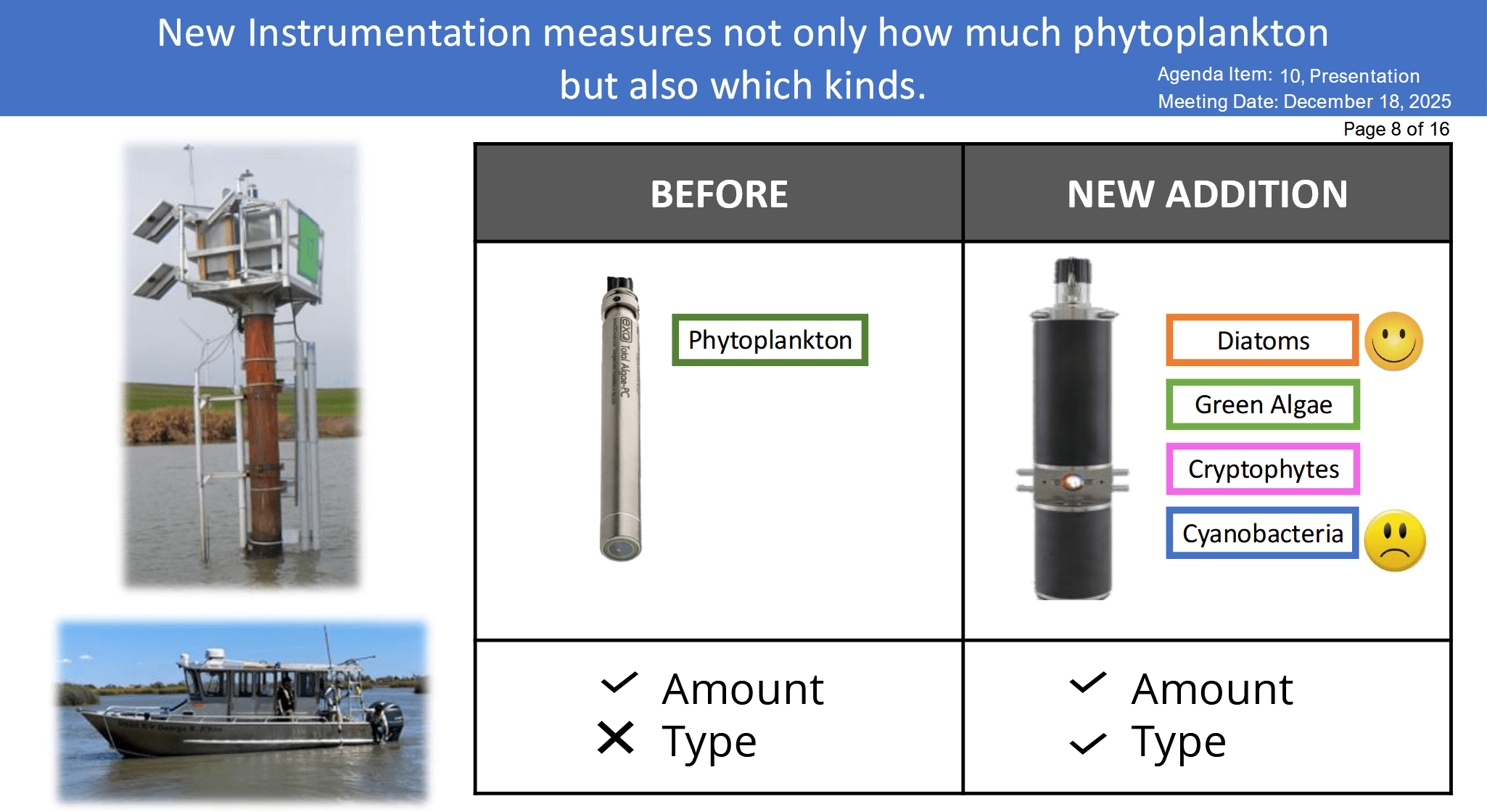 One hypothesized outcome of the treatment plant upgrade was that a shift in nutrient concentrations across the Delta would foster the growth of beneficial phytoplankton—primarily diatoms—that support the food web.
Traditionally, phytoplankton monitoring relies on sensors that measure chlorophyll. While widely used, these sensors can’t identify the types of phytoplankton present, requiring costly lab analysis of discrete samples, which limits the amount of data collected both across different locations and over time.
So the project adapted a FluoroProbe, a commercially available instrument, for use in the Delta. The FluoroProbe is an in situ instrument that collects data every second and identifies four classes of phytoplankton. This new tool now measures not only the amount of phytoplankton but also whether the right types—like diatoms—are present, providing a more detailed and efficient way to monitor the Delta ecosystem.
3. Operation Baseline produced high-resolution mapping surveys.
 The project developed a method to use the FluoroProbe on a boat by flowing water through it. The boat was equipped with as many available instruments as possible, including a new flow-through ammonium analyzer, funded by Operation Baseline. The boat was then used to conduct high-resolution mapping surveys across the Delta, providing unprecedented insights into conditions in channels, shallow water areas, and backwater regions.
The figure on the left shows ammonium concentrations, with yellow indicating higher levels. Previously, the wastewater treatment plant was a significant source of ammonium in the northern Delta, but now the yellow has disappeared, showing flatlined levels with ammonium nearly undetectable in most of the Delta. This is just one of many parameters measured during these boat surveys.
4. Mapping surveys captured spatial information that was missed by fixed stations.
 The graphic on the left, generated by the FluoroProbe instrument, shows a significant bloom in that region of the Delta. Importantly, it was a diatom bloom—the beneficial type of phytoplankton that supports the food web. This bloom might have gone unnoticed without the high-resolution mapping, as no fixed monitoring stations were located in that area.
These mapping surveys also help identify strategic locations for new fixed monitoring stations. Following this discovery, additional stations were installed to better track phytoplankton and nutrient dynamics in the Delta.
5. Operation Baseline expanded HABs cyanotoxin monitoring.
 Harmful algal blooms (HABs) are an increasing concern globally, nationally, and in the Delta. However, not all blooms are harmful, and not all cyanobacterial blooms produce toxins. Understanding and modeling phytoplankton and harmful algal blooms becomes even more complex when accounting for the presence—or absence—of cyanotoxins, which are critical for assessing potential public health risks.
To address this challenge, the Delta Science Program played a key role in launching efforts to collect comprehensive data on cyanotoxins alongside other water quality metrics. In 2018, a cyanotoxin monitoring program was established. Over the years, numerous agencies have contributed to expanding and sustaining the program.
6. Operation Baseline expanded nutrient sediment monitoring.
 While much attention has been given to ammonium and nitrate inputs from point sources—such as agriculture, wastewater treatment plants, and urban runoff—data were lacking on nutrient contributions from sediments, including recycled nutrients and those released by decomposing biomass.
So a modification was made to the mapping boat. Instead of drawing water solely from the regular water column, a chamber was deployed to collect samples. This allowed researchers to observe changes in nutrient levels over time, providing insights into the significance of ammonium and nitrate sources originating within the Delta itself. Additionally, sediment samples were collected to further understand nutrient dynamics and their interactions with the Delta ecosystem.
7. Operation Baseline generated data that can be used to develop and ground-truth models.
 While models offer powerful insights, they rely on accurate, measured data to function effectively. Operation Baseline provides critical data to develop and validate models, ensuring they are grounded in real-world observations. This observational data strengthens models, enabling them to support forecasting, hindcasting, mechanistic understanding, and scenario testing.
8. Develop integrated monitoring systems that provide system-wide information in near real-time.
 Many researchers are focused on integrating various data collection methods to leverage parameters observable from space. Phytoplankton is one such parameter, as its green pigmentation makes it detectable via satellite imagery. While nutrients themselves cannot be directly observed from space, phytoplankton serve as a visible indicator of nutrient dynamics. The goal is not only to measure phytoplankton abundance but also to potentially identify species composition, offering deeper insights into ecosystem health and food web dynamics.
LOOKING FORWARD
 Operation Baseline has established a robust baseline for the Delta, providing a critical reference point for measuring and tracking changes over time. The Delta is a dynamic system, constantly evolving due to factors such as the introduction of new invasive species like golden mussels, the impacts of climate change, and large-scale wetland restoration projects. This baseline equips researchers and managers with the tools needed to better understand and respond to these ongoing changes.
“To track these changes, we really need consistent funding for these integrated studies, and especially the high-resolution monitoring that really gives us the data we need to answer the questions that we have,” said Dylan Stern. “So, we really were able to demonstrate through this whole process that a coordinated and comprehensive monitoring is not only possible, but really essential to understand the nutrient balance and how we can protect the Delta food web.”

