
Several news sources featured in the Daily Digest may limit the number of articles you can access without a subscription. However, gift articles and open-access links are provided when available. For more open access California water news articles, explore the main page at MavensNotebook.com.
In California water news today …
What can engineers learn from Klamath River dam removals as trend ramps up?

“Ninety years after the Hoover Dam opened to great fanfare, and following decades of rapid dam building across the country, more dams in the U.S. are now being removed than built. In 2024 – which tied 2019 for the most dams (108) removed in a single year – the largest dam removal effort in U.S. history was completed. The Klamath River dam removal project dismantled four aging hydroelectric dams along the 257-mile Klamath River in Oregon and California. Led by the Klamath River Renewal Corp., the $500 million project involved a meticulously planned drawdown and dam deconstruction sequence designed to manage flow and sediment transport through the hydrologic reach and restore the river to a free-flowing condition. … Several more dam removal projects across the nation are in the works. As these efforts and others move forward, what lessons from the Klamath project can help increase the likelihood of similarly positive outcomes? … ” Read more from Civil Engineering Source.
Striking weather contrast to hit West Coast, with gobs of snow and record heat
“A striking weather contrast is expected to unfold across the West Coast in mid-March as buckets of rain and feet of mountain snow are on tap for the Pacific Northwest, while true summerlike heat is anticipated in California. Monthly temperature records may be threatened in Yosemite National Park, while Mount Rainier National Park contends with its wettest March in years. Cold storms this week will bring gobs of snow to the Cascade Range of British Columbia, Washington state and Oregon, with 4 to 8 feet forecast Monday through Saturday, prompting the National Weather Service to issue winter storm warnings. But the snow line is expected to climb next week as a warmer Pineapple Express system raises the risk of flooding due to heavy rain and snowmelt. Spoiler: California isn’t due for any of it. … ” Read more from the San Francisco Chronicle.
Sierra snowpack running critically low and reservoir water levels may not last the summer
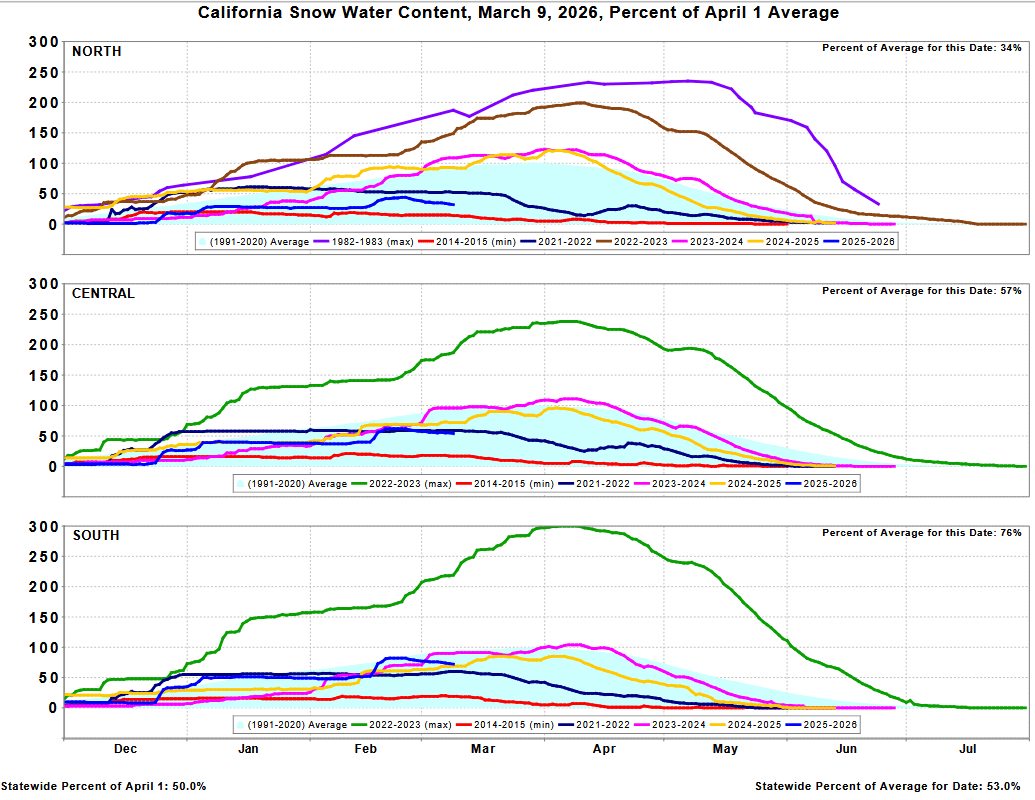
“The California Department of Water Resources (DWR) wrapped up its late-February snow survey with mixed results: conditions had improved slightly from January, but warm winter storms triggered significant low-elevation snowmelt, keeping statewide water levels well below average. David Rizzardo, hydrology section manager at DWR, said reaching 100% of average by April 1 would require several additional feet of accumulation — particularly across the Northern Sierra, home to California’s largest reservoirs. “Even with more storms in March, that much snow accumulating in a single month is very unlikely,” he said. Snowpack functions as California’s largest natural reservoir, gradually releasing water into rivers and lakes through spring. It typically accounts for roughly a third of the state’s annual water supply. When it falls short, reservoirs can struggle to sustain communities through the long, dry summer months. … ” Read more from Active NorCal.
Lake Oroville releases reduced as officials focus on conserving water
“With drier weather returning to Northern California, state water officials are dialing back releases from Lake Oroville in an effort to conserve as much water as possible while still meeting flood safety and environmental requirements. The California Department of Water Resources (DWR) reduced flows from Oroville Dam into the Feather River from about 10,000 cubic feet per second to roughly 9,000 cubic feet per second. The move reflects improving reservoir conditions and a shift toward preserving water as the region transitions out of the latest storm cycle. Lake Oroville, currently sitting at about 871 feet in elevation and roughly 87 percent of its total capacity, plays a crucial role in California’s water system. As the largest reservoir in the State Water Project, it helps deliver water to millions of residents while also protecting downstream communities from flooding. … ” Read more from Active NorCal.
Habitat mosaics: Piecing together the diversity of salmon life histories
“As humans, our lives are like puzzles, occurring in a variety of places that all shape us. The same is true for fish which often move across a patchwork of environments over the course of their lives. Scientists refer to these patchworks as habitat mosaics—networks of habitats that provide a variety of resources. Along a salmon’s migration path, these mosaics can include upstream tributaries, mainstem rivers, floodplains, estuaries, and the ocean. This migration path is often erroneously thought of as a direct pipeline, with all salmon growing in natal streams before shooting downstream to the ocean. However, a simple pipeline may not have been able to support the large numbers of salmon historically present in our rivers (think salmon runs “thick enough to walk across their backs from shore to shore”). So how did the environment support all those salmon, and where do habitat mosaics fit into the picture? … ” Read more from FishBio.
Six generations of farming: Cannon Michael on water, innovation, and the future of California agriculture
“California agriculture faces enormous pressure—from water shortages and rising regulations to uncertain markets. Yet farms like Bowles Farming Company continue to adapt, innovate, and feed millions of people. In a recent interview, Cannon Michael, president and CEO of Bowles Farming Company near Los Banos, shared insights into his family’s six-generation farming legacy, the realities of farming on California’s West Side, and why the future of agriculture will depend on water policy, innovation, and public understanding. Bowles Farming Company traces its roots back to the mid-1800s when Michael’s third great-grandfather immigrated from Germany and became involved in California’s early cattle industry through the historic Miller & Lux operation. Over the decades, the business evolved from cattle production into a diversified farming operation. Today, Michael represents the sixth generation of his family to run the farm, which now grows a wide range of crops in the San Joaquin Valley. … ” Read more from AgNet West.
Could forest thinning help with water conservation?
“Forests are essential to regulating snowmelt. That’s according to the latest study from the University of Washington. Researchers set out to study fire resilience by putting tried and true ways to keep fires at bay to the test. One of the ways is forest thinning, a traditional method of wildfire management, practiced by North American Indigenous people for centuries but often dismissed in modern times. It’s when foresters shred, mulch or burn small trees, scrubs and dense understory brushes, creating small and medium-sized gaps in the crowns. They also remove any plants resistant to fire. The latest study, published in the Frontiers in Forests and Global Change journal, shows that forest thinning not only protects against wildfires, but also helps conserve water and replenish the existing natural and human-made reservoirs. … ” Read more from Deseret News.
Earth is warming faster than previously estimated, new study shows
“Planetary warming has significantly accelerated over the past 10 years, with temperatures rising at a higher rate since 2015 than in any previous decade on record, a new study showed. The Earth warmed around 0.35 degrees Celsius in the decade to 2025, compared to just under 0.2C per decade on average between 1970 and 2015, according to a paper published on Friday in the scientific journal Geophysical Research Letters. This is the first statistically significant evidence of an acceleration of global warming, the authors said. The past three years have been the hottest on record, compared to the average before the Industrial Revolution. In 2024, warming went past 1.5C, the lower limit set by the Paris Agreement. That target refers to temperature increases over 20 years, but breaching it for one year shows efforts to slow down climate change have been insufficient, the scientists who wrote the new paper said. … ” Read more from the LA Times.
In commentary today …
Newsom oversees years of failed California water policy
Daniel M. Kolkey, a former judge and former counsel to Governor Pete Wilson, writes, “2026 began in California with two atmospheric rivers and storms, which resulted in precipitation that was 119% of average rainfall for January. However, much of it flowed into the Pacific Ocean. Moreover, by the end of February our statewide snowpack was only 66% of average for this date, constituting a significant decline from 85% at this time last year. This is critical because the snowpack acts as a reservoir that releases water to rivers and supplies man-made reservoirs when the climate is dry. If our existing number of reservoirs — built to supply a smaller population — reach capacity, they cannot store the runoff. We Californians must never lose sight of the fact that our state suffers intermittently from droughts. Indeed, California was suffering from drought when it first became a state in 1850. One of our longest droughts lasted seven years from 1928-1934. And California has suffered drought for 12 of the past 20 years — 2007-2009, 2012-2016 and 2019-2022. It therefore should be obvious that to serve its residents, California must build more water storage facilities that capture and store rain and runoff. … ” Continue reading at the OC Register.
A look at current reservoir and snow conditions …



In regional water news and commentary today …
NORTH COAST
Tolowa Dee-ni’ Nation’s fish hatchery operation netting results: ‘Nurturing the next generation of fish’
“The Tolowa Dee-ni’ Nation’s Fisheries Division and staff at Rowdy Creek Fish Hatchery in Smith River, Calif., have been busy collecting steelhead broodstock and rearing juvenile Chinook salmon that spawned in the fall and winter of 2025-26 and will be released this spring. Last November, staff from the Nation’s Natural Resource and Public Works and Facilities departments, with help from the California Department of Fish and Wildlife, collected adult Chinook salmon from the mainstem Smith River using a beach seine and transported them to the hatchery. Eggs were collected from females and fertilized using milt (sperm) from males. The eggs were incubated until hatched. In February, Fisheries Division and hatchery staff began transferring Chinook salmon fry (young salmon whose yolk sac is almost fully absorbed) to outdoor ponds for their next stage of growth, where they learn to feed. During the ponding process, staff weigh and count small batches of fry to estimate the number of fish that have been ponded. In late spring/early summer the juvenile Chinook salmon will be released into the river at the lower Smith River Fred Haight Boat Ramp. … ” Read more from the Redheaded Blackbelt.
Editorial: Clearlake needs the state’s help after sewage spill
The Santa Rosa Press Democrat editorial board writes, “Nearly two months after a ruptured sewer main in Lake County spilled 2.9 million gallons of raw sewage, residents still cannot use their tap water. Instead, they fill buckets, haul water and wait. It is past time that California delivers the assistance those families desperately need. The Press Democrat’s Anna Armstrong and Isabel Beer have documented the crisis in detail. They reported how the Jan. 11 pipeline rupture contaminated the shallow aquifer that supplies private drinking wells across the Burns Valley area of Clearlake. The affected zone quickly grew from 58 properties to more than 160. Lake County Special Districts, the agency responsible for the sewer system, has not made the reporters’ job easy. Officials have not responded to repeated requests for comments. That silence might reflect the fact that the current emergency has overwhelmed them. Even so, residents deserve answers about a disaster that was, by every indication, years in the making. … ” Read more from the Santa Rosa Press Democrat.
SIERRA NEVADA
Dry, and above average temps are forecasted this week for South Lake Tahoe
“A “moisture-starved” system passes through the Sierra on Monday and Tuesday, bringing only slightly increased breezes during the afternoon hours. A warming trend continues this week in South Lake Tahoe, with above-average temperatures according to the National Weather Service (NWS) in Reno. It will continue to be dry typical afternoon breezes expected through much of the week. Expect slightly increased breezes on Monday and Tuesday afternoons. The average high for March in South Lake Tahoe is 48°, with an average low of 28°. … ” Read more from South Tahoe Now.
SACRAMENTO VALLEY
Pull peach trees? Or grow without a buyer? Sutter County farmers face dilemma
“Thousands of tons of peaches without a cannery to process them will soon grow in orchards throughout the Central Valley, assuming those peach trees remain in the ground. Peach growers are waiting to learn whether they will receive funding to remove the thousands of acres of peaches growing without a home after the bankruptcy of Del Monte Foods led to the cancellation of 20-year contracts — many of which began within the past few years — valued collectively at more than $550 million. The California Canning Peach Association has proposed a $12 million tree-pull program to the U.S. Department of Agriculture, using $3 million from the association and industry matched by $9 million of federal aid. Rich Hudgins, canning association president, recently met in Washington, D.C., with USDA officials from the Agricultural Marketing Service, to whom he emphasized the plight of the affected growers, and the need for a resolution soon, citing pressure from state laws penalizing abandoned orchards. … Among Central Valley communities, Sutter County has the largest number of affected growers, Hudgins said. … ” Read more from the Sacramento Bee.
Getting our feet wet: bringing photography students into the Yolo Bypass
Eliza Gregory writes, ” … In the 2025-26 school year, I’ve had the pleasure of working with 25 college seniors in the BFA (Bachelor’s in Fine Arts) Photography Program at Sacramento State University to investigate the rhythms and restoration processes going on within the Yolo Bypass. In a mixture of environmental education, experiential learning, art-making, and storytelling, the students and I have explored the Yolo Bypass under the guidance of John Brennan and Carson Jeffres. They coordinated four field trips, to different parts of the Bypass, so that we could see salmon habitat restoration projects at various stages of development. These projects find ways to get water back onto the land—ways to let the land flood again, while maintaining the agriculture and urban areas within the floodplain. And now the work we made in response to that research is on display at the Crocker Museum through April 12th. … ” Read the full post at the California Water Blog.
BAY AREA
Marin Municipal Water District plans water main replacement in Fairfax
“The Marin Municipal Water District plans to replace century-old water pipes this spring and summer on Bolinas Road in Fairfax. The agency presented plans at the Fairfax Town Council meeting on Wednesday to replace 4,350 feet of pipeline starting near Deer Park Villa and working north to Broadway. The work will begin in April and will conclude by September or possibly earlier, according to the district. Crews will excavate 2-foot-wide trenches, proceeding in 200-foot segments. The work, planned for 8 a.m. to 5 p.m. weekdays, will affect nearby parking and require temporary water shutoffs of up to eight hours. “We’ll be reducing the risk of major water main ruptures and associated damages, as it applies to major events such as earthquakes,” said Zach Talbott, engineering manager. … ” Read more from the Marin Independent Journal.
Editorial: Leadership key as Ross Valley flood planners consider next steps
The Marin Independent Journal editorial board writes, “The beleaguered Ross Valley flood control and watershed restoration project appears to be dead in the water – so to speak. The county Public Works Department, which handles flood control duties across Marin, has hit the brakes on its work. Officials are wondering where the 20-year capital initiative is headed after hearing from federal authorities who raised significant questions – and potential costs – over its controversial plans for downtown San Anselmo. The project’s work has been fueled by a 20-year stormwater fee approved by Ross Valley property owners, but that charge – which generates about $2.6 million annually – expires in June 2027. … ” Read more from the Marin Independent Journal.
Marin Column: Flood-control fee funded district destined to fail
“On the morning of Dec. 31, 2005, downtown San Anselmo was under 4 feet of flood water. That inundation caused millions of dollars in damage to homes and businesses across Ross Valley. According to the Hub City’s Historical Society, San Anselmo Creek overflowed its banks eight times during the last 100 years. The 2005 disaster wasn’t so much a shock as it was a wake-up call. The cry was “do something.” The late Supervisor Hal Brown represented the area. Brown, well regarded for his consistent response to community concerns, understood that flood control would require a local source of funding. Leading county staff at the time was Marin’s “can do” Public Works Director Farhad Mansourian. Brown proposed a “storm drainage fee,” essentially a parcel tax, to pay for flooding mitigation. … ” Read more from the Marin Independent Journal.
Long after leaving Oakland, the A’s are still fighting a West Oakland metal shredder — alongside environmentalists
“Long after leaving Oakland, the A’s are still fighting in court and the California Legislature to push for an environmental crackdown on a longstanding metal-shredding plant that once stymied the baseball franchise’s dreams of a waterfront ballpark at the harbor. The A’s abandoned the stadium-and-condo development bid in 2023 and left town altogether over a year ago. But in an apparent side mission from playing baseball in Sacramento and building new digs in Las Vegas, the A’s lawyers are again looking to sue state regulators over Radius, with no apparent financial incentive. The franchise, named in legal documents as the Athletics Investment Group, sought in January to end an exemption that for years has allowed Radius’ facility in West Oakland to produce allegedly hazardous waste without meaningful regulation. … ” Read more from the San Jose Mercury News.
Vallejo Sea Level Rising Tour explores waterfront, community engagement
“The Bay Area could see up to 10 inches of sea level rise by 2050. Solano County, with its low-lying land along the Bay Shore, is one of several regions vulnerable to these rising levels — which experts say could be up to inches by 2050. On Saturday, residents showed up for an interactive walking tour of Vallejo’s Waterfront hosted by Solano Bayshore Resiliency. The event was part of the organization’s Resiliency Project, an effort to identify community-centered solutions to protect local ecosystems. Solano County and the Fairfield-Suisun Sewer District are partnering with surrounding cities to plan for the region’s “resilience” as sea levels continue to rise. The collaborative efforts will result in a Regional Shoreline Action Plan to help communities both adapt and prepare. … ” Read more from the Vacaville Reporter.
Oakley project would convert vineyards into logistics hub, stoking fears of data centers
“The Oakley City Council is scheduled Tuesday to consider approving a controversial 164-acre industrial project that would convert existing vineyards into a logistics hub with possible data centers near the Big Break Regional Shoreline. Since the area is not currently zoned for this use, applicant Oxfoot Oakley LLC is proposing both a General Plan amendment and a rezone to “light industrial” to align the Bridgehead Industrial Project with development standards. While the project as proposed doesn’t identify the future tenants, plans envision an industrial warehouse, logistics buildings and “potentially” data centers — facilities that house computing infrastructure for things like artificial intelligence. Before approving the project amid boos in a 3-2 vote at its Jan. 20 meeting, the Oakley Planning Commission heard speakers who raised concerns about the significant water use that data centers require and the adverse environmental impacts of an industrial facility on the nearby Big Break community and ecosystems. … ” Read more from Local News Matters.
Sunol Water Temple educational center remains unopened after 17 years of planning and millions spent
“When the San Francisco Public Utility Commission began to plan for a Sunol Water Temple welcome center, President Barack Obama had just taken his oath of office and the cost of gas was just over $2. More than 17 years and millions of dollars later, the project remains incomplete. “If we had a schedule, we would share it,” Tim Ramirez, division manager of natural resources and lands management at SFPUC, said of the proposed Alameda Creek Watershed Center. “The plan has gone through different iterations over the years, but I definitely think there’s the gusto. … The fact we’ve invested so many resources shows our gusto.” Built in 1910, the Sunol Water Temple is a Beaux Arts-style pergola inspired by the Temple of Vesta in Tivoli, Italy, serving as a memorial to the confluence of the Bay Area’s major watersheds. … ” Read more from the San Jose Mercury News.
SAN JOAQUIN VALLEY
Stanislaus County supervisors approve taking over Turlock Lake operations
“After more than five years, Turlock Lake State Recreation Area will once again be open to the public. Stanislaus County, Turlock Irrigation District and California State Parks announced this week the approval of an agreement to re-open and operate Turlock Lake thanks to nearly $8.2 million in funding from the state of California for facility improvements and one-time start-up costs. “Reopening Turlock Lake is more than unlocking the gates; it’s reopening a space that belongs to our community,” said District 2 Supervisor Vito Chiesa, whose district is home to Turlock Lake. “I am excited for this wonderful opportunity for our Parks and Recreation Department to collaborate with State Parks and Turlock Irrigation District to provide family-friendly recreation for our residents and visitors to enjoy.” … ” Read more from the Turlock Journal.
East Orosi residents to get safe drinking water after state order
“The State Water Resources Control Board ordered the consolidation of the East Orosi community’s water system with that of neighboring Orosi. The East Orosi Community Services District serves a severely disadvantaged community of about 420 residents in an unincorporated community in Tulare County. The district has failed to provide safe drinking water to the community for more than 20 years due to nitrate contamination in a groundwater well and aging infrastructure. Over the past 14 years, the board has provided about $1.2 million for emergency hauled and bottled water delivery to East Orosi residents. … ” Read more from the Visalia Times-Delta.
SAN DIEGO
‘Forever chemicals’ are in Sweetwater Authority’s drinking water. Here’s what to know.
“They’re toxic, slow to break down, tied to health problems — and if you’re one of the 200,000 customers served by Sweetwater Authority, they’re in your water. It’s been more than a year since the southern San Diego County agency first disclosed finding what are known as “forever chemicals” in its main reservoir. Officials have since found recent testing shows some lower levels. Officials say the water is safe to drink — but if concentrations of the chemicals continue to increase, the authority may have to increase customer rates to address the problem. Agency officials have been holding community workshops about the chemicals and say they’re committed to being transparent. If you live in National City, Bonita or parts of Chula Vista, you may be impacted. Here’s what to know. … ” Read more from iNewsSource.
Before the dredges: The marsh that became Mission Bay
“Mission Bay looks effortless now — sailboats drifting, joggers circling the paths, SeaWorld rising across the water. It feels permanent. It isn’t. Before it became Mission Bay, it appeared on 19th-century maps as “False Bay.” For much of San Diego’s early history, it was a shifting estuary of mudflats, tidal creeks, and salt marsh. At low tide, wide stretches turned to exposed mud. At high tide, seawater slipped inland through a narrow entrance. Before the San Diego River was permanently channelized in the early 20th century, its mouth periodically shifted, sometimes sending fresh sediment into the basin and sometimes bypassing it altogether. Storms reshaped the shoreline. It was dynamic — and to early developers, inconvenient. … ” Read more from the Times of San Diego.
Along the Colorado River …
“A different way of managing water in the west”
“Even though the San Diego County Water Authority’s MOU has proposed an initial water transfer of only 10,000 acre feet annually, General Manager Dan Denham said the agreement, (if approved by other agencies), could clear the way for the first-ever interstate transfers of Colorado River water starting next year. He said, “It’s just a different way of managing water in the West”. California Govenor Gavin Newsom has supported the idea, telling governors of the other six states in a recent letter that California would welcome joint investments in water recycling and desalination. Denham said Scott Cameron – the Trump administration’s acting head of the U.S. Bureau of Reclamation, also supports the idea. … ” Read more from Coyote Gulch.
Colorado River states remain deadlocked over future water management
“The seven states that rely on the Colorado River remain at odds over how to divide and manage the shrinking water supply as federal officials weigh new operating rules for the river’s largest reservoirs. Gene Shawcroft, Utah’s Colorado River commissioner and general manager of the Central Utah Water Conservancy District, discussed the latest negotiations during an interview with ARC Salt Lake. Officials with the U.S. Bureau of Reclamation are reviewing proposals that would guide how water is released from key reservoirs after current guidelines end. … ” Read more from Channel 2.
Nevada looks for help from cloud seeding amid record low snowpack
“Monitoring stations across Nevada continue to measure record low snowpack this winter as high temperatures and dry weather hamper snow accumulation, testing one of the state’s only tools to create more. Since 2023, the Nevada Legislature has provided the Desert Research Institute with an annual budget of $600,000, reviving state support for a long-running cloud seeding program that promises to boost snowfall in the driest state in the union. The program covers four mountain ranges: Tahoe-Truckee in Washoe County, Santa Rosa in Humboldt County, Ruby Mountains in Elko County, and Spring Mountains in Clark and Nye Counties. Water in Nevada is primarily provided by mountain snowfall during winter storms which help create natural reservoirs that provide a steady stream of spring runoff for cities, agriculture, and natural habitats during warmer drier months. But periodic drought and competing water needs are often greater than what’s produced by nature. … ” Read more from the Nevada Current.
In national water news today …
The role of AI and advanced satellite technology in reducing non‑revenue water
“Non-revenue water (NRW) is one of the toughest challenges facing utilities today, with up to 30% of all treated water lost through leaks, theft, and inefficiencies. For many utilities, that means millions in lost revenue, wasted energy, and regulatory headaches. In this free white paper, explore how new advanced satellite technology is transforming the way utilities identify, prioritize, and repair leaks across wide networks at unprecedented speed, boosting traditional leak detection efficiency by up to 400%. … ” Read more from Water Finance & Management.
The US barely bothers to track geoengineering. What could go wrong?
“People have tried to manipulate the weather for thousands of years, whether through magic, superstition, or science. In the 1840s, one schoolteacher suggested that the United States regulate the climate by setting massive, weekly forest fires. Fifty years later, researchers were trying to “shock” rain out clouds with cannon fire, and by 1989, one engineer proposed sending a 1,200-mile-wide glass parasol into space to reflect solar radiation and cool the planet. Although many of the wilder ideas to control nature were eventually abandoned, what’s now known as geoengineering remains a strange, somewhat ad hoc field even today. A recent report by the Government Accountability Office, or GAO, found that the federal government still does not have sufficient oversight over weather modification activities and is also “not fully meeting its responsibilities to maintain and share weather modification reports.” The two problems are connected, the report says. … ” Read more from Grist.
Indigenous rights, the environment, and international law: What’s at stake at this week’s seabed mining talks
“Indigenous advocates who have been fighting for their rights to be acknowledged in global regulations for seabed mining are bracing for the outcome of this week’s gathering of the International Seabed Authority in Jamaica, where representatives from three dozen countries are expected to discuss finalizing mining rules by the end of this year. The International Seabed Authority has spent a decade trying to formulate regulations to govern where, how, and to what extent corporations can extract minerals from the seabed in international waters, with input from governments, industry players, Indigenous peoples, and environmental advocates. Minerals on the seafloor formed over millions of years, and they include substances like cobalt and manganese that are used to make batteries for electric vehicles, defense technologies in submarines, and fighter aircraft. Leticia Carvalho, the secretary-general of the ISA, said last week that she wants to finalize global rules governing seabed mining by the end of this year, a reversal of her previous position that the regulations could take several years to finalize, in part a reaction to President Donald Trump’s aggressive push to mine both U.S. and international waters outside the international regulatory framework. … ” Read more from Grist.
Trump cuts threaten US role in global climate modeling
“The world’s largest climate modeling initiative is quietly ramping up its next project, but U.S. participation is a wild card. The Trump administration’s dramatic funding reductions in climate science are throwing American involvement into question, after U.S. modeling groups led the international collaboration for years. Some agencies plan to participate, but face new hurdles from staff cuts, financial uncertainties and reorganizations. Others could withdraw entirely. Known as the Coupled Model Intercomparison Project, or CMIP, the program involves contributions from dozens of research groups around the world whose models form the backbone of climate research. Studies based on these simulations help scientists understand how greenhouse gas emissions are affecting the planet’s oceans, clouds, ice sheets and more. And they help policymakers prepare for the consequences. … ” Read more from E&E News.

