Several news sources featured in the Daily Digest may limit the number of articles you can access without a subscription. However, gift articles and open-access links are provided when available. For more open access California water news articles, explore the main page at MavensNotebook.com.
On the calendar today …
- PUBLIC HEARING: Delta Conveyance Project water right hearing beginning at 9am. The State Water Resources Control Board Administrative Hearings Office is holding a Public Hearing on the pending Petitions for Change of Water Right Permits for the Delta Conveyance Project. Interested members of the public who would like to watch this hearing without participating may do so through the Administrative Hearings Office YouTube channel at: bit.ly/aho-youtube. Click here for the meeting notice.
- WEBINAR: Beyond Drought Monitoring: Assessing Water-Resource Vulnerability from 11am to 12pm. Growth in satellite observations and modeling capabilities has transformed drought monitoring by enabling near real-time situational awareness. Yet many operational efforts still emphasize hazards rather than impacts, and they often miss the compound and cascading risks that frequently accompany drought, including heatwaves, wildfires, floods, and debris flows. This presentation summarizes outcomes of the PEER2PEER International Convergence Research Networks in Transboundary Water Security (funded by NSF and managed by the United States National Academies) and, in that context, highlights pathways for advancing drought intelligence from monitoring to decision-relevant vulnerability assessment. Click here for more information and to register.
- WEBINAR: USGS Invasive Species Science – Innovation for a Healthy Nation from 11am to 1pm. As part of National Invasive Species Awareness Week (NISAW), USGS scientists will present cutting-edge research and tools designed to combat invasive species and protect ecosystems nationwide. The webinar, hosted by the North American Invasive Species Management Association (NAISMA), will highlight how USGS science drives innovation for a healthier, more resilient nation. Learn more and register: naisma.org/event/nisaw-webinar-usgs-invasive-species-science-innovation-for-a-healthy-nation/
- GRA SoCAL: Darcy Lecture: Groundwater Recharge Regimes are in Flux (Hybrid) from 6pm to 8pm. Groundwater provides drinking water for people, supports agriculture, and sustains healthy ecosystems, but has been depleted in some regions due to overuse. Groundwater is replenished through the process of groundwater recharge. After precipitation infiltrates into the soil, a portion is returned to the atmosphere through evapotranspiration, but some may percolate downward until it reaches the water table and recharges the aquifer. The process of groundwater recharge varies substantially in space and through time due to soil type, weather conditions, and vegetation. Case studies will be used to illustrate how groundwater recharge regimes are altered by changes in climate and shifts in land use. Groundwater level responses to recharge events were used to quantify groundwater recharge rate differences at locations with different land covers. Numerical modeling was used to diagnose the causes of changing recharge rates and predict the consequences of these changes across a range of environmental settings. A process-based understanding of the factors that drive changes in groundwater regimes is critical to sustainable management of groundwater resources under environmental change and avoiding or minimizing unintended consequences of human activities. Click here to register.
In California water news today …
Tribes, environmental advocates reject Delta Tunnel certification

“A coalition of tribes and environmental advocates are calling on the Delta Stewardship Council to reject the California Department of Water Resources Certification of Consistency for the proposed Delta Conveyance Project. “The coalition includes the Shingle Springs Band of Miwok Indians, the Winnemem Wintu Tribe, San Francisco Baykeeper, Center for Biological Diversity, California Sportfishing Protection Alliance, Little Manila Rising, Friends of the River, California Indian Environmental Alliance, Sierra Club California and Restore the Delta,” the coalition said in a statement. … ” Read more from the Daily Republic.
Pineapple Express to flood California with warm air, rain
“A Pineapple Express type of atmospheric river storm will bring mostly rain to Northern California through Wednesday, potentially triggering flooding in areas that received snow last week. Pineapple Expresses are long, narrow plumes of water vapor in the atmosphere with origins near Hawaii or other parts of the tropical Pacific. Because of their warm origins, Pineapple Expresses often bring above-normal temperatures to California and push the rain-snow line above most Sierra Nevada ski resorts. This week’s Pineapple Express will send the rain-snow line as high as 10,000 feet in the Tahoe region, meaning most of the precipitation will fall as rain. … ” Read more from the San Francisco Chronicle.
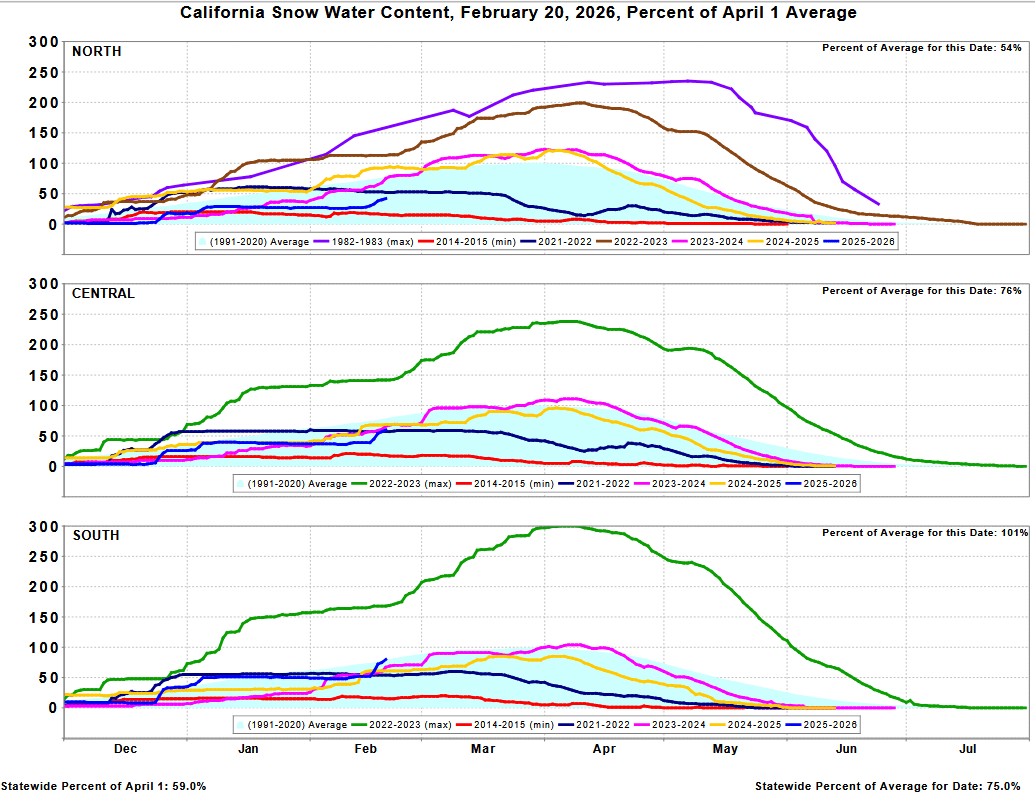
Following a whiplash transition from record warmth to very heavy mountain snowfall in California, yet another swing back toward anomalous warmth (first damp, then dry)
Daniel Swain writes, “Last week’s snowfall in the Sierra Nevada–and also at much lower elevations, for the first time this season, into even the lower foothills and Coast Ranges–marked a dramatic shift from a nearly 40-day stretch of dry and unusually warm conditions. Moreover: this sudden flip occurred during what is still the warmest winter on record for most the Western U.S., including many of California’s mountain areas. It brought widespread travel disruptions, especially for those caught unprepared, with all major mountain highways in the Sierra Nevada closing for extended periods. But the most serious and unexpectedly tragic consequence of this rapid weather pattern shift was the avalanche near Castle Peak (not too far from Donner Summit, and just west of Truckee) that claimed the lives of nine backcountry skiers–making not only the deadliest avalanche in contemporary California history, but also the single deadliest avalanche in the United States since 1981. … ” Read more from Weather West.
Global partnership powers breakthrough shorebird study

“In a first-of-its-kind study, the Migratory Shorebird Project shared trends for 22 Pacific Flyway shorebird species over the past decade. Ten of the 22 species analyzed showed declining populations, two showed positive trends, and the rest did not have significant enough results to draw a conclusion. Before now we did not have this information. This is a huge accomplishment and milestone for migratory bird conservation and highlights the power of partnership at scale. The Pacific Flyway stretches roughly 4,000 miles long and 1,000 miles wide from Alaska to Chile and is one of just a handful of global migration highways for birds, with over 8 million shorebirds using it annually. Having this new information is critical for effective flyway conservation. The study brought concerning news, but it’s not surprising given what we’ve learned from other comprehensive reports like the 2019 3 Billion Birds Report, the 2025 San Francisco Bay State of the Birds Report, Atlantic Flyway studies, and research about habitat loss over the past 150 years. The positive story from this groundbreaking study is the power of partnership. … ” Read more from Point Blue Conservation Service.
The truth is NOT in the eye of the beholder!
“For those familiar with fish archival tissues, fish otoliths are likely one of the first things that come to mind. Otoliths are indeed remarkable tools, offering insights into the water chemistry and trace elements the fish encountered while they were alive. However, we want to highlight another fascinating tissue on the rise – the fish eye lens. To understand the rise of this novel tissue, we first need to understand the needs behind its growing use. As fish biologists, we are often fueled by these burning questions: Where did this particular fish come from? What did it eat? While their otoliths may help us answer the first question, they fall short when it comes to piecing together a diet record. Yet, understanding diet is crucial for identifying the key habitats and resources that support these populations. Ecological systems are structured by who eats whom—and where. … ” Continue reading from the California Water Blog.
History in the Rings: A tree’s rings can tell a much deeper story than just the number of years it has lived.
“Maybe every five to seven years,” says Sam Lindblom. That’s how often a forest consisting of dry oak and pine in the mountains of Virginia should experience a low-severity fire—either wildfire or a controlled burn—to be healthy. Lindblom is the director of landscape conservation for The Nature Conservancy in Virginia, and he advocates for returning regular fire regimens to the landscape with the state and the USDA Forest Service to help improve biodiversity. His recommendation is partly based on dendrochronology, the science of studying tree rings to understand the detailed history of a single tree or an entire forest system. From the 1990s through the 2010s, scientists examined burn scars found in the cross sections and cores of trees across the central and southern Appalachians. They discovered that from precolonial times through the early 1900s, fire returned to forests about every two to 19 years, depending on location. It’s believed that the fires were started by lightning or were sometimes set by Indigenous communities who were managing their forests for overgrowth or hunting needs. That information, considered with many other factors, helps Lindblom and his colleagues develop forest restoration and management plans today. … ” Read more from The Nature Conservancy.
In commentary today …
As snowpack rebounds, complacency is biggest water risk
The Santa Rosa Press Democrat editorial board writes, “This winter’s wild swing from drought to deluge offers a vital lesson for California in the 21st century: Climate change requires preparation for extreme weather of all kinds. A week ago, it looked like the state was headed for another witheringly dry year. Now, after three back-to-back storms brought torrential rains to the lowlands and heavy snowfall to the Sierra Nevada, a significant fraction of California’s precipitation deficit has been erased. Forecasters say another storm will sweep in from the Pacific on Sunday. A good drenching promises to provide California farmers with water for irrigation, improve conditions for salmon migration and recharge aquifers. Snow in the mountains will maintain river flows through the spring and summer, supporting uses ranging from hydropower to recreation. The rapid turnaround in the state’s water outlook is instructive. … ” Read more from the Santa Rosa Press Democrat.
SB 872 is the ideal prescription for Sacramento’s myopic tunnel vision
Dennis Wyatt, editor of the Manteca Bulletin, writes, “California is sinking. In the past 100 years, some parts of the state — especially near Mendota in the mid-San Joaquin Valley — has dropped 40 feet. … It has reduced the capacity of the California Aqueduct in several places. The aqueduct is the linchpin that conveys water to 27 million Californians and 750,000 acres of farmland. … Senate Bill 872 introduced in Sacramento on Wednesday addresses both levee integrity and aqueduct subsidence. It directs $300 million annually from greenhouse gas reduction fees slapped on polluters for the next 20 years to protect the reliability of California’s primary water source for decades to come. … ” Disclaimer: This was very hard to excerpt because the commentary goes several places before it gets to the point. Read the full commentary at the Manteca Bulletin.
In regional water news and commentary today …
NORTH COAST
City of Arcata hosting ‘Water Rates Workshop’ February 25, April 15
“The City of Arcata invites residents, business owners and community members to attend a public informational workshop on proposed water and wastewater (sewer) rate increases to understand proposed changes. The workshop will provide an overview of the City’s water and wastewater systems, upcoming capital improvement needs and the rate study that supports the proposed changes. The proposed rate increases are based on the 2025 Water and Wastewater Rate Study prepared by Bartle Wells Associates, an independent rate consulting firm. The study evaluates the cost of providing water and wastewater services and recommends phased rate adjustments over five years to help maintain reliable service, address aging infrastructure and meet regulatory requirements. … ” Read more from the Redheaded Blackbelt.
SIERRA NEVADA
Warmer system heading to South Lake Tahoe bringing rain, upper elevation snow, mild temperatures
“Sunny skies and warmer temperatures were a nice way to wrap up the weekend after the stormy week, but it was short-lived as another storm is on the horizon. The next impactful storm will be warmer and shorter than last week’s. It arrives on Monday night, with rain and high-elevation mountain snow through Wednesday. There is some potential for flooding with this weak atmospheric river event. Chances for precipitation begin to creep into the Sierra late Monday night and taper off Wednesday, according to the National Weather Service (NWS) in Reno. This system may bring strong winds to the region, particularly on Tuesday. The Sierra crest may experience gusts over 100 mph, while wind-prone areas may have winds gusting up to 35-45 mph. … ” Read more from South Tahoe Now.
Tahoe is not Tahoe without public lands
Julie Regan writes, “There’s nowhere on Earth like Lake Tahoe, and the public lands that surround Big Blue are the heart and soul of life in our community. They are also integral to the plan to protect and restore the Tahoe Basin. Measurable progress is being made on environmental goals that were set at a time when many of these open spaces were still privately owned and subject to development. Last week, I had the honor of testifying in Washington, D.C. before a congressional committee on preserving Lake Tahoe’s public lands at the invitation of U.S. Senator Catherine Cortez Masto. As a leader in the partnership known as Team Tahoe, the Tahoe Regional Planning Agency (TRPA) and many partners, including the Washoe Tribe of Nevada and California, have been working for years on legislation to modernize a law called the Santini-Burton Act. Since its enactment in 1980, the law has provided funds for the USDA Forest Service (USFS) to acquire more than 16,000 acres of sensitive lands in the Tahoe Basin. You may best know the lands acquired with Santini-Burton funds by the open lots in our local neighborhoods. The USFS owns 3,500 of these parcels in the Tahoe Basin. You may even be lucky enough to have one next door to you, providing open space. … ” Read more from the Tahoe Daily Tribune.
Critical storm damage halts flows in Tuolumne County’s main water canal
“The most powerful storm of the winter season earlier this week brought so much wind and snow to the forested mountains between Twain Harte and Lyons Dam that about 200 trees have fallen on Pacific Gas and Electric Co.’s vulnerable Main Tuolumne Canal, which conveys 95% of Tuolumne Utilities District’s drinking water supply for more than 40,000 Tuolumne County residents. Fallen trees have crushed sections of the flumes, two of which must be repaired, including one flume with five complete breaks, PG&E said Saturday. Repairing the storm damage is urgent in part because more rain and mountain snow are forecast to return as soon as Tuesday. The canal’s trestle-supported flumes and dirt-clad, open-air ditches, which traverse 14 miles from Lyons Reservoir in the South Fork Stanislaus River canyon to the Phoenix Penstock above Phoenix Reservoir, date back to the mid-1850s. Miners financed and built the canal to bring water to the Mother Lode’s gold camps. … ” Read more from the Union Democrat.
SACRAMENTO VALLEY
Butte County Supervisors to hear about groundwater
“The Butte County Department of Water and Resource Conservation is set to go over a number of facets related to local groundwater during the upcoming Board of Supervisors meeting Tuesday. According to the related staff report, this will include the department’s Drought Resilience Plan along with various other projects Feather Ridge Estates Water System Improvement Project. … ” Read more from the Chico Enterprise-Record.
The American River nearly flooded Sacramento 40 years ago. How we forget
Opinion writer Tom Philp writes, “The winter of 40 years ago in Sacramento was eerily reminiscent of the current one, with a bone-dry January as storms bypassed the region to the north. Then a band of moisture originating in Hawaii put a bull’s-eye on Northern California. More water raced down the American River 40 years ago Thursday than Folsom Dam had ever experienced, then or now. Had the river risen just 6 more inches, or had the storm lasted a few more hours, much of Sacramento would have likely been underwater. The fear of flooding has steadily faded in Sacramento because of what happened after the great storms of 1986. Sacramento came together and created flood control protections, arguably the most effective regional government effort in local history. And now, some $5 billion in flood protection improvements later, Sacramento is almost ready for much bigger storms. … ” Read more from the Sacramento Bee.
BAY AREA
The Bay Area is in for a roller coaster week of weather
“Another round of widespread rainfall is returning to the Bay Area before surrendering to a warming and drying trend that’s expected to deliver temperatures as high as five to 10 degrees above normal throughout the region. The roller coaster week of weather can be attributed to a couple of factors, according to Rick Canepa, a meteorologist for the National Weather Service’s Bay Area office. A southwesterly flow developing across the northeastern Pacific is forecast to bring off-and-on showers to the North Bay Sunday evening, “but Tuesday into Tuesday night is when we will see the steadiest rain across the Bay Area,” he said over the phone. … ” Read more from SF Gate.
Corte Madera allocates $866K for storm pump upgrades
“The Corte Madera Town Council has set aside $866,000 to improve several flood control pump stations. The work is being done as part of the first phase of a storm drain pump station short-term repair project. The effort is expected to be completed in two waves. The initial phase aims to upgrade sensor, electrical and certain control systems. “This is a reliability-focused project, aimed at improving the electrical and control components at several of our storm drain pump stations to reduce operational risk before the winter,” Nick Cartagena, a town civil engineer, said at the council’s meeting on Tuesday. The second phase, which will be considered by the council later this year, will address protective coatings, corrosion safeguarding and structural repairs. … ” Read more from the Marin Independent Journal.
Sausalito to review 1985 law limiting waterfront development
“With Sausalito needing millions more dollars for infrastructure and sea-level rise projects, the city will revisit a controversial 1985 ordinance limiting the working waterfront’s development. Ordinance 1022 is one of the city’s political third rails. It seeks to preserve its maritime character “by reducing permissible density in commercial and industrial areas.” During two planning workshops in recent weeks, City Council members agreed the city needs to increase revenues feeding its $30 million annual budget by a third if it is to make tangible progress renovating its roads, drainage and other infrastructure as well as protect its shoreline from rising water. “There was strong alignment on revenue, strong alignment on infrastructure and tools to finance infrastructure,” City Manager Chris Zapata said of the emerging agenda. “There was strong alignment on economic vitality. There was strong alignment on maritime waterfront and Marinship planning.” … ” Read more from the Marin Independent Journal.
Once-common Bay Area birds are vanishing at dramatic rates
“Birds are experiencing “dramatic declines” across the Bay Area and California, according to a first-of-its-kind study led by the Petaluma-based wildlife organization Point Blue Conservation Science. The study, published in the scientific journal Ornithological Applications, traced avian population trends from 2012 through 2022. During that timeframe, scientists at Point Blue and more than 50 partner organizations counted birds and characterized their habitats across the Western Hemisphere’s Pacific Flyway, which millions of birds pass through to migrate each year. Notably, researchers found that at least 10 of the 22 shorebird species they were monitoring had plummeted significantly in the past decade alone. … ” Read more from SF Gate.
Officials mark completion of $20 million salt pond restoration in Mountain View
“Conservationists and environmental groups on Friday marked the completion of a $20 million restoration project in Mountain View that transformed a 435-acre former salt pond, along with an adjacent closed landfill, into wildlife habitat and public open space. Views of Stanford University’s Hoover Tower and Google’s campus to the north framed the event, where residents, environmental groups and local leaders gathered to celebrate the restoration of Pond A2W. Though this three-year restoration project covers only a small fraction of the total area, it marks a significant step in the 50-year plan to revive 15,100 acres of former salt ponds across the South Bay, East Bay and Peninsula into vital tidal marshes. To reshape the Mountain View pond and reinforce levees against sea-level rise and storm surges, crews imported 180,000 cubic yards of fill dirt from local construction sites. Restoration work included the construction of five habitat islands, creating horizontal levees or “habitat transition zones” and extending public trails by 1.2 miles. … ” Read more from the San Jose Mercury News.
CENTRAL COAST
Ranking the most wanted kelp forests
“Giant kelp and bull kelp forests create habitats that support an amazing diversity of sea life, and their floating canopies are a prominent feature at the surface of California coastal waters. Recently, satellite imagery has shown a dramatic decline in Northern California kelp forests, and a significant, though patchy, loss of kelp forests in central California. Because of cloud cover and the low resolution of satellite imagery, estimates of kelp coverage are inaccurate and smaller kelp canopies can be entirely missed. Kelp restoration efforts have begun to address some of the most obvious losses, but the scale of these human intervention activities is smaller than a football field and will never be able to fully compensate for regional losses of kelp. So, which kelp forests are most critical to restore, and which are worthy of high-resolution monitoring by drones? These and related questions are what Melissa Ashley, a California Sea Grant fellow with Monterey Bay National Marine Sanctuary asked in a study she conducted. … ” Read more from the Monterey Herald.
New idea offered for Paso Robles basin water fee — and there’s no way out this time
“Last year, managers of the Paso Robles groundwater basin were forced to abandon water use fees after a majority of property owners objected. Now, they’re back with a new fee plan to cover the cost of state-mandated activity — but this time, property owners won’t have the chance to strike it down. On Wednesday, the Paso Robles Area Groundwater Authority’s Board of Directors voted unanimously to take the first steps toward charging fees for groundwater use through a process created by Proposition 26. … If created, the fee will cover next year’s operating costs, from preparing state-mandated reports to paying consultants, Paso Robles Area Groundwater Authority consultant Taylor Blakslee said. … ” Read more from the San Luis Obispo Tribune.
Santa Barbara County sees above-average rainfall, strong water reserves
“After another week of storms, Santa Barbara County is seeing higher-than-normal rainfall and strong water reserves for the year. The amount of rainfall is well above 100% of what the county usually gets at this point in the water year, and is well above the county’s average rainfall for an entire water year, which runs from Sept. 1 to Aug. 31, according to the Santa Barbara County Flood Control District Rainfall and Reservoir Summary. Joshua Haggmark, Water Resources manager for the city of Santa Barbara, called the water supply a “dream-like” scenario. “I can’t imagine a more idyllic situation,” Haggmark said. “Both Gibraltar and Cachuma started spilling in December and have continued to spill, and these storms we got will continue to have that happen so it is just great. We’re in such a great water supply situation.” … ” Read more from Noozhawk.
SOUTHERN CALIFORNIA
Splash pad won’t be built at Pinehurst Park in Chino Hills
“The much-anticipated splash pad and community center planned for Pinehurst Park in Butterfield is off the table. The City of Chino Hills found out in August 2025 that the park is in the Prado Flood Control Basin because of the 15-foot increase planned for the spillway. The existing playgrounds, basketball court, and other structures are not impacted because they are not habitable, according to Community services director Jonathan Marshall. The city chose Pinehurst Park in 2022 for its flat areas that provided enough space to build a 22,100-square-feet splash pad with seating and shade areas, an 11,000-square-feet community center, outdoor showers, restrooms, and storage space. … ” Read more from the Chino Hills Champion.
SAN DIEGO
Why San Diego’s water rates keep going up
“Water is a necessity, and one that’s costing San Diegans more over time. You may have already noticed it on your water bill. Rates went up 14.7% this year. But it’s not going to stop there; another 14.5% increase is scheduled next year, 11.5% in 2028 and 11% in 2029, which adds up to a 62% hike over four years. So why the increase? According to the city, the biggest driver is the rising cost of buying water from the region’s wholesaler, the San Diego County Water Authority or SDCWA. … ” Read more from Channel 10.
Along the Colorado River …
California’s top environmental official explains the conundrum over the Colorado River

“The seven Western states that rely on the Colorado River for water supply have yet to reach an agreement on how to share the shrinking resource. “The big challenge is, how do we split up a smaller pie across seven states and Mexico? And that’s very, very difficult,” Crowfoot said. “Each of our states could make an argument to protect our status quo allocations, but we can’t.” Crowfoot noted that because states have yet to figure out how to share, the issue will likely be up to the federal government. The disagreement between states has nothing to do with political affiliation and is based on region. Crowfoot said the breakdown is between lower basin states California, Arizona and Nevada versus the upper basin states of Colorado, Utah, Wyoming and New Mexico. “It’s refreshing there isn’t political polarization that’s the challenge,” Crowfoot said. “The fact is, from our perspective, we all have to make sacrifices and contribute to keep water in these reservoirs.”… ” Watch the full interview at KCRA.
Colorado River water debacle intensifies amid risk ‘human systems failing’
“After a coalition of seven states failed to reach a consensus on how to jointly manage the Colorado River watershed, the federal government has stepped in to help select a plan that will guide decisions about water use in the region over the next 20 years. The intervention comes just a day after the newest spring runoff projections, which paint a dire picture of conditions in the West. The Colorado River watershed — a sprawling network of waterways that supplies water to 40 million people and power to 700,000 homes — is today jointly managed by California, Nevada and Arizona (which make up the lower basin) and Utah, Colorado, Wyoming and New Mexico (which represent the upper basin). Together, the two groups make management decisions guided by a set of compacts, laws, court decisions and regulatory guidelines collectively known as the “Law of the River.” … ” Read more from SF Gate.
CAP, cities launch campaign to protect Arizona’s Colorado River water
“A Central Arizona Project-backed advocacy group called the Coalition for Protecting Arizona’s Lifeline has begun rolling out television ads and online videos defending the water supplier’s rights to a Colorado River that is under serious hydrological and political strain. “Arizona is being unfairly targeted for reductions of Colorado River water that would cripple our state, flatten our economy and weaken our nation’s defense,” an ad aired by the coalition warns. It goes on to note that Arizona communities have done their part, committing more water for conservation in Lake Mead than those in other states, and that several options that the federal government is weighing for managing the river would fall hardest on the state. One such alternative under review, CAP General Manager Brenda Burman recently said, would essentially dry up the agency’s canal from the river to Phoenix and Tucson. … ” Read more from the Arizona Republic.
Editorial: All states should share in Colorado River cutbacks
The Las Vegas Review-Journal editorial board writes, “It takes two to tango — and to reach a compromise. The federal government’s Valentine’s Day deadline for an agreement on the Colorado River has come and gone. The seven states connected to the river failed to reach a deal on future water allocation. They also missed a deadline last November. Previous agreements will expire at the end of the year. A new arrangement is essential because there isn’t enough water to meet demand. The river was over-allocated in the Colorado River Compact of 1922. An extended drought has further reduced the amount of available water.The three Lower Basin states offered significant concessions in negotiations with their Upper Basin counterparts. … ” Read more from the Las Vegas Review-Journal.
Hoover Dam needs urgent repairs. It just got a $52M boost
“For almost a century, Hoover Dam has stood tall, delivering water and reliable hydropower to cities throughout the American West. But even the most impressive feats of human engineering need maintenance — $200 million of it over the next decade, to be exact, according to estimates from the Bureau of Reclamation, the federal agency in charge of water and dams in the West. “Sadly, even a structural achievement like the Hoover Dam is not immune from aging, and its maintenance needs have been mounting for quite some years,” said Rep. Susie Lee, D-Nev. Lee and Sen. Catherine Cortez Masto, D-Nev., joined Colorado River Commission of Nevada Chairwoman Puoy Premsrirut at a Lake Mead outlook Friday to celebrate the release of $52 million to the Bureau of Reclamation for necessary work. … ” Read more from the Las Vegas Review-Journal.
Thousands of fish are hard at work keeping Arizona canals clean
“In the cool dawn of a February morning, a crew is assembling to do maintenance work on a water canal in Tempe. This crew will spend the rest of its life in the canal, removing the plants that stop water from flowing. That’s because the workers aren’t human — they’re fish. The Salt River Project, which operates this canal, estimates that about 44,000 of these fish live in its canal system. This morning, it’s adding about 1,000 more. The fish are a species of carp called white amur. They’re native to Asia and especially adept at eating the aquatic vegetation that grows along the walls of the canal. Those plants can slow down the water and make it harder to send to faraway users of the canal or gum up the intakes that divert water in different directions. … ” Read more from KJZZ.
Great Salt Lake may hit historic lows this year, despite long-awaited snowfall
“Despite this week’s heavy snowfall, conservationists warn Utah’s snowpack — which hit a record low earlier this month — is likely not enough to keep the Great Salt Lake’s water levels from hitting new record lows later this year. “Utah is still facing major snowpack deficits, this doesn’t reverse months of snow drought. What we really need is sustained snowpack that lasts long into spring, so it can contribute to spring runoff,” said Samantha Hawkins, spokesperson for Grow the Flow — a conservation nonprofit dedicated to Great Salt Lake water conservation. Hawkins told Utah News Dispatch water levels are on track to “see a record low by this coming fall,” as snowpack is vital to replenishing Utah’s waterways through dry seasons. … ” Read more from the Utah News Dispatch.
Snow drought is worsening wildfire risk and water storage concerns in Colorado, according to experts
“Colorado’s record-low snowpack is already raising concerns about increased wildfire risk and water shortages this summer, even as the mountains are still in the depths of winter. Statewide, the snowpack levels are just 61% of median for this time of year, and it would take consistent, record-breaking snowfall for the rest of the season to reach normal peak snowpack levels, according to the U.S. Department of Agriculture. “We really should be bracing for an unusually early and potentially severe fire season,” Colorado Division of Fire Prevention and Control public information officer Tracy LeClair said. “Some of the conditions are worse than we saw in the big years, like 2012 and 2020, where we saw some of the largest fires and some of the most destructive fires in Colorado history.” … ” Read more from Sky Hi News.
In national water news today …
Aspen Institute study presents strategy for U.S. water sustainability
“A new strategy report published by the Aspen Institute in February provides a comprehensive roadmap for strengthening water security and resiliency across the United States. The Aspen National Water Strategy, published by the Aspen Institute’s Energy & Environment Program, aims to ensure that communities, economies and ecosystems can thrive amid growing water-related challenges. The effort is being co-chaired by Martin Doyle of Duke University and Newsha Ajami of the Lawrence Berkeley National Lab.
The strategy emphasizes that securing America’s water future goes far beyond managing shortages or surpluses. The report notes that effective security depends on well-functioning, trusted and affordable water systems. It also highlights how resilient communities able to withstand floods, droughts, and wildfires, and institutions capable of adapting to changing climates, economies and social conditions will be in a better position for success. … ” Read more from Water Finance & Management.
Did the USDA just forget about $400M in drought aid for farmers?
“For those coaxing thirsty crops like alfalfa from the parched fields and withered pasturelands in Eloy, Arizona, water is as good as gold — and just as scarce. “We’ve had nothing from the Colorado River for the last two or three years. I mean, we’ve had to cut back the volumes to the growers and have had to reduce acres and stuff to make it work,” said Ron McEachern, former general manager of the Central Arizona Irrigation and Drainage District, which serves the Eloy area. Nearly two years ago, the irrigation district was invited to apply to a new non-competitive grant program that the U.S. Department of Agriculture under the Biden administration was launching to help farmers in areas grappling with devastating droughts. Then, in late 2024, they got the break they’d been hoping for. The Central Arizona operation was one of 18 irrigation districts spread across 12 western states initially selected to receive up to $15 million each from the USDA. … Beginning last January, the Trump administration threw that into a tailspin. Read the full story at Grist.
Scientists have found another alarming pattern in wildfires
“The extreme heat, high winds, and severe dry conditions that produce towering, fast-moving flames that advance by the acre are not just becoming more common; new research shows that these factors are increasingly arising in multiple regions at the same time, creating the conditions for simultaneous wildfires around the world. In a study published today in the journal Science, researchers reported that the ideal conditions for major wildfires are now aligning across different parts of the world at more than double the rate they did nearly 50 years ago. Climate change is a major driver, accounting for about half of this increase. It’s the latest example of how humans are reshaping the nature of wildfires. These changes have led to periods of inescapable smoke from blazes and more stress on firefighters, expanding the public health, economic, and social costs of infernos. As the climate continues to warm, these trends are likely to continue to worsen. … ” Read more from the Grist.
A look at current water and reservoir conditions …