Several news sources featured in the Daily Digest may limit the number of articles you can access without a subscription. However, gift articles and open-access links are provided when available. For more open access California water news articles, explore the main page at MavensNotebook.com.
On the calendar today …
- WEBINAR: CSU WATER Legislative Webinar Series, Part 2 of 3, from 2pm to 3pm. CSU-WATER, in partnership with the Maddy Institute and the Office of Assemblymember David Tangipa, is hosting a three-part Legislative Webinar Series focused on California water policy, governance, and workforce leadership. This series is designed for individuals interested in water, climate, environmental science, engineering, public policy, and public service. Webinar details and the full session lineup are included in this flyer. Click here to register.
- WEBINAR: The California Department of Fish and Wildlife Beaver Restoration Program from 7pm to 9pm. Molly Alves and her team will talk about the new California Department of Fish and Wildlife Beaver Restoration Program (BRP); how it all started, what has been accomplished to date, and what exciting things are on the horizon. Click here to register.
In California water news today …
Environmental, tribal groups slam Bay-Delta deal over weak flow rules
“Environmental groups and tribal communities submitted written comments to state water regulators this week reiterating that the proposed Bay-Delta water management plan weakens water protections and could open the door to ecosystem disaster. During a three-day hearing last week, the tribal members warned that the plan would result in “privatizing water, prioritizing corporate profit over people.” In a news release on Tuesday, Gary Mulcahy of the Winnemem Wintu called the California State Water Board “clueless,” and Regina Chichizola, executive director of Save California Salmon, blasted state officials’ move to “advocate for an eight-year experiment that fails to meet water, environmental and aquatic species needs on so many levels as the VAs currently stand.” … ” Read more from the Sacramento Bee.
U.S. Army Corps begins public review for Oroville, New Bullards Bar dams
“The U.S. Army Corps of Engineers, Sacramento District, has initiated a public review process for proposed updates to the operation of Oroville Dam and New Bullards Bar Dam. A public scoping meeting took place on Feb. 4, in Marysville, marking the start of the National Environmental Policy Act (NEPA) scoping process for updates to the reservoirs’ Water Control Manuals. Each federally operated reservoir with a flood control mission has a water control manual, which outlines when and how water is stored or released to reduce flood risk while supporting other authorized purposes. … ” Read more from KRCR.
Western U.S. snowpack is worth trillions of dollars

“The American West’s snowpack is valuable for many reasons. Snowmelt supplies much of the water flowing through the region’s streams, rivers, irrigation canals and household faucets—a vital role that has taken on new urgency this winter as much of the West struggles with scant snow cover. Snowfall supports countless species, maintains forest health and helps keep a lid on wildfires. It even cools the planet by reflecting sunlight. Snowflakes also underlie the region’s multi-billion-dollar winter sports industry, fueling local economies and drawing millions of participants. In warmer months, boating and fishing depend on water that was once frozen. Snow performs all these functions, but can its worth be calculated in dollars and cents? And how is climate change affecting that value? … ” Read more from the Water Desk.
‘Rex block’ over California is jumbling weather patterns and flipping the forecast
“The atmosphere is entering a state of disarray over California. After coastal areas from Half Moon Bay to Los Angeles experienced record-breaking temperatures Wednesday, a major cooldown is expected Thursday before a chance of rain Friday. Terms and conditions apply, though. The same weather system that will contribute to cooler weather in some areas will actually warm up others. A low-pressure system undercutting the high-pressure system to the north will cause winds to swirl in many directions over California, a phenomenon known as a “rex block.” Air moves clockwise around areas of high pressure and counterclockwise around areas of low pressure. These alignments can remain in place for days at a time, often lingering for longer than weather models predict. … ” Read more from the San Francisco Chronicle.
Mussel mania: San Joaquin Valley water agencies gear up to fight invasive mollusk
“Water agencies of all sizes are crafting plans and forming task forces across local, state and federal entities to protect infrastructure from the spread of golden mussels, a tiny, invasive species that has already spread the length of the state’s network of waterways. In the San Joaquin Valley, Friant Water Authority is in the midst of another round of environmental DNA testing, this time on the entire length of the 152-mile canal, after golden mussel eDNA was detected near the White River intake in Tulare County. Initially, the authority hoped the mussel was contained to the southern reaches of its canal, in the Arvin-Edison Water Storage District, where State Water Project supplies enter the Friant system via the Cross Valley Canal. … ” Read more from SJV Water.
Jeff Aiello says California’s wolf and water crises are symptoms of broken environmental policy
“The February 5 edition of the AgNet News Hour featured one of the most candid and wide-ranging conversations of the year as hosts Nick Papagni and Josh McGill sat down with Jeff Aiello, a 13-time Emmy Award-winning cinematographer, PBS host, and founder of 1830 Entertainment. Aiello, best known for his work on American Grown: My Job Depends on Ag and Outside Beyond the Lens, shared what he has learned firsthand while documenting California agriculture, wolves, forests, and water policy. … ” Read more from Ag Net West.
Sites reservoir receives environmental approval
“The Sites Reservoir project, California’s largest new reservoir in decades, cleared another milestone last month when it received approval from the U.S. Bureau of Reclamation certifying that the project complies with the National Environmental Policy Act. The certification paves the way for construction of the 1.5-million-acre-foot reservoir — roughly 20 times the capacity of Lake Del Valle, to begin later this year. The project proposes to dam and flood an area west of the town of Maxwell, about 130 miles north of the Tri-Valley, to capture high-rainfall events, such as the atmospheric rivers that hit California in the winter of 2022-23. Project partners include the State of California, public irrigation districts and local water agencies — such as the Tri-Valley’s Zone 7 Water Agency — ranging from the Bay Area to Southern California. … ” Read more from the Livermore Independent.
California leads nation with no reported lead service lines in drinking water systems
“The State Water Resources Control Board today announced the launch of an interactive, publicly searchable map allowing Californians to check whether their drinking water service line contains lead. The new tool underscores California’s strong standing in lead service line remediation and transparency, with the latest statewide inventory showing no lead reported in nearly 10 million service connections. “Today we are proud to provide Californians with the means of checking their drinking water infrastructure for reports of lead,” said Darrin Polhemus, deputy director of the State Water Board’s Division of Drinking Water. “With no confirmed lead service lines out of the millions reported so far, California leads the nation. The new map empowers consumers, builds trust, and marks another step in our commitment to safe, lead-free drinking water.” … ” Continue reading from the State Water Board.
New water legislation seeks to boost recycling, aid farms and ecosystems
“U.S. Sen. Alex Padilla rolled out two new water bills aimed at easing the state’s growing climate-driven water shortages and making water supplies more dependable across the state. The Making Our Communities Resilient through Enhancing Water for Agriculture, Technology, the Environment, and Residences Act — the MORE WATER Act — and the Growing Resilient Operations from Water Savings and Municipal-Agricultural Reciprocally-beneficial Transactions, — the GROW SMART Act — have drawn strong backing from regional water agencies, which praised the measures as important steps toward improving water reliability and affordability throughout the Golden State. “After years of severe drought and mounting climate impacts, California needs bold solutions and sustained federal investment to confront water scarcity challenges in both cities and agricultural communities across the state,” Padilla, a Democrat, said in a news release Wednesday. … ” Read more from the Sacramento Bee.
California Academy of Sciences team finds ocean warming reaching deeper than expected
“Some researchers will go to almost any length to advance science. But for Luiz Rocha, it’s more like any depth. Rocha and a team from the California Academy of Sciences in San Francisco recently returned from an expedition to deep coral reefs, located off Guam. At more than 330 feet, it’s a layer known as the Twilight Zone. “So those depths are very hard to get to. We can do it by technical diving, which is the way we do it. But you can also do it with ROVs and with submarines. They’re much more expensive than the way we do it. But because it requires a lot of logistics, a lot of time, a lot of funding. The end result is that those that are really hard to study, very few people do it, and we don’t know much about it,” Rocha explains. … ” Read more from ABC 7.
Dry weather prompts wildfire concerns in much of West
“The West faces a long, active peak wildfire season unless conditions change, according to forecasters. The current situation is “dismal, just because of the state of snowpack,” said Jim Wallmann, a meteorologist based at the National Interagency Fire Center in Boise. Snowpack is well below normal in many river basins, and those with snow tend to be at high elevation and feature little surface area, he said. And with dry conditions expected into February’s second week, “it’s going to take a miracle March to get back close to normal for snowpack.” Grasses remain standing in several locations, helped by last year’s mostly good water conditions, Wallmann said. The risk of large wildfires will be elevated when summer arrives, especially in forests, if current conditions persist, he said. … ” Read more from the Capital Press.
In regional water news and commentary today …
NORTH COAST
Coastal Commission approves sweeping consent agreement to tear down and remediate Schneider Project, give site to Wiyot Tribes
“The California Coastal Commission today unanimously approved a sweeping consent agreement to address a host of major Coastal Act violations tied to a controversial luxury home project overlooking Humboldt Bay. The deal, which was developed by Coastal Commission staff in collaboration with Wiyot-area tribes and property owners Travis Schneider and Stephanie Bode, requires the partially built 21,000‑square‑foot house to be demolished and the site to be fully restored. The agreement also includes a $400,000 administrative penalty and calls for the land to be transferred to one or more of the Wiyot-area tribes. Commission staff described the agreement as “a creative and valuable resolution” to serious violations. … ” Read more from the Lost Coast Outpost.
SEE ALSO: ‘Environmental justice’: Settlement agreement OK’d for Schneider mansion violations, from the Eureka Times-Standard
‘A huge endeavor’: Eureka City Council oks regional climate action plan
“Humboldt’s Regional Climate Action Plan (RCAP) cleared another bureaucratic hurdle on Tuesday, securing unanimous approval from the Eureka City Council. The ambitious environmental document — developed in collaboration with the County of Humboldt, local cities and other government agencies — outlines an array of strategies and measures aimed at reducing regional greenhouse gas (GHG) emissions. Most of these strategies focus on transportation, which accounts for 73 percent of the county’s total GHG inventory, and prioritize expanding access to public transit, electric vehicle charging stations and walking/biking trails. The RCAP, adopted by the Humboldt County Board of Supervisors in December, aligns with the state’s goal of reducing GHG emissions to 40 percent below 1990 levels over the next four years and achieving carbon neutrality by 2045. … ” Read more from the Lost Coast Outpost.
SIERRA NEVADA
Placer County considers ban on single-use plastic in Tahoe Basin
“Placer County leaders are considering a new ordinance aimed at reducing trash and plastic pollution in the Tahoe Basin. The proposal would ban the sale and distribution of single-use plastic water bottles and paper cartons of still water under one gallon in the eastern portion of the county, from Donner Summit to North Lake Tahoe. It would also restrict items such as Styrofoam cups, to-go containers, and coolers, and require single-use plastic food service ware to be provided by request only. County officials say the goal is to keep plastic out of the environment and align Placer County with similar ordinances already in place in the Town of Truckee and the City of South Lake Tahoe. … ” Read more from CBS News.
SACRAMENTO VALLEY
U.S. Army engineers classify Oroville’s levee as ‘low risk’
“The 1.3-mile stretch of levee protecting Oroville from more than 100,000 cubic feet per second of water in the Feather River received a “low risk” rating by a recent study by the U.S. Army Corps of Engineers. The results of the study, conducted May 7 and May 8, 2025 and finalized December 2025, reported that most of Oroville’s levee has a “relatively low” risk of overflowing, aside from about a 1,000-foot stretch along Bedrock Park. U.S. Army Corps of Engineers geotechnical engineer Michael Gonia reported the results at the Oroville City Council’s regular meeting Tuesday and said Oroville received the low-risk rating for its strong emergency evacuation routes, the flood control provided by Oroville Dam and that its long term performance is expected to be adequate. … ” Read more from the Chico Enterprise-Record.
BAY AREA
Research: Heterosigma akashiwo in San Francisco Bay
“A new study by several scientists examines the environmental conditions that fueled a massive algal bloom in the San Francisco Bay. By analyzing water quality, circulation, and microscopic communities, the research helps explain how rare combinations of factors can drive major ecological events, including blooms of Heterosigma akashiwo, a species first identified in Japan. … ” Continue reading from the USGS.
CENTRAL COAST
Salinas Valley: A local effort is underway to build an inventory of smaller wells, but it is slow going.
“For the first time, thanks to mandates from the state’s Sustainable Groundwater Management Act (SGMA), a local effort to collect reliable data on small, private wells in the Salinas Valley groundwater basin is underway. The effort, run by the Monterey County Water Resources Agency (MCWRA) in partnership with the Salinas Valley Basin Groundwater Sustainability Agency (SVBGSA), aims to fill a major data gap under SGMA by building an inventory of these wells to assess their vulnerability and create drought contingency plans. “We are not asking rural residents to report the extractions,” says Piret Harmon, general manager of SVBGSA. “Because the hydrogeology is quite complex, it makes a big difference where exactly and how deep they are, how old they are, because that’s the only way we can truly understand where we need to focus our efforts in assuring everyone has sustainable groundwater.” … ” Read more from Monterey Now.
Rep. Panetta, others reintroduce bill to help organic agriculture grow
“Legislation designed to help farmers and other agricultural producers transition to organic practices and build successful and sustainable businesses was reintroduced by Reps. Jimmy Panetta, D-Carmel Valley, Alma Adams, NC-12, and U.S. Senator Peter Welch, D-VT. The legislation would help eliminate steep barriers farmers often face to enter the industry, including high certification costs and insufficient technical assistance from existing United States Department of Agriculture programs. According to the 2024 Monterey County Crop and Livestock Report, there were 73,551 total acres of land used for organic farming in Monterey County by 177 producers with reported gross sales of $884,921,000. Organic production commodity groups in the county include citrus and tree fruit, table and wine grapes, strawberries and other berries and fruits, broccoli, carrot, celery, lettuce, spinach, as well as livestock. … ” Read more from the Monterey Herald.
Growers in Paso Robles basin have new way to save water: fallow fields
“San Luis Obispo County has designed a new program to support farmers who wish to stop irrigating their land. The goal: To reduce overpumping in the Paso Robles Area Groundwater Basin. It’s one of 21 basins in the state considered “critically overdrafted” by the California Department of Water Resources, which means more water is pumped from the basin than is returned. On Tuesday, the San Luis Obispo County Board of Supervisors voted 4-0 to create a registry for farmers who voluntarily decide to fallow their land. Supervisor John Peschong abstained from the vote. Farmers who enroll in the program will maintain county property tax benefits related to their status as agricultural producers. Meanwhile, contrary to county law, they also will be allowed to resume irrigating their land when they want to, even if it is fallowed for more than five years. … ” Read more from the San Luis Obispo Tribune.
Students, educators team up for Carpinteria Salt Marsh cleanup after winter storms
“Students and educators from three area schools joined staff at the Carpinteria Salt Marsh Reserve on Saturday, Jan. 31, to remove storm-deposited trash from the ecologically sensitive wetland. The cleanup followed the first major storms of the rainy season, which washed debris down Santa Monica and Franklin creeks and into the 230-acre Carpinteria Salt Marsh, according to reserve director Dr. Andrew Brooks. Volunteers included teachers Will Holmes of Cate School, Taylor Abernethy of Dunn School and Joanna Cecilio of Flintridge Sacred Heart Academy, along with about 20 students. “Following the first big storms, trash accumulates quickly,” Brooks said. “If it’s not removed, it can impact the functioning of the entire marsh ecosystem, including birds, fish, crabs and other organisms that call the marsh home.” … ” Read more from the Coastal View.
SAN JOAQUIN VALLEY
Lathrop faces unexpected $5.4 million wastewater bill from Manteca
“The city of Lathrop was unexpectedly billed $5.4 million by the city of Manteca for wastewater services dating back to 2016. The surprise bill has prompted a review of the charges. “The city of Lathrop has paid every wastewater bill that we’ve received during that time period and so to receive a decade’s worth of true-ups came as a surprise to us,” said Thomas Hedegard, Lathrop’s deputy city manager. The bill was sent via email through a normal accounts payable channel without further context from Manteca. Hedegard explained that 14.7% of the wastewater plant in Manteca is used for the city of Lathrop. … ” Read more from KCRA.
EASTERN SIERRA
Mono Basin snow survey results
“Winter started out wet, but January was dry. In Lee Vining, there were only 3.7 inches of new snow measured in January, and none fell since January 8. The Mono Basin was blanketed with snow and then covered in poconip fog. This insulated the lower elevation snow while warm sunny days melted the higher elevation snow, resulting in an inverse snow line in some places that matches the inversion layer. This wet-then-shifting-to-dry weather pattern is starting to look like 1997, 2013, and 2022, when late January snowpack was near or above average but very little precipitation occurred before the average peak snowpack date of April 1st, resulting in much less snowmelt runoff than would have been expected based on February 1st snow surveys. Mono Basin snow surveys last week found 83% of average water content to-date, and over 50% of the April 1st average, but the distribution is uneven, with Rush Creek looking much wetter than Lee Vining Creek. … ” Read more from the Mono Lake Committee.
SOUTHERN CALIFORNIA
LA County supervisors ask Sheriff’s Department to fix unsafe water in jails
“Brown, bug-filled drinking water has been coming out of the taps at one county jail for years, according to reports from an oversight commission. The Sybil Brand Commission conducts regular, unannounced inspections of jails and lockup facilities maintained by the county, and has been reporting issues with drinking water at the Century Regional Detention Facility in Lynwood since 2023. The commission has also found problems with the drinking water at other county jails in recent months. L.A. County Supervisors voted on Tuesday, calling for the Sheriff’s Department to fix water quality issues at all county jails within 180 days. … ” Read more from the LAist.
LA County opposes Trump order, rejects federal takeover of local permitting in fire zones
“Los Angeles County is pushing back against President Trump’s executive order to take over the rebuilding process in the Palisades and Eaton fire zones, threatening to sue the administration if local land-use powers are overridden. The Board of Supervisors voted 5-0 without discussion on Tuesday, Feb. 3, to monitor the actions of the Federal Emergency Management Agency (FEMA) and the Small Business Administration (SBA), the agencies Trump’s order put in charge of expediting housing rebuild permits and “to cut through bureaucratic red tape and speed up reconstruction” in the fire-scarred areas where more than 16,000 structures were lost on Jan. 7, 2025. Also part of the motion, the supervisors authorized County Counsel to sue or join existing lawsuits that oppose the Trump executive order. … ” Read more from the LA Daily News.
SEE ALSO: In Palisades visit, Trump officials vow to speed up permits for fire rebuilding, from the LA Times
Thousands of mule deer will be killed on Catalina Island as part of restoration plan
“The California Department of Fish and Wildlife has approved a plan to kill and sterilize roughly 2,200 mule deer on Catalina Island as part of a large-scale restoration effort. The project — proposed by the Santa Catalina Island Conservancy — also includes plans to monitor fauna, such as the Island fox and monarch butterflies, and increase biodiversity by removing invasive vegetation and seeding native plants. Mule deer removal: Professionals will likely use drones, thermal technology and dogs to detect the deer before shooting them, primarily at night. Some deer will also be caught, sterilized and tracked in an effort to draw out any last deer. The efforts are estimated to be completed by 2032. … ” Read more from the LAist.
IMPERIAL/COACHELLA VALLEYS
Bombay Beach – a truly strange place
[Note: This is a reprint of an article originally published in 1986] Steve Sorenson writes, “Driving north on Highway 111, up the east side of the Imperial Valley, I find it hard to tell if the first glimpse of the Salton Sea is real or just a desert mirage. There is nothing in the empty landscape to give an impression of size or distance — only a silver, shimmering mist against a backdrop of hazy blue mountains. Just eighty years ago, before the Salton Sea existed, that landscape looked much the same, except that the shimmering mist truly was a mirage, a vaporous illusion, a ghost of ancient Lake Cahuilla, which once filled the entire basin from mountain range to mountain range before it completely evaporated.To the human observer, there’s something disturbing about the landscape of the Salton Sink — a gut-level reaction warning us that this is not a place meant for man, or even life. The rocky, alkaline soil is so sterile that none but the most tortured-looking plants can tolerate it. … ” Read more from the San Diego Reader.Commentary: Salton Sea: Living lake or dust field?
Russell Betts writes, “There are two ways to look at the Salton Sea. One is to imagine water skis cutting across its surface again, families fishing from the shoreline, sailboats catching the desert wind, and the Coachella Valley finally having a true inland lake amenity. The other is to accept a shrinking, dusty basin and pretend that throwing gravel and hay at it somehow counts as a solution. Those are the only two choices: restoration or managed decline. Picture what this valley once had and could have again: a recreational jewel in the desert, centered around a living lake. That future is not fantasy. It is entirely achievable if we decide we actually want it. And the valley has already said it does. … ” Read more from the Uken Report.
California State Parks seeks public input on Salton Sea State Recreation Area General Plan
“California State Parks is preparing a General Plan for Salton Sea State Recreation Area (SRA) and invites the public to participate in the planning process with in-person and virtual workshops this month. The General Plan will serve as the park’s primary and long-term management document. It will include goals and guidelines for future recreation opportunities, resource protection and facility development, as well as park improvements, services and programs. “California State Parks encourages park visitors, local residents, tribal representatives and other stakeholders to participate in the planning process,” said Enrique Arroyo, Ocotillo Wells District superintendent. “The feedback we receive is instrumental in helping shape the park’s future for decades to come.” … ” Read more from the Desert Review.
‘Sacrifice zone’: A data center boom in the California desert is raising concerns
“Developers are descending on a rural desert community along California’s Mexican border, trying to build over $15 billion worth of data centers to power Silicon Valley’s artificial intelligence boom. But concerns over pollution and Colorado River water use have turned one of the projects into a charged legal fight, where a developer is accusing city officials in Imperial, California, of “economic sabotage” for circulating flyers about the development. Meanwhile, activists are warning that the projects are getting approved without protecting local residents. … ” Read more from SF Gate.
SAN DIEGO
EPA Administrator Lee Zeldin returns to San Diego County to address ongoing sewage crisis
“One year after taking office, EPA Administrator Lee Zeldin will return to San Diego County Thursday to continue addressing the decades-old Tijuana sewage crisis that has plagued the South Bay community. Since being sworn in as the 17th administrator of the Environmental Protection Agency on January 29, 2025, Zeldin has made the cross-border sewage issue a priority, promising to deliver a “100% solution” to the problem that has impacted Imperial Beach and surrounding areas for years. … ” Read more from Channel 10.
Along the Colorado River …
As clock ticks on Colorado River talks, Arizona wants to steer away from the courtroom

“Gov. Katie Hobbs said Monday that unless Upper Basin states actually offer up some firm commitments to conserve water she won’t agree to any deal for Arizona to cut its own withdrawals from the Colorado River. And that would lead to either Interior Secretary Doug Burgum imposing his own solution on the seven states that draw water from the river — or the situation having to be hashed out in court. Only thing is, Burgum has so far refused to do more than bring the governors of the affect states together, as he did on Friday. And Terry Goddard, president of the Central Arizona Water Conservation District, which oversees the state’s Colorado River supply, said the options put forward by the Interior Department “are not palatable to Arizona or California,” one of the two other Lower Basin states. “All Burgum’s done is set us up for litigation,” he told Capitol Media Services. “And I think that’s sad.” … ” Read more from KJZZ.
Arizona pushes back against greater water cuts as the Colorado River crisis deepens
“With disappointing snowpack levels, dropping water levels at major reservoirs, and Upper Basin states unwilling to take on more reductions – a coalition of Arizona’s water leaders agreed that the Grand Canyon state cannot take on the brunt of future cuts during Monday’s Arizona Reconsultation Committee Meeting. The seven basin states continue to struggle to reach an agreement on post-2026 operations; the Upper Basin argues that the Lower Basin should take on more cuts since they use more water. Part of that argument is that the Lower Basin uses that water for crops that feed the rest of the country. The Upper Basin is made up of Utah, Colorado, New Mexico and Wyoming; the Lower Basin is made up of Arizona, California and Nevada. Brenda Burman, general manager of the Central Arizona Project General says water released for Lower Basin states might be reduced this year. … ” Read more from Arizona Public Media.
Warmer water in Lake Mead risks vital operations
 “Rising water temperatures across the Colorado River and its reservoirs are creating new challenges for water treatment operations in Lake Mead and hydropower production at Hoover Dam. Extended drought and climate change has steadily increased surface temperatures in Lake Mead. In the past, the Nevada reservoir could depend on cooler water being delivered from upstream Lake Powell, but as Lake Powell shrinks, warmer surface water is moving through Glen Canyon Dam and into Lake Mead. Water in the Colorado River generally warms 1.8 degrees F for every 30 miles traveled downstream during warmer months of the year, meaning by the time water reaches Lake Mead its several degrees higher than when it started. This year, water flowing into Lake Mead is projected to be at least 10.8 degrees F warmer than usual by the end of fall, said Todd Tietjen, the regional water quality manager for the Southern Nevada Water Authority. “We’ve seen this once or twice before,” Tietjen said. “But if it’s sustained, we don’t quite know what will happen.” … ” Read more from the Nevada Current.
The West faces a snow drought
Daniel Rothberg writes, “December felt rainy. At as the year began, we saw major California reservoirs fill up. The U.S. Drought Monitor recently reported improvements in California and Nevada, listing them as entirely and nearly drought-free. On its face, all of this precipitation and rainfall seemed to reflect positive news for water supplies heading into 2026. But the water supply story had another, less positive layer. As I’d watch rain fall, I’d check the weather in the Sierra to see if storms in the valley were translating to snow in the mountains. They rarely did, a major warning sign for the snow drought to come. By mid-January, NASA satellite imagery recorded snow cover in the Western U.S. as the lowest recorded since 2001, and about one-third of the median. It’s been wet, but it’s also been warm, resulting in more precipitation falling as rain at higher elevations. … ” Read more from Invisible Waters.
Audio: Alfalfa may be the solution to the looming water crisis in the West, a new study suggests
“A new study from Utah State University suggests that the Colorado River basin states — including Arizona — may have a solution to the looming water crisis right under their noses: alfalfa. The study proposes something called “deficit irrigation,” and Jonathan Thomspson said it just might work. Thompson is a contributing editor for High Country News, and the author of a newsletter called “The Land Desk,” where he recently wrote about the study. He talked to The Show about how central this single crop is to life in the West.” Listen to show or read transcript at KJZZ.
Proposed legislation paves the way for investment firm to sell water in McMullen Valley aquifer
“State Democrats are opposing a potential law that would allow a New York City hedge fund to sell water from western Arizona’s McMullen Valley aquifer. Last week, HB 2758 passed out of the state House Natural Resources, Energy and Water Committee, with support from Republicans. The McMullen Valley aquifer is a transfer aquifer, which means the water can be sold to more urban areas. The hedge fund, Water Asset Management (WAM), purchased nearly 13,000 acres of land in the McMullen Valley Basin from the International Farming Corporation in 2024 for $100 million. … ” Read more from KTAR.
Southern Nevada Water Authority heads to court over grass removal
“A legal battle is brewing over the Southern Nevada Water Authority’s turf removal program, with a judge issuing a temporary restraining order that pauses grass removal mandates in select communities. Judge Anna Albertson signed off on a short-term change to the restraining order Tuesday after a three-hour hearing, putting new restrictions in place for up to 14 days. The order currently affects only communities named in the lawsuit, including areas in east Las Vegas, Summerlin and Green Valley Ranch in Henderson. But that could change as attorneys actively seek more plaintiffs to join the complaint. “Yes, I am thinking about seriously joining it,” one resident said when asked by attorneys in the courtroom. Attorney Sam Castor said interest in the lawsuit is growing rapidly. … ” Read more from Channel 13.
Both prayer and cloud seeding apparently unable to restore Utah’s dismal snowpack
“Utah has been described as America’s second-driest state after Nevada. But besides prayer Utah’s state government seems far less imaginative than Arizona’s, (America’s third driest state), in their effort to find new sources of water for their thirsty residents. Well, umm…actually there’s one exception: Cloud seeding. Utah’s cloud seeding program began in the early 1950s with initial winter experiments aimed at boosting snowfall in mountainous regions to enhance water supplies. These early efforts were part of broader U.S. weather modification initiatives following World War II discoveries about silver iodide’s role in nucleating ice crystals in supercooled clouds … .The program’s foundational design targeted winter storms from November to April, releasing silver iodide particles from foothill and high-elevation sites to stimulate precipitation in key watersheds like the Uinta Mountains and central Utah ranges. … ” Read the full article at Coyote Gulch.
Cities, water providers across the state want seat at the table in Shoshone water court case
“After winning approval from the state water board in November, the plan to secure an important water right for the Western Slope now faces a new hurdle: water court. Sixty-three entities have filed statements of opposition to the Colorado River Water Conservation District’s application to add an instream flow use to the Shoshone hydropower plant’s water right. Many of those are Front Range water providers, cities and counties, who say their interests could be harmed by the change. But at least 23 of these “opposers” say in their statements that they are actually in favor of the deal and filed the documents in order to monitor and weigh in on the case. They include members of the Shoshone coalition: cities, counties, water providers and irrigation districts on the Western Slope that have pledged millions of dollars toward the River District’s purchase of the water rights. … ” Read more from Aspen Journalism.
Water monitors predict water restrictions in Colorado likely due to low snowpack
“A dry winter in Colorado’s high country has become far more than an inconvenience for mountain communities. With snow totals at record-low levels and reservoirs lagging behind normal levels, state water officials warned the drought may have wide-ranging consequences beyond hitting the slopes and a few runs you’d expect to be open at this time of year still being closed. We could be talking water restrictions this year. Our snowpack, (the source of much of Colorado’s water for the year) was far below normal as of early February. … ” Read more from CBS Colorado.
Colorado farmers worry low snowpack could wind up costing them their crops
“Colorado’s below-average snowfall this winter has been raising alarms beyond the ski hills, with some farmers expressing concerns about the potential impact to their crops and ultimately, their livelihoods. In Montezuma County near Cortez, the Wilson family relies heavily on alfalfa, a water-intensive crop that accounts for about 70% of their income. Fifth-generation farmer Landan Wilson said the lack of snowpack in the mountains is creating uncertainty about whether there will be enough moisture to sustain crops this year. … ” Read more from Channel 9.
Bark beetles are hungry for Colorado’s trees — but do they make wildfires worse?
“Bark beetles are attacking trees all over Colorado, but their effects are widely up for debate. State officials and scientists have recently expressed differing opinions on the beetles and the impact they have on wildfires, with some expressing concern that the state has an ulterior motive for its aggressive response to the bugs. In December, Colorado Gov. Jared Polis signed an executive order to address the beetle outbreak. The order established a task force to protect communities, forests and water resources for the foreseeable future. It also included details on mitigation efforts, linkingthe beetles to wildfires. “Mountain pine beetles have devastated millions of acres of forest across our state, increasing the risk of wildfires and threatening the health of our forests,” state Rep. Brittany Pettersen said in a press release. Due to the wildfire threat, the state announced it will remove trees infected with the beetles. Now, however, scientists are speaking out, saying the state’s claims are not accurate. … ” Read more from Straight Arrow News.
In national water news today …
It’s been an unusually harsh winter, maps show. When will that end?
“Have your lips been chapped and your skin felt extra dry this season? You’re not imagining things. In places like the East and Midwest, it hasn’t just been cold; humidity levels have been unusually low. Fueled by low temperatures, that lack of moisture means there hasn’t been much for your skin to absorb, drying it out. Where winter has had a tight grip, this one has been rather harsh for more reasons than one, compared with the climate of the past several winters. But across the United States overall, this winter has been a tale of two halves for the United States. … ” Read more from the Washington Post.
Map reveals a new way to visualize groundwater at local scales
“Groundwater is often described as the largest accessible freshwater supply on Earth, but its depth and availability can vary sharply over short distances. A peer-reviewed study published January 14, 2026 in Communications Earth & Environment focuses on this challenge, noting that groundwater conditions frequently change at scales far smaller than most national or global mapping tools can capture. As the authors explain, “Groundwater has large spatial variability, which poses challenges for management.” That variability matters because groundwater decisions are made well by well, field by field, and community by community. … ” Read more from Western Water.
Smart policy must keep pace with rapid agricultural innovation
“With rising costs, tighter margins and more uncertainty on the farm, it’s harder than ever for America’s farmers and ranchers to stay competitive. Historically, innovation has helped U.S. agriculture do more with less through increasing yields while managing costs. But today, producers are not only navigating domestic pressures. They are also facing intensifying global competition from countries like Brazil, where productivity levels, while not yet on par with U.S. growers, are improving and benefit from multiple growing cycles per year. As new agricultural technologies continue to emerge across the sector, U.S. policy must keep pace to ensure producers can translate innovation into real, on-the-ground gains and remain globally competitive without being undercut by uneven market conditions. … ” Read more from EDF’s Growing Returns.
The Olympics are ditching PFAS waxes — and the ‘ridiculous’ speed they gave skiers
“Tim Baucom has done this before. The Milan Cortina Games will be his third Olympics as a wax technician for the United States’ cross-country ski team, a job characterized by long flights schlepping tools and duffel bags of gear halfway around the world, and even longer days prepping skis. His objective is to help American athletes gain even a fraction of a second in competition. But for the first time at an Olympics, he won’t have what was once one of the most powerful tools in his kit: fluorinated ski waxes. In sports where a gold medal can be decided by inches, downhill and cross-country skiers and snowboarders across the competitive spectrum have used so-called “fluoros” since the 1980s. Typically sold as powders or blocks of hard wax, these lubricants are renowned for their ability to wick water and shed grime, making it easier to glide through snow with minimal resistance, especially in warm conditions. “There’s nothing in the chemical world that I’m aware of that can replicate their hydrophobic and dirt-repelling properties,” Baucom said. But the reason these products work so well is that they contain PFAS, short for per- and polyfluoroalkyl substances. … ” Read more from Grist.
How environmental enforcement has dropped under Trump
“Federal enforcement of polluters slumped in the first year of the second Trump administration, a new analysis of government data by a nonprofit watchdog group has found. Compared with the first year of previous administrations, including Trump’s first term, the current administration has taken fewer polluters to court and settled fewer existing cases, according to a review of federal court records by the Environmental Integrity Project. The pullback on environmental enforcement comes as the Environmental Protection Agency has pursued an aggressive deregulatory agenda, launching the rollback of multiple rules for air, climate and water pollution controls. In the past year, the agency has also lost more than 200 of its staff working on enforcement, including attorneys, according to a survey conducted by the EPA union American Federation of Government Employees Council 238 that was shared with Bloomberg News. … ” Read more from Bloomberg.
NASA: Analysis shows La Niña limited sea level rise in 2025
 “A mild La Niña caused greater rainfall over the Amazon basin, which offset rising sea levels due to record warming of Earth’s oceans. The rise in the global mean sea level slowed in 2025 relative to the year before, an effect largely due to the La Niña conditions that persisted over most of the year. According to a NASA analysis, the average height of the ocean increased last year by 0.03 inches (0.08 centimeters), down from 0.23 inches (0.59 centimeters) in 2024. The 2025 figure also fell below the long-term expected rate of 0.17 inches (0.44 centimeters) per year based on the rate of rise since the early 1990s. Though sea levels have increasingly trended upward in that period, years during which the rise in the average height was less usually have occurred during La Niñas — the part of the El Niño-Southern Oscillation cycle that cools the eastern Pacific Ocean, often leading to heavy rainfall over the equatorial portions of South America. … ” Read more from NASA/JPL.
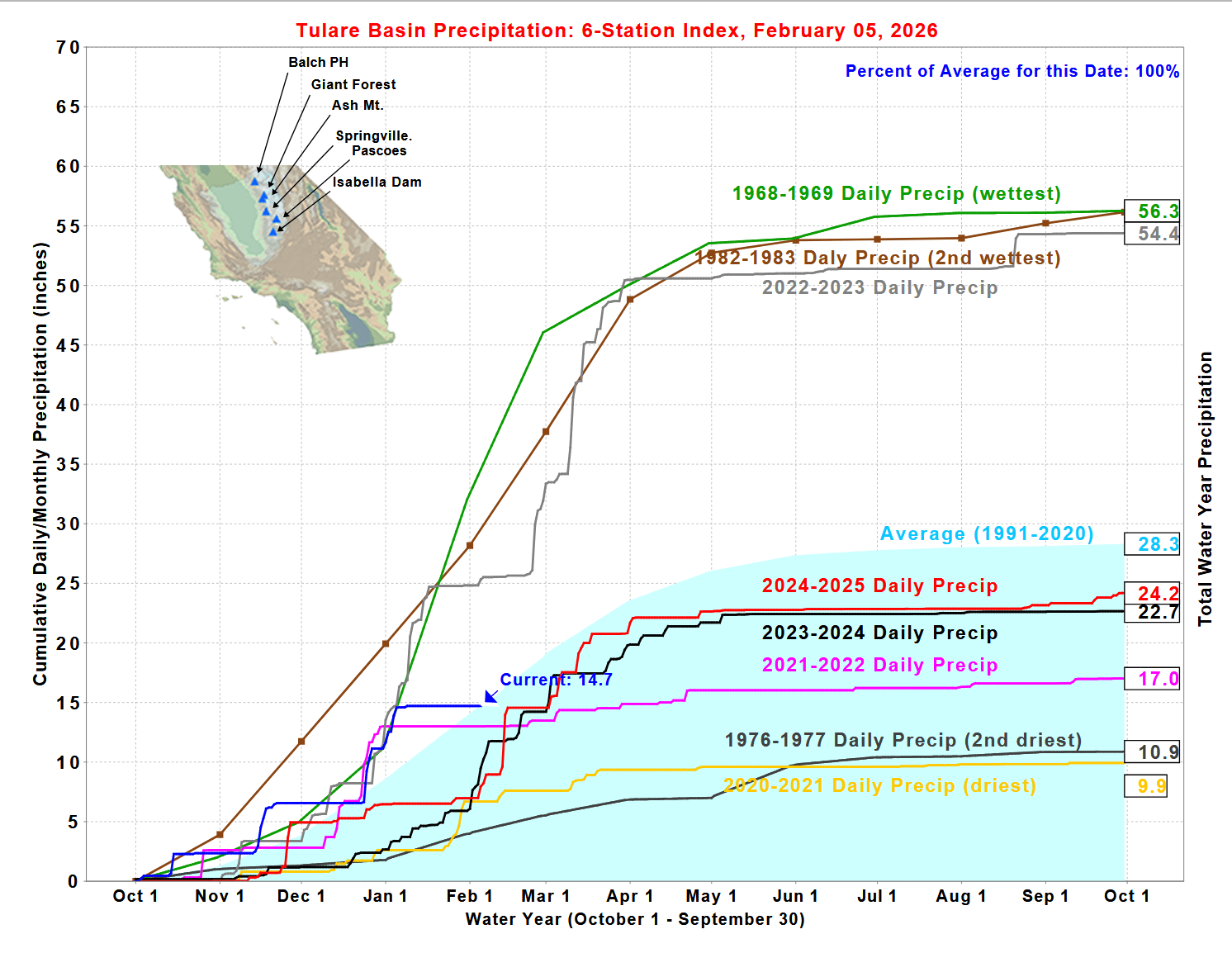
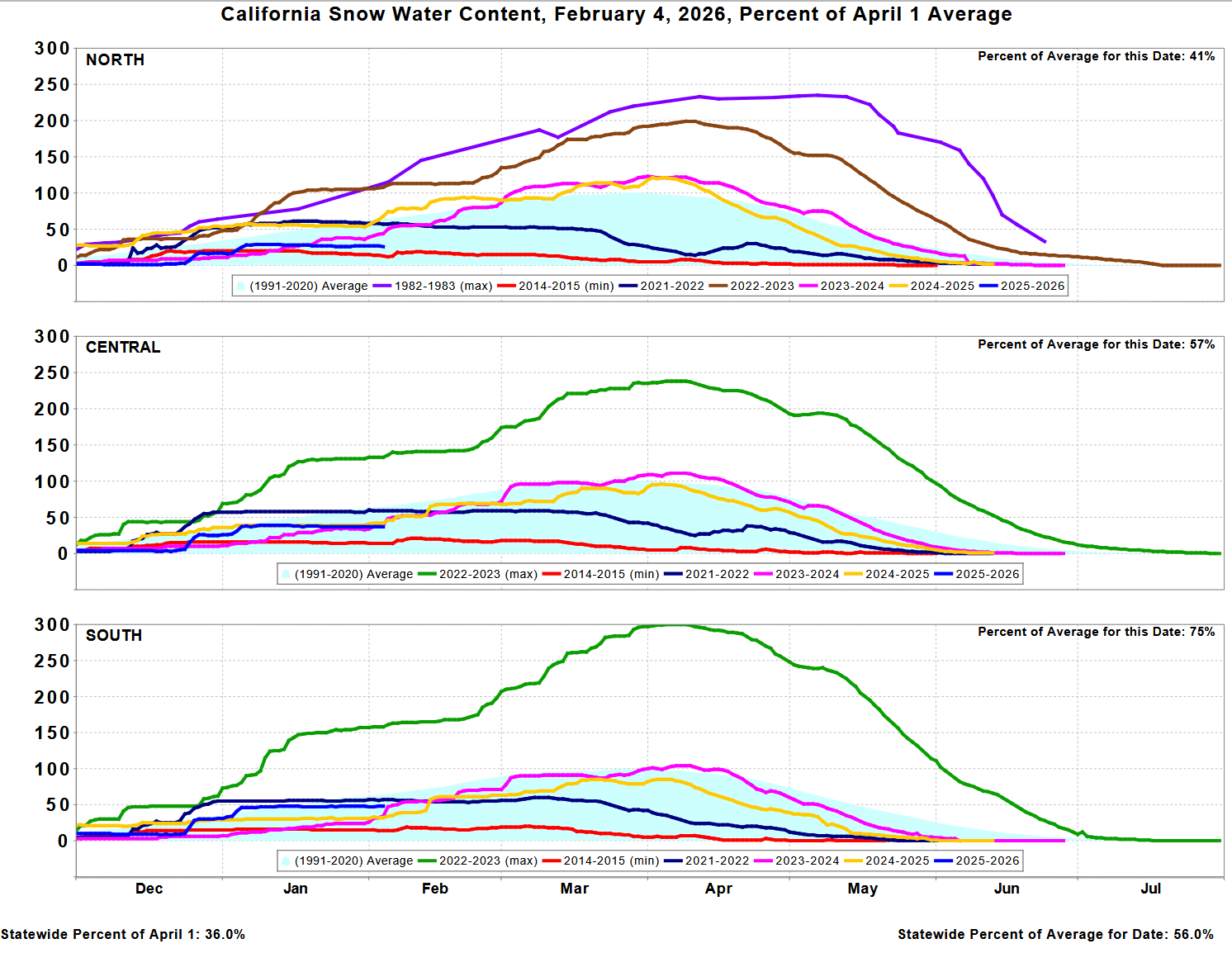
A look at current water and snow conditions …