
Several news sources featured in the Daily Digest may limit the number of articles you can access without a subscription. However, gift articles and open-access links are provided when available. For more open access California water news articles, explore the main page at MavensNotebook.com.
On the calendar today …
- MEETING: SB 1157 Indoor Water Use Working Group from 1pm to 4pm: This working group supports DWR in conducting statewide saturation end use studies and in assessing the long-term effects of telework. Attendance is open to the public. Input from non-working group members may be accepted time permitting. Water suppliers, local governments, community organizations, researchers, and other interested parties who would like to learn more and follow this important work are encouraged to attend. Register Here: csus.zoom.us/webinar/register/WN_rZhvgjc8SQSY9M7NRv5eOA
- WEBINAR: After the fire: Understanding post-fire recovery in California: water resource contamination from 5:30pm to 7:00pm. Californians who have experienced wildfire can face major hurdles during the recovery process, including identifying and repairing damaged infrastructure, testing for near-home environmental contamination, and navigating evolving regulations and building codes. Often times, people feel overwhelmed and are unsure of what to do next. If you are looking for information and resources around wildfire recovery, join the UC ANR Fire Network and our partners to learn about ongoing research efforts related to wildfire impacts on rural and urban communities. This webinar is intended for all California homeowners, residents, resource professionals, and other interested community members. Water Resource Contamination: Monday, February 2, 2026 from 5:30 – 7:00 PM PST. Click here to register.
January snow survey and snow drought …
DWR: Dry January cuts into early-season snowpack gains: Statewide, the snowpack is 59%

Andrew Nixon / DWR
“The Department of Water Resources (DWR) today conducted the second snow survey of the season at Phillips Station. The manual survey recorded 23 inches of snow depth and a snow water equivalent of 8 inches, which is 46 percent of average for this location. The snow water equivalent measures the amount of water contained in the snowpack and is a key component of DWR’s water supply forecast. Statewide, the snowpack is 59 percent of average for this date. Three weeks ago, the snowpack was 89 percent of average after a series of atmospheric rivers provided relief from a slow start to the snowpack. A dry January, which is historically the wettest month of the year in California, has now eroded the gains made at the start of the year and forecasts currently show no major precipitation in the next two weeks. … ” Read more from DWR.
Dry weather delivers blow to California snowpack
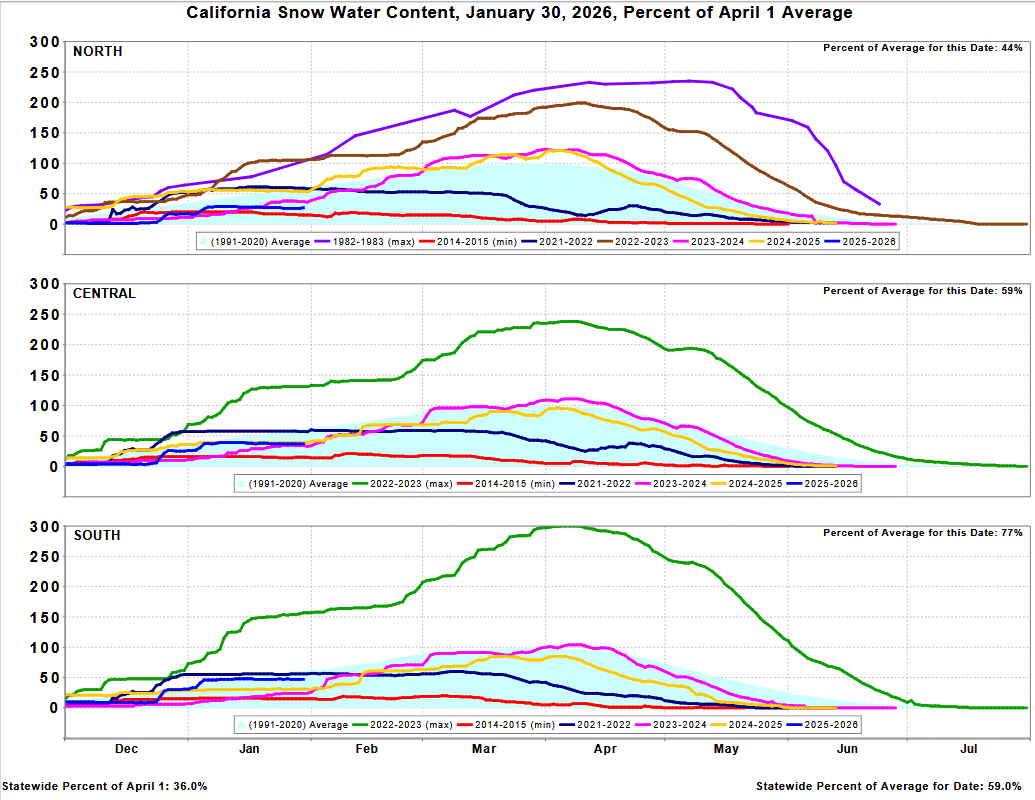 “California is facing a loss of its snowpack as its wettest time of the year crosses the halfway mark. The second snow survey of the season, held Friday at some 260 sites across California, showed Phillips Station — near Lake Tahoe — had 23 inches of snow depth. Its snow-water content, the amount of water if the snow melted, was 8 inches. That translates to a snowpack that’s 46% of average for the current survey, and 33% of average of the April 1 survey. It’s about a 5% drop in snowpack from the Dec. 30 survey. The snowpack is 59% of average for this date statewide. It was 67% of average on this date last year. The Sierra Nevada snowpack provides about 30% of the state’s water needs. “We still have some time to catch up,” said Andy Reising, manager of the Snow Surveys and Water Supply Forecasting Unit with the state Department of Water Resources. … ” Read more from the Courthouse News.
EXPLORE MORE COVERAGE:
- California’s Snowpack Is Shrinking, but Winter Isn’t Over Yet, from KQED
- California isn’t getting enough snow. Here’s what it means for water supplies, from the San Francisco Chronicle
- Halfway through winter, heat is melting the California snowpack, from the LA Times
Will California stay dry in February? Here’s the forecast
“Californians hoping for a return of rain and snow are going to have to wait. The first week of February is anticipated to be dry across California, except for a few light showers in parts of northwest California. The state is not in drought due partly to robust rainfall in the early fall, but the snowpack is extremely slim. A pattern that has gripped the U.S. this winter — a warm, dry West and cold, snowy East — is expected to persist for the first 10 days of the month. So the Super Bowl is likely to enjoy pleasant weather next weekend. Northern California’s precipitation forecast is more uncertain after Feb. 10, though drier-than-normal conditions will probably continue in Southern California through at least Feb. 14. … ” Read more from the San Francisco Chronicle.
SEE ALSO: Record temperatures forecast in California this week. Here’s how hot it could get, from the San Francisco Chronicle
Snow drought in the West reaches record levels
“While record snowfall and single-digit temperatures pummel much of the United States, an extreme snow drought and unusually warm weather are keeping skiers off the mountains, snowmobilers off the trails and water out of the rivers across much of the West. In many places famed for deep natural snow, including Park City, Utah; Vail, Colo.; and central and eastern Oregon, much of the ground is bare or blanketed with mere inches rather than feet of snow. The extent of snow-covered ground is at a record low. Instead of the typical winter sports, people across the West are still hiking and biking in 50- and 60-degree weather. Many are closely watching snowpack measurements because snow in the mountains provides natural storage for water in the arid West. The runoff will be slowly released in the coming months, acting as a primary water resource for millions of Western residents and for irrigating farm fields and filling trout streams and reservoirs. … ” Read more from the New York Times.
US ski resorts turn to drones to make it snow amid dire drought
 “Despite a barren start to Colorado’s ski season, Winter Park Resort opened on Halloween and served up holiday powder. The ski area’s secret is a contraption a few miles upwind of the chairlifts that looks like a meat smoker strapped to the top of a ladder. When weather conditions are just right, a Winter Park contractor fires up the machine, burning a fine dust of silver iodide into the sky — a process known as cloud seeding. Ideally, the particles disappear into a cloud that is cold enough and wet enough to produce snow, but may need a nudge. The silver iodide becomes the nuclei for water droplets, like iron filings to a magnet. Those droplets freeze and fall from the sky as snowflakes, freshening up the slopes of the resort as it tries to lure the Gore-Tex-clad masses between Denver and larger, showier ski destinations further west. … ” Read more from Bloomberg.
SEE ALSO: Western ski resorts and their terrible, horrible, no snow, very bad year, from the New York Times
Bay Delta Plan hearings …
Bay-Delta water plan divides tribes, farmers and regulators
 “California is weighing its first major rewrite of Bay-Delta water rules in decades, considering changes to how much water must remain in rivers and giving regional water agencies a more flexible way to comply with those limits. On the second day of a three-day State Water Resources Control Board hearing on Thursday, stakeholders fell into three broad camps as they continued to debate how California should manage the Bay-Delta in the years ahead. They included state officials backing adoption of the plan, environmental and tribal groups seeking stronger protections, and water agencies that welcomed added flexibility but pushed for major changes to the staff proposal. … ” Read more from the Sacramento Bee.
Water managers highlight early successes of Healthy Rivers and Landscapes projects at State Water Board hearings
Press release from the Northern California Water Association and the State Water Contractors: “During three days of hearings this week, January 28–30, the California State Water Resources Control Board heard testimony from state, regional and local water managers, local elected officials, state natural resource agency leaders, scientists, and community members from across the state expressing support for the Healthy Rivers and Landscapes (HRL) Program as a balanced and science-based path forward in the update to the Bay-Delta Water Quality Control Plan. The Healthy Rivers and Landscapes Program is designed to balance protection of all beneficial uses of water in the Bay-Delta watershed while making measurable progress toward the recovery of Chinook salmon and other native species. This statewide collaborative effort pairs strategically timed river flows with habitat restoration, supported by ongoing monitoring and science-based adaptive management. Together, these actions are advancing solutions that benefit ecosystems, local economies, and California’s long-term water security. … ” Continue reading this press release.
California Tribes and Fishermen Speak Out Against California Voluntary Water Agreements
Press release from Save Our Salmon: Today, Tribal members, fishing families, youth, and community allies are hosting a rally and public comment in opposition to the Bay-Delta Plan and proposed Voluntary Water Agreements (VAs) at the California State Water Board in Sacramento. The action takes place during the final day of State Water Board hearings, marking the last opportunity for public input on a plan that would impact rivers, salmon, and drinking water across California. It comes after two days of strong comments and panels opposing the plan by Tribes, Bay-Delta residents, environmental groups, and fishermen. Opposition to the Voluntary Agreements has grown as new federal actions threaten additional water exports from the Delta. Gary Mulcahy, Government Liaison of the Winnemem Wintu Tribe, warned, “The clueless SWRCB continues to advocate for an 8-year experiment that fails to meet water, environmental, and aquatic species needs on so many levels as the VAs currently stand.” … ” Continue reading this press release.
In other California water news …
Round Valley Indian Tribes respond to Trump administration’s attempt to thwart Eel River dam removal

“James Russ and Joseph Parker, the former and current presidents of the Round Valley Indian Tribes, are seeking to make their reservation healthy again. That means helping their people, they say, and specifically tackling high rates of diabetes and obesity that affect their tribal nation and many other Indigenous communities. It also means restoring their land and the river that has been intrinsically linked with their people for millennia. “We are Native people tied to the resources and rhythms of the Eel River,” Parker said. “Our health is connected to the river.” … ” Read more from the Santa Rosa Press Democrat.
Chinook salmon sightings at Cape Horn Dam reach highest numbers since 2013
“A new record has been set for the number of Chinook salmon sighted at Cape Horn Dam, with 1,324 fish reported by the Friends of the Eel River. This marks the highest number of Chinook salmon seen in this part of the watershed since 2013. Although the numbers are still far from historic levels, the increase is seen as a positive sign for the species in the Eel River. Cape Horn Dam, along with Scott Dam, forms the Van Arsdale Reservoir as part of the Potter Valley Project, which is scheduled for removal. … ” Read more from KRCR.
SEE ALSO: Eel River Dam Sees Highest Chinook Salmon Count in 13 Years, from Active NorCal
Is tyre pollution causing mass deaths in vulnerable salmon populations?
“Last week, a district judge in San Francisco, California, presided over a three-day trial brought by west coast fishers and conservationists against US tyre companies. The fishers allege that a chemical additive used in tyres is polluting rivers and waterways, killing coho salmon and other fish. If successful, the case could have implications far beyond the United States. The case was initiated after the apparent solving of a decades-old mystery: what was causing mass deaths of endangered coho salmon in the Pacific north-west as they returned to streams to spawn. The deaths happened after heavy rain. Before dying, the fish would exhibit unusual behaviour, swimming in circles, their mouths gaping, as if gasping for air. Scientists, suspecting storm runoff, described the phenomenon as “urban runoff mortality syndrome”. … ” Read more from The Guardian.
Tell me something good … about salmon
 “Almost exactly 15 years ago, researchers at UC Davis, California Trout and other partners started testing a wacky idea: Let’s plant salmon in rice fields to see how they grow. Could these winter-flooded fields serve as “nurseries” for struggling Central Valley salmon populations, allowing them a place to rest and feast on bugs before making their way to the ocean? It was called the Nigiri Project, a refreshing blend of rice and fish. Not only did it work, but salmon raised in rice fields grew two- to five times bigger than those raised in rivers, earning them the nickname “floodplain fatties.” The experimental pilot projects, conducted at Knaggs Ranch, showed that flooded rice fields could act as healthy fish habitats. It was the proof of concept needed for a much bigger project – the Department of Water Resources’ Big Notch Project — that launched last fall in Yolo County. That project cut a “notch” in Fremont Weir, installed new gates and carved new channels for salmon to improve flood control and fish passage. … ” Read more from UC Davis.
Students take the stage at the spinning salmon showcase
“California’s Chinook salmon face all kinds of challenges, from drought and warming to blocked migration routes. But in recent years, scientists have also been tracking a quieter threat: thiamine deficiency. This condition, caused by low levels of vitamin B1 (thiamine), can lead to strange swimming behaviour and high death rates in juvenile salmon. Since 2020, UC Davis, UC Berkeley, NOAA Fisheries, USGS, USFW, OSU and the California Department of Fish and Wildlife have been working to figure out exactly how thiamine levels affect salmon survival. A big part of that research is finding the effective concentration 50(EC50)—a technical term used to describe the amount of thiamine needed for half of the fall-run juvenile Chinook in the Central Valley to survive (See Figure 3). That kind of data typically comes from the lab, but in this case, some of the most important data is also coming from an unexpected source: high school classrooms. … ” Read more from the California Water Blog.
Water not the only factor farmers face in search of profit
“Listen to famers who worry that harvesting fewer acres due to requirements to pump less water with SGMA or receiving less surface water will result in big economic losses for both them and for the region’s economy. The cries are among the loudest from regions like western Fresno County where few natural water supplies exist including Westlands Water District. But there are other factors in the discussion in search of profitability. In multiple crops, farmers are far more efficient and productive year after year producing more corn and soybeans per acre, more milk per cow, more processing tomatoes with less water and a drop in labor needs. … ” Continue reading from Sierra 2 the Sea.
Rare earths mining takes a heavy toll. Is it worth moving mountains for a domestic supply?
“In the global race to secure hard-to-find minerals that help power everything from smartphones to wind turbines, California’s Mojave desert is emerging as an unlikely front line. The Colosseum mine, an abandoned gold pit, is now seen as a potential source of the rare earth elements underpinning the country’s clean energy development and technological leadership ambitions. Once part of the first mining rush, the site’s revival for rare earth extraction epitomizes the current era, whose emphasis on copper, nickel, lithium, and rare-earth elements reflects demand created by the growth of electronics, the explosion of data centers, and green energy. Colosseum, a defunct Mojave Desert gold mine, may have a new life. If, that is, the federal government continues to authorize an intensive and environmentally destructive operation in a protected area, the Mojave National Preserve. … ” Read more from … & the West.
New LiDAR datasets provide wall-to-wall coverage of California
In partnership with the California Air Resources Board, NASA Ames Research Center, and the Wildfire and Forest Resilience Task Force, the California Natural Resources Agency has released the first statewide, high-resolution LiDAR datasets that map forest and vegetation conditions, using more than 100 million acres of LiDAR data. The effort provides a single, wall-to-wall view of California’s forests at the highest available resolution. The publicly available datasets show vegetation location, height, density, ladder fuels, and carbon storage, and support wildfire risk reduction, ecosystem management, and climate planning. The data are available now for use by agencies, Tribes, researchers, land managers, and communities. Read more at the California Wildfire & Forest Resilience Task Force website.
How California governor candidates say they will tackle environmental issues
“Affordability consistently tops the list of issues that California voters care about. And according to one environmental group, climate issues also rank up there. In fact, as far as they’re concerned, climate solutions and affordability go hand-in-hand. A recent poll conducted by California Environmental Voters found that roughly 2 in 3 likely voters favor increasing the state’s investment in clean energy, believe the cost of electric vehicles should come down and think billion-dollar corporations with major environmental impacts should pay to offset climate-driven increases in the cost of home insurance. “The reality is, the climate crisis is driving an affordability crisis,” said California Environmental Voters CEO Mary Creasman. “These unnatural disasters are driving up energy costs, insurance costs, grocery bills, water rates and more. Corporate greed and climate impacts are creating an economic crisis.” … ” Read more from the OC Register.
In commentary today …
California’s drought is over, but we still must invest in water supply projects
Edward Ring writes, “For the last 25 years, the US Drought Monitor (USDM), a collaborative effort by the University of Nebraska, NOAA, the USDA, and other experts throughout the country, has released a weekly map that shows the location and intensity of drought across the United States. On January 8, for the first time ever, USDM’s weekly map showed the entire State of California to be drought free. The timing of USDM’s finding coincides with the release this week of a California Policy Center study, Statistical Review of United States Drought Monitor, that calls into question the objectivity of USDM’s reports. The USDM’s baseline assessment for the 20th century had California in a state of drought about 30 percent of the time, whereas their assessments for the first 25 years of the 21st century had the state experiencing drought more than 60 percent of the time. But our own analysis showed almost no change in drought frequency between this century and the last. … ” Read more from Edward Ring.
One year after the LA fires, we know what must change
Eric Horne, California Director for Megafire Action, writes, “Just a year ago, Los Angeles watched neighborhoods burn, skies fill with smoke, and families flee with minutes to spare, including members of my own family. As we commemorate the anniversary of this tragic event, many communities are still recovering, landscapes remain visibly scarred, and too many families are still living with the long tail of destruction—financial, emotional, and physical. Yet the most unsettling truth is that, despite the passage of time, the threat of megafires like those we witnessed in Altadena and the Palisades has only intensified. The past year has made one thing painfully clear: we know what must change to prevent future megafires, and the time to act is now. … ” Continue reading at Capitol Weekly.
In regional water news and commentary today …
NORTH COAST
Resource Environmental Solutions wins award for Klamath River restoration
“Environmental Business Journal (EBJ), a strategic business intelligence provider to the environmental industry, has honored Resource Environmental Solutions (RES) with a Project Merit Award for its work on the Klamath River Renewal Project, the largest dam removal and river restoration effort in American history. The removal of four Klamath River dams — Copco 1 and 2, Irongate and John C. Boyle — began in 2023 and was completed over a 16-month period. The project, aimed primarily at saving the river’s Chinook salmon from extinction, has reopened more than 400 stream-miles of historical salmon, steelhead and lamprey habitat that had been blocked for more than a century. … ” Read more from the Herald & News.
Engineering a comeback: How Ducks Unlimited science and collaboration offer hope for Klamath Basin
“After years of drought and poor wetland conditions, the 2025 season at Tule Lake and Lower Klamath national wildlife refuges marked an improvement for habitat recovery and waterfowl response in the Klamath Basin. Improved water management, strong collaboration among partners and data-driven decision-making supported migrating and breeding birds while reducing disease risk and setting the stage for continued recovery. As part of Ducks Unlimited’s Klamath Basin Initiative, these improvements reflect a broader, long-term commitment to restoring wetlands, strengthening water management and supporting the wildlife and communities that depend on this landscape. The Initiative brings together partners, science and strategic investments to rebuild wetland systems across the Basin, and the progress seen this season at Tule Lake and Lower Klamath demonstrates the impact of that collaborative approach. … ” Read more from Ducks Unlimited.
Arcata City Council to decide on water rate increase strategy
“The Arcata City Council will decide at next week’s meeting how much they’re going to increase the amount customers are charged for water. Increasing the water rate is a slow process, governed by Proposition 218, which regulates the process government agencies have to follow to increase property-related fees. Prop 218 requires governments to choose a five-year rate increase plan before the fees are increased; the council will choose theirs on Wednesday. The Arcata City Council was presented with two different options by engineering consultants Bartle Wells Associates in October. One option is to increase the rates by 44% the first year, not at all the second year, and then small, annual increases of 8-10% for the next three years, ending at $13.50 per hundred cubic feet (HCF) of water used monthly. … ” Read more from the Lost Coast Outpost.
Lake County officials admit incorrect testing as Clearlake sewage spill cleanup pushes third week
“More than two weeks after raw sewage spilled from a broken pipe into a Clearlake neighborhood and upended daily life for residents — many of whom have not had access to running water since Jan. 11 — officials acknowledged Lake County Special Districts erred while conducting early testing, furthering the delay of cleanup. “There was something that was happening or had happened,” Lake County Undersheriff Corey Paulich, who also serves as the Deputy Director of the Office of Emergency Services, said of the testing. “There shouldn’t be any more issues.” The error only deepened the frustrations of residents, who showed up en masse to a town hall meeting at Clearlake City Hall Wednesday, Jan. 28, leaving city and county officials scrambling to respond to a spill of deepening magnitude. … ” Read more from the Lake County Record-Bee.
Clearlake sewer spill area expanded; more water tanks installed
“Officials on Friday said they have expanded the incident area for a massive sewer spill in the northern part of Clearlake as a precautionary measure. Sunday will mark three weeks since a Lake County Sanitation District-owned force main rupture triggered the Robin Lane sewer spill, which released nearly three million gallons of raw sewage into streets and across private properties. On Monday, the city of Clearlake began managing the recovery phase of the incident in unified command with the Lake County Sheriff’s Office of Emergency Services. During the week, officials expanded the number of impacted properties from 58 to 200. … ” Read more from the Lake County News.
SACRAMENTO VALLEY
Butte County: As almond bloom nears, farmers prepare for possible colder temperatures
“With almond bloom approaching, farmers in Butte County and beyond are also preparing for the possibility of cold temperatures. Butte County Farm Bureau Executive Director Colleen Cecil said cold temperatures, which can get to or below freezing overnight, have the potential to do “significant damage” to crops. While other crops can be affected, Cecil said that almonds pose the most challenges when it comes to freezing temperatures. As of now, however, she said the temperatures have been warm, which can lead to the beginning of the bloom. “As we continue to have these warmer, sunny days, the trees will begin to believe it’s spring and wake up and blooms will happen,” she said. “That’s when we could get in trouble if we see these overnight freezing temperatures.” … ” Read more from the Chico Enterprise-Record.
Record Salmon returns documented in Roseville Area Creeks
“A recent survey of the Dry Creek watershed organized by the Dry Creek Conservancy recorded the highest number of spawning salmon seen in the area in more than a decade, offering encouraging signs for local waterways and restoration efforts. The Dry Creek Salmon Survey, conducted from Fall 2025 through Winter 2026, documented salmon activity in Dry Creek and its tributaries, including Secret Ravine, Miner’s Ravine, Antelope Creek, and Linda Creek. The effort aimed to track population trends, assess spawning distribution, and raise public awareness about salmon conservation. Volunteer survey teams waded one- to two-mile creek segments, visually counting live salmon, carcasses, and redds while taking care to avoid disturbing spawning habitat. Carcass data, including length, sex, and adipose fin presence, were recorded. … ” Read more from Roseville Today.
E-scooters sometimes end up in Sacramento’s waterways. Who removes them?
“Two bird rental e-scooters lay stuck in the mud along the riverbank near the Tower Bridge, just feet from the water. It’s a scene river cleanup volunteers say they encounter far more often than most Sacramento residents may realize. Sacramento’s current rental e-scooter market is shared by Bird and Lime. Most rental scooters are located in Downtown and surrounding neighborhoods. While the scooters are typically used for short-distance travel, some are abandoned or even intentionally dumped in waterways. Crystal Tobias is a longtime river cleanup volunteer in the Sacramento region. She said e-scooters have become a recurring problem during river cleanups she’s participated in. “Oh, dozens and dozens of them,” Tobias said. “Maybe over a hundred. It’s every waterway… Steelhead Creek, Arcade Creek, the American River, Discovery Park. It’s just rampant.” … ” Read more from Capital Public Radio.
BAY AREA
Neighbors of spectacular new Bodega Bay preserve overwhelmed by visitor traffic
“To paraphrase that haunting voice in the movie “Field of Dreams”: If you preserve it, they will come. Ever since word got out about the opening of the spectacular Estero Americano Coast Preserve, just south of Bodega Bay, outdoor enthusiasts have arrived in droves, from all over the Bay Area and beyond. The 547-acre parcel, formerly the Bottarini Ranch, is owned and managed by The Wildlands Conservancy, which acquired it in 2015, following a purchase put together by the nonprofit Sonoma Land Trust. The property features 5 miles of trails wending through coastal prairies, along dramatic bluffs and down to a remote beach. … Surveying the exiting group, one of the new arrivals, a rangy man in a white ballcap, declared, “Everyone looks so happy!” Everyone is not happy. … ” Read more from the San Jose Mercury News.
Chicken Ranch Beach: Wetland Enhancement Project update
“SPAWN has made incredible progress on the Chicken Ranch Beach Wetland Enhancement Project! Thanks to the hard work of SPAWN staff and interns, dedicated volunteers, and the West Coast Wild’s restoration crew, 4,400 flourishing plants have been planted at the restoration site. … The Chicken Ranch Beach Wetland Enhancement Project is a roughly 1-acre restoration effort spearheaded by the Tomales Bay Foundation to improve water quality, protect public health and restore critical wetland habitat. The property adjacent to Chicken Ranch Beach, located in Inverness California, has historically been impacted with high levels of fecal coliform and E-coli bacteria. The shallow ditch on the property intercepted shallow groundwater flows and conveyed water across the surface of Tomales Bay with bacteria counts routinely exceeding state limits for recreational water contact. In 2025, Heal the Bay rated Chicken Ranch Beach as one of the 10 most polluted beaches in California. Despite this, the public beach continues to be a very popular destination near Tomales Bay. … ” Read more from the Turtle Island Restoration Network.
CENTRAL COAST
Radio show: Monterey Bay This Week: Regulator rejects Vistra’s water monitoring plans, local communities resist ICE, an interview on Iran, and more
“Highlights from this week’s news roundup: The Central Coast Water Board has rejected Vistra’s plans for assessing surface water and groundwater contamination from its battery fire in Moss Landing last year. … ” Listen at KAZU.
SAN JOAQUIN VALLEY
Officials issue warning after finding invasive golden mussels in water system: ‘It is absolutely a big problem’
“Water agencies in California’s San Joaquin Valley are desperately trying to figure out the best way to combat an influx of golden mussels. San Joaquin Valley water agencies have discovered golden mussels clogging up pipes and equipment from Stockton to Arvin, according to Maven’s Notebook. In December 2025, the Arvin-Edison Water Storage District discovered golden mussels in its pipes and equipment. This led Friant Water Authority to do a thorough inspection of the Friant-Kern Canal. There, they found a plethora of this invasive species and went to work removing as many as possible. The agencies said that ensuring these mussels don’t reach the upper watershed of the San Joaquin River or Millerton Lake is vital to protecting the entire Friant system. … ” Read more from The Cool Down.
Snowpack lags in watersheds for Stanislaus, nearby counties. Is it time to worry?
“The whiplash winter of 2026 has put the snowpack well below average in watersheds for Modesto and nearby areas. Two caveats: The main storm season still has two months to go and reservoir storage is above average thanks to recent wet years. The snowpack was 59% of average in the central Sierra Nevada as of Friday, the California Department of Water Resources said. It supplies farms and cities via the Stanislaus, Tuolumne, Merced and San Joaquin rivers. October and November storms got the snowpack off to a strong start, but a dry spell dropped it to 14% of the historical average for Dec. 22. Then came the holiday storms, raising the figure to 90% as of Jan. 9. … ” Read more from the Modesto Bee.
Tehachapi-Cummings County Water District talks Delta Conveyance Works, pump plant engine change orders, board compensation and coming water year
“The Tehachapi-Cummings County Water District Board of Directors met last week to discuss a number of state, local and internal issues, including the Delta Conveyance Project, local water allocations, and shoring up communication on project change orders. TCCWD General Manager Tom Neisler said the Delta Conveyance Project, a long politically-embattled project to essentially finish the State Water Project with a tunnel that will transport water from the Sacramento River to the San Luis Reservoir, has hit a legal snag. Neisler said at the very end of last year the 3rd Circuit Court of Appeals affirmed a trial court’s ruling on the project’s validation action was too vague, a ruling that prevents bonds from being sold to pay for the project. … ” Read more from the Tehachapi News.
Tehachapi’s 2026 water prospects rosy despite ongoing State Water Project concerns
“While the long-term viability of California’s water supply is a source of great concern in the state at large, Tehachapi’s near future looks stable, and the next year seems downright rosy, based on a recent forecast by the Tehachapi-Cummings County Water District. At a recent meeting of the TCCWD Board of Directors, General Manager Tom Neisler said he does not expect to use any banked water to supplement their attempts to meet customer demands this coming year. “We’re in pretty good shape for 2026,” he said in an interview after the meeting. … ” Read more from the Tehachapi News.
SOUTHERN CALIFORNIA
What winter? Groundhog Day in SoCal is sizzling with no end in sight
“While a groundhog in Pennsylvania has predicted six more weeks of winter and cold-stunned iguanas fall from trees in Florida, Southern California is working up a sweat. A midwinter heat wave has descended on much of the state and is expected to spike temperatures as much as 20 degrees above normal in the coming week. The summer-like heat is thanks to a ridge of high pressure lingering high in the atmosphere that extends through the San Francisco Bay Area and into the Pacific Northwest. Meteorologists with the National Weather Service expect it to last through the end of the week and potentially through Super Bowl Sunday. After a cooler Monday for the L.A. area, another push of warm weather may bring near-record temperatures by Wednesday — potentially reaching 90 degrees across the inland coast and valley areas of L.A. and Ventura counties, according to the weather service. … ” Read more from the LA Times.
Fighting to survive, an Altadena water company is charging a new ‘fire recovery fee’
“When the Eaton fire raged through neighborhoods in Altadena, the flames leveled three-quarters of the homes served by the tiny Las Flores Water Co. It also destroyed the roofs of two covered reservoirs where the utility stored drinking water. The company soon restored clean water to those homes left standing. But the disaster has left it with costly repairs, and a sharp drop in income since most of its 1,500 customers haven’t yet rebuilt or reconnected their water. Attempting to avert financial failure, the private water company’s board now plans to start charging people a new “fire recovery fee” of about $3,000 over the next five years, or about $50 a month. It’s the best way to avoid insolvency, said John Bednarski, president of the Las Flores board. Its reserves, now roughly $500,000, are shrinking. … ” Read more from the LA Times.
Ants are thriving in an LA wildfire burn zone. Here’s why it matters
“Joe Parker, a Caltech entomologist who has studied indigenous forest ants in key canyons above Pasadena and Altadena for eight years, felt his heart sink as he watched by live video the Eaton fire burn through the canyon where his documented ant colonies live. Thinking they were all gone, along with nearly a decade of research, he and his team of graduate students a few months after the Jan. 7, 2025, fire got permission to visit Millard Canyon. He was surprised to find 13 of 15 ant colonies his team had documented pre-fire had survived. These ants, the velvety tree ant (Liometopum occidentale) that survived in Millard Canyon were holed up inside the trunks of 13 coast live oak trees, a fire-resistant tree species dominant in the canyons of Southern California. “We feared the worst as we watched on the video app as the fire engulfed the canyon. It was amazing to see how the ants were still there, protected inside the coast live oaks trees in which they nest by excavating the internal heartwood of these trees and building a complex nest structure inside,” Parker said. … ” Read more from the OC Register.
Banning residents face months-long utility billing delays
“Residents are dealing with months of delayed and irregular utility bills after what city officials described as a failed software transition that disrupted billing for water, sewer and electric services citywide. The disruption began after December 2024, according to residents, when utility bills stopped arriving. Some residents went as long as five months without receiving a bill before the city resumed billing in 2025, issuing charges to cover months of missed utility usage. The city had relied on the same utility billing software system since 1992. Officials said the decades-old system had become outdated, prompting the city to implement a new platform in November 2024. The rollout was unsuccessful. … ” Read more from the Record-Gazette.
SAN DIEGO
Local emergency declared due to large sinkhole in Carlsbad
“The City of Carlsbad and the Carlsbad Municipal Water District declared a state of local emergency Saturday morning after a large sinkhole developed due to a water main break at the intersection of Carlsbad Village Drive and El Camino Real. The local emergency allows for road repairs to begin immediately, according to a press release from the City of Carlsbad. The water main break was reported at 4 a.m. Saturday, and the large sinkhole is initially impacted six lanes of El Camino Real and four lanes of Carlsbad Village Drive, according to the Declaration of Local Emergency. … ” Read more from NBC 7.
Along the Colorado River …
The West’s water war arrives in Washington
 “Interior Secretary Doug Burgum stepped into the seven-state brawl over the Colorado River on Friday — a high-stakes battle over water supplies that poses significant political danger in Western swing states for the Trump administration. Burgum convened most of the region’s governors and their lead water negotiators in his office Friday afternoon for more than two hours in a bid to secure a deal to divide up the flows from the river, which have shrunk dramatically as climate change inflicts deeper droughts across the region. It’s the Trump administration’s first big foray into the battle over a waterway that supports 40 million people from Wyoming to the U.S.-Mexico border, along with 5.5 million acres of farmland, American Indian tribes and the high-tech industry that has blossomed around Phoenix. But governors who attended the meeting said the meeting produced no breakthrough, and it was quickly clear that major divisions remain. … ” Read more from Politico.
SEE ALSO: Burgum’s Colorado River summit raises hopes, but no deal, from E&E News
Trump’s office called 7 governors to D.C. for Colorado River talks. Here’s what California said
“Top California officials traveled to Washington D.C., summoned by the Trump administration for a Friday meeting as a standoff over the Colorado River’s water supplies continues amid alarmingly dry conditions. Interior Secretary Doug Burgum called in the governors from the seven Colorado River basin states in an unprecedented move to referee fraught negotiations about how to portion out the river’s overtapped supply. The stakes are high, as California, Arizona, and Nevada in the lower basin clash with Colorado, Wyoming, Utah and New Mexico upstream over how to govern the river after this year, when the current agreements end. .., ” Read more from Cal Matters.
Colorado River governors express cautious optimism after ‘historic’ DC meeting
“With the deadline to reach a water usage agreement looming, leaders from the seven Colorado River Basin states expressed cautious optimism that their “historic” meeting in Washington, D.C., will spur the compromise needed to reach a consensus. U.S. Secretary of the Interior Doug Burgum called the meeting at the request of Arizona Gov. Katie Hobbs, after the states blew past a Nov. 11 deadline to reach an agreement. The new Feb. 14 deadline was set by the Bureau of Reclamation, which manages water in the West under the Interior Department. Arizona stands to see the largest cuts if the states can’t reach an agreement, because its Central Arizona Project is one of the newest users of the river water, making it legally one of the first to be cut. … ” Read more from the Nevada Current.
EXPLORE MORE COVERAGE:
- Governors leave D.C. with no deal on Colorado River, mixed messages, from the Arizona Daily Star
- Hobbs pitches Arizona’s case to avoid Colorado River cuts in D.C., from KJZZ
- Colorado ‘is not going to be a sucker’ around Colorado River issues, says Attorney General Weiser, as Gov. Polis attends negotiation in DC, from Colorado Public Radio
- Fate of Colorado River hangs in balance as political battle brews, from Washington Post
- Governors Dive Into an Impasse Over Colorado River Water Use, from the New York Times
- Arizona seeks fair share of Colorado River water in negotiations with upper basin states, from Arizona Capital Times
Commentary: The water conflict a century in the making
Journalist Sammy Roth writes, “Lake Mead is two-thirds empty. Lake Powell is even emptier. Not for the first time, the seven Western states that rely on the Colorado River are fighting over how to keep these reservoirs from crashing — an event that could spur water shortages from Denver to Las Vegas to Los Angeles. The tens of millions of people who rely on the Colorado River have weathered such crises before, even amid a stubborn quarter-century megadrought fueled by climate change. The states have always struck deals to use less water, overcoming their political differences to avert “dead pool” at Mead and Powell, meaning that water could no longer flow downstream. This time, a deal may not be possible. And it’s clear who’s to blame. Not the farmers who grow alfalfa and other feed for animals, despite the fact that they use one-third of all water in the Colorado River basin. Not California, even though the Golden State uses more river water than any of its neighbors. Not even the Trump administration, which has done a lousy job pressing the states to compromise. No, the Upper Basin states of Colorado, New Mexico, Utah and Wyoming have emerged as the main obstacles to a fair deal. … ” Read more from the New York Times.
Inside Phoenix’s water system as Colorado River cuts loom
“When you turn on your faucet, hose, or shower, there’s a good chance the water flowing out came from the Colorado River and traveled more than 200 miles before reaching your home. In Phoenix, about 40% of the city’s water supply depends on the Colorado River. Before it ever reaches you, that water must pass through massive treatment plants operating around the clock. At the Union Hills Water Treatment Plant, 110 million gallons of water pass through it every day, supplying the northern part of the Phoenix metro area. Every drop comes from the Colorado River, and it pumps out enough water to fill more than 200 backyard swimming pools every hour. … ” Read more from ABC 15.
Winter storms leave Colorado River Basin drought mostly unchanged
“The U.S. Drought Monitor Report released on January 29, 2026, reveals that drought conditions across the United States remain largely unchanged despite one of the most expansive winter storm systems of the season. The storm delivered heavy snow, sleet, freezing rain, and ice across a wide swath of the country, from the southern Rockies to the East Coast. In many regions, precipitation totals were substantial when measured in liquid equivalent. However, the form of that precipitation matters. Much of the moisture fell as snow or ice and remains locked in frozen ground or snowpack. Until temperatures rise enough to melt and infiltrate, that water does little to reduce drought impacts. As a result, drought improvements were limited and highly localized, while large portions of the country saw no meaningful change. … ” Read more from Western Water.
SEE ALSO: A truly awful Colorado River snowpack so far in 2026, from the Inkstain blog
‘An incredible fight ahead:’ Colorado calls in reinforcements to contain zebra mussel threat
“Colorado’s expert on aquatic invasive species said Wednesday the state has an “incredible fight ahead” as it works to contain the spread of zebra mussels in the Colorado River. “I wish I could tell you the story of zebra mussels has concluded,” Robert Walters told a crowd of dozens of water professionals at the Colorado Water Congress in Aurora. “We’re doing everything we can to contain this population.” Walters leads Parks and Wildlife’s growing aquatic nuisance species program. He outlined the state’s latest efforts to prevent the mussels from expanding and clogging pipes that deliver water to farmers and thousands of water users on the West Slope. … ” Read more from KUNC.
In national water news today …
A crisis emerges across the US as ‘forever chemicals’ quietly contaminate drinking water wells
 “Kristen Hanneman made a small decision in 2022 that would upend life for her entire town. State scientists were checking private drinking water wells across Wisconsin for a widely used family of harmful chemicals called PFAS. They mailed an offer to test the well outside her tidy farmhouse surrounded by potato farms cut out of dense forest. Without much thought, she accepted. Months later, Hanneman found herself on the phone with a state toxicologist who told her to stop drinking the water — now. The well her three kids grew up on had levels thousands of times higher than federal drinking water limits for what are commonly known as forever chemicals. Hanneman’s well was hardly the only one with a problem. And the chemicals were everywhere. Pristine lakes and superb hunting made Stella a sportsman’s dream. Now officials say the fish and deer should be eaten sparingly or not at all. … ” Read more from the Associated Press.
SEE ALSO: Takeaways from the AP’s reporting on PFAS contamination of private drinking water wells, from the Associated Press
EPA’s new “compliance first” policy
“On December 5, 2025, the U.S. Environmental Protection Agency’s Office of Enforcement and Compliance Assurance issued a memorandum titled “Reinforcing a ‘Compliance First’ Orientation for Compliance Assurance and Civil Enforcement Activities”(Compliance Memorandum). The Compliance Memorandum, nicknamed the Pritzlaff Memo, directs staff to prioritize efficient compliance over punitive measures, supporting the agency’s “Powering the Great American Comeback” initiative and balancing environmental protection with economic growth. The Compliance Memorandum emphasizes that enforcement should focus on obtaining compliance efficiently and economically. We have yet to see how the Compliance Memorandum manifests. These themes are noteworthy … ” Read more from Stoel Rives.
Cyber, physical security fact sheets offer tips for utilities
“The Water Information Sharing and Analysis Center (WaterISAC) has released two new fact sheets on the top actions water/wastewater systems can take to strengthen physical and cybersecurity efforts. … ” Read more from Water Finance & Management.
A startup falsely blamed for triggering floods pitches cloud seeding to lawmakers
“A startup dogged by conspiracy theories is trying to change the way Washington views technologies that coax snowflakes from the clouds, one Metro station at a time. Rainmaker Technology uses drones, artificial intelligence weather forecasting and particles of snow-forming silver iodide to squeeze additional precipitation from certain types of clouds. That led some conservative influencers and lawmakers last year to accuse the cloud-seeding startup of triggering deadly flooding. It responded to those erroneous claims with a surge of media appearances, lobbying and meetings with Trump administration officials. … ” Read more from Politico.
Plastic pollution promotes hazardous water conditions, new study finds
“Dangerous concentrations of algae such as “red tides” have been consistently emerging in locations around the world. A region in Southern Australia is experiencing a nine-month toxic algae bloom that spans thousands of miles and has caused thousands of deaths across marine species. Such harmful algal blooms (HABs) produce toxins that can force municipalities to close beaches and lakes due to public health risks. Excess amounts of nutrient input from land sources into aquatic environments, such as agricultural runoff and waste discharge, typically have been blamed as the source of harmful algae blooms. But data from a new study by University of California San Diego researchers reveals that petroleum-based plastic pollution may be amplifying these problems by removing the animals that keep algae in check. … ” Read more from UC San Diego.

