
A wrap-up of posts published on Maven’s Notebook this week …
Note to readers: Sign up for weekly email service and you will receive notification of this post on Friday mornings. Readers on daily email service can add weekly email service by updating their subscription preferences. Click here to sign up!
In California water news this week …
Heated debate over California water plan as environmentalists warn of ‘ecosystem collapse’
 “The question of how to protect fish and the ecological health of rivers that feed California’s largest estuary is generating heated debate in a series of hearings in Sacramento, as state officials try to gain support for a plan that has been years in the making. “I am passionate that this is the pathway to recover fish,” said state Natural Resources Secretary Wade Crowfoot. “This is the paradigm we need: collaborative, adaptive management versus conflict and litigation.” The plan is being discussed in three days of hearings convened by the State Water Resources Control Board. It sets out rules for water quality that will determine how much water can be pumped out of the Sacramento-San Joaquin River Delta for the state’s farms and cities. … ” Read more from the LA Times. | Read via Yahoo News.
A hard look at the 3,000-page Bay-Delta Plan

Photo taken August 28, 2025. Ken James / DWR
“A historic effort to pump some life back into the San Joaquin River’s devastated salmon runs began more than 15 years ago as water users began releasing more water each year from Friant Dam for restoration purposes. Under the rules of the San Joaquin River Restoration Program, Friant water users are permitted to recapture that water downstream of the 153-mile project area, but only if doing so has no adverse impact on the environment downstream of the recapture point. Now, as part of a state-backed plan known as the Voluntary Agreements that would rewrite Bay-Delta water and ecosystem management rules, the Friant water users have offered up to 50,000 acre-feet of annual Delta outflow to improve conditions for fish. To achieve this, they propose to forego recapturing the San Joaquin River restoration flows. But environmental watchdog groups are crying foul. … ” Read more from Alastair Bland at Maven’s Notebook.
December storms, improved flexibility allow DWR to increase State Water Project allocation to 30%

“Today, the Department of Water Resources (DWR) announced an increase to the State Water Project (SWP) allocation for 2026. The allocation is now 30 percent of requested supplies, up from the initial allocation of 10 percent on December 1. Storms in mid-December have made it possible for the SWP to increase the expected amount of water deliveries this year to the 29 public water agencies served by the SWP, which provides water to 27 million Californians and 750,000 acres of farmland. SWP allocations are based on a number of factors including hydrological conditions, existing reservoir storage, and an assumption of dry conditions through the rest of the year. The assumption of dry conditions is increasingly important given the shrinking and warming of California’s traditional precipitation season. In December, all of California benefited from winter storms. However, January has been unseasonably dry and warm and, as a result, snowpack and precipitation are below average for this time of year. … ” Read more from DWR (includes statements from the State Water Contractors and Metropolitan Water District).
The Sierra snowpack is dropping fast. Here’s why experts say it’s not as bad as it seems.
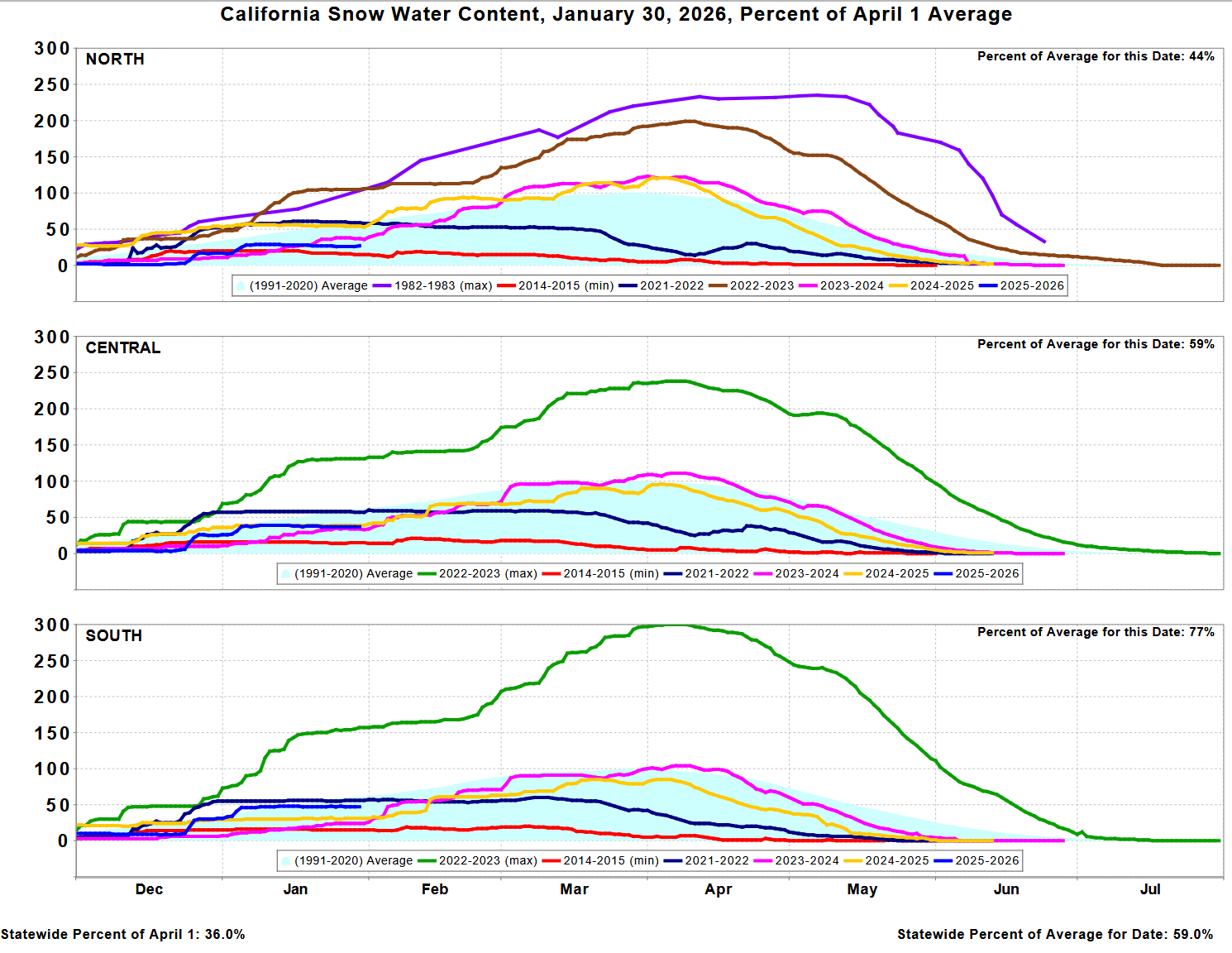 “The Sierra Nevada snowpack, the source of nearly one-third of California’s water supply, is looking a little like a New Year’s resolution: Full of hope and promise at the beginning of January, but now struggling with a bothersome reality check. Starting on Christmas Eve, big storms dumped 7 to 8 feet of new snow across the Lake Tahoe area over a two-week period, ending a dry December and drenching the rest of the state with rain. By Jan. 6, with umbrellas and snow shovels getting a workout, the statewide Sierra Nevada snowpack was a respectable 93% of its historical average. But in the three weeks since, the switch has flipped. Sunny and warm weather has been the norm throughout most of California. On Thursday, the Sierra snowpack had fallen to just 59% of its historical average. “It’s been 23 days without a good storm,” said Jan Null, a meteorologist with Golden Gate Weather Services in Half Moon Bay. “And I don’t see anything of any significance in the forecast for the next week.” … ” Read more from the San Jose Mercury News.
New rules change how La Niña and El Niño are classified. Here’s what that means
“The National Oceanic and Atmospheric Administration is updating the way it classifies El Niño and La Niña with an index that accounts for the effects of climate change. More La Niña and fewer El Niño declarations are possible as a result of the new scale, which weighs the long-term warming trend of oceans. El Niño and La Niña are periods of ocean temperature extremes in the eastern and central equatorial Pacific Ocean. When sea-surface temperatures are at least 0.5 degrees Celsius above normal in this region for five consecutive months, El Niño is declared. Scientists diagnose La Niña as cooler than normal waters. Previously, “normal” was defined by a 30-year average of sea surface temperatures in the east-central equatorial Pacific. Now the anomaly threshold is computed in the context of broader ocean temperatures. More specifically, the index subtracts the temperature anomaly of all global waters within 20 degrees of the equator from this small region in the Pacific tropics. … ” Read more from the San Francisco Chronicle.
Colorado River states meet Friday in DC with federal deadline looming, litigation threat growing
 “The governors of six of the seven of the Colorado River Basin states plan to meet Friday in Washington, D.C., in an attempt to break a stalemate in Colorado River water negotiations. Interior Secretary Doug Burgum has invited all of the governors and their negotiators to meet in the nation’s capital as states approach a federal deadline to reach a voluntary agreement to replace river operating guidelines that will expire at the end of 2026. The governors of Arizona, Colorado, New Mexico, Utah, Wyoming and Nevada are set to attend. California Gov. Gavin Newsom can’t attend “due to a longstanding family commitment,” according to spokesman Anthony Martinez, but California Natural Resources Secretary Wade Crowfoot plans to attend the meeting in his place. The Bureau of Reclamation — which manages water in the West under the Interior Department — initially gave states until Nov. 11 to submit a preliminary agreement for a plan to replace the guidelines. … ” Read more from the Arizona Mirror.
Fiery speeches and calls for compromise: What Colorado River negotiators are saying on eve of DC summit
“Governors in the Colorado River basin and their negotiators are meeting with Interior Secretary Doug Burgum in Washington on Friday to try and break a yearslong impasse among states over how to share the dwindling waterway. On the eve of the high-stakes summit, negotiators from both the upper and lower river basins are not sounding confident they can reach an agreement before a fast-approaching Feb. 14 deadline. “It depends on the day that you ask me,” Colorado’s negotiator, Becky Mitchell, said Tuesday when asked by KUNC News if she thinks the states are heading toward a court battle. “But I will tell you the level of commitment that we have, both within Colorado and the upper basin, is strong to try to find some way to make a deal. There’s some things that we can’t give on.” … ” Read more from KUNC.
Trump administration signs off on plan for California’s biggest reservoir in decades
 “The Trump administration gave the OK for California’s Sites Reservoir on Friday, clearing a major hurdle for what would be the state’s largest water project in decades. The proposed reservoir 70 miles northwest of Sacramento, which is also supported by Gov. Gavin Newsom, is intended to collect flows from the Sacramento River during wet years and store them for cities and farms during dry times. The $6 billion facility would hold 1.5 million acre-feet of water, enough to provide for more than 3 million households annually. Both the federal and state governments agree that water storage needs to be a top priority in an era of increasing droughts, despite other major differences between Sacramento and Washington under the current administration. … ” Read more from the San Francisco Chronicle.
Price tag drops on project to expand massive reservoir near Bay Area to increase water supplies

“A $1 billion plan to raise the height of the dam at one of California’s largest reservoirs, San Luis Reservoir between Gilroy and Los Banos, to provide more water to Santa Clara County and parts of the Central Valley during droughts, has received a major and unusual boost: The cost has gone down. In an era when large public works projects, from high-speed rail to new reservoirs, routinely see big jumps in price, the cost to expand the reservoir, originally built in the 1960s, has fallen by about 20% — from $1.06 billion to $847 million. The reason: In recent months, Caltrans endorsed a cheaper alternative for how a section of Highway 152, a busy road adjacent to the reservoir, will be raised and rebuilt to accommodate the higher water level. “This is incredibly favorable news,” said Scott Petersen, a spokesman for the San Luis and Delta Mendota Water Authority, which is overseeing the project. “This means the water is going to be more affordable.” … ” Read more from the San Jose Mercury News.
Trump and Newsom are both tugging at water supplies. Trump is winning.
“President Donald Trump and Gov. Gavin Newsom are so in sync on California water that they’re in a race to capture as much of it as possible — possibly even at each other’s expense. Trump and Newsom’s relative alignment on water issues has been good news all around for farmers and cities that draw from both sides of the state’s main water hub: the federally run Central Valley Project and the aptly named State Water Project, which is state-run. Water deliveries have ticked up, mostly as a result of back-to-back wet years but also as a result of loosened environmental rules on both sides, much to the chagrin of environmental groups concerned about the collapse of endangered fish populations in the sensitive Sacramento-San Joaquin Delta. But the feds have been steadily squeezing out more water over the course of the past year — to the point where state customers are getting worried that their own supplies could be in jeopardy. … ” Read more from Politico.
Artificial intelligence and California’s water
“It can be hard to escape the hype over artificial intelligence (AI) right now, especially if you live in California. Is it going to transform society for the better or destroy the world as we know it? And, critical to those of us working on water issues, what do these advances mean for efficient water use—and our jobs? Through a series of blog posts, we will explore how California might leverage AI to better manage our water resources, while mitigating the risks of this rapidly evolving technology. AI isn’t new to California water, but recent advances may be changing the game. AI refers to computers performing tasks that typically involve human intelligence, such as reasoning, problem solving, and learning. While AI has exploded in the last few years, some water managers have been using early AI since the 1980s. … ” Read more from the PPIC.
This L.A. startup uses SpaceX tech to cool data centers with less power and no water
“As the artificial intelligence industry heats up, Karman Industries is trying to cool it down. The Signal Hill startup says it has developed a cooling system that uses SpaceX rocket engine technology to rein in the environmental impact of data centers, chilling them with less space, less power and no water. It recently raised $20 million and expects to start building its first compressors in Long Beach later this year. “Our high-level thesis is we could build the best compressor out there using the latest and greatest technology,” said David Tearse, chief executive of Karman. “We want to reduce that electrical consumption of cooling so that you have the most efficient way to cool these chips.” … ” Read more from the LA Times. | Read via AOL News.
SEE ALSO: Microsoft Pledged to Save Water. In the A.I. Era, It Expects Water Use to Soar., from the New York Times
Tire manufacturers fight accusations that toxic runoff harms fish
“On the last day of a three-day bench trial, tire manufacturers maintained that there is not yet enough data to form opinions about the effects of a runoff tire chemicals on protected and endangered fish populations. Environmental organizations claim the tire manufacturers — including Bridgestone America, Goodyear Tires and Michelin North America— make or distribute products that contain 6PPD, a chemical that ultimately transforms into 6PPD-quinone when it reacts with ozone. As the tire interacts with the environment and roads, 6PPD-Q leaches onto hard surfaces. When it rains, the chemical falls into rivers and other waterways, where it can kill fish in a matter of hours, the Institute for Fisheries Resources and the Pacific Coast Federation of Fishermen’s Associations claim. … ” Read more from the Courthouse News Service.
The Delta’s role in California’s carbon sequestration and climate goals

“Carbon is the foundation of the Delta’s peat soils and a key component of two major greenhouse gases: carbon dioxide, which persists in the atmosphere indefinitely, and methane, a short-lived but highly potent greenhouse gas. Since the 1850s, draining the Delta’s soils has released over a billion tons of carbon dioxide into the atmosphere—equivalent to about a quarter of the United States’ annual emissions today. However, the process could potentially be reversed, making Delta wetland restoration a powerful ally in the quest to reduce greenhouse gas emissions. The critical role of Delta wetlands in addressing these challenges was a key focus of a panel discussion at the September 2025 meeting of the Delta Stewardship Council. Oxidation of the Delta’s peat soils has not only contributed to climate change but also increased pressure on Delta levees, raising flood risks and threatening California’s water supply, while reducing farmland. “However, re-wetting our Delta soils can reverse that, and we know that now, because of long-term high-quality data,” said Dr. Lisamarie Windham-Myers, Delta Lead Scientist. “Those climate benefits may seem like they’re far out in the future, but they’re actually coming faster than we expected.” … ” Read more from Maven’s Notebook.
Tribal consultation: Wintu people say proposed reforms to a state list of tribes is erasure, threatens their homelands
“As a Wintu cultural monitor, Shawna Wilson says she always carries her hard hat, clipboard, and tribal ID card in her vehicle because she never knows when she might have to step into her role and stop a construction project. … “It can be difficult to navigate when you’re dealing with foremen who don’t want to listen or slow down their work,” said Wilson, a member of the Wintu Tribe of Northern California. “But it’s important we speak up for our lands and ancestors.” Sometimes her Tribe is left in the dark simply due to poor communication, but Wilson said sometimes public officials falsely believe they don’t have to consult with her Tribe because the Wintu are federally unrecognized. Wilson and several California tribal leaders say excluding non-recognized tribes, something which currently violates state law, could soon become encoded into California regulations, much to their alarm. A state commission is currently evaluating a proposal that would remove unrecognized tribes, including the Wintu, from an important list agencies use to determine which tribes to consult. … ” Read the full story at the Shasta Scout.
Meghan Hertel, of Sacramento, has been appointed Director of the Department of Fish and Wildlife.
 From the Office of the Governor: Hertel has been the Deputy Secretary of Biodiversity and Habitat at the California Natural Resources Agency since 2024. She was the North American Director of the Land Life Company from 2022 to 2024. Hertel held several positions at Audubon California from 2010 to 2022, including Director of Land and Water Conservation, Interim State Co-Director, Director of Working Lands, Associate Director of Public Policy, and San Joaquin River Project Manager. She was a Conservation Program Administrator at the Resources Legacy Fund from 2007 to 2010. Hertel earned a Master of Arts degree in Environmental Science and Policy from Clark University and a Bachelor of Arts degree in Political Science from the University of Florida. This position requires Senate confirmation and the compensation is $218,268. Hertel is a Democrat.
In commentary this week …
To fight the golden mussel, California counties need a coordinated approach
Calaveras County Supervisor Amanda Folendorf writes, “In rural California, protecting our water is a daily, hands-on battle against aquatic invasive species like the latest one, the golden mussel. Crews now must scrub boat hulls, sample canal water and vigilantly monitor reservoirs. Yet, invaders too often slip through anyway. Golden mussels continue to appear in new reservoirs, bypassing our best defenses. They are now threatening fisheries, water infrastructure and the recreation economy that sustains many rural communities. In October 2024, state water managers first discovered that golden mussels had invaded North America after finding them in the Stockton Deepwater Shipping Channel near the Port of Stockton. Given how this is connected to the Sacramento-San Joaquin Delta, where all the rivers of the western Sierra merge before heading toward San Francisco Bay, the location of this discovery could not have been worse. … ” Read more from the Sacramento Bee. | Read via the Merced Sun-Star.
What Americans lose if their National Center for Atmospheric Research is dismantled
Carlos Martinez, a senior climate scientist with the Climate & Energy Program at the Union of Concerned Scientists, writes, “Americans set few everyday expectations for science, but they are fundamental: We expect the weather forecast to be right, we expect science and technology that allow weather hazards to be anticipated within reason, and we expect public services to protect our lives and livelihoods from such hazards—floods, fires, tornadoes, and hurricanes. Well, the fulfillment of those expectations is in real doubt now that the Trump administration plans to dismantle the National Science Foundation’s (NSF) National Center for Atmospheric Research (NCAR), a federally funded institution that underpins critical science that Americans rely on. Administration officials have argued that NCAR’s work can simply be redistributed to other institutions without loss. But NCAR is not just another research center. It is purpose-built critical infrastructure designed to integrate observations, modeling, supercomputing, and applied research in ways that no single university, agency, or contractor can replicate on its own. … ” Read more from EOS.
C-WIN: Big tunnel, big taxes: Newsom’s gigantic water project would spike property taxes
In regional water news this week …
Feds to rewrite Klamath River endangered species rules
“Federal water managers are reopening endangered species and water-sharing rules in the Klamath Basin as salmon return to newly free-flowing stretches of the river and as the Trump administration pushes agencies to maximize water deliveries. What happened: The Bureau of Reclamation formally asked federal fisheries agencies last week to help rewrite the endangered species rules that govern its dams and pumps that deliver water from the Klamath River on the California-Oregon border to farms and wildlife refuges in both states, Adam Nickels, the bureau’s acting California regional director, told a Reno-based conference of federal and local water managers Wednesday. Alan Heck, the bureau’s Klamath Basin manager, told the conference attendees that he expected the new guidelines to represent a “fairly large shift in the way we do business” following President Donald Trump’s executive order to maximize water supply last year and an assessment earlier this month of endangered species protections in the region. … ” Read more from Politico Pro (sorry, subscription required).
Eel Dam removal: Fish versus farmers?
“On December 19, 2025, Secretary of Agriculture Brooke Rollins announced the federal government’s effort to stop the proposed decommissioning of the Potter Valley Hydroelectric Project in California. This project, owned and operated by Pacific Gas and Electric (PG&E), consists of two dams and a diversion tunnel that channels water from the Eel River Valley to the Russian River basin, where the water is used to irrigate 307,000 acres of farmland. “If this plan goes through as proposed, it will devastate hundreds of family farms and wipe out more than a century of agricultural tradition in Potter Valley,” Rollins said in her press release. “Under California’s radical leadership, the needs of hardworking families are being ignored while the needs of fish are treated as more important.” The way Rollins frames it, this looks like a classic environmentalist versus farmer battle. But—as is often the case in such simplistic narratives—the reality is a lot more complicated. … ” Read more from Acres.
Nearly two million juvenile salmon released into winter-flooded rice fields in hopes of stronger survival rates to the Pacific Ocean
 “Marking one of the largest salmon releases of its kind, a coalition of rice farmers, fishermen, water suppliers, researchers, and conservationists, in partnership with U.S. Fish and Wildlife Service’s Coleman National Fish Hatchery, has introduced 1.8 million salmon fry into winter-flooded rice fields near the Sacramento River in hopes of contributing to higher numbers of healthier fish reaching the Pacific Ocean and returning to the valley as adults. The multiyear project is introducing fall-run salmon fry from Coleman National Fish Hatchery into working ricelands at Conaway Ranch and Knaggs Ranch, located in Yolo County. This large-scale hatchery release is a “fish on floodplain farm fields” project designed to demonstrate how winter ricelands can be managed to provide wetland-like food-rich habitat for migrating salmon. “We believe hatchery fish released into rice fields, where they have access to abundant food, will thrive, similarly to how salmon historically benefitted from feeding on natural floodplains,” said James Stone, President of the NorCal Guides and Sportsmen’s Association. … ” Continue reading this press release.
Salmon survey confirms major habitat breakthrough in Auburn Ravine
“A fall salmon survey conducted in Auburn Ravine in late November confirmed that Chinook salmon are now accessing upstream spawning habitat that had been blocked for nearly a century, marking a major milestone for local restoration efforts. Friends of Auburn Ravine volunteers surveyed the creek on Nov. 22 and observed 52 live fall-run Chinook salmon, along with one additional fish that had already died after spawning, according to James Haufler, a board member with the nonprofit. “The big thing about that particular survey is that all the salmon that came upstream this year made it past what used to be called Hemphill Dam,” Haufler said. “That’s now actually a fish passage site.” … ” Read more from Gold Country Media.
25 years of revitalization efforts, leads to a record-breaking salmon spawn in Putah Creek
“Putah Creek, the 85-mile long stream that forms the border between Solano and Yolo counties, just had a record breaking year for salmon. 2,100 Chinook returned to the waters of Putah Creek to spawn in 2025. A decade ago scientists estimated about 1,700 salmon returned to the stream. That may sound like a modest increase but compared to three decades ago when salmon were extinct in the waterway, this represents a complete turnaround for the once struggling Putah Creek. The victim of droughts, dams and water policy that diverted flows away from the stream, it was all but dried up in the 1990s. But thanks to a landmark accord in 2000, following a decade-long legal battle, Putah Creek has undergone a transformation that has brought back the water and much of the wildlife that was once lost. … ” Read more from Capital Public Radio.
Mokelumne River salmon returns highlight hatchery program success
“The East Bay Municipal Utility District (EBMUD) reports more than 10,500 Chinook salmon returned to the Mokelumne River from the Pacific Ocean to spawn during the 2025 fall run. These returns represent a healthy count for natural spawning in the river and allowed EBMUD’s fish hatchery to reach its goal of collecting and fertilizing 7.5 million salmon eggs in coordination with the California Department of Fish and Wildlife (CDFW). Though the Mokelumne contributes only about 3 percent of the freshwater flow into the Sacramento-San Joaquin Delta, its salmon population has made up as much as 50 percent of the commercial catch off the California coast. “These results reflect EBMUD’s dedication to the stewardship of the Mokelumne River, our commitment to habitat restoration, and our investments in science-driven fish hatchery operations and river management,” said EBMUD Board President Luz Gómez. “We are proud of our successful partnership with the California Department of Fish and Wildlife and thank our many local, state, and federal partners as we work together to strengthen California’s salmon populations and protect our vital natural resources.” … ” Read more from EBMUD.
Palo Alto’s horizontal levee passes test, reduced flooding during recent storms
“When the recent storms and king tides slammed into the Bay Area they did what they always do, smash against seawalls and trigger flooding in low-lying areas. But along a quiet marsh behind the wastewater treatment plant in Palo Alto, something different was happening. Instead of crashing or flooding, the tides were surging, onto a new kind of barrier known as a horizontal levee. We’ve been following its construction for several years, when engineers first began planning the angled runway design, to absorb the tide and release it- rather than trying to hold it back. “And that king tide came through here and it came up to the edge of the berm,” says Assistant Public Works Director Karin North from the City of Palo Alto, pointing to the high-water mark. … ” Read more from ABC 7.
Tiny Altadena water company meeting attracts hundreds as solvency hangs in the balance
“Some Altadena residents were left with sticker shock after the small Las Flores Water Company, which only has about 1,500 customers, proposed charging an extra $50 a month for the next five years to keep from going bankrupt. After a recent meeting at which more than 200 residents showed up, Las Flores Board President John Bednarski said the board will “deliberate at one of our upcoming meetings to take into account the feedback that we got.” Not only did the fires destroy homes and businesses, but also critical infrastructure. Small private water companies, such as Las Flores and two others that serve unincorporated Altadena, have received limited insurance payouts and don’t have access to as many state and federal grants to rebuild, experts say. … ” Read more from the LAist.
L.A. is ripping up 1,600 acres of pavement — but is it too little, too late?
“At the end of last year, Los Angeles County adopted a new target to remove and replace 1,600 acres of pavement with green infrastructure including trees, plants and rain gardens by 2045 as part of its ongoing Sustainability Plan. In doing so, the county aims to join a growing number of cities worldwide that are ditching pavement to respond to ecological vulnerabilities. While depaving efforts in places like Chicago and Portland, Ore., have largely been driven by residents and nonprofit groups, L.A.’s plan marks the first explicit depaving target from a major U.S. public agency, signaling an emerging shift in how policymakers are rethinking infrastructure. Depaving, the act of removing asphalt and concrete in places where hardscape isn’t needed, comes with the goal to create more space for vegetation, trees and soil that provide useful benefits like cooling and shade. Urban planners are increasingly turning to depaving as an adaptation strategy as extreme weather exposes the limits of aging civic infrastructure. … ” Read more from the LA Times. | Read via Yahoo News.

