

Several news sources featured in the Daily Digest may limit the number of articles you can access without a subscription. However, gift articles and open-access links are provided when available. For more open access California water news articles, explore the main page at MavensNotebook.com.
On the calendar today …
- PUBLIC HEARING: Sacramento/Delta updates to the Bay Delta Plan beginning at 9am. The State Water Board will receive public comments on the December 2025 revised draft updates to the Sacramento/Delta portion of the update to the Bay Delta Plan and Chapter 13 of the draft Staff Report. Click here for the notice.
In California water news this weekend …
December storms, improved flexibility allow DWR to increase State Water Project allocation to 30%

“Today, the Department of Water Resources (DWR) announced an increase to the State Water Project (SWP) allocation for 2026. The allocation is now 30 percent of requested supplies, up from the initial allocation of 10 percent on December 1. Storms in mid-December have made it possible for the SWP to increase the expected amount of water deliveries this year to the 29 public water agencies served by the SWP, which provides water to 27 million Californians and 750,000 acres of farmland. SWP allocations are based on a number of factors including hydrological conditions, existing reservoir storage, and an assumption of dry conditions through the rest of the year. The assumption of dry conditions is increasingly important given the shrinking and warming of California’s traditional precipitation season. In December, all of California benefited from winter storms. However, January has been unseasonably dry and warm and, as a result, snowpack and precipitation are below average for this time of year. … ” Read more from DWR (includes statements from the State Water Contractors and Metropolitan Water District).
The Sierra snowpack is dropping fast. Here’s why experts say it’s not as bad as it seems.
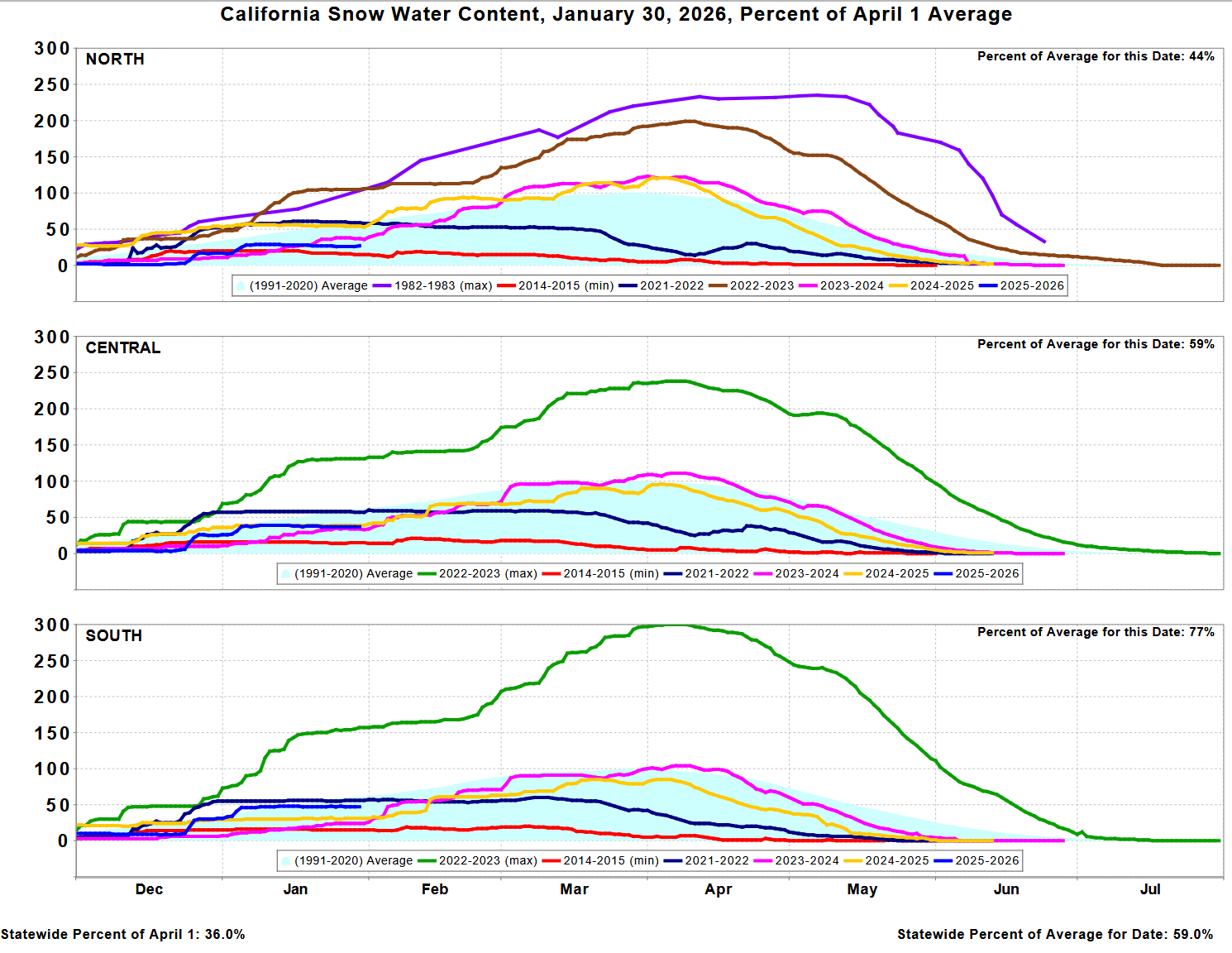 “The Sierra Nevada snowpack, the source of nearly one-third of California’s water supply, is looking a little like a New Year’s resolution: Full of hope and promise at the beginning of January, but now struggling with a bothersome reality check. Starting on Christmas Eve, big storms dumped 7 to 8 feet of new snow across the Lake Tahoe area over a two-week period, ending a dry December and drenching the rest of the state with rain. By Jan. 6, with umbrellas and snow shovels getting a workout, the statewide Sierra Nevada snowpack was a respectable 93% of its historical average. But in the three weeks since, the switch has flipped. Sunny and warm weather has been the norm throughout most of California. On Thursday, the Sierra snowpack had fallen to just 59% of its historical average. “It’s been 23 days without a good storm,” said Jan Null, a meteorologist with Golden Gate Weather Services in Half Moon Bay. “And I don’t see anything of any significance in the forecast for the next week.” … ” Read more from the San Jose Mercury News.
This species faces its doom. Only Californians can save it.
 “Barring a big change, monarchs that shelter along California’s coast every winter will almost certainly die out within about 50 years. Although the U.S. Fish and Wildlife Service moved to protect the iconic butterflies under the Endangered Species Act in December 2024, the Trump administration delayed that process amid its larger effort to weaken the law. The latest monarch numbers are the third-lowest on record, according to a new annual tally the Xerces Society for Invertebrate Conservation released on Thursday. The report is in keeping with an overall decline: After the butterflies hit rock-bottom numbers in 2020, they rebounded slightly for only a few years before plunging again in 2024. “I’m most concerned that if the numbers continue to remain low, there’s less opportunity for monarchs to bounce back,” Isis Howard, a conservation biologist for the Xerces Society, told SFGATE. “They need some good luck, and they need our action.” … ” Read more SF Gate.
SEE ALSO: West Coast monarch butterfly populations hit historic low. This may be the ‘new normal’, from the LA Times
The endangered Endangered Species Act
“This year’s Western monarch butterfly winter count may be the second- or third-lowest ever. Until recently, a proposed Endangered Species Act listing seemed like a safe bet. Now, even if that happens, the Trump administration has proposed a packet of revisions that critics say will gut the law—and put local species at risk. U.S. Department of the Interior Secretary Doug Burgum said in a statement that the Trump administration is merely restoring the ESA to its “original intent” and ending “years of legal confusion and regulatory overreach.” Of the five new ESA rules so far, four are essentially repeats from the first Trump administration that were in effect for a few months before the Biden administration mostly did away with them. This time around, the rules could be real game-changers. “We’re in the middle of a biodiversity meltdown, and these changes will destroy one of the most effective tools we had,” says Stu Weiss, chief scientist at the environmental consultancy Creekside Science, monarch expert, and winner of a Bay Nature Local Hero Award in 2023. … ” Read more from Bay Nature.
The Spinning Salmon Program: Science in the classroom
“Every fall, thousands of tiny salmon eggs arrive in high school classrooms across Northern California. Students huddle around their tanks, watching closely as the fish hatch, swim, and grow. But this isn’t just about raising fish, it’s about contributing to real science. Through the Spinning Salmon Program, now in its fifth year, over 3,500 students have helped researchers understand thiamine deficiency, a vitamin B1 shortage that can cause strange swimming behavior, including spinning, and low survival in young Chinook salmon.1 Students record observations on the behavior and survival of a control group of young salmon that have not been treated for thiamine deficiency. Because these fish are not typically monitored outside of laboratory settings, students’ data represent an important dataset on non-treated juvenile salmon. … ” Read more from the Delta Stewardship Council.
California Forever gains momentum
“On Jan. 21, California Forever, the company proposing to build a big, green city near the northeastern banks of the Sacramento River Delta, announced that they had inked “the largest construction labor agreement in history.” The deal, struck with the Napa/Solano Building Trades Council and the Northern California Carpenters Union, secured local Labor’s support for the project—the largest proposed development currently underway in the state and the nation. According to a statement issued last week, the plan is to create “the first walkable city built in a century” halfway between San Francisco and Sacramento. … ” Read more from California Local.
SEE ALSO: Poll: Less than 1 in 5 support Suisun City’s annexation plans, from the Daily Republic
Bay Area lab’s new model for forecasting wildfires could change how they’re fought — and save lives
“When a lightning storm struck the parched Diablo mountain range in August 2020, igniting fires that turned the skies an apocalyptic shade of orange, the Governor’s Office activated current Oakland Fire Department Assistant Chief Christopher Foley to face the fire’s multiple fronts. As the SCU fires spread through Alameda, Santa Clara and Contra Costa counties, the CZU Lightning Complex fires were raging in the Santa Cruz Mountains and San Mateo County. At the same time, the LNU Lightning Complex fires burned across the Bay Area’s wine country. “Most of the state was burning,” said Foley, reflecting on how firefighting agencies from all over California assisted each other. “The fires down in Santa Cruz County and into Alameda County and then up the coast, they were all fairly simultaneous. We’re fortunate to be in the most robust mutual aid system in the country, if not the world. But it doesn’t take much for the system to get stripped. There is a limit to what we can do.” … ” Read more from the San Jose Mercury News.
Who’s the greenest of them all?
“California’s gubernatorial contest just got shaken up. Again. San Jose Mayor Matt Mahan announced Thursday that he’s throwing his hat in the ring, immediately grabbing Silicon Valley backers, but not so much enviros. “Big yawn. Meh,” RL Miller, president of the political action committee Climate Hawks Vote and chair of the California Democratic Party’s environmental caucus, said in reaction to Mahan’s entry. Mahan’s campaign website, heavy on homelessness and public safety, is silent on climate and the environment (neither word appears) but proposes cutting regulations to increase housing construction. “As a climate person, he has said absolutely nothing to interest me,” Miller said. … ” Read more from Politico.
SEE ALSO: Climate change, electric vehicles and Delta tunnel among the focuses of gubernatorial candidate forum, from the LA Times
In people news this weekend …
Promotions, passings, profiles – submit people news items to maven@mavensnotebook.com.
Meghan Hertel, of Sacramento, has been appointed Director of the Department of Fish and Wildlife.
 From the Office of the Governor: Hertel has been the Deputy Secretary of Biodiversity and Habitat at the California Natural Resources Agency since 2024. She was the North American Director of the Land Life Company from 2022 to 2024. Hertel held several positions at Audubon California from 2010 to 2022, including Director of Land and Water Conservation, Interim State Co-Director, Director of Working Lands, Associate Director of Public Policy, and San Joaquin River Project Manager. She was a Conservation Program Administrator at the Resources Legacy Fund from 2007 to 2010. Hertel earned a Master of Arts degree in Environmental Science and Policy from Clark University and a Bachelor of Arts degree in Political Science from the University of Florida. This position requires Senate confirmation and the compensation is $218,268. Hertel is a Democrat.
Podcasts …
WE GROW CALIFORNIA: 2026 just started and its already A LOT – with Chris White
Chris White, Executive Director of the San Joaquin River Water Authority Exchange Contractors, joins Darcy Villere in the studio and kicks off 2026 with A LOT of information. There are changes on how the Central Valley Project and State Water Projects are operating and Chris does his best to break it down for Darcy refreshes his memory and making sense out of all the moving parts – water being just one of them.
TALKING UNDER WATER: AI and energy needs in a sustainable water future
In this episode Talking Under Water co-host Bob Crossen speaks with Gabriel Collins, the Baker Botts Fellow in Energy and Environmental Regulatory Affairs at Rice University’s Baker Institute for Public Policy, about the evolving pressures on industrial water use and the widening implications of the AI boom. Drawing from his cross-sector expertise, Collins unpacks why water is an inherently hyper‑local resource and how industries — ranging from semiconductor fabrication to refineries and petrochemical plants — are adapting to shrinking supplies and rising costs.
WATER IS A MANY SPLENDOR’ED THING: Living the Amish Life
 How do Amish communities living in rural areas manage their water needs in today’s world? Water is a Many Splendor’ed Thing brings you another water relationship that has a personally significant impact to your life. Produced by Stephen Baker, Bringing People Together to Solve Water Problems, water@operationunite.co 530-205-6388
In regional water news this weekend …
NORTH COAST
King tides return, but any possible coastal flooding will be minor
“Minor high tide flooding is possible through early next week, though the National Weather Service expects any resulting coastal flooding to be less severe than the inundation that damaged homes in King Salmon earlier this month. High tides are expected through Monday, with the possibility of low-lying minor nuisance flooding peaking on Saturday morning. According to the National Weather Service in Eureka, there’s a 30% probability for minor coastal flooding Friday around 9 a.m. and a 40% chance Saturday at 9:44 a.m. The possible flooding is described by NWS as nuisance flooding, with a potential for low-lying roads that typically flood during high tides to see up to a half of foot of water. Doug Boushey, a meteorologist with the NWS Eureka office, emphasized any flooding impacts “won’t be as severe as king tide flooding observed earlier in January.” … ” Read more from the Eureka Times-Standard.
Amazon is building a new delivery center just outside Ukiah — what could it mean for the community?
Amazon is constructing a delivery center in Mendocino County, and its location is just north of Ukiah at the Friends of Liberty Industrial Park. According to site plan documents obtained from the county, Amazon purchased just under 14 acres at the business park. The new facility, which the documents show will cover 59,000 square feet, is being built by Alston Construction, a Sacramento-based contractor. The facility is planned for 1775 N. State St. in Ukiah. According to Natalie Banke, Amazon’s West Coast public relations manager, the facility should be finished later this year, though she did not give an exact date of completion. … ” Read more from Local News Matters.
SIERRA NEVADA
Salmon survey confirms major habitat breakthrough in Auburn Ravine
“A fall salmon survey conducted in Auburn Ravine in late November confirmed that Chinook salmon are now accessing upstream spawning habitat that had been blocked for nearly a century, marking a major milestone for local restoration efforts. Friends of Auburn Ravine volunteers surveyed the creek on Nov. 22 and observed 52 live fall-run Chinook salmon, along with one additional fish that had already died after spawning, according to James Haufler, a board member with the nonprofit. “The big thing about that particular survey is that all the salmon that came upstream this year made it past what used to be called Hemphill Dam,” Haufler said. “That’s now actually a fish passage site.” … ” Read more from Gold Country Media.
SACRAMENTO VALLEY
25 years of revitalization efforts, leads to a record-breaking salmon spawn in Putah Creek
“Putah Creek, the 85-mile long stream that forms the border between Solano and Yolo counties, just had a record breaking year for salmon. 2,100 Chinook returned to the waters of Putah Creek to spawn in 2025. A decade ago scientists estimated about 1,700 salmon returned to the stream. That may sound like a modest increase but compared to three decades ago when salmon were extinct in the waterway, this represents a complete turnaround for the once struggling Putah Creek. The victim of droughts, dams and water policy that diverted flows away from the stream, it was all but dried up in the 1990s. But thanks to a landmark accord in 2000, following a decade-long legal battle, Putah Creek has undergone a transformation that has brought back the water and much of the wildlife that was once lost. … ” Read more from Capital Public Radio.
NAPA/SONOMA
Regenerative vineyards can pay their way, new Sonoma County study finds
“Sonoma County grape growers weighing a shift to regenerative practices now have some hard numbers to work with. A study published this month in the American Journal of Enology and Viticulture tracked costs and revenues at four vineyards in Russian River Valley and Alexander Valley, comparing conventional management against regenerative approaches like no-till farming, composting, and integrating sheep for grazing. The verdict: over a 30-year vineyard lifespan, the two approaches come out roughly even financially—with regenerative running just 2 to 8 percent lower in net present value. That’s assuming yields stay the same. And that’s the key assumption growers will want to scrutinize. … ” Read more from the San Jose Mercury News.
BAY AREA
Bay Area to see another high tide this weekend, with flooding of low-lying areas
“Officials advised of minor coastal flooding in parts of the Bay Area through Sunday as high tides, large waves and minor storm surge were expected to inundate low-lying shorelines. The National Weather Service issued a coastal flood advisory along San Francisco, San Pablo and Monterey bays through noon Sunday. Up to 1.4 feet of inundation was expected, more than a foot lower than the early January record flooding that caused widespread damage in Marin County. Isolated road closures were possible, the weather service said. People were warned not to drive around barricades or water of unknown depth. … ” Read more from the San Francisco Chronicle.
The one factor behind the Bay Area’s ongoing dry spell
“After a relatively wet start to winter, the Bay Area has been under a serious dry spell since early January. Downtown San Francisco is running about 20% below average precipitation for the month. National Weather Service meteorologist Rachel Kennedy explained one reason for the dry weather: a blast of arctic air, which led to record-cold temperatures and heavy snow and ice for much of the country this month, reaching as far south as Miami, is also affecting Bay Area weather. “That kind of arctic air outbreak much to our east — in the Midwest and East Coast of the U.S. — that’s kind of helping to block this [high-pressure] ridge, and we’re really just waiting for something to break it down,” she told SFGATE. … ” Read more from SF Gate.
Marin Voice: It’s time to remove obstacles and support flood-control projects
“Have you ever wondered why it is so difficult for responsible entities to combat climate change? The reasons are varied and complex. Exasperating the issue is the reality that California has evolved into a state that makes it very difficult and virtually impossible to get this work done. As a former engineer with the Marin County Flood Control District, I would like to share some observations regarding the obstacles to dealing with flooding, climate change and sea-level rise. Marin is fragmented into a multitude of jurisdictions. In my experience, the agencies in these jurisdictions tend to remain siloed and individualistic. This siloing is generally centered around funding – who will spend what and where. … ” Read more from the Marin Independent Journal.
Palo Alto’s horizontal levee passes test, reduced flooding during recent storms
“When the recent storms and king tides slammed into the Bay Area they did what they always do, smash against seawalls and trigger flooding in low-lying areas. But along a quiet marsh behind the wastewater treatment plant in Palo Alto, something different was happening. Instead of crashing or flooding, the tides were surging, onto a new kind of barrier known as a horizontal levee. We’ve been following its construction for several years, when engineers first began planning the angled runway design, to absorb the tide and release it- rather than trying to hold it back. “And that king tide came through here and it came up to the edge of the berm,” says Assistant Public Works Director Karin North from the City of Palo Alto, pointing to the high-water mark. … ” Read more from ABC 7.
CENTRAL COAST
Los Osos Basin Committee Submits Key Study
“The Los Osos Basin Management Committee has completed a key study on the water supply and sent it off to the State Water Board. Community Services District General Manager Ron Munds reported to the LOCSD Board the “Final Draft of the Los Osos Water Recycling Funding Program Study Supply Alternatives Analysis needed to be submitted to the State Water Resources Control Board,” and they had met a Nov. 15 deadline. He noted that they had already gotten a time extension to address the numerous comments received on the Draft Plan. In essence, the study looked at all beneficial ways the town could use the treated effluent coming from the County’s Water Recycling Facility (sewer treatment plant), and several ways to “acquire new water.” … ” Read more from the Estero Bay News.
Carpinteria: Sanitary district enters new era as pure water provider
“A new era of water purification and partnership has begun. With the Jan. 14 approval of the Carpinteria Advanced Purification Project (CAPP), the Carpinteria Valley Water District (CVWD) entered into a 50-year partnership with the Carpinteria Sanitary District to recharge the local groundwater basin with pure water. This means Carpinteria will get about a quarter of its water supply from a newly constructed Advanced Water Purification Facility (AWFP) that will be operated by specially trained personnel of the Carpinteria Sanitary District. Our agency, and many like ours, are switching identities from utilities that treat and discharge water to ones that capture and purify a valuable resource. … ” Read more from Coastal View.
Carpinteria basin well owners must register wells, install flowmeters by March 31
“In preparation for metering well water usage and charging customers accordingly, the Carpinteria Groundwater Sustainability Agency is alerting all property owners with wells of mandatory registration and flowmeter installation before the March 31, 2026, deadline. Well owners will be responsible for installing approved flowmeters on their wells to enable accurate measurement of water usage and application of fees. Domestic well water users must register to qualify for exemption from the flowmeter requirement. “In creating our local Groundwater Sustainability Plan, the public has asked that well owners contribute to cover costs associated with operating the Carpinteria Groundwater Sustainability Agency, and flowmeters are the best option for fair and equitable calculation of actual water usage and charges,” said Kelley Dyer, executive director of the Carpinteria Groundwater Sustainability Agency. … ” Read more from Noozhawk.
SAN JOAQUIN VALLEY
Mokelume River salmon run highlights hatchery success
“The East Bay Municipal Utility District reported this week that more than 10,500 Chinook salmon have returned to the Mokelumne River to spawn during the 2025 fall run. The agency said the returns represent a healthy count for natural spawning in the river and allowed its fish hatchery to reach its goal of collecting and fertilizing 7.5 million salmon eggs in coordination with the California Department of Fish and Wildlife. Though the Mokelumne contributes only about 3% of the freshwater flow into the Sacramento-San Joaquin Delta, its salmon population has made up as much as 50% of the commercial catch off the California coast. … ” Read more from the Lodi News-Sentinel.
Solar project four times the size of San Francisco is ‘survival plan’ for the Central Valley
“Solar energy has been sourced across California before, but a new project plans to exceed all expectations. Blanketing a whopping 136,000 acres of farmland in the Central Valley, the upcoming solar installation plan could be among the largest in the world. According to SFGATE, the Westlands Water District, a company that provides water to a large swath of Fresno and Kings counties, has approved the plan. Remarkably, the vast stretch of land where the solar panels will be laid out is four times larger than the city of San Francisco. The plan is not limited to solar energy production but also includes building energy storage and electric transmission facilities in the spectrum. The Valley Clean Infrastructure Plan has a broader vision to supply electricity beyond the center of the state. … ” Read more from Green Matters.
Kern water agency wants $14 million or it will cut off water to 600 homes in Stanislaus County
“Residents of the Diablo Canyon housing development in Stanislaus County have four months to pony up $14 million or the Kern County Water Agency (KCWA) will cut off their water, according to a KCWA press release issued Wednesday. That’s how much KCWA says it is owed in back water bills by the Western Hills Water District, which serves the 600-home Diablo Canyon development in the foothills west of Interstate 5. Residents found themselves in almost the exact same predicament last June before they voted to jack up their water bills to $600 a month in order to make payments to KCWA. That only won them a short reprieve, however. KCWA’s press release blindsided Western Hills, which has been in negotiations with KCWA to find a solution to the complex, 25-year-long deal that soured after the 2008 housing market crash and that has raised a lot of questions both in Diablo Canyon and Kern County. In the current dust-up, both sides claim they’ve been negotiating in good faith. … ” Read more from SJV Water.
EASTERN SIERRA
Board of Supervisors to discuss golden mussel threat
“On Tuesday, February 3, the Inyo County Board of Supervisors will host a workshop to discuss how to address the significant threat to our local environment and economy posed by the Golden Mussel. The workshop will include a presentation by the California Department of Fish and Wildlife (CDFW) as well as a discussion and review of a draft ordinance that will create regulations aimed at preventing an infestation in local waterways and surface water infrastructure. An incredibly fast-spreading invasive species, the Golden Mussel has overtaken nearly the length of California in less than a year, posing a severe threat to fisheries and water infrastructure. Although other invasive mussel species already threaten local waterways, the Golden Mussel is considered a greater threat due to its ability to survive in the more extreme environments in Eastern Sierra alpine lakes that typically don’t provide habitat for other invasive species. … ” Read more from the Sierra Wave.
SOUTHERN CALIFORNIA
LA residents protest new battery storage facility, fearing fire risk and a link to AI data centers
“San Gabriel Valley residents gathered in the dozens Tuesday, crowding the City of Industry’s City Council chambers during a special planning commission meeting. The item of contention on the agenda? The construction of a new 400-mega watt battery energy storage facility that would update the regional power grid’s capacity. The public comment was contentious as residents voiced their concerns about the new project’s potential environmental impact, like unearthing contaminated soil, and fire risk. Ultimately, the planning commission voted unanimously to greenlight the construction of the 400,000 square foot Marici Energy Storage System Facility along Gale Avenue. The battery storage system will be built by Aypa Power, a Blackstone portfolio company, and it will connect to Southern California Edison’s electric transmission system. … ” Read more from the LAist.
Fullerton city council approves water well treatment project
“Fullerton City Council voted on Jan. 20 to approve several grants and programs that will help the city’s water remain safe for drinking. The Fullerton City Council approved a $4.3 million State Water Resources Control Board grant submittal, the acceptance and implementation of the Water Well 10 per-and polyfluoroalkyl substances (PFAS) Water Treatment Project and confirmed the California Environmental Quality Act project exemption. Orange County Water District is financing the design and construction of the Well 10 PFAS Treatment Plant Project for the City of Fullerton under a 2020 agreement with OCWD. The grant has no fiscal impact on the city, as OCWD would use the funds to reduce project construction costs. … ” Read more from the Daily Titan.
IMPERIAL/COACHELLA VALLEYS
Supervisors approve land purchase from IID for Niland Wastewater Expansion
“The Imperial County Board of Supervisors approved the purchase of 39.96 acres of real property in Niland for nearly $290,000. The county is purchasing the land from the Imperial Irrigation District (IID) to continue the Niland Wastewater Treatment Plant expansion project after previously purchasing land from the IID in 2024. An analyst from the County Executive Office, Andrea Gonzalez, provided background information during the public hearing. Complications projected at $900,000 to construct a pipeline initiated the decision to purchase additional land for phase 2 of the project as a cost-saving measure. This was considered the most cost-effective solution to avoid the bill of a new pipeline and address IID’s need for accessibility. “This phase 2 land acquisition is a necessity for the continuation of the grant-funded construction project currently in progress. It carries out a previously agreed-upon cost-saving measure to serve the following three purposes,” said Gonzalez. … ” Read more from the Imperial Valley Press.
SAN DIEGO
Saving the Tijuana River Estuary: A fight for one of Southern California’s last wetlands
“Once used as an illegal trash dump and a Navy training site, the Tijuana River Estuary has long faced threats from development. Proposals over the years have ranged from building a concrete flood channel to constructing an upscale marina. But thanks to the efforts behind the formation of the Tijuana Estuary Foundation, the estuary today stands as among the largest remaining coastal wetlands in Southern California and plays a pivotal role in filtering pollution, supporting an extraordinary range of biodiversity, and serving as a haven for threatened wildlife. Now a San Diego Foundation nonprofit partner, the Tijuana Estuary Foundation has worked tirelessly since 1979 to help ensure the estuary’s health continues to flourish. “There has to be a commitment to protect and enhance this area,” says Dr. Mike McCoy, founder and president of the Tijuana Estuary Foundation and the catalyst in saving the marshland. … ” Read more from the San Diego Foundation.
Commentary: Hold your breath — the Tijuana River crisis could get worse
Doug Liden, retired engineer from the U.S. Environmental Protection Agency, writes, “”In the West, water flows uphill towards money,” Marc Reisner writes in “Cadillac Desert.” His observation rings even truer today. Just south of Tijuana, for example, plans are underway to build a $600 million ocean desalination plant that will increase Tijuana’s water supply by a whopping 50%. While Tijuana arguably needs more water to feed its growing population and to counter cuts from the Colorado River, the project raises an important question: Will that additional supply of drinking water result in more sewage coming across the border? Mexico is under a treaty obligation to keep all “treated and untreated wastewater” out of the United States. Most interpret that agreement to mean that no flows should enter the U.S. via the Tijuana River that have not been generated by rainfall. … ” Read more from the San Diego Union-Tribune.
Along the Colorado River …
Colorado River states meet Friday in DC with federal deadline looming, litigation threat growing
 “The governors of six of the seven of the Colorado River Basin states plan to meet Friday in Washington, D.C., in an attempt to break a stalemate in Colorado River water negotiations. Interior Secretary Doug Burgum has invited all of the governors and their negotiators to meet in the nation’s capital as states approach a federal deadline to reach a voluntary agreement to replace river operating guidelines that will expire at the end of 2026. The governors of Arizona, Colorado, New Mexico, Utah, Wyoming and Nevada are set to attend. California Gov. Gavin Newsom can’t attend “due to a longstanding family commitment,” according to spokesman Anthony Martinez, but California Natural Resources Secretary Wade Crowfoot plans to attend the meeting in his place. The Bureau of Reclamation — which manages water in the West under the Interior Department — initially gave states until Nov. 11 to submit a preliminary agreement for a plan to replace the guidelines. … ” Read more from the Arizona Mirror.
Fiery speeches and calls for compromise: What Colorado River negotiators are saying on eve of DC summit
“Governors in the Colorado River basin and their negotiators are meeting with Interior Secretary Doug Burgum in Washington on Friday to try and break a yearslong impasse among states over how to share the dwindling waterway. On the eve of the high-stakes summit, negotiators from both the upper and lower river basins are not sounding confident they can reach an agreement before a fast-approaching Feb. 14 deadline. “It depends on the day that you ask me,” Colorado’s negotiator, Becky Mitchell, said Tuesday when asked by KUNC News if she thinks the states are heading toward a court battle. “But I will tell you the level of commitment that we have, both within Colorado and the upper basin, is strong to try to find some way to make a deal. There’s some things that we can’t give on.” … ” Read more from KUNC.
EXPLORE MORE COVERAGE:
- Can Interior Secretary Doug Burgum make the Colorado River states finally agree?, from Deseret News
- Arizona Gov. Katie Hobbs confident in path forward ahead of Colorado River meeting, from KTAR
- ADWR Director briefs State House committee on progress toward “the new paradigm” for Colorado River operations, from the Arizona DWR
- Governor Hobbs statement on upcoming Colorado meeting
- Colorado River water cuts would be ‘devastating’ to Central Arizona Project, leaders say, from KJZZ
- Colorado Committed to Solutions Ahead of Colorado River Talks, statement by Colorado Governor Polis
- Governors Dive Into an Impasse Over Colorado River Water Use, from the New York Times
- Fate of Colorado River hangs in balance as political battle brews, from the Washington Post
Lawmakers advance plan to beef up Arizona’s Colorado River Litigation fund
“A bipartisan bill to beef up Arizona’s Colorado River Litigation fund advanced Thursday at the state Capitol. Lawmakers created the fund last year and put in $1 million. It will be used for legal costs in the event that Arizona ends up in court. Another $2 million of existing funds for the Arizona Department of Water Resources were also consolidated for the litigation last year, according to Gov. Katie Hobbs’ spokesperson, Liliana Soto. The seven basin states that use the river are in negotiations on a new water sharing agreement. As one of the Lower Basin states, Arizona is expected to take significant cuts. … ” Read more from KJZZ.
Arizona, Colorado building river litigation war chests
“Arizona and Colorado officials are building war chests for possible future litigation over Colorado River water rights even as the states try to negotiate an agreement on river management to keep the dispute out of court. The Central Arizona Project now plans to spend up to $6 million a year for two years on possible litigation to protect its imperiled Colorado River supplies that serve residents of the Tucson and Phoenix areas as well as farmers. Colorado officials have already started hiring additional lawyers to prepare for future lawsuits that the state’s attorney general says are likely inevitable. On Friday, Jan. 30, U.S. Interior Secretary Doug Burgum is scheduled to meet with governors or their representatives from all seven Colorado River Basin states, in a last-ditch effort to secure an agreement to curb longstanding overuse of river water. The hope of Arizona Gov. Katie Hobbs and others who will attend is to at least move closer to a deal and thereby avoid expensive, time-consuming litigation that all parties say they don’t want. … ” Read more from the Las Vegas Sun.
Congressman David Schweikert (R-Ariz.) introduces Equal Access to the Colorado River Act to protect Arizona in future shortages
“This month, Congressman David Schweikert (R-Ariz.) introduced H.R. 7078, the Equal Access to the Colorado River Act, to ensure Arizona is treated fairly during Colorado River shortages by requiring proportional cutbacks across the Lower Basin states based on their original legal apportionments. This bill amends the Colorado River Basin Project Act to ensure that, during times of drought or reduced availability of mainstem Colorado River water, the Lower Basin States, Arizona, California, and Nevada, share water cutbacks proportionally based on their original legal apportionments. The Colorado River Basin Act was introduced in 1968 and represented a significant investment in Arizona’s water infrastructure. Notably, this act provided the resources for wide-ranging water infrastructure development and significant regional water plan development in the lower basin of the Colorado River. Specifically, Section 1521 created the Central Arizona Project, which led to the development of water infrastructure connecting rural, water-deficient areas to the Colorado River. Today, Central. Arizona Project extends 336 miles. … ” Read more from Congressman David Schweikert.
Lake Mead’s projected record low gets even lower
“New federal projections for Southern Nevada’s main water source were released Friday and paint an even more dismal picture amid a tight interstate negotiation over the future of the American West. The Bureau of Reclamation estimated in its most probable scenario that Lake Mead, the nation’s largest reservoir, will fall to 1,036.5 feet above sea level in November 2027. That’s about 5 feet lower than the level that the reservoir fell to in 2022, when experts sounded alarm bells about desperately needed conservation and solutions to the Colorado River’s overuse problem. It’s about 2 feet below the lowest level that forecasters predicted in November, as well. … ” Read more from the Las Vegas Review-Journal.
SEE ALSO: ABC15 takes a closer look at the Hoover Dam as water levels remain critically low, from Channel 15
Judge grants restraining order in grass removal lawsuit against Southern Nevada Water Authority
“A district court judge has granted a temporary restraining order in a lawsuit over the removal of “non-functional grass.” A group of valley homeowners filed the lawsuit, claiming the ban on “non-functional grass” in their community led to their trees dying. The Southern Nevada Water Authority is now enforcing a state law requiring the removal of non-functioning turf by the end of this year. The homeowners argue that the turf is functional because it helps keep their trees alive. The ruling prohibits SNWA from designating any turf as functional or non-functional, as the case continues. … ” Read more from Channel 5.
It’s a mild winter in Nevada. Here’s how that could end up hitting your pocketbook.
Amy Alonzo writes, “Last year was the third-warmest year on Earth since recordkeeping began in 1850. Nevadans felt it. Temperatures across Nevada averaged 6 degrees above usual in November, as I wrote the other day. Some days, temperatures were 10 degrees over normal. And as we rolled into and through the holiday season, I read social media posts from gardeners who were befuddled, and excited, about flowers blooming well out of season. While skiing near Lake Tahoe, people on the chairlift commented on the beautiful weather as the lift transported them over rocky terrain usually buried under snow. I agree the mild conditions are pleasant — I’d rather walk around in a sweater than bundled up in layers, I’m enjoying not shoveling “Sierra cement” (our notoriously dense and wet snow) out of the driveway and the energy bill for our old, not-as-efficient-as-it-could-be house is lower than it has been over the past couple winters. … ” Read more from the Nevada Independent.
New tool maps Nevada’s groundwater-dependent ecosystems
“Groundwater-dependent ecosystems, often called GDEs, are natural systems that rely on groundwater to survive. In Nevada, these include meadows, wetlands, rivers, springs, and some shrublands and forests. Because Nevada is one of the driest states in the nation, these ecosystems are especially sensitive to changes in groundwater levels caused by drought, rising temperatures, and human water use. When groundwater levels decline, plants may no longer be able to reach water with their roots. That loss can ripple outward, affecting wildlife habitat, water quality, local economies, and community water supplies. … ” Read more from Western Water.
Proposal would allow more water to move from rural Arizona to cities
“Wells are going dry and the ground is sinking in the towns of Wenden and Salome in eastern La Paz County. Residents fear a proposed water transfer from their basin to Central Arizona cities will force them to chase water deeper, which they cannot afford. But the New York-based hedge fund attempting the transfer argues this would save more water than their current land use: growing alfalfa. The towns are within McMullen Valley, an area that in 1991 was written into law as one of five “transportation basins,” areas where water from the aquifer can be pumped from farmland and taken away to urban areas with groundwater regulation. The five basins have different rules. Now Rep. Gail Griffin, R-Hereford, has proposed legislation that would make water transfers from McMullen Valley a reality. … ” Read more from Arizona Central.
In national water news this weekend …
How Trump’s EPA rollbacks could harm our air and water – and worsen global heating
“In his first year back in office, Donald Trump has fundamentally reshaped the Environmental Protection Agency, initiating nearly 70 actions to undo rules protecting ecosystems and the climate. The agency’s wide-ranging assault on the environment will put people at risk, threatening air and water quality, increasing harmful chemical exposure, and worsening global warming, experts told the Guardian. The changes amount to “a war on all fronts that this administration has launched against our health and the safety of our communities and the quality of our environment,” said Matthew Tejada, the former director of the EPA’s environmental justice program. … ” Read more from The Guardian.
Federal water recycling grant program would operate through 2032 under Curtis bill
“The federal Large-Scale Water Recycling Project Grant Program would be extended through 2032 under a bipartisan bill proposed by U.S. Sen. John Curtis (R-UT). The senator on Jan. 27 signed on as the lead original cosponsor of the Large-Scale Water Recycling Reauthorization Act, S. 3693, which is sponsored by U.S. Sen. Catherine Cortez Masto (D-NV). “For the millions that rely upon the Colorado River Basin, water scarcity is a daily reality,” Sen. Curtis said. “Large-scale water recycling is one of the most effective, forward-looking tools we have to stretch limited supplies, support growing communities, and protect our environment. … ” Read more from the Ripon Advance.
Climate change is fueling extremes, both hot and cold
“On a typical winter day, the Arctic air that has gripped much of the United States this week should be a few thousand miles to the north, sitting atop the North Pole. But as man-made climate change continues to disrupt global weather patterns, that mass of cold air, known as the polar vortex, is straying beyond its usual confines. The escaped polar vortex is just one instance of extreme weather playing out right now around the world. With so much cold air much farther south than usual, typically frigid regions have become relatively balmy. “While cold conditions in the U.S. have made headlines, Greenland and the Arctic have quietly had a remarkably mild winter,” wrote Ben Noll, a meteorologist at The Washington Post. … ” Read more from the New York Times.
[spacer]
