
Several news sources featured in the Daily Digest may limit the number of articles you can access without a subscription. However, gift articles and open-access links are provided when available. For more open access California water news articles, explore the main page at MavensNotebook.com.
On the calendar today …
- GRA SoCAL: Tribal Engagement and SGMA Implementation: Guidance for Water Professionals to Include Indigenous Knowledge in Groundwater Management from 9am to 10am. Click here to register. It’s free!
- WEBINAR: California-Nevada January 2026 Drought & Climate Outlook from 11am to 12pm. The California-Nevada Drought Early Warning System December 2025 Drought & Climate Outlook Webinar is part of a series of regular drought and climate outlook webinars designed to provide stakeholders and other interested parties in the region with timely information on current drought status and impacts, as well as a preview of current and developing climatic events (i.e., El Niño and La Niña). Click here to register.
In California water news today …
Not dry, but drought remains an issue, mid-wet season 2026
Dr. Jay Lund writes, “People in and out of California love the attention that comes with declaring droughts and the end of droughts. Given the many types and locations of droughts in California, it is rare to have no drought anywhere in the state. Yet, for the last two weeks, the UC Drought Monitor has reported that, for the first time in 20 years, by their criteria, no part of California is in “drought”. This is good, but not that good. Alas, having a drought nowhere does not mean it is wet everywhere – only that it is not dry. Similarly, the absence of drought anywhere does not mean that this is one of California’s wettest years, or even that this year could not become a drought year (although it is less likely). California is just not dry right now. We are only midway through California’s wet season (October – March). Overall, water conditions are very good now, but much could change in the coming weeks and months. Let’s look at water conditions in California now, about halfway into the 2026 wet season. … ” Read more from the California Water Blog.
The Delta’s role in California’s carbon sequestration and climate goals

“Carbon is the foundation of the Delta’s peat soils and a key component of two major greenhouse gases: carbon dioxide, which persists in the atmosphere indefinitely, and methane, a short-lived but highly potent greenhouse gas. Since the 1850s, draining the Delta’s soils has released over a billion tons of carbon dioxide into the atmosphere—equivalent to about a quarter of the United States’ annual emissions today. However, the process could potentially be reversed, making Delta wetland restoration a powerful ally in the quest to reduce greenhouse gas emissions. The critical role of Delta wetlands in addressing these challenges was a key focus of a panel discussion at the September 2025 meeting of the Delta Stewardship Council. Oxidation of the Delta’s peat soils has not only contributed to climate change but also increased pressure on Delta levees, raising flood risks and threatening California’s water supply, while reducing farmland. “However, re-wetting our Delta soils can reverse that, and we know that now, because of long-term high-quality data,” said Dr. Lisamarie Windham-Myers, Delta Lead Scientist. “Those climate benefits may seem like they’re far out in the future, but they’re actually coming faster than we expected.” … ” Read more from Maven’s Notebook.
Conservation may not be enough to sustain water supplies, researchers find
“As temperatures rise and water supplies drop, public policy could bolster municipal water provisions under pressure. But one policy prescription — pushing conservation — will likely be insufficient as a standalone fix to sustain some reservoirs, according to research led by scientists at Penn State. The study, published in the journal Water Resources Research, centers on three western U.S. cities connected by the Colorado River: Denver, Las Vegas and Phoenix. Drawing from resident surveys and a new computational model, researchers found that reducing demand would be effective in buoying supplies under relatively mild climate change scenarios but have minimal impact in more dire circumstances. If climate change brings more severe or prolonged dry conditions, managing customer demand “starts to fail as a way to maintain water availability,” said Renee Obringer, assistant professor in the Department of Energy and Mineral Engineering in the College of Earth and Mineral Sciences (EMS). … ” Read more from Penn State.
On the brink: Ten industries most impacted by the aridification of the American West
Robert Marcos writes, “In his article in Singletracks author Greg Heil said, “It’s hard to imagine but in the 1960s, there were approximately 1,000 different ski areas operated across the United States. Today, that number has been cut in half, with roughly 487 resorts still operating.” As I look outside here in Grand Junction it’s hard to believe that our current climate can support ANY ski resorts, let alone 487. But after reading Greg’s article I thought, what other industries, besides snow skiing, are threatened by increasing aridification? … ” Continue reading from Coyote Gulch.
Onetime Solano beetle up for federal species protection
“A speedy hunting beetle, exclusive to the San Joaquin Valley and likely a former Solano County resident, is one of 10 species that was recently identified for possible protection under the federal Endangered Species Act. “I’m relieved to see these 10 precious plants and animals move closer to the protection they so desperately need,” said Noah Greenwald, endangered species co-director at the Center for Biological Diversity. “Unfortunately they’re joining a backlog of hundreds of species waiting for safeguards during an administration that didn’t protect a single species last year – the first time that’s happened since 1981. As the global extinction crisis deepens, imperiled wildlife need the Endangered Species Act’s strong protections now more than ever,” he added. … ” Read more from the Daily Republic.
FEMA is cutting payouts to fire departments. It could impact California’s wildfire response
“As the Trump administration looks to downsize the Federal Emergency Management Agency, a recent change at the organization is jeopardizing tens of millions of dollars for local fire departments, with the potential of hampering wildland firefighting efforts across the West. FEMA has reduced the payments that local fire departments receive for the use of their equipment, namely fire engines, when they’re asked to help with wildfires outside their jurisdiction. The new reimbursement rates, firefighters say, don’t cover their costs. This not only short-changes hundreds of city and small-town fire departments, many of which operate on shoestring budgets with volunteer staffs, but could prompt some departments to stop answering calls for help. … ” Read more from the San Francisco Chronicle.
Sacramento Report: Happy Suspense Day to all who celebrate
“The shot clock has begun. Bills that were introduced last year are running up against a deadline next week, which has resulted in a committee-meeting frenzy this week. That includes Assemblymember David Alvarez’s proposal, Assembly Bill 35, to help climate projects funded by a voter-approved $10 billion climate bond to be disbursed more quickly, including for projects in the Tijuana River Valley. It cleared a key legislative hurdle on Thursday and is expected to go up for a floor vote in the Assembly next week, as I reported in my latest story for CalMatters. … ” Read more from the Voice of San Diego.
In regional water news and commentary today …
NORTH COAST
Commentary: The Endangered Species Act meets the Klamath River Basin, with wretched results
Jacques Leslie, author and Los Angeles Times contributing opinion writer, writes, “Until I began covering the Klamath River basin as a journalist in 2007, I took for granted that the Endangered Species Act was, as many environmentalists believed, the bedrock of American environmental law. For most of this century, the Klamath, which traverses the California-Oregon border, has been considered the nation’s most embattled watershed, and as I learned more about it, I realized that for all of the Act’s good intentions, its deficiencies were as consequential for the basin as its strengths. In this way, as in many others, what happened in the Klamath represents a microcosm of the country. … ” Read more from PBS SoCal.
SIERRA NEVADA
Dry, and warming week ahead in South Lake Tahoe
“The Lake Tahoe Basin has been experiencing a dry, though cold, spell, and will see a slow, gradual warming trend in the week ahead. There will be some valley inversion this week, but other than that, it will be more of the same, weather-wise. As high pressure builds, there is still a very slight chance for snow along the crest on Wednesday, but the chance is mainly north of Lake Tahoe and Washoe County. The 15-day forecast does not show any precipitation at this time. … ” Read more from South Tahoe Now.
SACRAMENTO VALLEY
Proposed Rio Americano stadium changes spark environmental debate
“A proposal to upgrade Rio Americano High School’s stadium is drawing attention beyond students and parents, raising concerns about potential impacts to the nearby American River Parkway. On any given day, the parkway is filled with cyclists, walkers and wildlife just beyond the trail. For some community members, that proximity is exactly why the school’s plans are being closely scrutinized. Warren Truitt, past president of the Save the American River Association, described the area as “It’s kind like having your own zoo in your backyard.” Truitt and others worry that proposed improvements, including permanent lighting, a press box, a sound system, and bleachers could affect wildlife and the surrounding environment. … ” Read more from Channel 10.
BAY AREA
Deadline nears for closure of West Marin ranches and dairies
“A group of ranches and dairies in the Point Reyes National Seashore has about two months left to close down under an agreement with the Nature Conservancy. The federal park announced on Jan. 8, 2025, that six dairies and six beef ranches operating there would cease operations within 15 months following a confidential legal settlement with environmental organizations that had long sought to ban agricultural uses of the park. It was estimated at the time that some 90 people lived on the properties, mostly Latino workers, and some undocumented. Marlene Cardozo, marketing manager for the Nature Conservancy, said two beef ranches — G Ranch, operated by Kevin Lunny, and F Ranch, operated by Tim Gallagher — have completed their closures and been paid. Cardozo said another dairy included in the agreement, I Ranch, operated by Robert McClure, also has ceased operations. … ” Read more from the Marin Independent Journal.
This wealthy Bay Area beach town is battling to save one road. Billions of dollars in real estate is at stake
 “One of the Bay Area’s most expensive enclaves relies on a two-lane road that will be covered by rising seas in the coming decades. A powerful homeowners group says the county must protect the road into the future — or be liable for billions of dollars of inaccessible real estate. Calle del Arroyo in Stinson Beach runs half a mile from Highway 1 to the gated community of Seadrift. It’s the emergency access and tsunami evacuation route for about 500 homes both in Seadrift and on the town’s narrow beachfront lanes. A recent Marin County sea level rise report for Stinson Beach recommended the road, which is county-owned, be raised soon, because it’s often impassable during annual king tides now and is expected to flood during major storms by around 2050, when storm surge swells the lagoon, and during monthly high tides by around 2060 to 2075. … ” Read more from the San Francisco Chronicle.
Commentary: Sausalito mayor assesses next steps after tidal flooding
Sausalito Mayor Steven Woodside writes, “The record king tides in early January were dramatic and disruptive, but not as devastating as they might have been in Sausalito. With heavy rain and storm surge at the highest tides since the 1980s, some streets, businesses and shoreline dwellings experienced unprecedented flooding and property damage. Although our main thoroughfare, Bridgeway, was threatened, it remained serviceable. No major landslide or collapse caused irreparable personal injury. Were we lucky that the confluence of rain, wind and rising seas left most of us relatively unharmed? It was more than luck. … ” Read more from the Marin Independent Journal.
Editorial: Marin shorebirds help track health of coastal ecosystem
The Marin Independent Journal editorial board writes, “Bird populations are an indication of the health and vibrancy of the local ecosystem. A recent report shows a steady decline in Bay Area shorebird numbers. A program leader at Point Blue Conservation Science, one of the authors of the report, says the numbers show an “alarming drop” from those counted in a similar 2011 study. The bird population can be sort of like the proverbial “canary in the coal mine,” an indicator of the health of its local ecosystem. The new count can also be an indicator of local and regional weather patterns and land-management practices. Sometimes, California’s numbers can fluctuate depending on local activities, such as when and how farmers decide to work their fields or other human activities along their long migration routes. …. ” Read more from the Marin Independent Journal.
Biophysical controls on sediment erodibility in San Francisco Bay

“The erodibility of bed sediment in estuaries can shape everything from water clarity to habitat quality, and influences the magnitude of sediment transport. While scientists largely understand how bed sediments in sandy environments erode, less attention has focused on muddy sediments in estuaries. New research from USGS shows that waves matter—but so do the animals living in the mud. In a study conducted in the shallow waters of San Pablo Bay and Grizzly Bay in northern San Francisco Bay, scientists investigated what controls the erodibility of muddy sediments—how readily they are mobilized from the bayfloor and stirred up into the water column. The team collected detailed measurements during both summer 2019 and winter 2020, capturing seasonal contrasts in physical conditions and biological activity. … ” Read more from the USGS.
The ‘dry spell’ is over for the Bay Area, with two rounds of rain on the way
“Enjoy the drier weather while it lasts — two rounds of light rain are in store for the Bay Area this week, according to the National Weather Service.As a high pressure system makes its way east, an upper level low is expected to move into the Gulf of Alaska and zero in on the Bay Area, bringing as much as a tenth of an inch of rain to the region late Tuesday into early Wednesday morning. Chances diminish the further south you are, Karleisa Rogacheski, a meteorologist for the weather service’s Bay Area office, told SFGATE Sunday morning. People living in Sonoma and Napa counties will have a 30 to 60% chance of rain, while people living along the San Francisco peninsula and in the East and South bays will see just a 15 to 25% chance of precipitation in their area. … ” Read more from SF Gate.
SOUTHERN CALIFORNIA
UTA research helps Los Angeles understand hidden water impacts long after fires end
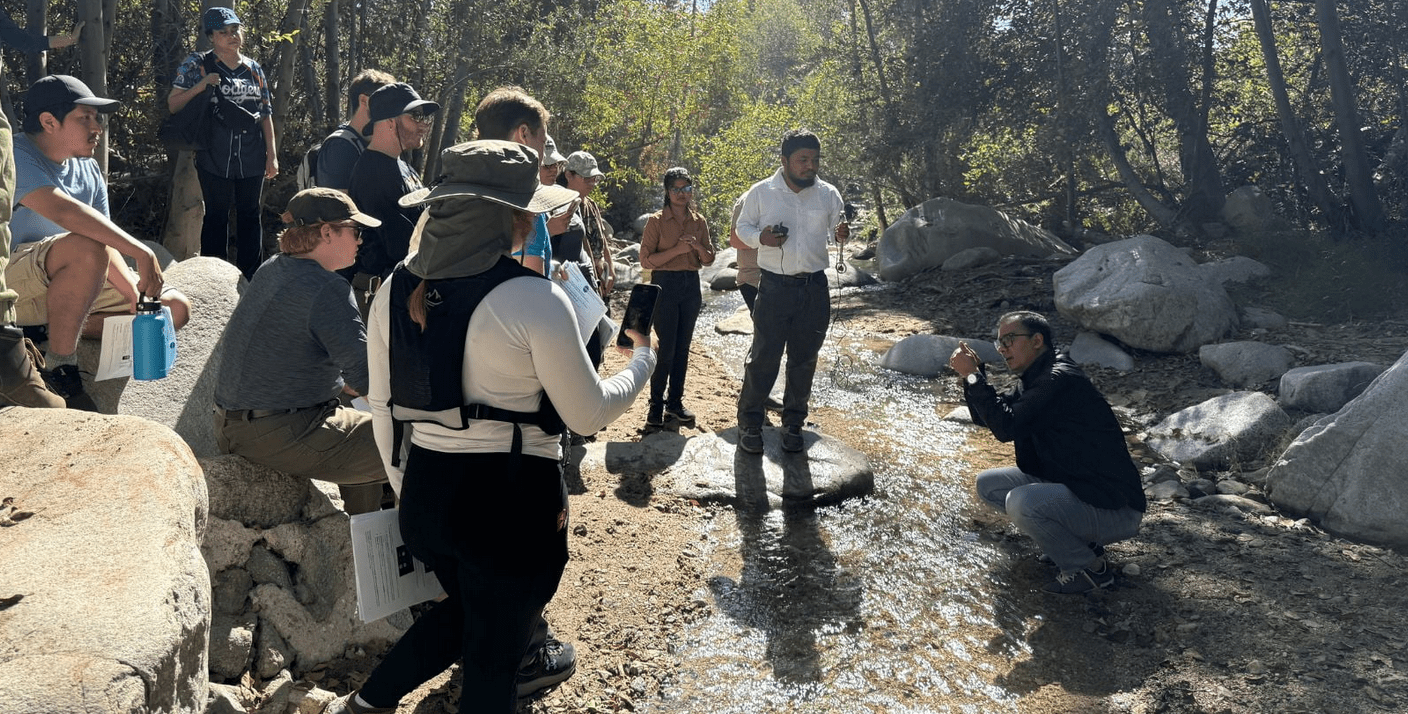
“Once the flames are extinguished after a wildfire, the results can have major impacts on water quality. Adnan Rajib, an assistant professor of civil engineering at The University of Texas at Arlington, has received a $199,993 RAPID grant from the National Science Foundation to study post-wildfire water quality in Los Angeles and help local authorities understand and predict the lingering effects of wildfires on the city’s water supply. The 2025 wildfires in the Los Angeles area were some of the worst disasters in California’s history. However, beyond the direct effects of the fire on property, the burned wildlands resulted in a great deal of ash and reduced ground cover that would have prevented erosion. As a result, when major rain events occurred post-fire, a significant amount of ash and soil washed into the water supply. This dramatic discharge of sediment may remain in the water supply for many years because the natural system is not designed to filter that much sediment. … ” Read more from the University of Texas at Arlington.
Altadena residents push back against $3,000 water assessment
“Nearly 200 Altadena residents gathered on Thursday to voice their concerns on a proposed $3,000 assessment from their water provider, the Las Flores Water Company, as the community continues to recover from the devastating Eaton Fire. Anger and frustration dominated the meeting as homeowners learned the private water company planned to levy the fee to keep service operating. “I think we’re going to get hosed again,” said Altadena resident Michael Barlett. “We’ve already suffered so much and we’re getting suffered again. This time, it’s financially, but just to have an extra $3,000 paid and assessed … it’s too much to keep a company that’s not viable, viable.” … ” Read more from KABC.
How Monterey Park residents pushed back on a data center – and changed the course
“Billions of dollars are pouring into data centers to power streaming services, cloud storage and the biggest energy monster of all, artificial intelligence. Dozens of data centers already dot the region, from El Segundo to downtown L.A. But in Monterey Park, residents concerned about the environmental and health impacts of data centers are drawing a line. A developer has proposed building a nearly 250,000-square-foot data center in a local business park. Last Wednesday night, hundreds of people packed City Hall to say they didn’t want it – or for that matter, any such facility. “No data centers in Monterey Park!” the crowd chanted. … ” Read more from the LAist.
SAN DIEGO
The region’s three sewage recycling systems, prompted by drought, will soon go online
“Because leaders across this drought-afflicted region all embraced the same innovative idea a decade ago, three separate sewage recycling systems will soon come online in Oceanside, East County and San Diego. While drought was the main motivator for spending millions to purify sewage into drinking water, local leaders were also spurred by increasing costs for imported water and long-term concerns about the Colorado River. Whatever the motivation, years of planning and construction are nearing separate finish lines for each of the three projects: Pure Water Oceanside, East County Advanced Water Purification and Pure Water San Diego. Oceanside, which actually completed a small first phase of its sewage recycling in 2022, is slated to complete a major expansion by the end of this year to produce 6 million gallons of purified water per day. … ” Read more from the San Diego Union-Tribune.
Feds move on after $1.1M pilot program to clean Tijuana River washed away
“The federal government awarded a $1.1 million contract to an Ohio company to conduct a pilot project deploying a technology to kill bacteria and eliminate odors in the sewage-tainted Tijuana River. It failed, in large part because the company had never used the technology in an environment with such a large amount of solid waste pollution and with unpredictable changes in water flow. The company, Greenwater Services, uses a nanobubble ozone technology (NBOT) primarily to attack harmful algae blooms in slow-moving or still water, such as lakes and ponds. The project at the international border showed the company’s equipment was ill-prepared for the conditions that plague the region. … ” Read more from the San Diego Union-Tribune.
SEE ALSO: Storm Trashes Tijuana River Cleanup Test, Fuels Diesel Spill Fight, from Hoodline
Along the Colorado River …
As deal deadline approaches, Colorado River stewards debate a broad range of options
“It’s crunch time for negotiators from seven western states trying to strike a deal before Feb. 14 on how to share the dwindling Colorado River. But four days of talks in a Salt Lake City conference room earlier this month did not appear to have sparked a breakthrough. “We got tired of each other,” Utah’s negotiator, Gene Shawcroft, said Tuesday at a public board meeting, days after the meeting ended. “And two of the days, we made some progress, but one day we went backwards almost as much progress as we made in two and a half days.” The states in the lower and upper basins remain at an impasse over how cuts to water use should be handled during times of drought. … ” Read more from KUNC.
Editorial: A trickle of water sense from California
The Las Vegas Review-Journal editorial board writes, “California has hundreds of miles of coastline, yet melted snow from other states remains an important source of its water. Perhaps a needed change is on the horizon — one that would even help Nevada. Interstate negotiations over the Colorado River appear deadlocked. The three Lower Basin states, including Nevada, remain at odds with their four Upper Basin counterparts. There is significant disagreement over what to do when the river doesn’t deliver enough water. Unfortunately, that has been the reality for many years, as the river was overallocated from the beginning. Lake Mead is forecast to drop even further in the coming months. … ” Continue reading at the Las Vegas Review-Journal.
CAP’s general manager says Arizona water cuts could be ‘devastating’
“As water flows steadily through a Central Arizona Project canal, it’s easy to forget just how much effort it takes to get it there, and how much uncertainty now surrounds its future. Brenda Burman, the general manager of the Central Arizona Project, is responsible for making sure that water gets to your taps. “We bring in Colorado River water all the way from Parker, Arizona, across the desert, into the valley, and then all the way down past Tucson,” Burman said. “So ultimately, we are bringing water to over six million people and eleven tribes.” The Central Arizona Project is one of the most critical pieces of infrastructure in the state, with the canal spanning over 300 miles. It is also at the center of high-stakes negotiations now underway over how the shrinking Colorado River will be shared in the future. … ” Read more from ABC 15.
These planes with lasers will measure snow from Arizona skies
“While Valley residents enjoy short-sleeve days of sunshine and temperatures in the 70s, snow is stacking up on nearby mountains. Arizona’s high-altitude mountain ranges are gathering an important part of the state’s water supply — snow that melts into rivers and reservoirs come springtime. Now, scientists and water managers are adding a new tool to figure out exactly how much snow is held in those mountains, and how much water they can expect in the hotter, drier months. They’re using planes rigged with high-tech sensors that can measure snow to the centimeter, even when the sensors are thousands of feet above. “We already have good forecasts,” said Bo Svoma, a climate scientist with the Salt River Project. “But looking toward the future — with the changing climate and a greater strain on Western U.S. water resources — the better we can forecast, we can keep those reservoirs fuller as long as possible before we go into a drought.” … ” Read more from KJZZ.
Coaxing water from air could stretch resources, ASU researcher says
“One number buzzed among the crowd gathered at a recent conference in Tempe: 1 billion cubic meters of water per year. In more familiar terms, that’s 264 billion gallons, the size of 400,000 Olympic-sized swimming pools, or a little over the capacity of Lake Havasu. That’s also how much water Paul Westerhoff suggests we should aim to pull from the sky. At the third International Atmospheric Water Harvesting Summit held Jan. 15-16 at Arizona State University, Westerhoff and others discussed a promising alternative supply of water for the world’s water woes: the air. … ” Read more from Arizona Central.
Parched Arizona could pursue cloud seeding
“Drought-plagued Arizona could see state-funded drones spraying microscopic silver iodide particles into mountain clouds to boost snowfall if proponents get their way. The state Legislature is considering allowing the use of money earmarked for boosting rural water supplies to pay for “cloud seeding” operations to increase precipitation in the state’s high country. But the proposal sponsored by Rep. Gail Griffin, R-Hereford, may have a tough road ahead. That’s because even some majority Republicans on the committee that heard her proposal expressed concern about the safety and efficacy of cloud seeding. It passed Griffin’s committee on Jan. 13 with a bare majority. And some Republicans have been pushing bills in recent sessions that would ban any weather modification efforts, although they’re mainly focused on theoretical proposals to lower global temperatures by partially blocking sunlight. … ” Read more from the Arizona Republic.
Commentary: They want to change the definition of ‘water.’ That’s catastrophic for Nevada.
Dexter Lim, Mason Voehl, and Olivia Tanager write, “In the desert, water is everything — even when it’s not here. You can see the history of its good works in the dry streams and vast playas carved throughout the Southwest. These ancient formations persist as key runoff collection sites, forming what are called ephemeral waters. Unlike conventional streams and lakes that hold standing water, ephemeral channels temporarily hold water only when rain, snowmelt or flooding is sufficiently plentiful to fill the watercourse. Since prehistory, these features have directed water across critical surface access points and into the underground reservoirs that every well in the West relies on. … A new rule proposed by President Donald Trump’s administration would strip Clean Water Act (CWA) protections from nearly all ephemeral waters in America. … ” Continue reading at the Nevada Independent.
Data centers are coming to Colorado. Can the parched state handle their large-scale water needs?
“Data centers are popping up around the United States, and in more arid areas like Colorado, experts say the huge complexes should come with a warning label when it comes to water use. Data centers have been powering computing efforts for decades, but as the potential of artificial intelligence models has become more clear, so has the need for more computing power. That means more servers, routers and the huge complexes that house them. The boom in data centers is already raising concerns about ripple effects in other industries, including agriculture which is the largest water user in Colorado. Electricity and water utilities are wrapped up in powering servers and keeping them cool. But AI advancement will have trade-offs, experts say. … ” Read more from the Colorado Sun.
In national water news today …
Report: 13 Great Lakes’ worth of water underlies the contiguous United States
“It’s not easy to determine how much water there is across a landscape. A measly 1% of Earth’s freshwater is on the surface, where it can be seen and measured with relative ease. But beneath that, measurements vary massively depending on water table depth and ground porosity we can’t directly see. Reed Maxwell, a hydrologist at Princeton University, likes to think of rainfall, snow, and surface water as a checking account used for short-term water management needs and groundwater as a savings account, where a larger sum should, ideally, be building up over time. “We’re operating in a situation where we don’t know how much is going into the savings account every month, and we don’t know how much is in our savings account,” he said. But a new groundwater map by Maxwell and colleagues offers the highest-resolution estimate so far of the amount of groundwater in the contiguous United States: about 306,500 cubic kilometers. That’s 13 times the volume of all the Great Lakes combined, almost 7 times the amount of water discharged by all rivers on Earth in a year. … ” Read more from EOS.
Lawmakers rake in earmarks for water, energy projects
“Three major water infrastructure projects and a hurricane protection system will be the beneficiaries of the largest earmarks in Congress’ fiscal 2026 spending bills. When the Senate passes the last of the appropriations bills — which is supposed to happen this week — Republicans and Democrats will have secured more than 8,400 earmarks collectively worth more than $15.7 billion for projects in their home states and districts. The approval of those earmarks will be a welcome development for lawmakers who have waited nearly two years to secure funding for local initiatives such as road and transit improvements, dam and lock maintenance, wildfire mitigation, and wastewater and sewer projects. … ” Read more from E&E News.
An obscure provision in FEMA’s program to prevent disaster is making serious flooding worse
“Since its creation in 1979, the Federal Emergency Management Agency has been charged with protecting communities from natural disasters. Central to that mission is curtailing serious flooding, the most prevalent and severe weather threat to people and property across all 50 states. That objective, though, is impeded by an old and obscure federal regulation — overseen and enforced by FEMA itself — that is actually making flooding worse. That result was felt just last month, when a powerful storm hit the Pacific Northwest. Flooding along Washington’s Nooksack and Skokomish rivers destroyed homes and inundated roads, prompting evacuations and the declaration of a state of emergency. Some losses may have been alleviated, experts assert, had planned flood mitigation work along these same rivers’ banks not experienced significant delays and cancellations as a direct result of the rule’s powerful reach, which extends nationwide. … ” Read more from the Circle of Blue.

