Several news sources featured in the Daily Digest may limit the number of articles you can access without a subscription. However, gift articles and open-access links are provided when available. For more open access California water news articles, explore the main page at MavensNotebook.com.
In California water news today …
PG&E plans to remove century-old California dams. But there’s a new obstacle: Trump

“The Trump administration is following up on its pledge to try to stop the removal of two dams on Northern California’s Eel River, a move that gives farmers and rural residents opposed to the controversial demolition a welcome ally. U.S. Agriculture Secretary Brooke Rollins last month filed to intervene in the regulatory proceedings over PG&E’s Potter Valley Project. Pacific Gas and Electric Co. is seeking federal approval to retire the hydroelectric enterprise, which comprises the dams in Lake and Mendocino counties, because of the project’s age and high operating costs. Many support the effort as a means of restoring the Eel River and helping struggling salmon runs. Rollins, siding with critics, argues that the power project, which also contributes water supplies to the region, including Sonoma and Marin counties, is the “lifeblood” of local agriculture. She has cast the facility’s dismantling as a threat to American “freedoms” and accused California’s “radical leadership” of prioritizing fish over “hardworking families.” (The state has little say on the matter.) … ” Read more from the San Francisco Chronicle. | Read via MSN News.
California weather: Warming trend ahead with one major exception
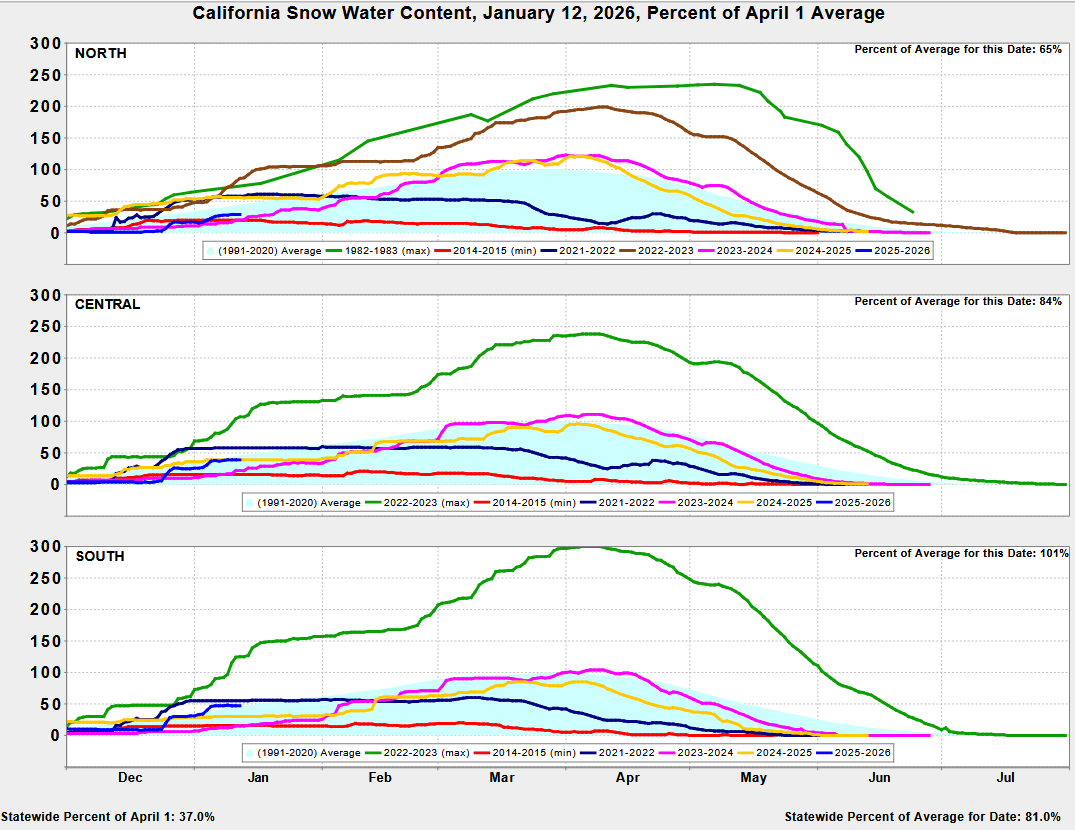
“A strong high-pressure system is steering storms away from California, resulting in a dry forecast for the foreseeable future. Under clear skies in winter, California’s weather tends to follow a typical pattern of cool nights and mild days. This week’s warmth will be most pronounced in Los Angeles, which could hit 80 degrees five days in a row beginning Tuesday, as weak to moderate Santa Ana winds continue. In the Sierra Nevada, sunshine will soften and melt the snowpack. High temperatures will reach the 40s to 50s at Tahoe ski resorts this week, with warm conditions lasting through the Martin Luther King Jr. Day weekend, too. There’s a notable exception to that forecast, though. “Stout inversions” are predicted to dominate in parts of Northern California, the National Weather Service’s Reno office wrote in an online forecast. … ” Read more from the San Francisco Chronicle.
California storms have suddenly shut off. When will rain return?
“This weekend feels different across the Bay Area. Clouds are in short order and the air is notably dry after weeks of moisture, both signs that for the first time in nearly three weeks, California has shifted into a sustained dry stretch. It’s a welcome change after a soggy late fall and early winter that brought repeated rounds of rain in November and December, followed by a stubborn stretch of dense tule fog that blanketed the Central and Sacramento valleys for weeks. But January is one of the wettest months of the year for the Bay Area, and the question now is: When does the rain return? The short answer is that there’s no strong signal pointing to rain coming back anytime soon. Long-range weather models are unusually consistent on this point. … ” Read more from the San Francisco Chronicle.
Right as rain: Salmon surge after consecutive wet years
“In some places, if you don’t like the weather you just have to wait an hour and it will change. That is not always the case though, and three consecutive wet years in California show that some weather patterns may stay for a while. Having three wet years is unusual in this region, in fact, the last time this happened was in the late 1990s. What’s more, these wet years followed three persistent drought years from 2020 to 2022. The typical pattern, at least in recent decades, is to have a series of drought years fall between occasional wet ones (which are often unusually wet). Luckily, there are some fish species jumping at the chance to take advantage of this wet weather pattern, including salmon. … ” Read more from FishBio.
Lake County: Sewage release impacts Burns Valley Creek area; advisory issued regarding well water
“A sewage spill over the weekend has impacted a creek and nearby private wells in the Clearlake area. On Sunday Lake County Special Districts confirmed that sewage entered the stormwater drainage system, leading to Burns Valley Creek. “As a result, some raw sewage contaminated water has leaked into Clear Lake,” the agency said in a statement posted to the county social media account. The city of Clearlake issued a separate public notice on Sunday for any residence in the area of Pond Road northwest of Old Highway 53 up to Olympic and along Rumsey between Pamela and Smith. “Well water in this area should be considered impacted by the sewage leak, do not consume,” the city said. … ” Read more from the Lake County News.
Davis: Three generations of stewardship: Exploring the legacy of environmental protection on Putah Creek
 Petrea Moyle Marchand writes, “After the indefinite cancellation of school at the start of the Covid-19 quarantine, my Dad, Peter Moyle, offered to teach my kids about Putah Creek. A fish biologist and University of California, Davis professor who started studying the creek during his early years at UC Davis in the 1970s, there are few people in the world who know as much about the creek. “Sure!” I responded enthusiastically, without asking the kids. Putting down the phone, I turned to Cam and Romy, age 13 and 11, with a stern look to tamp down any resistance. “You’re doing science lessons with your grandfather. And there will be homework. You’re going to participate and work hard.” Neither Romy or Cam are scientifically inclined, so my directive resulted in the expected resigned looks and sighs. I was briefly reminded of my own childhood antipathy to long hikes and unwanted nature lectures, once even lying down in protest across a trail. Given how much I appreciate those experiences now, it was easy to ignore my kids’ complaints. Years ago, when I asked my father about his greatest achievement, he responded he was proudest of his work to help restore Putah Creek. … ” Read more from the California Water Blog.
Highway 101 flooding solution in central Marin remains years away
“It was a Saturday, but drivers in central Marin were in gridlock. Highway 101 at Lucky Drive was flooded, choking traffic in all directions around it. It would stay that way for nearly six hours on the busy post-holiday afternoon. The low-lying, flood-prone area along the Corte Madera Creek — battered in the days leading up to Jan. 3 by torrential rain, winds and historic king tides — has been identified as one of Marin County’s most vulnerable locations to rising seas. Constructing a defense is complicated. The problem lies at the intersection of multiple jurisdictions and includes an array of decision makers, from municipalities to county government to the California Department of Transportation. And while high-level concepts to reduce flooding are described in plans, concrete proposals and cost estimates have yet to be established. … ” Read more from the Marin Independent Journal.
The biggest US solar-storage project yet takes shape in the San Joaquin Valley
“Out in the fertile yet water-constrained farmlands of California’s western Central Valley, a massive solar, battery, and power grid project that could provide a quarter of the state’s clean energy needs by 2035 has taken a critical step forward. In December, the board of directors of the Westlands Water District, the agency that manages water delivery to more than 600,000 acres in California’s agricultural heartland, approved the Valley Clean Infrastructure Plan. VCIP calls for building up to 21 gigawatts of solar energy and an equivalent amount of battery storage across up to 136,000 acres, along with a series of high-voltage transmission lines to connect the electricity generated to the state’s grid. That would be the largest solar and battery project in the country, and it will take up to a decade to be completed. … ” Read more from Canary Media.
SoCAL: As California’s drought ends, Pasadena weighs future of its underground water reserve
“As the Municipal Services Committee gears up to discuss the Raymond Basin at its next meeting, a new wrinkle has developed that will impact the discussion. California is drought-free for the first time in decades after a powerful winter brought heavy rain and snow. While the short-term relief is welcome, water officials caution it does not erase longer-term risks, particularly for cities like Pasadena that depend heavily on imported water. The majority of Pasadena’s water is imported through the Metropolitan Water District of Southern California, which delivers water across Southern California using a blend of Colorado River supplies, State Water Project deliveries, and local sources. … ” Read more from Pasadena Now.
The most important lesson from DIY turf replacement in SoCal
Hugo Martin writes, “For the longest time, I resisted replacing my lawn. I take great pride in mowing my own grass, trimming the edges, plucking dandelions by hand and snickering at my water-conscious friends’ drought tolerant alternatives. My attitude: You can take my lawn when you pry it from my cold, dead hands. But on Jan. 7, Mother Nature forced my hand. The gale-force winds that fueled devastating fires in Altadena and Pacific Palisades toppled over two gorgeous Texas Umbrella trees that had shaded my front yard since long before I bought my house in Monrovia. When the trees tipped over, the extensive root system tore up my manicured lawn. I developed a new attitude: If a government rebate program will help pay for it, why not overhaul my front yard? … ” Read more from the LA Times.
Storms pushing large amounts of trash from Mexico into Tijuana River Valley, but new equipment making a difference
“Recent storms have once again pushed large amounts of trash from Mexico into the Tijuana River Valley, but new equipment installed along the river is already making a noticeable difference. Project leaders say newly added floating trash deflectors are improving how debris is captured, preventing waste from scattering throughout the river corridor in San Ysidro and reducing the risk of pollution reaching the Pacific Ocean. According to project director Oscar Romo, that change has dramatically improved cleanup efforts. “It’s already making a difference, it pushes the trash over an area to where we can collect the trash near the bigger barriers,” he said. … ” Read more from Fox 5.
Along the Colorado River …
Colorado River states have just weeks to strike a deal. Here’s why it’s so hard for them to agree.
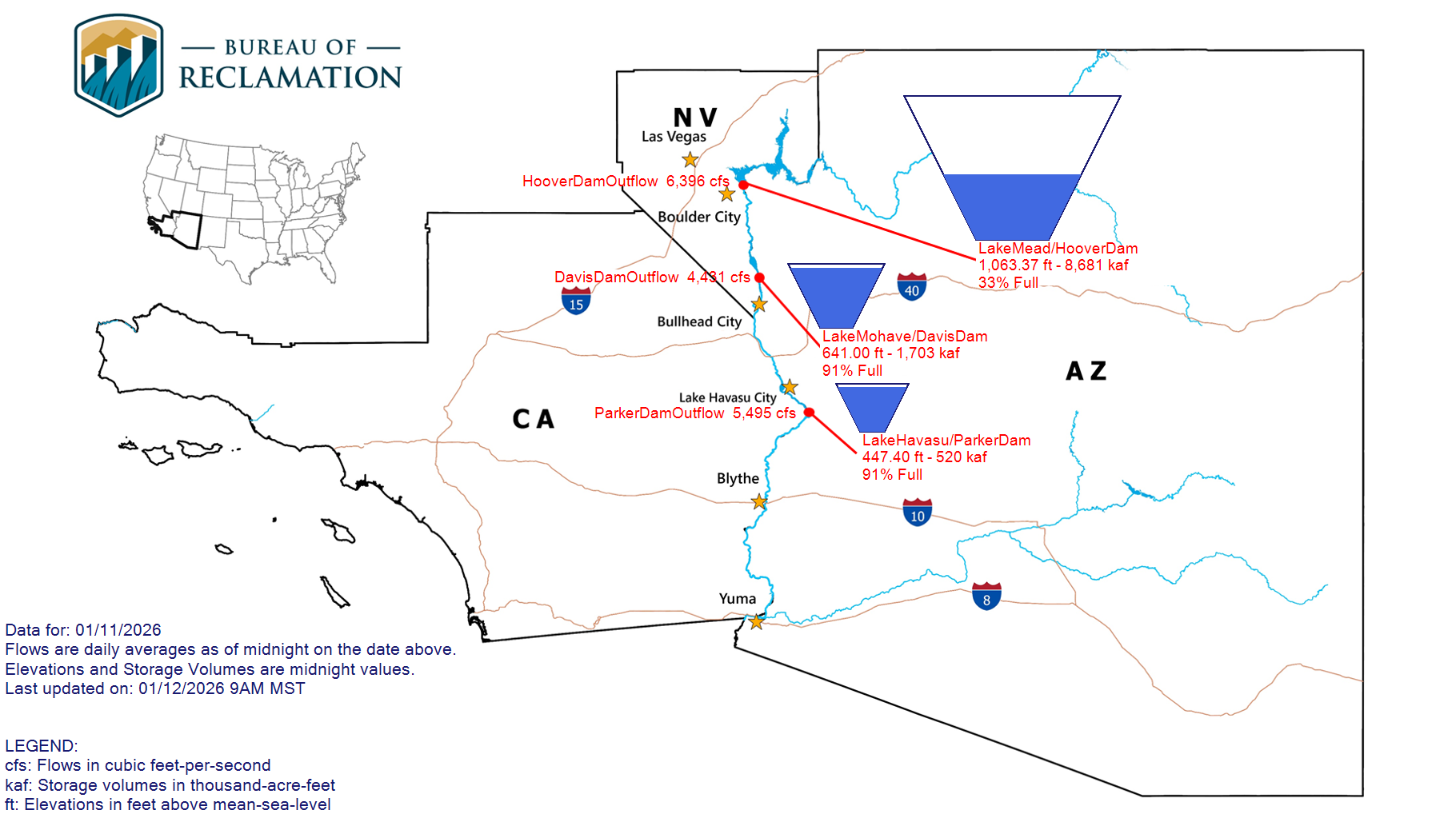
 “The clock is ticking: The seven basin states only have until February 14 to come up with a plan for how to manage the river in dry times. The current guidelines expire at the end of the year. If they test their luck and fail to reach an agreement, they risk the Interior Department making a plan for them or years of litigation. The seven state negotiators are meeting for four days in Salt Lake City this week as they work to hash out a deal before that deadline, according to Becki Bryant, public affairs officer with the Bureau of Reclamation. The bureau released a draft environmental impact statement on Friday that lays out a series of pathways to manage the river system and its major reservoirs. If the states reach a deal, the bureau says it will insert that plan as the preferred way forward, Scott Cameron, acting commissioner for the bureau, told The Tribune at the conference. If states can’t agree, the federal government will choose an alternative itself, he added. In this game of water diplomacy, there will likely be no clear winners. “No one is too big to fail,” said Becky Mitchell, Colorado’s negotiator. … ” Read more from the New York Times.
Arizona data centers raise power and water questions
“Large-scale data centers are moving forward across Southern Arizona, driven by demand for cloud computing, artificial intelligence, and high-capacity digital infrastructure. While supporters point to job creation and tax revenue, state and local officials are now grappling with questions about electricity rates, water use, and regulatory oversight. Two major projects dominate the current discussion. One is Project Blue, a hyperscale data center planned east of Tucson in Pima County. The other involves Luckett Road North and South, two data center developments approved for rezoning in the Town of Marana. Together, these projects have placed new pressure on utility regulation, water planning, and public transparency. … ” Read more from Western Water.
Patagonia mine faces scrutiny after heavy metal discharge
“A critical minerals mine in the Patagonia Mountains is upgrading its water treatment process and answering questions from concerned residents after a discharge exceeded its permitted level of a potentially toxic heavy metal. According to the Arizona Department of Environmental Quality, a compliance sampling report submitted in late November by the South32 Hermosa mine showed the company released water from the site containing antimony levels above the limit of 6 micrograms per liter allowed by its state Aquifer Protection Program permit. The mine’s treatment plant discharged the water into Harshaw Creek, a mostly dry wash that runs downhill to the town of Patagonia, about 9 miles away. … ” Read more from the Arizona Daily Star.
Low reservoir levels main cause of toxic algae in Blue Mesa
“A new study pinpoints the main cause of harmful algal blooms in Blue Mesa Reservoir, and includes a recommendation for a minimum water level to prevent them. A study released in December by scientists at the U.S. Geological Survey and the National Park Service said the main driver for recent toxic harmful algal blooms in Blue Mesa is low reservoir levels, which create shallow and warm conditions favorable for algal growth. The study also says maintaining a water-level elevation above 7,470 feet might help minimize the occurrence of these blooms. “When the reservoir gets below 7,470, which is 49 feet below full pool, every year that that happened during the growing season, the algae thrived and ended up producing toxins greater than health advisory,” said Katie Walton-Day, a research hydrologist with the USGS and a lead author on the study. “So the message is that that level is important, and I think more work needs to be done to understand the timing of that level.” … ” Read more from Aspen Journalism.
In national water news today …
America’s AI boom is running into an unplanned water problem
 “The fastest‑growing piece of America’s artificial intelligence infrastructure is colliding with one of its most finite local resources: water. As utilities, state regulators, and local governments rush to accommodate a surge in data‑center construction driven by AI and cloud computing, water is emerging as a constraint that few permitting systems were designed to manage. The issue isn’t that data centers are unexpected. It’s that they have crossed a threshold of scale—yet are still being regulated as if they were ordinary real‑estate projects rather than nationally strategic infrastructure. The U.S. Department of Energy notes that planning for these facilities requires coordination beyond the local level. In many jurisdictions, data centers are approved under commercial real‑estate frameworks, even though their energy and water demands more closely resemble those of mission‑critical infrastructure. … ” Read more from Forbes.
Poor communities threatened by aging sewers see crucial aid slashed under Trump
“Yvette Lyles thought of the modest brick ranch home as a Christmas present for her family. It was close to a state park where she and her kids could picnic, fish and enjoy the outdoors. A place to make memories. But she soon learned her southern Illinois community had a big problem: Recurring floods from heavy rains sent untreated sewage into streets, yards and homes where they buckled floors, cracked walls and destroyed belongings. The first time it happened after they moved in, her family was trapped inside for days. Cahokia Heights, a mostly Black city where about one-third live in poverty, is among scores of communities nationwide with aging and decrepit wastewater systems that can put people and their homes at risk. Exposure to untreated sewage, which can enter homes by backing up through plumbing or via floods after rainwater overwhelms sewer systems, can cause illness. Such problems are often in rural areas or declining cities without the money or expertise to fix problems on their own. … ” Read more from the Associated Press.
Fed agency looking for wildlife refuges that ‘no longer align with the mission’
“The Trump administration is reviewing hundreds of national wildlife refuges and dozens of fish hatcheries. The U.S. Fish and Wildlife Service said it’s looking for sites “established for a purpose that no longer aligns with the mission” of the bureau, according to a Dec. 16 order from Director Brian Nesvik, who used to lead Wyoming’s state wildlife agency. He said the review should also consider “opportunities to achieve efficiencies in the areas of governance, oversight, and span of control,” along with ways to remove organizational barriers and staff capacity to work with local communities, and state and tribal wildlife management agencies. Senior Advisor Joshua Coursey, a Wyoming mule deer advocate, will lead the review of wildlife refuges, while Acting Deputy Director for Operations David Miko will lead the one for fish hatcheries. … ” Read more from Wyoming Public Radio.
Under Trump, US adds fuel to a heating planet
“By pulling the United States out of the main international climate treaty, seizing Venezuelan crude oil and using government power to resuscitate the domestic coal industry while choking off clean energy, the Trump administration is not just ignoring climate change, it is likely making the problem worse. President Trump has never been shy about rejecting the scientific reality of global warming: It’s a “hoax,” he has said, a “scam,” and a “con job.” In recent days his administration has slammed the door on every possible avenue of global cooperation on the environment. At the same time, it is sending the message that it wants the world to be awash in fossil fuels sold by America, no matter the consequences. … ” Read more from the New York Times.
A look at current water and snow conditions …