
Several news sources featured in the Daily Digest may limit the number of articles you can access without a subscription. However, gift articles and open-access links are provided when available. For more open access California water news articles, explore the main page at MavensNotebook.com.
On the calendar today …
- MEETING: State Water Resources Control Board beginning at 9am. Agenda items include consideration of a proposed Resolution approving an amendment to the Los Angeles Region Water Quality Control Plan to establish a site-specific water quality objective for chloride in Reach 6 of the Los Angeles River, and current hydrologic conditions and response. Click here for the agenda.
In California water news today …
Weekend storms boost California water, but thin snowpack poses risk
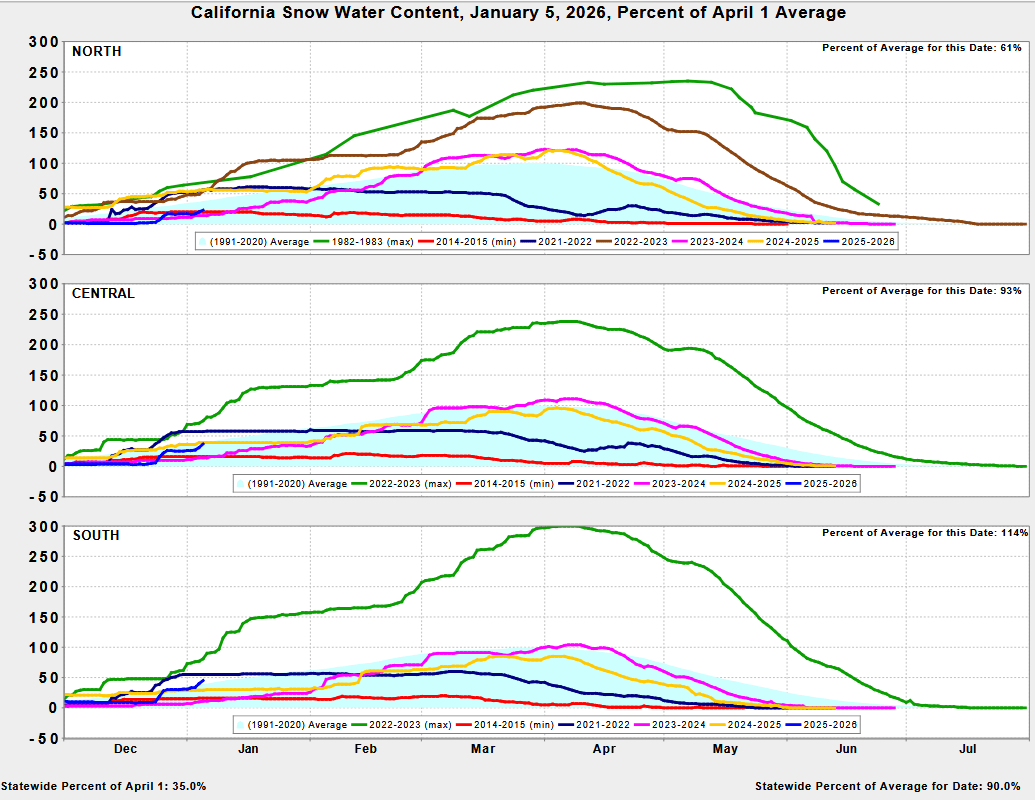 “Northern California saw a wet weekend that solidified the region’s water supply, but experts urged caution, noting that snowpack and reservoir levels still remain below average. The development follows the state’s first snowpack reading last week, where the measurement recorded 24% of the April 1 average for California and 71% of normal. … “As it stands, northern California is in great shape for overall precipitation at this point in the water year, but snowpack is still lacking a bit. Many of our early season storms were very warm, thus snowfall was low,” said Scott Rowe, a senior service hydrologist at National Weather Service’s Sacramento office. State climatologist Dr. Michael Anderson agreed, pointing to a current split between Northern and Southern Sierra Nevada regions, and how snowpack in the Northern Sierra, which provides the largest reservoirs in the State Water Project, still stands at just 61% of normal. … ” Read more from the Sacramento Bee (gift article).
California’s largest reservoir rises 36 feet as rains boost water supply statewide
 “When it rains, it pours. And that’s good news for California’s water supply. After a relatively slow start to the winter rainy season, a series of atmospheric river storms has sent hundreds of billions of gallons of water pouring into reservoirs across California over the past three weeks, easing the concerns of water managers and significantly reducing the likelihood of shortages next summer. Since Dec. 16, the state’s largest reservoir — Shasta, a massive 35-mile-long lake near Redding — has risen by 36 feet. On Monday, it was 77% full, at 129% of its historical average for this time of year and still rising. Similarly, the water level at Oroville, the state’s second-largest reservoir, has jumped 69 feet over the same three weeks. The reservoir, formed by Oroville Dam in Butte County, was 73% full and at 134% of its historical average as of Monday, having added nearly as much water in the past 24 hours as Crystal Springs Reservoir in San Mateo County holds when full. … ” Read more from the San Jose Mercury News.
SEE ALSO: Atmospheric rivers push Lake Shasta water levels up 35 feet, from the Redding Record-Searchlight
Oroville Dam spillway opens after stormy week
 “The Department of Water Resources began releasing water out of the Oroville Dam’s main spillway 6 a.m. Monday after rainstorms this week pushed Lake Oroville’s capacity to around 70%. Water flowed out of the spillway at more than 3,500 cubic feet per second around noon Monday with 16,000 flowing out of the lake in total, an increase from 12,550 cubic feet per second on Jan. 2 when the department first increased releases. DWR is expected to decrease flows Tuesday to about 10,000 cubic feet per second as dry conditions are forecast this week in the Feather River watershed. … ” Read more from the Chico Enterprise-Record.
Video: Why Valley Water is evaluating California’s Delta Conveyance Project
“Every day, Santa Clara County relies on a mix of local and imported water to meet our community’s water needs. As climate change brings longer and more severe droughts, Valley Water is exploring ways to strengthen our water supply. One key project under evaluation is the State of California’s Delta Conveyance Project. To plan for a reliable supply of safe, clean water now and in the future, Valley Water follows the Water Supply Master Plan 2050. This long-term plan guides investments that support water reliability, sustainability, and resilience in the decades ahead. The Delta Conveyance Project is one of the projects included in the Water Supply Master Plan 2050. The project is the state’s proposal to modernize the way water moves through the Sacramento–San Joaquin Delta. About 40% of Santa Clara County’s water flows through Delta waterways constructed by man-made levees. However, the existing infrastructure is aging and vulnerable to sea-level rise, earthquakes, and flooding. The Delta Conveyance Project would reduce these risks by upgrading and protecting this key part of California’s water system. … ” Read more from Valley Water News.
CalWATRS debut overhauls water rights reporting
“The deadline for all water right holders and reporters to submit their annual water use reports to the California State Resources Control Board’s new data system is approaching on January 31, 2026. The CalWATRS system — California Water Accounting, Tracking, and Reporting System — was fully launched in October, and there may still be some “minor performance issues” to address, according to the CalWATRS website portal. CalWATRS is a component of the State Water Board’s larger Updating Water Rights Data, UPWARD, project in the Division of Water Rights. In an email from State Water Board Information Officer Ailene Voisin, the final 2021-2022 California budget allocated $30 million for UPWARD, one-time, as part of the Water Resilience Package. Another $30 million was allocated one-time from the General Fund in the final 2022-23 California Budget, totaling $60 million in total for UPWARD. “That total amount was for all Division of Water Rights modernization efforts, of which CalWATRS was the largest piece,” Voisin stated. … ” Read more from Valley Ag Voice.
Reclamation updates Long-Term Operation Plan for the Central Valley Project

“The Bureau of Reclamation today signed a Record of Decision adopting an updated long-term operation plan for the Central Valley Project. The decision advances actions designed to maximize water deliveries across California while maintaining protections for endangered fish species. “With the signing of this Record of Decision, we are delivering on the promise of Executive Order 14181 to strengthen California’s water resilience,” said Secretary of the Interior Doug Burgum. “This updated operations plan reflects our commitment to using the best available science to increase water deliveries while safeguarding the environment and honoring the legacy of the Central Valley Project’s 90 years of service.” The revised plan responds to Executive Order 14181, issued Jan. 24, 2025, which directs federal agencies to take all available measures to increase water deliveries from the CVP, including issuing a new Record of Decision consistent with federal law. … ” Read more from Valley Ag Voice.
Satellite radar advances could transform global snow monitoring

Nick Shockey / DWR
“Runoff from deep mountain snowpacks is the primary source of much-needed water for arid to semiarid regions in the western United States as well as in many other parts of the world. Each year, water managers in these regions must balance their water budgets, which account for water gained, lost, and stored in the watersheds they oversee, affecting everything from water supply to agriculture to tourism to wildfire containment. To do so, water managers primarily rely on established statistical models that predict the volume and timing of mountain runoff. However, the information available to feed these models comes mainly from a sparse network of snow-monitoring weather stations, as well as from snow cover maps derived from optical satellite imagery that provide information on snow extent but not on the amount of water stored in the snowpack. … ” Read more from EOS.
New state laws affecting farms take effect Jan. 1
“Several new state laws set to take effect this week will impact agriculture in California. Beginning Jan. 1, California farmers and ranchers will see changes pertaining to employee wages, management of abandoned farmland, organic waste disposal, agritourism and immigration enforcement. As with other sectors, the cost of agricultural labor will rise as California’s minimum wage increases in 2026 from $16.50 to $16.90 an hour. Under a 2016 state law, minimum wage increased by set amounts from 2017 through 2023, when it reached $15 an hour. Since then and going forward, the law requires minimum wage be adjusted annually according to the consumer price index, which is used to measure inflation. … ” Read more from Ag Alert.
GOP lawmaker Doug LaMalfa dies at 65
 “Rep. Doug LaMalfa, a California Republican known for his expertise on water and forestry issues, has died at 65, according to statements from GOP officials. LaMalfa, a fourth-generation rice farmer and former state legislator, was serving his seventh term representing a rural district in the northeast corner of the state. He sat on the Agriculture, Natural Resources, and Transportation and Infrastructure committees. “Doug was a loving father and husband, and staunch advocate for his constituents and rural America,” House Majority Whip Tom Emmer (R-Minn.) said in a statement posted to social media. “Our prayers are with Doug’s wife, Jill, and their children.” … ” Read more from Politico.
In regional water news and commentary today …
NORTH COAST/NORTHEAST CALIFORNIA
‘Magical place’: Revived California land purchased for $10 million
“The Klamath Indigenous Land Trust recently purchased 10,000 acres along the Klamath River, signifying one of the largest Indigenous-led private land purchases in U.S. history as salmon continue to make their historic return to the newly revived watershed. The expansive property, located mostly in California and extending into Oregon, includes the sites of reservoirs that existed up until the removal of four of the Klamath’s dams in 2023 and 2024. PacifiCorp owned the parcel for a century prior to the purchase and partnered with KILT to complete the transfer, the land trust announced in a news release last week. … ” Read more from SF Gate.
Emergency water measures in place in Trinidad following water main leak
“Boil water and mandatory water conservation notices are in place in Trinidad after a “failed water pipe discovered early Saturday morning on a problematic section of distribution line at the city/Trinidad Rancheria boundary line on Scenic Drive” drained much of the city’s water supply — resulting in high-turbidity, potentially unsafe water. Over a less-than-five-hour period, the city estimates that it lost roughly 400,000 gallons of stored water, completely depleting its stored water supply. The city repaired the leak the following day, but emergency measures remain in place as of Monday afternoon. On Sunday, City Clerk and Interim City Manager Gabriel Adams’ office issued an update. … ” Read more from the Eureka Times-Herald.
Arcata water rate hearing pushed back; also, what’s it all about?
“A public hearing on a proposed increase to Arcata’s water rates has been pushed back until March. If you didn’t know: for a whole variety of reasons, Arcata’s city council voted several months ago to raise the price it charges to deliver water for 6,600 customers and remove wastewater from 5,600 customers. When a city does that, it has to hold a public hearing where people can lodge complaints and learn more about the process. Originally scheduled for this Wednesday, Jan. 7, it’s been rescheduled for March 18. An informational meeting that was supposed to follow the day after will now be held late this month or in early February. … ” Read more from the Lost Coast Outpost.
Nine years of partnership pays off: Fitzhugh Creek Meadow restoration achieves dramatic results

“The BLM Applegate Field Office is celebrating a remarkable transformation at Fitzhugh Creek Meadow, where nearly a decade of partnership-driven restoration is delivering clear and inspiring results. The meadow’s recovery began in the 1980s, when former Recreation Planner Claude Singleton worked to protect the creek corridor. Willow trees started returning in the 1990s, but the meadow itself still needed active restoration. That next effort began in 2017, when Jennifer Mueller took on Fitzhugh Creek as a long-term restoration site. Since then, she has helped lead all three phases of beaver dam analogue (BDA) construction, installed monitoring equipment, and coordinated with partners throughout the project’s nine-year timeline. … ” Continue reading from the Bureau of Land Management.
CalTrout’s legal strategy affirms commitment to Potter Valley Project solution
“CalTrout prides itself in working jointly with stakeholders of all types- landowners, water users, utility agencies, etc.- to find collaborative solutions to complicated natural resource issues. This cooperative approach has served as the hallmark for CalTrout’s strategy thus far in handling the Potter Valley Project (PVP). Owned by PG&E, PVP is a century old hydropower and water diversion project on California’s Eel River, consisting of Scott and Cape Horn dams that have caused severe degradation to the watershed. CalTrout and others recognized a unique opportunity to steer the future of the Eel River back toward robust fisheries and a healthy watershed with the removal of both Eel River dams. To do this, we focused our efforts on building trust, forming strong partnerships, and working proactively with PG&E. However, due to major obstacles and lack of forward progress, we turned to an alternative strategy in CalTrout’s toolbox. … ” Read more from CalTrout.
SIERRA NEVADA
Water Masters’ documentary highlights local water issues
“Water is precious in Nevada, now more than ever. As population growth and industrial needs increase the demand for water, researchers at the College of Engineering’s Nevada Center for Water Resiliency (NCWR) seek solutions. The issues are highlighted in a new 30-minute documentary, “Water Masters,” which premiered in December at the University of Nevada, Reno. Produced by Emmy-winning director Dan Druhora, “Water Masters” explores water use along the Truckee River Watershed, the water system connecting Lake Tahoe to Pyramid Lake. The film examines the concept of upstream and downstream users, highlighting how population growth and the expansion of industry — such as new data centers that require water for cooling — increase water needs. … ” Read more from the Tahoe Daily Tribune.
SACRAMENTO VALLEY
Sacramento Valley Conservancy launches vernal pool stewardship program
“The Sacramento Valley Conservancy (SVC) is proud to announce the launch of its Vernal Pool Stewardship Program, a community-driven effort to protect some of the region’s most rare and ecologically important landscapes through hands-on stewardship, education and volunteer engagement. Sacramento Valley Conservancy is entrusted with the protection and stewardship of more than 8,000 acres of vernal pool preserves in Sacramento County, including 3,300 acres of rare vernal pool wetlands in Rancho Cordova and the surrounding area. These seasonal wetlands support unique plants and wildlife found nowhere else, and play a critical role in water quality, flood management and regional biodiversity. … ” Read more from the Carmichael Times.
SMUD ends power deal for Coyote Creek solar project tied to environmental suit
“Sacramento Municipal Utility District announced Monday that it was canceling the power purchase agreement it signed with DESRI for the Coyote Creek solar project, citing “project uncertainties,” including environmental impacts and pending litigation. “Due to project uncertainties, SMUD announced today that they will not be purchasing power from the Coyote Creek project. Some of the uncertainties include: supply chain constraints, rising prices, tariffs, schedule delays, environmental impacts and pending litigation,” the news release said. One of the most controversial solar projects in the state, New York-based DESRI’s Coyote Creek project was proposed to provide energy to more than 44,000 homes served by SMUD, but it faced strong opposition from environmental and tribal communities because the site lay in one of the state’s remaining oak woodlands and could put up to 3,500 blue and native oak trees at risk of removal. … ” Read more from the Sacramento Bee.
SEE ALSO: Victory! SMUD cancels controversial Coyote Creek Project PPA that would remove nearly 3500 trees, from Dan Bacher at the Daily Kos
NAPA/SONOMA
Last in series of storms triggers Sonoma County road closures, buoys reservoirs
“North Bay commuters began the first work week of the new year navigating obstacles from the latest drenching rainstorm, the final round in a winter system that arrived last week, swelling waterways and flooding low-lying roads. Monday’s storm triggered a handful of road closures around Sonoma County following a soggy weekend that saw a combination of runoff and record king tides submerge some bayshore routes, including parts of Highway 101 in Marin County and surface streets in Corte Madera. Between last Wednesday and Sunday, up to 3.5 inches of rain had fallen across valley-bottom areas of Sonoma County, with up to 4.3 inches on the flats in Napa County and more than 5 inches in coastal mountains and higher elevations along the Sonoma-Napa border, according to National Weather Service data. … ” Read more from the Santa Rosa Press Democrat.
Emergency repairs sought after Sonoma Valley Sanitation pipeline rupture
“Sonoma County supervisors are preparing to authorize emergency repairs after a pipe burst in the Sonoma Valley County Sanitation District’s reclamation system. An emergency resolution has been added to Tuesday’s Board of Supervisors meeting to fund the work. County officials said about 700,000 gallons of treated recycled water spilled into Schell Slough after the pipe burst last week. The break was discovered on New Year’s Eve. Crews said the rupture opened a sinkhole in a tidal marsh just feet from a nearby levee. … ” Read more from NorCal Public Media.
BAY AREA
Marin tidal flooding prompts renewed push for fortification
“As another wave of rain hit Marin County on Monday morning, U.S. Rep. Jared Huffman and top county officials toured sites hit hardest by the weekend flooding and pledged to continue their efforts to shore up vulnerable infrastructure. “This area has been worried about events like this for a long time,” said Huffman, standing on a raised road to Santa Margarita Island in the Santa Venetia neighborhood of San Rafael. Behind Huffman was a muddy creek bordered by an earthen levee that abutted the backyards of dozens of homes on Vendola Drive. The 75-year-old levee had multiple failures in recent days, from seepage and water overtopping it to a partial collapse at one home, county officials said. “This is not sustainable in the long term, a levee like this,” Huffman said of the berm that was reinforced with timber after a mid-1980s flood. “Especially with these tides and all of the volatility with our weather. We’re not going to give up on funding that longer-term solution.” … ” Read more from the Marin Independent Journal.
Rep. Huffman tours flooded Marin, says county was ‘caught off guard’ by storm surge
“Marin County got a taste of its climate future this weekend: a combination of king tides, winter storms and high winds closed parts of U.S. Highway 101, flooded homes and vehicles, and left whole neighborhoods islanded. Congressman Jared Huffman, D-San Rafael, visited some of the hardest-hit areas with county officials on Monday at a series of rain-soaked press briefings. “One of the things that strikes me about the last 48 to 72 hours is we seem to have been caught off guard by the scale of this,” said Huffman standing with the mayors of Larkspur and Corte Madera. They gathered near an area where flood waters had climbed 3 feet up the sandbagged wall around a local fitness center over the weekend. … ” Read more from Local News Matters.
SEE ALSO: Marin County Looked Like ‘a Lagoon’ After King Tides, Heavy Rain, from KQED
Here’s what caused the Bay Area’s highest king tides since 1998
“The Bay Area’s record king tides were created by the perfect alignment of two main factors. Factor 1: Celestial Bodies There was a full moon during the highest king tides, but on top of that, the sun, moon and Earth were all aligned and in close proximity to each other. This formation created extra pull on our tides here on planet Earth. Factor 2: Low Pressure System While this celestial formation was happening, there was also an area of low pressure crossing Northern California. This also created storm surge on our bay waters. … ” Read more from ABC Bay Area.
SAN JOAQUIN VALLEY
Stockton’s Smith Canal Gate officially closes for first time to prevent flooding

“After days of stormy weather, a new state-of-the-art gate in Stockton officially shut for the first time to prevent flooding. More than a year after it was completed, the Smith Canal Gate was closed Monday because water levels rose to 8 feet, along with some other factors, including rising king tides and precipitation, according to Darren Suen, San Joaquin Area Flood Control Agency executive director. “It’s incredibly important keeping water off these levees to ensure that the levees don’t have to have water sitting up against them a long time, preventing the risk of flooding and people remain safe in their homes during these wet times,” Suen said. … ” Read more from CBS News.
Farmers grateful for above average rain in Central CA, but hoping for more
“Central California’s wet season is off to an active start. “Since October 1, you can see Fresno and Merced are both already at 7 inches of rain,” ABC30 meteorologist Christine Gregory stated. The rounds of wet weather through the holidays served as good news for farmers. “It’s helping build our water supply for this upcoming year. No problems here locally when it comes to agriculture,” Fresno County Farm Bureau CEO Ryan Jacobsen said. This time last year, we had about three inches of rain, but now we’re ahead of schedule. … ” Read moire from Channel 30.
SOUTHERN CALIFORNIA
Southern California is about to get a break from the rain. How long will it last?
“It’s finally time to stash away those rain boots — at least for a little while. After a sopping start to the new year, Southern California’s persistent drizzle is expected to wrap up by late Tuesday, ushering in a period of dry conditions, warmer temperatures and even some Santa Ana winds by the weekend, according to the National Weather Service. “By the end of the month, there might be another chance of some rain moving in, but right now — at least for the next couple weeks — it should be dry,” said Rich Thompson, a meteorologist with the National Weather Service in Oxnard. It’s not yet clear just how strong the Santa Ana winds might be, but Thompson said there is some risk of downed trees given the saturated soils from weeks of rain. But that also means the risk of fire weather that typically accompanies the winds will be low, he said. … ” Read more from the LA Times.
Southern California rain totals impressive after holiday storms. Here are the numbers
“After two weeks of storms during the Christmas and New Year’s holidays, officials are sharing just how much rain fell across Southern California. “Here are some impressive 14-day rainfall totals across Southwest California!” the National Weather Service posted early Monday, citing data from Ventura County Public Works. A map, color-coded in red (high), yellow (moderate) and green (light) rainfall amounts, showed that the heaviest downpours drenched the region’s mountain and foothill areas. Multiple stations in the San Gabriel Mountains measured between 10 and 20 inches of rain, with one area in the Angeles National Forest recording 22.29 inches, according to the NWS. … ” Read more from KTLA.
AccuWeather estimates more than $250 billion in damages and economic loss from LA wildfires
“As fires continue to rage across Southern California and the scope of catastrophic damage, loss of life, business disruptions and other economic impacts becomes clearer, AccuWeather has updated and increased its preliminary estimate of the total damage and economic loss to between $250 billion and $275 billion. “These fast-moving, wind-driven infernos have created one of the costliest wildfire disasters in modern U.S. history,” AccuWeather Chief Meteorologist Jonathan Porter said. “Hurricane-force winds sent flames ripping through neighborhoods filled with multi-million-dollar homes. The devastation left behind is heartbreaking, and the economic toll is staggering.” … ” Read more from AccuWeather.
LA residents are still battling toxic hazards a year after historic wildfires
““DANGER: Lead Work Area” reads a sign on a front door of an Altadena home. “May damage fertility or the unborn child. Causes damage to the central nervous system.” Block after block there are reminders that contaminants still linger. House cleaners, hazardous waste workers and homeowners alike come and go wearing masks, respirators, gloves and hazmat suits as they wipe, vacuum and power-wash homes that weren’t burnt to ash. It’s been a year of heartbreak and worry since the most destructive wildfires in the Los Angeles area’s history scorched neighborhoods and displaced tens of thousands of people. Two wind-whipped blazes that ignited on Jan. 7, 2025, killed at least 31 people and destroyed nearly 17,000 structures, including homes, schools, businesses and places of worship. Rebuilding will take years. … ” Read more from ABC News.
Along the Colorado River …
Radio show: Optimism about Colorado River seems in short supply — but not at this Utah storytelling event
 “Scientists, writers, artists and others with an interest in the Colorado River got together recently in Moab, Utah, for an event called Rivers of Change. It focused on Glen Canyon Dam and Lake Powell — and what’s happening there and how that impacts the rest of the river. Zanna Stutz is program manager at Glen Canyon Institute, a science-based advocacy organization, which co-hosted the event. The Show spoke with her more about it and started with some of the main takeaways coming out of this.” Listen to radio show or read transcript from KJZZ.
EPA proposed rule could risk polluting 80% of U.S. wetlands. Tribes are worried
“Monday is the deadline for the public to weigh in on a potential rule change by the Environmental Protection Agency and U.S. Army Corps of Engineers that could impact which water bodies may be protected from pollution. Tribes are among key stakeholders seeking an extension to comment. WOTUS — or the waters of the United States — is a definition guiding which resources fall under the Clean Water Act, a federal law governing the discharge of pollutants into waterways like rivers, lakes and streams. But as currently written, the proposed EPA rule would narrow the 1972 landmark law’s enforcement with estimates suggesting that 80% of the nation’s wetlands could be at risk. While wetlands make up less than 1% of the Grand Canyon State’s landscape, this fragile ecosystem covers more than 116 million acres nationwide. … ” Read more from KJZZ.
At Lake Powell, engineering is outpacing Colorado River policy
“Arizona’s Lake Powell is in trouble. U.S. Bureau of Reclamation modeling shows the reservoir dropped roughly 36 ft between December 2024 and December 2025, a decline that is no longer a warning but an operating condition engineers are designing around. The drop is compressing the margin between routine operations and hard infrastructure limits at Glen Canyon Dam as negotiations over post-2026 Colorado River operating rules remain unresolved. According to a Reclamation 24-Month Study, Lake Powell’s end-of-month elevation declined from about 3,572 ft in December 2024 to roughly 3,536 ft a year later, pushing the reservoir deeper into shortage-era operating tiers. The result is tighter flexibility for hydropower generation and releases due to physical limits built into the dam, not policy choices. Those limits are now colliding with a governance gap. … ” Read more from ENR.
Colorado ends 2025 with extremely low snowpack
“More than 100 sensors measuring snowpack around Colorado generally told the same concerning story at the end of 2025. “There’s not really anywhere in Colorado that’s doing well in terms of snowpack right now,” Colorado state climatologist Russ Schumacher said Wednesday. “About a third of the stations across the state are either at their lowest or second lowest snowpacks, the water-equivalent in the snow for this time of year.” A very warm December and a lack of snowstorms combined to keep snowpack well below normal statewide. The Upper Arkansas Basin in the central part of the state is currently the driest, with about 49% of the normal snowpack. … ” Read more from KUNC.
In national water news today …
EPA thinks about limiting water toxin, but only because court ordered it

“The Environmental Protection Agency announced on Monday it would set a new limit on the toxic chemical perchlorate in drinking water, while casting doubt on its necessity, to comply with a 2023 D.C. Circuit decision. A three-judge panel unanimously ordered the environmental agency to begin regulating the chemical — which is used to manufacture fireworks, explosives and rocket fuel — after finding the agency ignored clear health risks in 2020 when it withdrew an Obama-era decision to regulate it. “The EPA’s proposed regulation could require over 66,000 systems in the United States to test and monitor for the presence of perchlorate,” the agency said. “The EPA anticipated that very few regulated water systems — approximately one-tenth of 1% — are likely to find perchlorate in drinking water above the proposed enforceable limits or the [maximum contaminant level goal].” … ” Read more from the Courthouse News Service.
SEE ALSO: EPA says it will propose drinking water limit for perchlorate, but only because court ordered it, from the LA Times
EPA funding salvaged in Congress spending bill
“In a step toward heading off a government shutdown when a temporary funding agreement expires at the end of January, appropriators in both the Senate and House of Representatives released a bipartisan spending package Monday morning that kept the budget of the Environmental Protection Agency largely intact. The spending package would fund several federal agencies and scientific bodies, including the EPA, departments of Interior and Energy and the National Science Foundation through Sept. 30, the end of the fiscal year. The “minibus” bills, which will likely move to the House floor for a vote this week, allocated more than $38 billion to Interior, Environment and related agencies, or $9.5 billion more than the Trump administration’s budget request. “This legislation is a forceful rejection of draconian cuts to public services proposed by the Trump administration and Republicans in Congress,” said Rep. Rosa DeLauro, D-Conn., the ranking member of the House Appropriations Committee, in a statement. … ” Read more from Inside Climate News.
USDA launches new regenerative pilot program to lower farmer production costs and advance MAHA agenda
“U.S. Secretary of Agriculture Brooke L. Rollins, alongside U.S. Health and Human Services Secretary Robert F. Kennedy, Jr., and Centers for Medicare & Medicaid Services Administrator Dr. Mehmet Oz announced a $700 million Regenerative Pilot Program to help American farmers adopt practices that improve soil health, enhance water quality, and boost long-term productivity, all while strengthening America’s food and fiber supply. Building off the Make Our Children Healthy Again Strategy released in September, the U.S. Department of Health and Human Services (HHS) is also investing in research on the connection between regenerative agriculture and public health, as well as developing public health messaging explaining this connection. … ” Read more from Valley Ag Voice.
Earth’s freshwater fish face harsh new climate challenges, researchers warn
“Southeast Asia’s Mekong River is one of the world’s most diverse and productive freshwater ecosystems, home to more than 1,000 fish species, including both the critically endangered Mekong giant catfish (Pangasianodon gigas) and giant barb (Catlocarpio siamensis). Many of these species migrate long distances and depend on the timing and extent of the annual flood pulse that expands habitat and triggers spawning. But that seasonal rhythm is shifting as monsoon seasons become increasingly erratic — the result of climate change, with upriver dams adding to the water level fluctuation problem. There have been years in which Cambodia’s Tonle Sap Lake, the region’s major nursery ground, has failed to expand as it did in the past, reducing habitat for migratory fish. … ” Read more from Nevada Today.
Groundbreaking AccuWeather® climate study reveals profound climate trends with far-reaching impacts
 “AccuWeather® today is releasing a new and important study of climate trends for the contiguous United States. If the climate trends we have identified continue, they are likely to have major impacts on the U.S. economy, our food and water supply, human comfort levels, energy needs and the health and welfare of citizens over the coming decades. … This comprehensive study is based on a detailed and error-corrected database of 44 official, geographically dispersed weather stations in AccuWeather’s Data Suite. “If these trends continue, the well-known climate models may not be capturing all of the important changes our studies have revealed,” said Dr. Joel Myers, Founder and Executive Chair of AccuWeather. … ” Read more from AccuWeather.

