
Several news sources featured in the Daily Digest may limit the number of articles you can access without a subscription. However, gift articles and open-access links are provided when available. For more open access California water news articles, explore the main page at MavensNotebook.com.
In California water news today …
Storminess to continue in California, West into another week, but a pattern change is in sight
 “A nearly relentless wet pattern has soaked California and the West for weeks, but relief from the storminess is finally on the horizon. In the meantime, AccuWeather meteorologists are warning Californians and westerners not to put away the rain gear just yet. “Rainy weather is expected to continue for much of coastal and Northern California through Monday night, as a series of storms continue to hit the state,” said AccuWeather Meteorologist Kai Kerkow. Beyond Monday, the storm track is expected to shift north, aiming rain and mountain snow more at the Pacific Northwest. Eventually, a large enough area of high pressure will build into the West and help shut off the tap altogether for most through mid-January. … ” Read more from AccuWeather.
Last call for rain: California’s weather to take a colder, drier turn this week
“The stormy pattern that has gripped California since Christmas Eve is finally winding down. Two final systems are forecast to skirt Northern California this week ahead of an extended dry spell. The first storm Monday will bring another shot of moderate to heavy rain to the Sacramento Valley, Bay Area and Central Coast. Another system will follow Wednesday. That one is forecast to be drier, but will filter colder air into the region, leading to near-freezing nighttime temperatures. Continued snow showers are also likely in the Sierra Nevada. Southern California is expected to receive little to no precipitation from either system. Here’s what to know about the final chances for rain before the pattern changes … ” Read more from the San Francisco Chronicle.
Winter storms ease drought in California, for now
“Heavy rain and snow has pounded California in recent weeks, causing floods, power outages, mudslides and other disruptions. But the storms have also filled reservoirs and deepened the snowpack in the Sierra Nevada mountain range, easing drought concerns in a state that is perpetually worried about not having enough water. The near-constant pace of storms so far this winter has brought the state above-average precipitation, driving the storage level in most of California’s water reservoirs to well above normal for this point in the rainy season. Measurements show virtually no drought in the state. “This is actually an exceptional wet period, something of the opposite of a drought,” said Daniel Swain, a climate scientist who works within the University of California system. … ” Read more from the New York Times.
SEE ALSO:
-
- Heavy rain and king tides cause flooding in California, from the New York Times
- Farmers cautiously optimistic as winter storms boost Sierra snowpack, from ABC 30
- California flooding breaks multiple records, from Newsweek
DWR begins required flood control releases from Lake Oroville
“Ahead of forecasted storms continuing through the weekend, the Department of Water Resources (DWR) has increased water releases to the Feather River from the Oroville-Thermalito Complex to maintain flood protection for downstream communities. With runoff into Lake Oroville projected to range between 50,000 to 70,000 cubic feet per second (cfs) by early next week, DWR also expects to start using Oroville dam’s main spillway on January 5 for additional flood control releases. Between mid-September and May, DWR is required to operate Lake Oroville for flood control under federal Water Control Manual Guidelines set by the U.S. Army Corps of Engineers. These federal regulations establish a set storage space that is reserved to capture inflows from rain and future snowmelt, while protecting downstream communities from damaging flood events through coordinated releases. To maintain this storage space, DWR must increase releases from Lake Oroville. … ” Read more from DWR.
SEE ALSO: Oroville Dam’s spillway opens for flood control Monday, from Action News Now
Video: Fremont Weir overtops for the first time with Big Notch Fish Passage Facility ready to operate
“After a dry start, a series of late-December storms brought enough rain to swell the Sacramento River and overtop the Fremont Weir. While this is normal for the winter season, it’s the first time the Fremont Weir has overtopped with the Big Notch Project officially in operation. “With changing water level conditions associated with storm events, DWR followed its protocol to close the gates at the Big Notch Fish Passage Facility. With the start of overtopping, DWR opened the gates at the Adult Fish Passage Facility,” said Steven Garcia, a DWR ecosystem engineer who operates the gates for both facilities. … ” Read more from DWR.
Water releases from New Bullards Bar begin ahead of atmospheric river
“As another atmospheric river approaches Northern California, local agencies have begun conducting releases from spillways to make room for more water. It’s been 29 years since the 1997 New Year’s flood in Yuba County. Since then, there have been major improvements in modernizing the levees and flood risk management. Part of that work includes releasing water in anticipation of storms, which is exactly what the Yuba Water Agency is doing right now. “Whatever they have to do to keep us safe. Got to make room for the next wave of water coming down,” said William Harmon, who lives in Marysville. … ” Read more from CBS News.
Drinking water for nearly 1.1 million people could have been captured during recent storm if Sites Reservoir were operational today

“The Sites Project Authority announced that during the recent atmospheric river events, Sites Reservoir would have been filling, and it is estimated that Sites could capture more than 168,000 acre-feet of water from late December 2025 through the end of January 2026. This analysis continues to demonstrate the availability of water in the Sacramento River that can be safely diverted to bolster supplies for dry years and confirms the project’s ability to meet performance and funding expectations. The issuance of the water right order from the State Water Resources Control Board is the key approval necessary to move forward with building the project. Continued delays in the order’s issuance increase project costs by approximately $20 million per month. Time is of the essence. … ” Read more from the Sites Project Authority.
SEE ALSO: More than 168,000 acre-feet of water could have been captured by Sites Reservoir from recent storms, from Action News Now
West Coast levee failures show growing risks from America’s aging flood defenses

, Professor of Civil and Environmental Engineering, Tufts University, writes, ” In recent weeks, powerful atmospheric river storms have swept across Washington, Oregon and California, unloading enormous amounts of rain. As rivers surged, they overtopped or breached multiple levees – those long, often unnoticed barriers holding floodwaters back from homes and towns. Most of the time, levees don’t demand attention. They quietly do their job, year after year. But when storms intensify, levees suddenly matter in a very personal way. They can determine whether a neighborhood stays dry or ends up underwater. The damage in the West reflects a nationwide problem that has been building for decades. Across the U.S., levees are getting older while weather is getting more extreme. Many of these structures were never designed for the enormous responsibility they now carry. As a civil engineer at Tufts University, I study water infrastructure, including the vulnerability of levees and strategies for making them more resilient. My research also shows that when levees fail, the consequences don’t fall evenly on the population. … ” Read more from The Conversation.
A deadly new wave of ‘whiplash weather’ is set to hit our biggest cities. Are we ready?
“California is no stranger to wildfires, but January 2025 saw some of the worst yet. Supercharged by global heating, more than a dozen fires raged across the Los Angeles metropolitan area and around San Diego, driven by hot Santa Ana winds reaching speeds of 160km/h (100mph). Hundreds of thousands of people were evacuated and more than 16,000 homes and other buildings were destroyed – some owned by celebrities, including Billy Crystal, Jeff Bridges and Anthony Hopkins. The fires killed 31 people, but another 400 or so are thought to have died due to indirect effects of the fires, most notably the poor air quality. While the fires took just a few weeks to do their worst, it had taken years to set the stage for their appearance. For the last decade or so, extreme drought was the order of the day across much of southern California. But then the weather flipped, bringing exceptionally heavy rainfall in 2022 and 2023, which resulted in an explosion of growth across forest, brush and grassland. … ” Read more from BBC Science Focus.
Appeals court shoots down California water managers’ plan to finance Delta tunnel
“A California appellate court dealt a setback this week to the state’s Delta tunnel project, ruling that the Department of Water Resources lacks the legal authority to issue billions of dollars in bonds to dig the controversial conveyance under the Sacramento-San Joaquin Delta to Southern California. In an opinion issued Wednesday, the state’s 3rd District Court of Appeal said the bond plan — first approved by water managers in 2020 — was too vague and gave the department “unfettered discretion” to decide what to build and how to pay for it. The court upheld a 2024 decision by a Sacramento judge, siding with project opponents led by the Sierra Club and several capital region counties, including Sacramento. … ” Read more from the Sacramento Bee.
Supreme Court denies Friant claim they own SJR water
“Friant Water Authority and the City of Fresno filed suit in 2016 over a federal government decision in 2014/15 to withhold San Joaquin River water typically sent 150 miles south down the Friant Kern Canal.The federal Bureau of Reclamation severely limited their allocation that year due to extreme statewide drought conditions. The water is stored behind Friant Dam in the San Joaquin watershed that Friant claims their 15,000 growers own. Lawyers for Friant alleged in an appeal of lower court rulings that Friant should be compensated for the loss of the water because it amounted to a “taking” of their property. They sought $350 million. The appeal of the lower court rulings headed to the Supreme Court in 2025, some 10 years later — and as of Dec. 15, the high court “denied” the Friant claim without comment sustaining the government’s and lower court position that the Bureau of Reclamation who orchestrated the Central Valley Project, owns the water. … ” Read more from the Hanford Sentinel.
California water solutions: Inside Turlock Irrigation District
“California’s water challenges often dominate headlines, but the most effective solutions are frequently happening at the local level. In a compelling conversation on Ag Meter, Josh Weimer, Director of External Affairs for the Turlock Irrigation District (TID), explains how smart water management, technology, and local control are helping one Central Valley community stay resilient amid ongoing drought, regulation, and uncertainty.Founded in 1887, Turlock Irrigation District is the oldest irrigation district in California. Today, it delivers surface water to roughly 150,000 acres, serving about 4,700 growers—many of them small, multi-generational family farms. TID is also one of only four irrigation districts in the state that provides retail electricity, making it a rare example of a community-owned utility delivering both water and power. … ” Read more from Ag Net West.
Helping the California Winter Rice Habitat Incentive Program increase bird use of winter-flooded rice fields

“The Central Valley of California provides important habitat for waterbirds (waterfowl, shorebirds, and wading birds). With more than 90% of the historical wetlands in the Central Valley lost due to agricultural development and water diversion, flooding agricultural rice fields after harvest provides an important alternative source of wetland habitats in the fall and winter for waterbirds that migrate through and overwinter in California, especially in the Sacramento Valley. To encourage private landowners to flood rice fields during the fall and winter, the California Winter Rice Habitat Incentive program was established in 2018 and provides monetary incentives to private landowners that agree to follow a management plan and flood their post-harvested rice fields for at least 70 days between October 15 and March 15 for the benefit of waterbirds. … ” Read more from the USGS.
Telemetry surveys: Tracking life beneath the surface

“As dawn cracks into the early morning sky, environmental manager Ashley Lopez and fisheries biologist David Colby join Bryte Yard technicians Aaron Siemsen and Greg Jerman near the boat dock of Elkhorn Boat Launching Facility along the lower Sacramento River in West Sacramento, California. At the dock, the river is calm as the team slips on their life jackets and steel-toed boots before loading their gear onto a 24-foot-snub-nosed aluminum district boat. Siemsen and Jerman carefully lower the boat steadily into the still river, communicating with hand signals. Once aboard, the team prepares four large Juvenile Salmon Acoustic Telemetry System (JSATS) receivers and four smaller Innovasea VR2W 69-kilohertz (kHz) receivers for deployment. These receivers are essential tools to a telemetry survey – in which data is gathered to help scientists monitor migration patterns, survival rates, movements and behavioral changes in aquatic species, like salmon and green sturgeon. … ” Read more from the Army Corps of Engineers.
DELTA LEAD SCIENTIST: The role of wetland restoration in reviving Delta food webs

“Historically, the Delta was a vast network of tidal wetlands interwoven with meandering channels. However, widespread land use changes beginning in the late 1800s have resulted in the loss of approximately 95% of this habitat. To address this significant loss, the 2022 update to the Delta Plan established ambitious targets for large-scale wetland restoration throughout the region. Wetland restoration serves multiple purposes, including reducing greenhouse gas emissions, mitigating flood risks, enhancing habitats, and supporting recreational opportunities. Another critical goal is to restore the health of the Delta’s food webs—the intricate networks of interactions between plants and animals that sustain the ecosystem. At the November meeting of the Delta Stewardship Council, Delta Lead Scientist Dr. Lisamarie Windham-Myers highlighted a study focused on restoring Delta ecosystems, particularly tidal marshes and their associated food webs, in her monthly report. … ” Read more from Maven’s Notebook.
In commentary today …
State Water Board reaffirms Bay-Delta voluntary agreement sell-out
Chris Shutes, Executive Director for the California Sportfishing Protection Alliance, writes, “On December 10, 2025, the State Water Resources Control Board (Board) issued a revised draft version of its update of the Bay-Delta Plan. The draft includes a “partially recirculated” Chapter 13 of its September 2023 Draft Staff Report on the Bay-Delta Plan update. Both the Bay-Delta plan update and the new Chapter 13 of the Staff Report can be downloaded here. The December Draft adopts a scientifically indefensible “voluntary” approach to flow requirements for the San Francisco Bay, the Bay-Delta estuary, and the Central Valley watersheds. The “Voluntary Agreement” that the December Draft proposes for the Board’s adoption would protect California’s water supply at the expense of fisheries and ecosystems. Over all water years, the largest annual water cost for water that isn’t paid for, in any region of the state, is 2%. The largest increase in meeting critical flow thresholds for any single species of fish under the VA is 2%. It is truly the 2% Solution! … ” Continue reading at the California Sportfishing Protection Alliance.
Trump’s plan to open California’s coastline to oil drilling threatens more than ocean life
Julie Packard, founding executive director of the Monterey Bay Aquarium, and Leon Panetta, a former Secretary of Defense and director of the Central Intelligence Agency, write, “Forty years ago, Californians rose up by the thousands and stopped an ill-conceived federal plan to open our coast to offshore oil and gas drilling. We understood clearly that our healthy coastal waters are the foundation of a thriving economy and are a national treasure worth protecting. There’s wonder in ocean life and caring for it helps us all. It’s as true today as it was then. We won that battle. We helped pass a moratorium on offshore drilling and we worked to establish the Monterey Bay National Marine Sanctuary, which specifically forbids offshore drilling. In the decades since, we’ve taken remarkable steps to safeguard our coastal waters. California created a science-based statewide network of marine protected areas that is restoring ecosystems and fisheries. Federal waters from Point Arena to the Channel Islands are protected as part of five vibrant national marine sanctuaries that are home to extraordinary ocean life. … ” Read more from the San Francisco Chronicle.
In regional water news and commentary today …
NORTH COAST
‘Worst it’s ever happened’: King Salmon sees no break in high tides
“Homes and businesses in King Salmon continue to be affected by the ongoing historic high tides and the coming storm system, which saw no break Saturday, as record-breaking tides hit. According to Troy Nicolini of the Eureka National Weather Service, “We have a really high astronomical tide today combined with pretty significant storm surge, as high as it gets, and we’ll get it somewhere in the 10.1-10.3 (foot) range at about 10:45 at its north-spit gauge across the bay from King Salmon. That’s a record-breaking high tide for today, and when we were talking to people there in King Salmon they’ve said it’s the highest they’ve ever seen, which confirms our measurements.” … ” Read more from the Eureka Times-Standard.
SEE ALSO: Highest-ever recorded tide in Humboldt Bay results in widespread flooding in King Salmon, from the Eureka Times-Standard
SIERRA NEVADA
Storm heads out of Lake Tahoe Basin Monday, sunny and clear by end of week
“The winter storm will continue to bring periods of heavy Sierra snow and valley rain through Monday before heading out. There is a possibility of a colder, midweek storm that may bring more snow chances to the Sierra, with rain showers and snow possible down to lower elevations. But, after that, the Lake Tahoe Basin is set for a drier, warmer weather pattern that will arrive just in time for next weekend. It should last into mid-January, according to the National Weather Service (NWS) in Reno. … ” Read more from South Tahoe Now.
When winter comes as rain in the Sierra Nevada
“Snow finally touched down in the Sierra Nevada on Christmas Day after an unusually warm, rain-heavy start to winter — a shift locals have been watching closely, especially those accustomed to the snowy days that come with living in the Sierra. For Piper Johnson, an artist and the owner of Piper J Gallery in Truckee, the rain has been a mixed bag for business. “When I saw rain in the forecast this December, as much as I want snow, I thought, at least the tourists who came up to ski might be looking for something else to do,” Johnson said. … ” Read more from the Sierra Nevada Ally.
Nevada Irrigation District: State of local water: looking back at 2025, planning for the future
“Water quietly shapes every aspect of daily life in our local communities, from the creeks that define our environment, to the raw water that sustains farms and ranches, to the clean drinking water into our homes. Much of this work happens beyond public view, yet its impact is felt everywhere. Behind the scenes, the Nevada Irrigation District (NID) manages an intricate and interconnected water system. The District invests in and manages critical infrastructure while providing innovative approaches to meet today’s demands and preparing for the climate-driven challenges that will shape our water future. With so many moving parts, how does it all come together? … ” Read more from YubaNet.
Groveland Community Services District awarded $3.4 Million to repair Hetch Hetchy water disinfectant tanks
“A long-awaited $3.4 million grant is earmarked to extend by 20 to 40 years the life of key aging infrastructure at a local community services district. Groveland Community Services District (GCSD) General Manager Pete Kampa shares that the district received a signed grant agreement for its Clearwell Rehabilitation Project. The district’s Big Creek and Second Garrotte clearwells are used to provide the necessary contact time for raw water from Hetch Hetchy, the district’s primary source, to be disinfected. Hetch Hetchy water has a filtration avoidance permit due to its naturally pristine condition so disinfection is the only treatment it receives prior to distribution. However, the clearwells, which developed severe internal corrosion, require significant renovation. … ” Read more from My Mother Lode.
SACRAMENTO VALLEY
The aftermath of the Park Fire
“This winter, a host of stakeholders are examining how Chico-area waterways and the Chinook salmon and steelhead trout that live in them are faring, after the intense burning of the July-September 2024 Park Fire. Two of the most interesting sets of observations will come from Deer Creek and Mill Creek, which are tributaries of the Sacramento River. These undammed creeks have long been known for their ability to support unique populations of Central Valley spring-run Chinook salmon and of steelhead trout. Learning how severely the fire impacted the fishes’ populations will determine what actions state, federal, Tribal, local, nonprofit, and resident partners take next. … ” Continue reading at the California Sportfishing Protection Alliance.
Butte County: Prescribed burn season begins
“As the wet season ebbs and flows, those looking toward the ridges on the eastern side of Butte County will start to notice more smoke rising from the hills. Organizations like Cal Fire-Butte County, the Butte Fire Safe Council and the Plumas National Forest Service have begun early work, cutting up fire fuels and piling organic debris in preparation for prescribed burn projects over the past month. Some burns, such as a recent one by Cal Fire-Butte County along the Skyway near Paradise, began in December and were conducted by the Magalia Fire Center personnel. Cal Fire-Butte County Public Information Officer Rick Carhart issued a statement regarding the project, saying, “crews have been working to clear the area of heavy, dangerous fire fuel. This work has made a huge difference in creating a much safer landscape in the event of a wildfire next year.” … ” Read more from the Chico Enterprise-Record.
NAPA/SONOMA
King tides, storm system create high surf along Sonoma Coast as officials close roads due to flooding
“Surging seasonal king tides and a bout of heavy rain Friday and Saturday morning created crashing waves and caused some minor flooding along the Sonoma Coast, raised water levels on the Petaluma River to record highs and triggered a coastal flood warning for the San Francisco Bay by the National Weather Service that will last through Saturday afternoon. Press Democrat photographer Kent Porter captured the scene in Bodega Bay Friday and Saturday, as debris washed ashore at Salmon Creek State Beach and kite surfers took advantage of high winds at Doran Regional Park. According to the Sonoma County road closure map, four roads in the region were closed due to flooding as of 3 p.m. Saturday. The closures include Todd Road in Santa Rosa, Valley Ford Road in Petaluma, Mark West Station Road in Windsor and Green Valley Road in Graton. … ” Read more from the Santa Rosa Press Democrat.
BAY AREA
‘Worst I’ve ever seen it’: Bay Area flooding closes roads, strands motorists
“In Marin County, flooding left motorists stranded and kayakers paddling in areas where bicyclists usually pedaled. In San Francisco, storm surge drenched onlookers on the Embarcadero and at Crissy Field. Elsewhere, storm surge forced other road closures in Alameda County and as far as Pacifica and Half Moon Bay. Jon Borges surveyed the flooded intersection by the Grand Gasoline gas station just off 101 at De Silva Island Drive in Mill Valley, and his friend’s stranded Toyota pickup. “I was not expecting that at all,” he said Saturday of the impacts of the weekend’s king tides, which flooded many low-lying areas in Mill Valley, as well as in San Francisco’s Embarcadero and elsewhere around the Bay Area. … ” Read more from the San Francisco Chronicle.
SEE ALSO:
- High tides and heavy rain flood parts of the Bay Area, from The Guardian
- Multiple records shattered across Bay Area as extreme flooding sweeps through the region, from SF Gate
Historic flooding hits Marin’s low-lying areas
“Historically high king tides magnified by a winter storm surge inundated Marin’s low-lying coastal areas on Saturday. As the tide crested before noon, main arteries like Highway 101 near Lucky Drive were entirely submerged and remained paralyzed for hours. To the north, eastbound Highway 37 was completely flooded and closed. By 2:30 PM, receding waters on 101 near Lucky Drive allowed a single lane of cars to pass in both directions. Nearby businesses and residential areas in Corte Madera and Larkspur also flooded Saturday, in some instances for the second day in a row. Businesses along the Seminary Drive frontage road near Mill Valley flooded. County officials reported nearby highway exits and on-off ramps were impeded. … ” Read more from the Marin Independent Journal.
SEE ALSO:
- Marin tidal flooding drowns shorelines as more rain looms, from the Marin Independent Journal
- King Tides causes major flooding in Marin County, from NBC Bay Area
SPAWN is restoring habitat for coho salmon in Marin County
“In the Lagunitas Creek watershed of Marin County, the Olema-based nonprofit called Turtle Island Restoration Network (TIRN) is helping to increase the largest population of Central California Coast wild coho salmon. The program focused on this project is TIRN’s Salmon Protection and Watershed Network (SPAWN). SPAWN has a staff of one full-time employee, several residential interns, and hundreds of volunteers. The program takes on a variety of projects, including cultivating native plants, re-creating floodplains, and building woody debris structures in streams to increase habitat complexity. “In a good year, we see about 500 coho salmon spawn. There’s a lot of effort to stabilize this population,” said Todd Steiner, Founder and Special Projects Director of Turtle Island Restoration Network. … ” Read more from the California Sportfishing Protection Alliance.
CENTRAL COAST
Rare fish sighting excites California scuba divers
“Californian scuba diver Ted Judah and his wife had a memorable shallow-water experience on the morning of 30 December, when they chanced on an “amazing, cool, spectacular, rare fish” while shore-diving from McAbee beach, in the Cannery Row area of Monterey. Judah posted the sighting of what he had taken to be a small oarfish on a Facebook diver-group page and was overwhelmed by the positive reaction. It wasn’t long before he was contacted by a marine biologist from Monterey Bay Aquarium who identified the mysterious creature as a juvenile deepwater ribbonfish known as a king-of-the-salmon (Trachipterus altivelis) – an exotic-looking creature that had only rarely been seen alive before. … ” Read more from Diver Net.
From source to sea: Monitoring and protecting Santa Barbara’s hidden creeks
“The city of Santa Barbara, California, is known as the “American Riviera,” sporting a sandy coastline, warm and sunny climate, and classic Spanish Architecture. Tucked in between the Pacific Ocean to the south and the Santa Ynez Mountains to the north, it’s a city shaped by nature. … Four major creeks arise in the mountains to the north and slice through the city before emptying into the ocean: Arroyo Burro Creek, Laguna Channel, Mission Creek, and Sycamore Creek. Their estuaries are at popular beaches, but they run right through some of Santa Barbara’s most densely populated areas. The City of Santa Barbara’s Creeks Division is in charge of monitoring these creeks, whose watersheds cover tens of thousands of acres within and outside city limits. Urbanization has increased impervious surfaces within their watersheds and led to fully impervious creek banks in some locations, causing increased stormwater runoff and harmful pollution entering these waterbodies. … ” Read more from the Environmental Monitor.
Camarillo challenges ruling over groundwater supply
“The City of Camarillo filed a Writ of Mandate in Santa Barbara County Superior Court, seeking an urgent review of a recent groundwater ruling that city officials claim relies on outdated science and could threaten the region’s water security for decades. The legal challenge targets a “Phase 1” ruling issued in October regarding the OPV Coalition v. Fox Canyon Groundwater Management Agency case. City leaders argue the decision established a “dangerously low” safe yield for the local basin— the amount of water that can be pumped sustainably— by ignoring critical evidence and modern modeling. “If this legal decision is left to stand, Camarillo could be forced to make major water supply and investment decisions for the future based on a ruling that the city finds inconsistent with existing and established laws,” Mayor David Tennessen said in announcing the filing late last month. At the heart of the dispute is Camarillo’s $70 million North Pleasant Valley Desalter. The city alleges the court excluded evidence regarding the facility’s role in treating salty groundwater and meeting state mandates to reduce reliance imported water from the Sacramento– San Joaquin Delta. … ” Read more from the Camarillo Acorn.
SAN JOAQUIN VALLEY
Groundwater safety questions raised in western Kern County
“Questions raised about groundwater safety in west Kern County A farmer near McKittrick says the state’s review could have real negative impacts on local water use. Beneath farmland in McKittrick, a quiet but high-stakes dispute is unfolding over the groundwater below the surface. Brad Kroeker is a Partner with Starrh Family Farms, and he says, “They are trying to say that the water under our farm is not usable for farming, and we’re disputing that. We’re trying to fight against that.” Brad says his family has been fighting for years to prove the water under their farm is safe for agriculture. … ” Read more from Channel 23.
SOUTHERN CALIFORNIA
Southern California storms slam Santa Barbara, Ventura. Rain through Tuesday
“California’s wet winter continued Saturday as rain fell across the Southland, grounding flights coming in and out of Santa Barbara Airport and causing extensive road closures along the coast. The soggy weather is expected to continue through Tuesday with the heaviest downfalls tapering off by midday Monday, according to the National Weather Service. However, even light rain can have an outsized impact when it comes on the heels of other heavy winter storms, said Robbie Munroe, a meteorologist with the National Weather Service. “There is only so much room for that rain to go, so it could still be a little hazardous out there,” he said. … ” Read more from the LA Times.
SEE ALSO: Epic stretch of SoCal rainfall muddies roads, spurs beach advisories. When will it end?, from the LA Times
Public invited to online workshop for Santa Clarita groundwater plan
“The Santa Clarita Valley Groundwater Sustainability Agency invites members of the public to participate in a virtual workshop focused on the state-required periodic evaluation of the Groundwater Sustainability Plan for the Santa Clara River Valley East Groundwater Subbasin. The workshop is scheduled via Zoom 6-7:30 p.m. Wednesday, Jan. 7. The GSP was approved by the SCV-GSA board of directors in 2022 and the California Department of Water Resources’ Sustainable Groundwater Management Office in 2024. This periodic evaluation is a state-required step, performed every five years, to provide any needed clarifications and updates to the GSP. … ” Read more from The Signal.
Low-lying coastal areas could see flooding as king tides return to SoCal
“King tides are expected to hit the Southern California coast this weekend as some residents are still cleaning up from the New Year’s storm. The city of Huntington Beach has been preparing for high tides expected Friday and Saturday morning. Some low-lying coastal areas could see flooding. “We’re having lifeguards report early. We’re watching all these conditions as they’re happening,” said Huntington Beach Marine Safety Division Chief Trevor McDonald. “We’re communicating with public works, and essentially, we’ll be able to rebuild those berms as needed.” … ” Read more from KABC.
A year after LA wildfires, California seeks billions more in federal aid to rebuild
“It was not even a year ago when California Gov. Gavin Newsom and President Donald Trump — political foes who don’t shy from disparaging one another — cast aside their usual insults and, in a rare moment of unity, came together to confront the aftermath of the Southern California wildfires. Although Newsom hadn’t officially been invited, he was there to greet Trump on the tarmac at LAX in January 2024 when the president paid a visit to Los Angeles after the fires. The two shook hands and appeared cordial. And despite Trump having suggested that federal aid to help with post-fire recovery be tied to conditions — possibly voter ID or the state’s water or forestry management practices — Newsom made a point of crediting Trump for the times he said the president had supported Californians. … ” Read more from the OC Register.
How you can help the Climate Adaptation and Resilience Plan for the Santa Ana River Watershed
“Community-based organizations and tribal representatives are gathering perspectives from local communities to address climate resilience. Rivers & Lands Conservancy was recently invited by the Santa Ana Watershed Project Authority to support efforts to develop a “Climate Adaptation and Resilience Plan” for the Santa Ana River Watershed; an area that spans from the mountains in San Bernardino, through the valleys of Riverside, to the coast in Orange County. One of the many goals of the Climate Adaptation and Resilience Plan, also known as “CARP,” is to incorporate local perspectives from people living and working throughout the watershed. Efforts to develop a CARP for the Santa Ana River Watershed are spearheaded by lead project administrator, Santa Ana Watershed Project Authority. … ” Read more from the Inland Daily Bulletin.
IMPERIAL/COACHELLA VALLEYS
Salton Sea restoration moves forward with local community input
“State and federal officials are engaging local residents in a renewed push to restore the Salton Sea, hosting a series of open-house meetings to outline a future for the receding lake that includes long-term funding and large-scale habitat projects. The Salton Sea Management Program (SSMP) recently concluded two days of community forums in Brawley and Coachella. The events, held Dec. 17 and 18, brought together representatives from the U.S. Army Corps of Engineers and Audubon California to brief the public on a critical feasibility study that could unlock significant federal resources. … ” Read more from the Imperial Valley Press.
Salton Sea Bird Festival returns Jan. 17 with restoration tours and wildlife viewing
“The Salton Sea Bird Festival will return on Saturday, Jan. 17, 2026, offering birdwatchers and outdoor enthusiasts a rare look at one of the Pacific Flyway’s most critical stops during the peak of winter migration. The daylong event, organized through a partnership of state, federal, and nonprofit organizations, features a diverse lineup of field trips and educational activities designed to showcase the ecological significance of California’s largest inland lake. Among the day’s highlights is a guided public tour of the Species Conservation Habitat (SCH) project. Hosted by the Salton Sea Management Program (SSMP), the tour provides a behind-the-scenes look at the 9,500-acre aquatic restoration site located at the southern end of the sea. … ” Read more from the Imperial Valley Press.
SAN DIEGO
Tijuana River Trash Boom proving its worth after recent rain storms
“The recent rainstorms are putting the Tijuana River Trash Boom Project to the test, and so far, it’s proving its worth. The trash boom was installed about a year and a half ago to stop waste from spreading through the Tijuana River Valley and into the Pacific Ocean. The barriers, stretching roughly 700 feet across the beginning of the Tijuana River Valley, are designed to catch debris flowing from Tijuana before it reaches the ocean. … ” Read more from Channel 8.
Along the Colorado River …
Despite Calif. rains, America’s largest reservoir remains in peril
 “It’s been raining buckets in California, but one of the state’s largest suppliers of drinking water in neighboring Nevada was at a troublingly low level yet again at the end of 2025. Data from the U.S. Bureau of Reclamation shows that the water elevation at Lake Mead’s Hoover Dam was 1,062.24 feet at the end of December. That’s the lowest it’s been during this time of the year since 2022, when it was 1,044.82 feet. Before that, levels were the lowest in 1936, when the region experienced a severe drought. Lake Mead stored 8.59 million acre-feet of water on Dec. 31, according to USBR data. The lake can store about 26 million acre-feet of water, meaning it was only about 33% full at the end of the year. … ” Read more from SF Gate.
Water shortage in 2026: Pressure builds on Colorado River, Lake Mead
“Southern Nevada begins 2026 under Tier 1 water shortage restrictions, a challenge that’s been beaten before. In fact, water use has been declining even as population numbers keep going up, water officials have said. “Nevada is not currently using its full Colorado River allocation, and near-term shortage declarations will not likely impact current customer use,” according to a statement on the Southern Nevada Water Authority (SNWA) website. The full allocation is 300,000 acre-feet, but under Tier 1 restrictions, only 279,000 acre-feet will be allowed — a 7% reduction. An acre-foot is 325,851 gallons — the amount of water to cover one acre in water a foot deep. An acre-foot is enough water to supply two to three households for a year. … ” Read more from Channel 8.
Arizona water chiefs reports movement in Colorado River talks, potential Lake Powell protections
“Arizona’s chief water executive reports movement in Colorado River negotiations and a potential agreement on Lake Powell protections. The seven basin states that rely on the Colorado River were supposed to come to a deal in November on where to make necessary water cuts, but that deadline passed without an agreement after negotiations stalled. Arizona Department of Water Resources Director Tom Buschatzke said the states plus the federal government are now meeting once a week and plan to continue doing so until the next looming deadline, which is Feb. 14. He noted that U.S. Secretary of the Interior Doug Burgum invited the seven basin governors to meet with him in person in Washington, D.C., to discuss the river in December. Scheduling conflicts prevented that, but the meeting could take place in the next several weeks. … ” Read more from KJZZ.
Tribes stake their claim on the Colorado River, and help conserve it
“Tribes across the West have worked with states to protect the Colorado River and conserve enough water to raise elevations in the river’s two largest reservoirs, Lakes Powell and Mead, a move that has helped states during critical droughts. Now tribes want to make it clear that any future agreements on how to manage the river’s water must include their input and an acknowledgment that they intend to develop their water rights. “It’s high time that tribes begin to really begin to flex their sovereignty,” said Mike Natchees, a member of the Ute Indian Tribe Business Committee. The Ute Indian Tribe holds significant senior water rights, including 500,000 acre-feet in the Green River basin in Utah, but faces challenges with unused water flowing downstream due to lack of infrastructure and funding. “It just continues to flow downstream. We are uncompensated for it. It is undeveloped. And again, that is unacceptable for the Ute Indian Tribe,” Natchees said. … ” Read more from the Nevada Current.
Farmers face devastating water cuts as Colorado River disappears
“The Colorado River is in crisis. With deadlines looming, discussions about water rights in the nation’s capital are said to be contentious. Gina Dockstader, who farms organic citrus and dates in California’s Imperial Valley with her family, understands the implications. “Everybody needs to do something. We know there’s less water in the river. Everybody will need to feel the pain. Everybody needs to share in that,” said Dockstader, who also chairs the regional water district’s board of directors. Though the annual water year for federal water deliveries starts on Oct. 1, seven states with straws in the Colorado River are at the table to stop a disastrous reservoir decline in lakes Mead and Powell, which are at less than 30% of capacity because of chronic overuse. They have until mid-February to agree on difficult water cuts to prevent the catastrophic drying of a river system used to irrigate hundreds of thousands of acres of specialty crops and supply the urban water needs of 40 million people. … ” Read more from Farm Progress.
Colorado River at the crossroads: What comes after 2026
“The rules that govern how Lake Powell and Lake Mead are operated during drought will expire at the end of 2026. What replaces them is now the subject of increasingly tense negotiations among the seven Colorado River Basin states, dozens of Tribal governments, and the federal government. For communities that depend on Lake Powell, including Page and the surrounding region, those negotiations are no longer distant policy debates. They will shape how much water moves through Glen Canyon Dam, how low reservoir levels are allowed to fall, and how the system responds when the next dry stretch arrives. … ” Read more from the Lake Powell Chronicle.
Water shortage in 2026: Pressure builds on Colorado River, Lake Mead
“Southern Nevada begins 2026 under Tier 1 water shortage restrictions, a challenge that’s been beaten before. In fact, water use has been declining even as population numbers keep going up, water officials have said. “Nevada is not currently using its full Colorado River allocation, and near-term shortage declarations will not likely impact current customer use,” according to a statement on the Southern Nevada Water Authority (SNWA) website. The full allocation is 300,000 acre-feet, but under Tier 1 restrictions, only 279,000 acre-feet will be allowed — a 7% reduction. An acre-foot is 325,851 gallons — the amount of water to cover one acre in water a foot deep. An acre-foot is enough water to supply two to three households for a year. … ” Read more from KLAS.
In national water news today …
The US used to be really dirty – environmental cleanup laws have made a huge difference

James Salzman, University of California, Santa Barbara; University of California, Los Angeles, writes, “Growing up in the 1970s, I took for granted the trash piles along the highway, tires washed up on beaches, and smog fouling city air. The famed “Crying Indian” commercial of 1971 became a symbol of widespread environmental damage across the United States. That’s why the first Earth Day on April 22, 1970, energized the nation. In the largest single-day public demonstration in U.S. history, roughly 10% of the population took to the streets to shout together: “Enough is enough!” Republican and Democratic politicians alike listened. Over the decade that followed, all the nation’s foundational environmental laws were passed with strong bipartisan support – the Clean Air Act, Clean Water Act, Endangered Species Act and more. … ” Read more from the Conversation.
Trump’s EPA focus: delay, rescind, dismantle environmental and health protections
“Over the past year, environmental experts who have dedicated their lives to public service have watched the partisan, unilateral destruction of the agency they once helped run. “What’s happening at the EPA right now is not business as usual,” said Marc Boom, senior director of public affairs for the Environmental Protection Network (EPN), a group of former U.S. Environmental Protection Agency employees, at a press briefing on Tuesday. “It’s a serial shutdown of the agency’s ability to protect public health.” … The Trump administration proposed slashing the EPA’s $9 billion budget by 55 percent, but Congress is considering less drastic cuts as part of the Interior, Environment and Related Agencies Appropriations Act. As lawmakers consider the agency’s budget in the coming weeks, EPN experts said, they face a stark choice: protect Americans from environmental harms or leave them without a watchdog when pollution or chemical accidents occur. … ” Read more from Inside Climate News.
What we learned about microplastics in 2025
“For many scientists, 2025 was the year of microplastics. Researchers have known for decades that tiny plastic particles were floating around in rivers and lakes and accumulating in the ocean. But it’s only in the past year or so that they have begun to understand that the tiny plastics — including some that are impossible to see with the naked eye — are in our bodies and food as well. And scientists are beginning to crack open what that means for human health. Here are some of the main things we learned about microplastics in 2025. … ” Read more from the Washington Post.
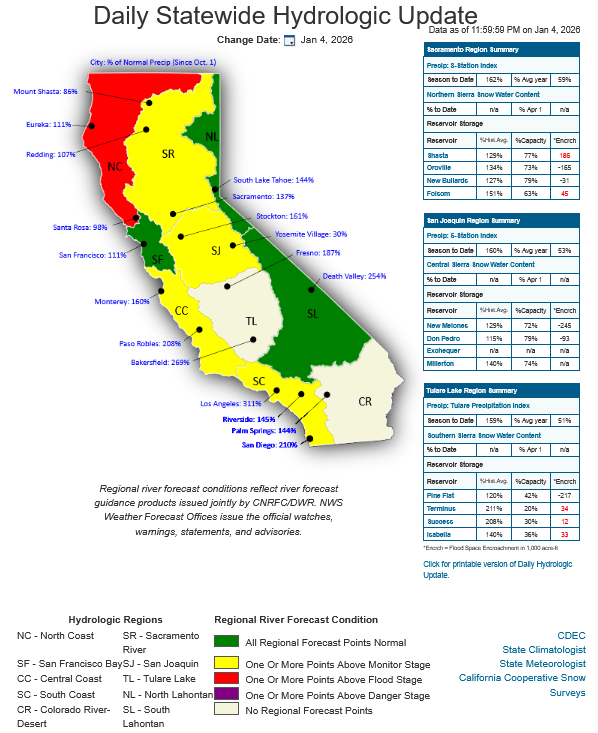
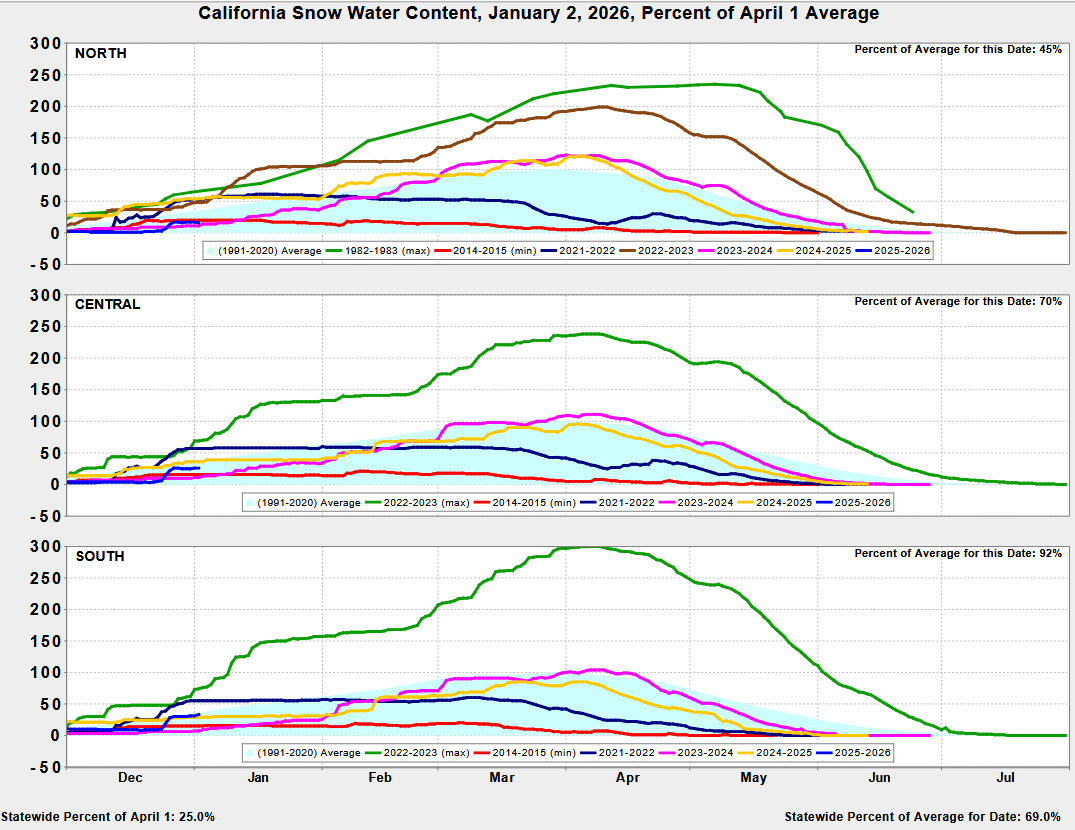
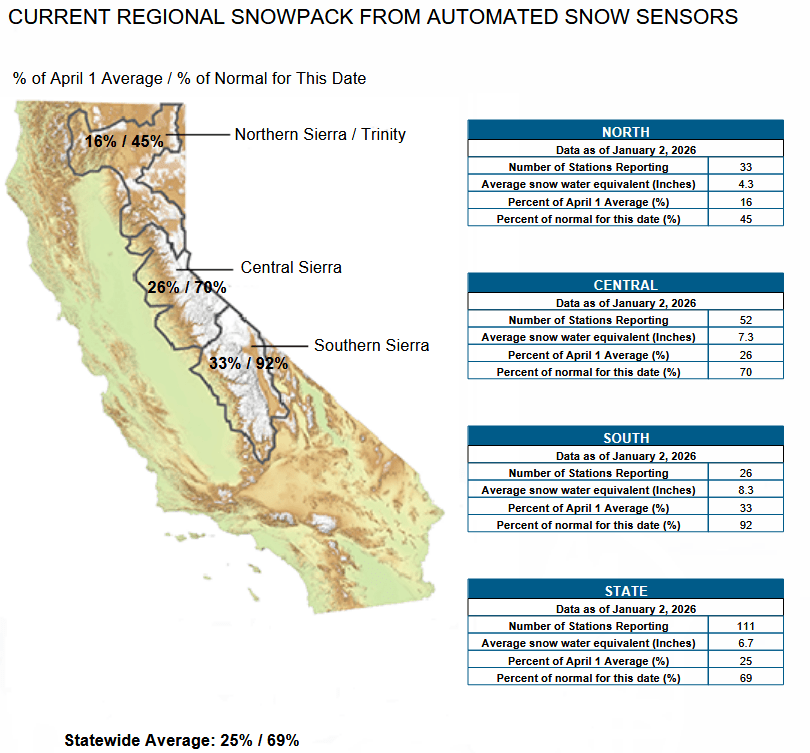
A look at current reservoir and snow conditions …




Also on Maven’s Notebook today …
YOUR INPUT WANTED: 2025-2030 Nonpoint Source Program Implementation Plan

