Several news sources featured in the Daily Digest may limit the number of articles you can access without a subscription. However, gift articles and open-access links are provided when available. For more open access California water news articles, explore the main page at MavensNotebook.com.
In California water news today …
Rain to return to California, just in time for New Year’s celebrations
 “Following several days of dry, sunny and windy conditions, a new storm packing rain and travel delays will roll into California later this week. California and much of the Pacific Coast and interior western United States are getting a break from the siege of storms that had been ongoing for weeks in December. The storms brought one to three months’ worth of rain in just a few days. The dry pattern will last through Tuesday in most areas and is needed to help streams and rivers recede from their high levels. The same pattern, however, is producing gusty winds from the Northeast, known to locals as a Santa Ana. The intensity of this particular Santa Ana event will fall into the moderate category, with gusts over the ridges and through the canyons and passes ranging from 40-60 mph. A few locally higher gusts are likely. … ” Read more from AccuWeather.
SEE ALSO:
- California rainfall: Track how much precipitation has fallen across the state and Bay Area, from the San Francisco Chronicle
- Rains raise Northern California reservoir lake levels including at Berryessa, from the East Bay Times
Dramatic changes in store for private island on edge of San Francisco Bay
“A small but significant island on the fringes of San Francisco Bay is entering a new chapter after a long and checkered history, which includes stints as a rumored rum-running outpost and a kitesurfing club for Silicon Valley elite. The 50-acre Point Buckler Island, an uninhabited land mass in Suisun Bay, is being restored to its natural, marshy state. The project follows the seizure of the property by local authorities over alleged unauthorized development and its subsequent sale through an auction to the nonprofit John Muir Land Trust. The conservation group says the restoration work will help the island recover from the environmental degradation that’s plagued its past. Most notably, the construction of levees over the past century has left much of the island dry, which environmentalists say has harmed fish and birds that rely on wetlands for food and shelter at a critical juncture in their migrations. … ” Read more from the San Francisco Chronicle.
Applying sustainable groundwater management: A sediment basin retrofit for enhanced recharge
“By 2017, the San Joaquin Valley was deep into one of the most severe droughts in California’s modern record. Despite aggressive water conservation policies, groundwater levels in the region continued their century-long decline of one-to-two foot per year, accelerating toward the aquifer’s minimum threshold, where an “undesirable result” may occur (North Kings Groundwater Sustainability Agency 2022). Some consequences were already evident, including dry wells and satellite measurements that documented widespread and continued land subsidence across the valley (NASA JPL 2017). This long-term result of over-pumping had already permanently eliminated as much as 606,000 acre-feet of aquifer storage (Smith, et al. 2017). For Fresno, a half-million-person city within the critically overdrafted Kings Subbasin, finding new ways to capture and store water underground became critical to ensuring long-term water security. Ideal projects would expand recharge capacity without large capital investment or new land acquisition. … ” Read more from Stormwater Solutions (free registration required).
Future ancestors of freshwater fishes in California
Dr. Peter Moyle writes, “We are living in the Anthropocene, an era being defined by global mass extinctions caused by humanity. While on-going and impending extinctions of birds and other terrestrial vertebrates gain the most attention, the situation with freshwater fishes (and other freshwater organisms) is as bad or worse, partly because many freshwater extinctions are nearly invisible events, hidden by murky waters (Moyle and Leidy 2023). The extinction threat is especially high for obligatory freshwater fishes including many species endemic to California (Moyle and Leidy 2023). The ultimate cause is competition between people and fish for clean water. People are winning the competition at an accelerated rate, assisted by invasive species and global warming[1] and by the by continued expansion of the human population and its demands (Rypel 2023). The freshwater fish fauna of California is thus already on its way to becoming simplified and homogenized (Moyle and Mount 2007, Leidy and Moyle 2021). The challenge, then, is how do we save some of the evolutionary lineages of native fishes to become the post-disaster ancestors of future fishes in the near (50-100 years) and long-term (100-1,000+ years)? This essay presents a rough proposal for answering this question. … ” Continue reading at the California Water Blog.
Sacramento River salmon redd dewatering – Fall 2025
Tom Cannon writes, “I have previously reported on the dewatering of fall-run salmon redds in the upper Sacramento River near Redding during the early fall spawning season. Redd dewatering has a significant negative effect on salmon egg and fry production that translates to lower annual escapement and significantly contributes to the multi-decade decline in the population. October is the peak in the fall-run Chinook salmon spawning season (Figure 2). During early November 2024, the Bureau of Reclamation reduced Keswick Dam releases from the October average of 7000 cfs to 4000 cfs. The flow reduction reduced water levels in the upper river spawning grounds below Keswick Dam from approximately the 11-ft water surface elevation (stage) to about the 8.5 ft level, a drop of about 2.5 feet. … ” Read more from the California Fisheries blog.
Judges can’t limit reviews to preferred endangered species
“A federal appeals panel has ruled courts evaluating disputes over the environmental impact of development and environmental regulatory decisions must widen their focus to include all endangered species and not just those central to claims brought by environmental activists or other opponents. Judge Jacqueline Nguyen wrote the opinion for the U.S. Ninth Circuit Court of Appeals, filed Dec. 3; Judge Danielle Forrest concurred. Judge Lawrence VanDyke wrote a special concurrence. At issue is Endangered Species Act litigation under which nongovernmental organizations – typically, environmental activist groups – seek injunctions to halt activities they argue could harm certain animal or plant populations. One such injunction required San Luis Obispo County to take specific steps in managing the Lopez Dam and Reservoir in response to a lawsuit from a coalition of groups, including San Luis Obispo Coastkeeper, Los Padres Forest Watch, California Coastkeeper Alliance and Ecological Rights Foundation. … ” Read more from the Northern California Record.
LADWP tiered water rates don’t violate CA constitution: Appeals panel
“A state appeals panel has agreed California’s constitution doesn’t prevent the Los Angeles Department of Water and Power from implementing tiered rates based on usage, but also said the city can’t make its water customers fund a special subsidy for low-income accounts. The underlying issue dates to March 2016 when the LA City Council passed a new water rate ordinance. In August 2018, Stephen and Melinda Dreher initiated a class claim with the city, and in March 2019 filed a complaint in state court for damages and challenging the rates on behalf of themselves and other customers. In addition to the low income subsidy, the Drehers claimed the tiered rate structure exceeded “the proportional cost of the service attributable” to each customer’s land parcel. Los Angeles County Superior Court Judge Mary Strobel ordered the city to stop including the subsidy charge — which generated $25.9 million in its first year — but said the Drehers weren’t entitled to refunds on charges they paid before the ruling because they didn’t pay under protest. Strobel also ruled the tiered rates otherwise complied with state law. … ” Read more from the Southern California Record.
Big Tech blocks California data center rules, leaving only a study requirement
“Tools that power artificial intelligence devour energy. But attempts to shield regular Californians from footing the bill in 2025 ended with a law requiring regulators to write a report about the issue by 2027. If that sounds pretty watered down, it is. Efforts to regulate the energy usage of data centers — the beating heart of AI — ran headlong into Big Tech, business groups and the governor. That’s not surprising given that California is increasingly dependent on big tech for state revenue: A handful of companies pay upwards of $5 billion just on income tax withholding. The law mandating the report is the lone survivor of last year’s push to rein in the data-center industry. Its deadline means the findings won’t likely be ready in time for lawmakers to use in 2026. The measure began as a plan to give data centers their own electricity rate, shielding households and small businesses from higher bills. … ” Read more from Cal Matters.
How fuel reductions fueled the ‘Christmas Valley miracle’
“When the Caldor Fire swept through Christmas Valley and Meyers in 2021, many expected to return to a smoking, blackened wreck—and were surprised by the fire leaving the areas largely unharmed. What’s now known as the “Christmas Valley miracle” was supported through years of fuel reduction treatment. In a study accepted by the journal of Forest Ecology and Management earlier this month, researchers Hugh Safford and Saba Saberi found that trees in treated areas were three times more likely to survive than those in untreated areas. Safford, who lives in Meyers for part of the year, said he was familiar with the work that the Lake Tahoe Basin Management Unit (LTBMU) and the U.S. Forest Service (USFS) conduct in the area. He was interested in studying an area he was familiar with, and when he walked the area after the fire was put out, said he saw obvious patterns tied to fuel treatment. … ” Read more from the Tahoe Daily Tribune.
SEE ALSO: Why Fuel Breaks Work to Slow or Stop a Wildfire’s Advance, from the Tahoe Daily Tribune
A return to a past Sierra wildfire to see the future of a recent one
“The first two miles were pleasant enough. The grade was mild, the forest serene. It was what lay ahead that worried me: A 2,500-foot descent to Jordan Hot Springs, a spot in California’s High Sierra backcountry that has long had a hold on my imagination — an idyllic meadow with rock-dammed bathtub-hot pools. … I was retracing my steps of 20 years earlier to a scene of mass death I had never been able to erase from my mind. At a small plateau alongside Ninemile Creek in the Golden Trout Wilderness Area, I had stood in a forest of black sticks standing on both sides of a steep canyon like whiskers on a beast too large to comprehend. I had hiked to Jordan Hot Springs and the burn scar of the 2002 McNally fire to probe big questions of fire ecology: Are Sierra forests overgrown? Is fire management the unintended cause of destructive crown fires? Do forests reduced to blackened earth and charcoal trees recover? The McNally fire wiped out whole forests in 2002. What does it tell us today about the future of vast areas devastated by recent fires? At that time, the questions proved too big. I never wrote a story. But the image stuck. Year after year I would wonder, “What does that canyon look like today?” … ” Read more from the LA Times.
In commentary today …
Editorial: If feds want Potter Valley dams, they should buy them
The Santa Rosa Press Democrat editorial board writes, “President Donald Trump’s California derangement syndrome is back as his administration tries to prevent PG&E from removing aging dams in the Potter Valley Project. Agriculture Secretary Brooke Rollins has moved to intervene in the Federal Energy Regulatory Commission process to determine whether PG&E may tear down two dams and a mothballed powerhouse. Rollins wants FERC to deny the application. Agriculture secretaries often get involved in these sorts of proceedings. Major changes to watersheds can impact farmers, after all. What is unusual in this case is that in supporting irrigators, a supposedly pro-business administration undermines private enterprise. PG&E wants to surrender its license for the hydropower system on the Eel River because it now costs more than it is worth. The dams and powerhouse are more than a century old and are nowhere close to meeting modern standards. They require costly repairs and upgrades to remain safe. PG&E absorbs those costs, and no doubt passes some onto ratepayers. … ” Read more from the Santa Rosa Press Democrat.
Why California needs to get over the ‘yuck’ factor of wastewater recycling
Aaron Tartakovsky, co-founder and CEO at Epic Cleantec, writes, “In San Francisco, we like to be at the forefront of innovation — driverless Waymos zipping through traffic, artificial intelligence startups launching weekly, robot baristas whipping up oat milk lattes at SFO. But beyond the dizzying blur of innovation, something equally transformative is happening out of sight, stealthily reshaping the city’s future. Deep inside the walls of our buildings, a quiet revolution in how San Franciscans manage and reuse their water is taking place. Take Salesforce Tower. While most people see a gleaming architectural icon, few realize that inside is one of the most pioneering water reuse systems in the country. Each day, the building captures wastewater from showers, sinks and toilets, purifies it to exceptionally high standards, and reuses it for flushing and cooling. The result? Nearly 8 million gallons of recycled water annually — the equivalent of 60 million bottles. … ” Read more from the San Francisco Chronicle.
Mountain meadows should be a priority for California climate bond
Ryan Burnett, Director of the Sierra Nevada Group at Point Blue Conservation Science, writes, “When I stepped into a Sierra Nevada meadow over 25 years ago, I was struck by the diversity of life, the hub of biological activity — full of birds, frogs, fish and plants. As a wildlife ecologist, I was in love. That infatuation has endured, growing into one of the great passions in my life. As a lifelong Californian, I’ve always been enamored with the natural wonders our state contains, and meadows are no exception. Californians have a lot to be proud of. In addition to the highest GDP of any state, we have a proven track record as the country’s climate and environmental leader. Since voters recently approved Proposition 4, we can be proud that California will deepen its commitment to large-scale action to address the state’s water, wildfire and climate challenges. … ” Read more from the San Jose Mercury News.
Congressional ‘Fix Our Forests Act’ would worsen wildfire threat in California
Chad Hanson, a wildfire scientist with the John Muir Project, writes, “As the Eaton and Palisades fires devastated the communities of Altadena and Pacific Palisades in Los Angeles County in January, the nation watched in horror. Driven by extremely dry air and wind gusts over 80 mph, the fires were unstoppable, forcing firefighters to focus on helping people to evacuate as houses and businesses burned around them. By the time it was over, the fires had destroyed over 10,000 homes and killed at least 31 people. While smoke hung in the air in Los Angeles, some politicians and political commentators were already stridently proclaiming that these fires prove we need more intensive forest management to stop such blazes and protect communities. People were mourning, and confused, and much was still unknown about the circumstances of the fires. Many, in shock, were looking for easy answers. Congress responded by passing the “Fix Our Forests Act” (H.R. 471) through the House on Jan. 23 while the fires still burned. … ” Read more from the San Jose Mercury News.
Biomass is a money pit that won’t solve energy or wildfire problems
Shaye Wolf, the climate science director at the Center for Biological Diversity, writes, “California’s most expensive electricity source is finally poised to lose a government handout that props up its high costs and harmful pollution. In an era of clean, cheap solar and wind energy, policymakers are rightly beginning to treat biomass energy like the boondoggle it is. Biomass energy — electricity made by burning or gasifying trees — is an expensive, dirty relic that relies on industry misinformation and taxpayer money. In a vote later this month, the California Public Utilities Commission is expected to end the BioMAT subsidy program, which requires electric utilities to buy biomass power at exorbitant costs — four times the average. Californians get hit with those extra costs in our power bills, along with pollution that harms our health and climate. Utilities and environmental groups support ending this costly subsidy. … ” Read more from the Marin Independent Journal.
If world is at risk, green opposition to nuclear, hydro power is incoherent
The San Diego Union-Tribune editorial board writes, “President Donald Trump’s belief that climate change is a gigantic “hoax” — and his willingness to act on that belief by blocking a wide range of constructive actions and withdrawing the U.S. from global efforts to address the problem — has alarmed responsible elected leaders, scientists and environmental organizations across the world. But the American public? Not as much as many would expect. In polls this year asking Americans to list the nation’s most important problems, the economy, inflation, health care, immigration and crime consistently outranked climate change and related issues. Part of this is what European media calls the “greenlash”: a chunk of the public realizing that many climate initiatives will make energy and the products it helps produce cost far more after years of being told that the transition would be relatively painless. … ” Continue reading from the San Diego Union-Tribune.
Photos of the dirty 1970s will make you appreciate the EPA
James Salzman, a professor of environmental law at UC Santa Barbara School of Environment and UCLA Law School, writes, “Growing up in the 1970s, I took for granted the trash piles along the highway, tires washed up on beaches and smog fouling city air. Such scenes are why the first Earth Day — on April 22, 1970 — energized the nation. In the largest single-day public demonstration in U.S. history, roughly 10% of the population took to the streets to shout together: “Enough is enough!” Republican and Democratic politicians alike listened. Over the decade that followed, all the nation’s foundational environmental laws were passed with strong bipartisan support, including the Clean Air Act, Clean Water Act and Endangered Species Act. These laws are taking a beating at the moment, including from the Environmental Protection Agency — the federal agency created in 1970 to protect the environment. The agency’s leader, Lee Zeldin, boasted of “driving a dagger straight into the heart” of environmental regulations. President Trump regularly derides environmental laws as job killers and government overreach.The conditions that made these laws necessary have largely been forgotten, allowing critics to focus entirely on costs while ignoring the laws’ very real benefits and achievements. … ” Read more from the LA Times. | Read via Yahoo News.
In regional water news and commentary today …
NORTH COAST
Mongolian scientists are studying the Klamath River for insights into the cost of dams
“As Mongolia looks to expand hydroelectric power, scientists from that country are studying the undamming of a California river. Mongolian scientists and officials have made multiple trips to Oregon and California to study the impacts of damming — and undamming — as the East Asian country explores hydroelectric projects. A coalition of state and tribal partners completed the largest undamming project in U.S. history along the Klamath River last year. Since then, the nonprofit Klamath River Renewal Corporation has overseen a massive restoration effort, which includes planting billions of seeds. … ” Read more from Jefferson Public Radio.
Radio show: Amy Cordalis on her family’s fight to save the Klamath River
“On this edition of Your Call’s One Planet Series, Indigenous rights and environmental advocate Amy Bowers Cordalis discusses her new book, The Water Remembers: My Indigenous Family’s Fight to Save a River and a Way of Life. Cordalis chronicles a multigenerational struggle to protect Indigenous cultural heritage and the Klamath River from environmental damage, which led to the largest river restoration project in history. She writes: “The lessons from Klamath dam removal are critical now because the relationship between humans and nature is out of balance across the planet. Klamath dam removal proves that humans can work with nature to create a thriving future on planet earth. Dam removal is just the beginning. … ” Listen at KALW.
In California’s redwoods, scientists rebuild lost ecosystems high up in the canopy
“The Van Eck Forest in northwestern California is home to iconic coast redwood trees, which store more above-ground carbon per acre than any other forest type. The oldest trees can grow to heights of more than 90 meters (300 feet) and may be more than 2,000 years old. But due to the region’s extensive logging, which reduced old-growth redwood forests to just 5% of their original extent, very few large, old redwood trees (Sequoia sempervirens) exist today. Consequently, there are also fewer fern mats high up in the forest canopy: large masses of leather-leaf ferns (Polypodium scouleri), a keystone species that stores water, mitigates forest temperatures and provides habitat for animals. To help restore these historic forests, a conservation nonprofit and a university are experimenting with ways to transplant the mats back into redwood treetops. In a collaboration that began in 2021, the Pacific Forest Trust and scientists from California State Polytechnic University, Humboldt, are taking fern mats that have fallen from old-growth trees and replanting them in younger trees to restore the canopy layer. … ” Read more from Mongabay.
Cascades frogs vanished from Lassen Volcanic National Park in 2007. Now, they’re back.

“The last Cascades frog in Lassen Volcanic National Park in Northern California was well known to amphibian survey crews. Year after year, she turned up near Juniper Lake, full of eggs, seeking a mate. But it was a hopeless search; there were no other frogs left. She appeared one last time in 2007. Cascades frogs were once plentiful in the park; now, researchers believed, there were none. Seeing that final frog inspired ecologist Karen Pope to shift from observational research to studying nature to help restore it. “We’ve gotten to a place where, if we sit back, we’re going to keep watching the last frog,” said Pope, who recently retired from the Forest Service. Now, thanks to a collaboration among timber companies, the National Park Service, the Forest Service, the California Department of Fish and Wildlife and scientists from Washington State University, scientists are reintroducing Cascades frogs to Lassen Volcanic National Park. … ” Read more from High Country News.
Trump administration steps into review of proposed Potter Valley Dam removal

“The U.S. Department of Agriculture has announced it is stepping into a federal review of the proposed removal of the Potter Valley Hydroelectric Project in Mendocino and Lake counties. According to the USDA, PG&E’s plans to remove the Scott and Cape Horn dams could cut off water used by farmers, residents and firefighters in Mendocino, Lake, Humboldt and Sonoma counties. To intervene, Agriculture Secretary Brooke Rollins filed paperwork Friday to take part in the Federal Energy Regulatory Commission’s review of the proposed removal. FERC oversees hydroelectric projects across the country. The move comes days after Rollins wrote a letter to the editor to The Mendocino Voice, outlining the Trump administration’s reasons for opposing the removal. … ” Read more from the Mendocino Voice.
SEE ALSO:
- Trump administration to review proposed dam removal in Mendocino, Lake counties, from NorCal Public Media
- USDA intervenes in California hydropower decommissioning as FERC reviews Potter Valley Project, from International Water & Power
Ukiah Valley Water Authority proposes rate hike across multiple regional water districts
“The Ukiah Valley Water Authority is proposing rate increases for multiple water districts in the region. According to a news release sent out by the water authority — a joint powers authority, including the city of Ukiah and four water districts — the reasons behind the rate increases are to “fund maintenance, infrastructure upgrades, and long-term system reliability after completing a regional rate study.” Hildebrand Consulting analyzed the finances of four agencies: Millview County Water District, Redwood Valley County Water District, Willow County Water District and the city of Ukiah. After reviewing the analyses, each district proposed its own schedule of rate increases based on infrastructure and other needs. … ” Read more from Local News Matters.
MOUNTAIN COUNTIES
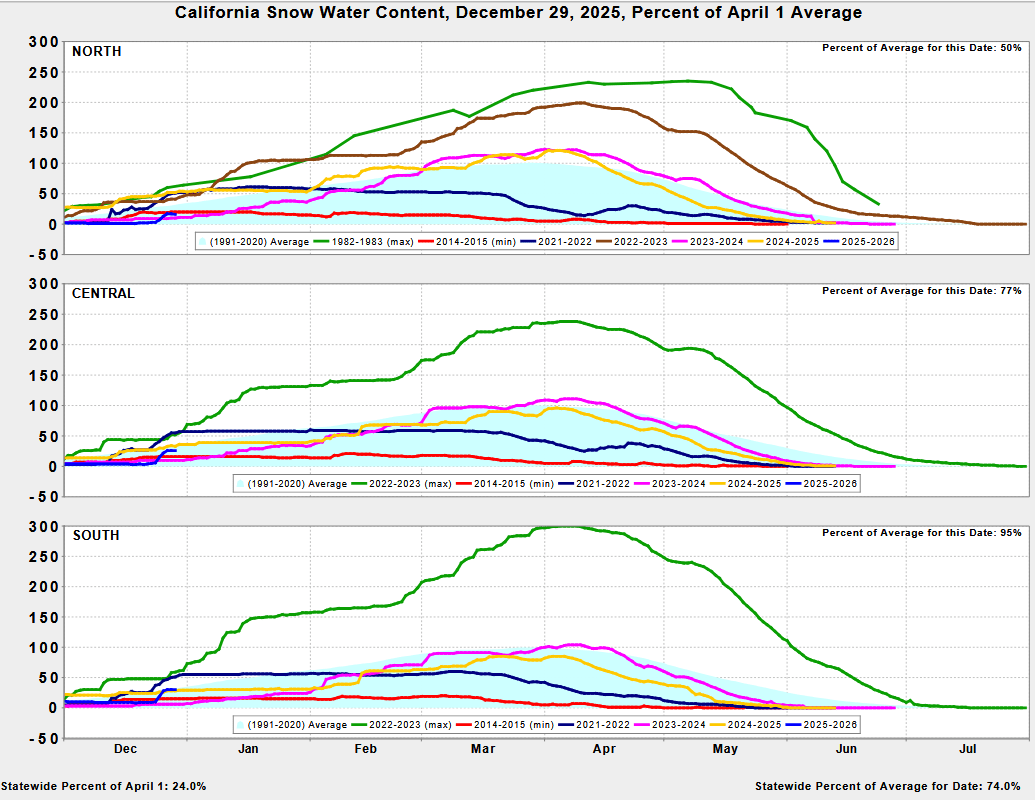
‘A Christmas miracle’: Tahoe, Mammoth ski resorts revel in snow dumps after dry early season
“A winter storm system that clobbered the Bay Area with triple-digit wind speeds, landslides and power outages this week received a welcome reception in some of the state’s most popular ski enclaves, with one resort describing the massive snowfall there as a “Christmas miracle.” After a record snow drought, what had been a pitiful start to this year’s ski season took a dramatic — even a dangerous — turn starting on Christmas Eve. Over the last three days, ski mountains in the Tahoe and Central Sierra areas took in between 3 and 5 feet of fresh powder, with resorts reveling in the reversal of fortune despite some of their own storm-related setbacks. Near Donner Peak, “22” of snow has fallen in the past 24 hours,” Sugar Bowl Resort posted on its website Friday morning. “Get up here!” … ” Read more from the San Francisco Chronicle.
SEE ALSO: Christmas storm delivers huge snow totals across the Sierra, western Nevada, from Channel 4
Palisades Tahoe opens upper mountain runs after receiving 79.5 inches of snow
“The Christmas week holiday storms brought over 6 feet of snow to Palisades Tahoe, which opened runs on their upper mountain to the public today. “We got 79 inches of new snow. It was an absolute Christmas miracle. It was pretty slim pickings before, but now we’re working on getting our whole mountain open. Our team has been working around the clock to get this place open,” says Palisades PR Manager, Patrick Lacey. Lacey adds that without the team, none of it would be possible, from Ski Patrol to Avalanche Technicians; everyone worked hard to make it possible. We spoke to excited skiers and snowboarders who traveled from all across the nation. “13-hour drive. It was great. You know, the weather was coming over, the passes a little iffy, but we got here,” says Jeff from Washington. … ” Read more from Channel 2.
SACRAMENTO VALLEY
Supporting the reintroduction of Sacramento winter-run chinook to the Battle Creek watershed
“The day the gates closed on the Shasta Dam in 1943, approximately 200 miles of California’s prime salmon and steelhead spawning habitat disappeared. Although devastating for all four distinct runs of Central Valley Chinook salmon, the high dam hit the Sacramento winter-run Chinook the hardest. Sacramento winter Chinook—the only winter-run Chinook in the world—evolved from the cold, spring-fed waters of the McCloud River, Upper Sacramento, Pit Rivers, and Battle Creek. These streams originate from the volcanic aquifers of Mount Shasta and Lassen, which store water from snowmelt and slowly release it as steady, reliable, cold flows throughout summer months. … ” Read more from Cal Trout.
Research aids American River fish
“A year-round survey is keeping tabs on oxygen levels in the American River. Operating with Sacramento Water Forum funding since 2022, the project measures dissolved oxygen from below the Folsom Dam to Nimbus Basin; surveys also extend to Fair Oaks and Watt Avenue reaches. Although dissolved oxygen levels are critical to all river health, research is particularly supportive to Chinook salmon reproduction. Teams of biologists engage in daily readings. This reporter accompanied them on a recent river outing. A critical salmonid spawning habitat lies below Nimbus Dam. Here, shallow gravel beds challenge data-gathering. … ” Read more from the Carmichael Times.
NAPA/SONOMA
BAY AREA
Bay Area gets a breather after holiday storms, but rain isn’t done yet
“What a week it’s been across California. Several rounds of rain and gusty winds made for a messy holiday stretch. While the worst of that activity has moved on, the broader weather pattern that produced it hasn’t fully let go. You can feel the difference already. After days of deep moisture overhead, the atmosphere over the Bay Area has dried out dramatically. That’s a far cry from where things were last week, when the atmosphere was full of water. That drying trend is tied to a slow but important shift in the upper-level pattern. The sprawling upper-level low-pressure system that helped trigger last week’s atmospheric rivers is finally moving east. At the same time, high pressure will build in from the eastern Pacific. … ” Read more from the San Francisco Chronicle.
San Geronimo pipeline upgrade project approved
“Seismically vulnerable segments of a pipeline that carries untreated water across the San Geronimo Creek are slated for replacement. The board governing the Marin Municipal Water District unanimously approved the project on Dec. 16. The vote included the adoption of an environmental assessment that imposes steps to minimize potential disturbances to the creek and surrounding habitat. The pipe is part of the district’s “North Marin Line,” which was constructed in 1957 to convey raw water from Kent Lake and Nicasio Reservoir to the San Geronimo treatment plant. Pipe crossings are supported by concrete trestles installed in the creek. The pipe is leaky and at the end of its useful life. “It’s such a critical line in our system that we want to make sure that it’s operable, right?” said Elysha Irish, the district’s engineering manager. “Nicasio and Kent Lakes are some of our largest lakes in our system. Also, Soulajule (Reservoir) would be fed through that line should we choose to operate it.” … ” Read more from the Marin Independent Journal.
‘Innovative’ approach to sea level rise is first of its kind in San Francisco Bay
“Under a fresh plot of dirt along the San Francisco Bay, a revolutionary new way to address climate change is taking shape in Palo Alto. Young native plants are taking root in the soil, which sits atop a layer of wood chips, a layer of sand and a layer of gravel. Treated water from a nearby wastewater plant will soon trickle through it all, irrigating the plants while getting extra filtering before going into the bay. This so-called living levee is designed to grow in elevation as plants die off and sediment settles, adjusting to rising seas and protecting the shoreline from big storms. It can be used in conjunction with conventional seawalls, which don’t integrate into the habitat and may eventually be overtopped. … ” Read more from the San Francisco Chronicle.
CENTRAL COAST
Del Rey Oaks tells nursery owner to leave after crossing a ‘bridge too far’ with lease violations.
“After seven years of operating Del Rey Gardens on city-owned land in Del Rey Oaks, Mitsugu Mori must leave the property by Dec. 31, after officials discovered he had capped the nursery center’s California American water line and instead tapped into a city line carrying non-potable well water. It was not the first time Mori had performed work without notifying the city. In 2019, city officials discovered he had pushed the boundaries of the nursery located on Rosita Road off of Canyon Del Rey Boulevard beyond what was allowed on the lease, as well as extended a dirt road between the back of the nursery to the Safeway for hauling materials, among other changes. “When I got here four years ago, the city was already in the process of moving to evict the garden center for breaches in the lease and violations of the conditional use permit,” City Manager John Guertin told the Del Rey Oaks City Council on Dec. 16. He said they “got to a point where we still weren’t in love with everything that was happening down there, but we got to sort of an equilibrium where we could co-exist and it was working.” … ” Read more from Monterey Now.
Supervisors approve increased growth rate for Los Osos for 2026
“Deviating from the recommendation of the Los Osos Basin Management Committee, the San Luis Obispo County Board of Supervisors approved increasing the 2026 growth rate cap for the coastal town from 0 percent to 0.4 percent. “Keeping the growth rate at 0.4 percent … is more than protective of the groundwater, couple that with the 2:1 offset that’s required, and we have a solid,” 2nd District Supervisor Bruce Gibson said at the Dec. 16 meeting. The supervisors’ greenlit proposed amendment to the growth management ordinance also removes annual growth caps countywide except in Los Osos, since only 11 percent of the allowed housing growth was used countywide. Although the local coastal program caps Los Osos’ growth rate at 1 percent, supervisors chose a lower threshold to be more “conservative.” … ” Read more from New Times SLO.
Lake Cachuma water releases begin as runoff from major storm fills reservoir
“Runoff from this week’s powerful storms has pushed Lake Cachuma to the brim, and officials said Friday they have begun releasing water from the reservoir. As of 2:45 p.m. Friday, the reservoir was at 98% of capacity, and a little more than a foot from spill level. Officials begun releasing water from the lake at 9 a.m. in anticipation of more runoff in the coming hours and days, according to Lael Wageneck, a spokesman for the Santa Barbara County Public Works Department. All four of the outflow gates at Bradbury Dam, which forms the lake, have been opened. … ” Read more from Noozhawk.
Good vibrations for coastal collaborations
Collaborative, data-focused work is at the center of the Montecito Groundwater Sustainability Agency’s (Montecito GSA) activities and their Groundwater Sustainability Plan. Public or private wells that provide direct access to the groundwater supply can be used to collect needed data. In addition to public wells owned by Montecito Water District, more than 50 private wells now participate in monitoring programs related to conditions such as seawater intrusion, groundwater quality, groundwater levels, and metered extractions. More typical around the state are groundwater basins with a relatively small number of high-producing wells that supply groundwater for uses such as municipal and/or agriculture. Montecito is unique in that there are several hundred relatively low producing wells, public and private, that access a geologically intricate basin to provide water for individual and group uses in a relatively small geographic area. Current and continued private involvement are key to establishing and maintaining truly representative monitoring networks with relevant data. … ” Read more from the Montecito Voice.
Camarillo seeks ‘extraordinary remedy’ in response to phase 1 ruling in regional groundwater adjudication case
“[Last week], the City of Camarillo filed a Writ of Mandate with the Santa Barbara Superior Court requesting further review of the Phase 1 ruling in OPV Coalition, et al., v. Fox Canyon Groundwater Management Agency, et al. Issued in October, the ruling did not consider key evidence, combined legally distinct water sources, relied on outdated modeling, and ultimately established a dangerously low total available groundwater supply, or “safe yield,” for the region. Recognizing the imminent and long-term threat this decision has on the City’s water supplies, an appeal has been made to the court to swiftly intervene. Prompt action by the court is critical because, based on similar groundwater adjudication cases in California, the litigation could continue for 10 years or more before a final judgment is reached. “If this legal decision is left to stand, Camarillo could be forced to make major water supply and investment decisions for the future based on a ruling that the City finds inconsistent with existing and established laws,” said Mayor David Tennessen. “We are seeking a transparent, data-driven outcome that protects ratepayers, respects state and federal investments, and allows the City to plan responsibly for its water future.” … ” Continue reading from the City of Camarillo.
SAN JOAQUIN VALLEY
Turlock: Year ends with rain, but no help for snowpack
“It wasn’t a white Christmas, but it certainly was a wet one, with Turlock pelted by more than an inch of rain on Christmas Eve. A total of 1.05 inches of rain fell on the city Dec. 24, and with a splash or two Dec. 25-26, the total thus far for the 2025-26 water year (which began on Oct. 1) stands at just under 6.4 inches. That year-to-date total is an inch better than in 2023 (5.32), when the rest of the water year produced nearly 17 more inches of the wet stuff for a staggering year-end total of 22.14. And the figure is nearly on par with 2017 (6.59), which concluded the water year at 20.42 inches. … ” Read more from the Turlock Journal.
New project aims to reconnect Merced grasslands to the San Joaquin River
“A new project in the Central Valley is aiming to restore hundreds of acres of grasslands to reconnect the San Joaquin River. The initiative is part of a larger effort to preserve the Great Valley Grasslands State Park, and involves removing levees to reconnect the river with its historic floodplain. Great Valley Grasslands in Merced County spans more than 2,800 acres of a broader 160,000-acre ecological zone. It’s one of California’s largest continuous wetland areas. The nonprofits American Rivers, River Partners, FlowWest and several local tribes have supported the project dating back to 2009. The project will reconnect the San Joaquin River with 220 acres of historic floodplain by removing a defunct levee built in the 1950s. … ” Read more from the Merced Focus.
Major legislation to support FKC repair completion
“Two Central Valley Democrats in the U.S. House of Representatives have introduced a package of legislation that includes providing enormous funding for the completion of much needed repairs to the Friant-Kern Canal. In addition the package includes considerable funding for the Lindsay-Strathmore Irrigation District’s planned major groundwater recharge project. Merced Representative Adam Gray introduced a legislative package on December 11 titled the “End California Water Crisis Package” that was co-sponsored by Fresno Representative Jim Costa. The package includes three bills: The Water Agency and Transparency Enhancement Review, WATER Act, the Build Now Act and the Central Valley Water Solutions Act. … ” Read more from the Porterville Recorder.
Friant Water Authority provides update on dealing with golden mussels
“The Friant Water Authority, which oversees the Friant-Kern Canal, has provided an update on how it will deal with golden mussels discovered in the canal. In its weekly update it posts every Friday on water operations and availability, FWA stated it will prioritize the delivery of remaining water supplies before the end of the water year over short-term treatments to deal with golden mussels. In its update it provided on December 19 FWA confirmed the presence of golden mussels in the canal. On Friday FWA stated operations and maintenance staff “have partially dewatered the lower reaches of the FKC in consultation with districts that receive water through those reaches to assess canal infrastructure for the presence of adult and juvenile golden mussels.” … ” Read more from the Porterville Recorder.
City of Porterville working on lead water service inventory
“The City of Porterville has sent out a letter to the community concerning the city’s drinking water, stating while it hasn’t met last year’s deadline to complete an inventory of how much lead is in the water, the lead level in the city’s water is essentially non-detectable and remains safe to drink. The city stated it was required to complete and submit an initial lead service line inventory by October 16, 2024 as mandated by the Environmental Protection Agency, EPA. The inventory is a federal requirement under the Lead and Copper Rule revisions and helps those operating public water systems to identify what’s in water service lines and its location. … ” Read more from the Porterville Recorder.
EASTERN SIERRA
Local ‘water protectors’ sue LADWP: Utility failed to revegetate abandoned pastures, plaintiffs say
“The three official member organizations of the Eastern Sierra Water Alliance filed a joint lawsuit Wednesday against the Los Angeles Department of Water and Power, claiming the utility has failed to comply with legally required vegetation mitigation work in the Laws area near Bishop. The plaintiffs are the Owens Valley Indian Water Commission, Sierra Club Range of Light Group, and Friends of the Inyo. In a media release issued the same day the lawsuit was filed, the plaintiffs state that, as part of a 2003 project under the California Environmental Quality Act, LADWP committed to revegetate abandoned pastures in the Laws area, in exchange for creating new pastures in other nearby areas, an effort that “would have created a biodiverse upland desert scrub community in the previously abandoned pastures by 2013.” … ” Read more from the Mammoth Times.
SOUTHERN CALIFORNIA
SoCal’s wettest Christmas holiday ever, and the intensifying drought-to-deluge cycle behind it
“A year ago, officials were sounding alarms about a bone-dry winter that days later would combine with wind gusts of up to 100 mph to bring about the worst fires in Los Angeles history. Now, Southern California just experienced its wettest Christmas in modern history. This Christmas Eve and Christmas Day were the rainiest in the modern record for many parts of Southern California, according to the National Weather Service office in Oxnard. Some mountain areas have received close to 18 inches of rain since Tuesday, with more rain falling on Friday — though it should clear up by the weekend. This is also one of the wettest starts to the water year, which began Oct. 1. Through midday Friday, it already ranked in the seven wettest for Southern California — a complete opposite from last year. … ” Read more from the LA Times.
Yes, that was a tornado in Los Angeles on Christmas
“A tornado did, in fact, spin through Los Angeles on Christmas, the National Weather Service confirmed, damaging a home and a commercial strip mall. With a wind speed of up to 80 mph, the brief tornado traveled for about a third of a mile in Boyle Heights just after 10 a.m. Thursday. It was classified as an EF-0 on the Enhanced Fujita scale, the weakest kind of tornado, in which three-second gusts can be 65 to 85 mph. The tornado first hit a home on Lee Street, damaging the roof and allowing rainwater to leak inside. It then hit a strip mall on the northeast corner of Whittier Boulevard and South Lorena Street, breaking some windows and tree branches, bending a utility pole and destroying several business signs, the weather service said in a statement Friday evening. … ” Read more from the LA Times.
San Bernardino County faces new storm threat after holiday floods
“San Bernardino County is still reeling from a massive Christmas storm that dumped more than 10 inches of rain on mountain communities like Wrightwood and Lytle Creek, washing out roads, destroying bridges, and leaving dozens of homes severely damaged. Now, residents face an even greater challenge: another round of heavy rain is forecast through New Year’s Day, raising fears of renewed flooding and mudslides in areas already scarred by wildfires. County officials confirmed at least 50 homes sustained “severe damage,” and Wrightwood remains under a boil-water notice as power outages persist. Emergency crews and volunteers are racing to provide shelter and restore basic services before the next storm hits. … ” Continue reading from the Desert Sun.
Floodwaters leave Southern California desert homes buried in mud
“What was once a living room is now filled with mud — the aftermath of floodwaters that tore through several homes in Pinon Hills, a desert community in San Bernardino County. As raging water roared through properties during last week’s downpours, Los Angeles County first responders rescued people trapped on rooftops. “The water was just coming in so fast it almost looked like waves,” one resident told KTLA. Ramona Ralph, who lives next door, endured the Christmas Eve nightmare. She managed to get her horses out before the barn collapsed. Her yard turned into a river, and her neighbor’s home filled with mud. “I know Paul isn’t in a good situation right now, but he’s alive,” Ralph said. … ” Read more from KTLA.
State says Castaic oil cleanup to continue in January
“About 2 miles west of where Chiquita Canyon Landfill operators recently dealt with a leachate cleanup, state officials Friday said they were making good progress taking care of an unrelated oil spill that reached the Santa Clara River. A contracted cleanup team from Patriot Environmental Services has been at the spill site — mostly in a dry creek bed north of the Santa Clara River and Henry Mayo Drive and east of San Martinez Grande Canyon Road — since Nov. 8. A Department of Fish and Wildlife official said there’s been no observable direct impacts to wildlife from the spill, which was initially estimated to be approximately 400 gallons on Dec. 5. … ” Read more from The Signal.
L.A. fire cleanups reports describe repeated violations, illegal dumping allegation
“The primary federal contractor entrusted with purging fire debris from the Eaton and Palisades fires may have illegally dumped toxic ash and misused contaminated soil in breach of state policy, according to federal government reports recently obtained by The Times. The records depict harried disaster workers appearing to take dangerous shortcuts that could leave hazardous pollution and endanger thousands of survivors poised to return to these communities. The Federal Emergency Management Agency and the U.S. Army Corps of Engineers allocated $60 million to hire personnel to monitor daily cleanup operations and document any health and safety risks. The Times obtained thousands of government oversight reports that detail these federal efforts to rid fire-destroyed homes of toxic debris between February and mid-May. … ” Read more from the LA Times.
New law revives dormant plans for solar plant near Mojave National Preserve
“A proposed solar power plant near Baker, rejected by the San Bernardino County Board of Supervisors nearly a decade ago, has been revived under a new law allowing developers to bypass local approval for energy projects and seek a green light directly from the California Energy Commission. If approved, Soda Mountain Solar, LLC would build a 300-megawatt solar plant and battery storage system on 2,670 acres of federal land administered by the Bureau of Land Management, about six miles southwest of Baker. It would operate year-round and deliver electricity to the state’s power grid. … ” Read more from the OC Register.
The Mojave River: From the mountains to beneath our feet
“The Mojave River and the associated groundwater aquifers are important water supplies in the Mojave Desert of Southern California. The river and the aquifer along it are connected, and when hydrologic conditions change in one, the other usually is affected. The fluctuation of groundwater levels in wells along the river in the floodplain aquifer indicate that the replenishment of groundwater is dependent on seepage from the river ( Thompson, 1929 ). Reports and diaries from explorers of the Mojave River during the 18 th and 19 th centuries describe abundant water and pastures or shallow depth to groundwater along most reaches of the river; however, the river only flowed perennially in a few spots by 1991. Decades of groundwater withdrawal by pumping throughout this part of the Mojave Desert has changed flow characteristics of the aquifer system and the river; reaches of the river that previously had perennial, now flow only after large storms that mostly occur in the mountains to the south. Here, we explore the connections between precipitation, streamflow, groundwater, subsurface geology and water quality in the Mojave River. … ” Read more from the USGS.
Along the Colorado River …
Could this idea help solve some of the Colorado River water fights?
 “The president of the Utah State Senate has an idea he thinks could help states along the Colorado River. “What we do in Utah is we solve problems and that’s what we’re in the middle of,” Senate President J. Stuart Adams, R-Layton, said in a recent interview with FOX 13 News. His idea is to pay California to build more desalination plants along the Pacific Ocean for their water needs. In exchange, they’d give up some shares of water along the Colorado River for Utah and other upstream states to use. “I don’t look at it as funding California. I look at it as funding water for Utah,” Sen. Adams said. … ” Read more from Fox 13.
Colorado River crisis won’t stop explosive growth in Las Vegas, officials say
“It’s a no-brainer for many: As the outer boundaries of the Las Vegas Valley blur and thousands of homes pop up where only desert used to be, the bathtub ring around Lake Mead seems to only deepen. An ever-growing desert metropolis and worsening mega-drought seem like a recipe for disaster, and the doom-and-gloom headlines about the Colorado River seem to only confirm people’s worst fears. But ask Colby Pellegrino, deputy general manager of resources at the Southern Nevada Water Authority, and Las Vegans might walk away with more hope that future generations will be able to enjoy living in the city like they do. “Our goal is to always be ahead from an adaptation standpoint,” Pellegrino said in an interview. “The key to new development and continuing to diversify and grow is, what is the water footprint of that growth? That’s where all of the hard things that we’ve done — our evaporative cooling moratorium, no turf in new homes — all of that is ensuring that we shrink down the water footprint as we continue to grow our community.” … ” Read more from the Las Vegas Review Journal.
Drought conditions on the Colorado River are getting worse because of climate change. How will leaders respond in 2026?
“The Colorado River has been in the midst of climate change-fueled drought for the better part of two decades, and 2025 brought no relief to the stressed system. Even though snowpack in the early part of the year was close to normal for much of the basin, inefficient runoff meant a lot of the water in the snow didn’t make it into rivers and streams. The Colorado River’s political future is also uncertain. The river’s current operating guidelines, including how water is released from its two largest reservoirs, Lake Powell and Lake Mead, expire in 2026. The seven states that rely on the river have missed several key deadlines to come up with a plan. That includes the most recent deadline of November 11, 2025, when the states were supposed to have a big-picture idea of what water allocation amongst the states would look like, and where cuts to usage would occur. … ” Read more from Aspen Public Radio.
Colorado River Basin drought persists as winter begins
“The United States Drought Monitor report issued December 24, 2025, describes a country experiencing sharp contrasts in weather and water conditions. While portions of the Pacific Northwest received repeated rounds of heavy precipitation, much of the rest of the western and central United States remained under a persistent ridge of high pressure that suppressed rainfall and promoted unusually warm temperatures. In the eastern United States, several storm systems delivered widespread precipitation, but warmer conditions caused much of it to fall as rain rather than snow. Frozen soils and slow-responding groundwater limited the benefits of this moisture, resulting in only modest drought improvements in select areas. By contrast, large portions of the West and High Plains saw little to no precipitation, with above-normal temperatures accelerating winter drought impacts that are more typical of spring. … ” Read more from Western Water.
Where a Saudi company pumps desert groundwater, Arizona considers imposing limits
“Lush green fields of alfalfa spread across thousands of acres in a desert valley in western Arizona, where a dairy company from Saudi Arabia grows the thirsty crop by pulling up groundwater from dozens of wells. The company, Fondomonte, is the largest water user in the Ranegras Plain groundwater basin, shipping hay overseas to feed its cows in the Middle East. Like other landowners in the area, it has been allowed to pump unlimited amounts from the aquifer, even as water levels have declined. That soon could change, as Arizona officials are considering a plan to start regulating groundwater pumping in the rural area 100 miles west of Phoenix. … ” Read more from the LA Times. | Read via AOL News.
Yavapai-Apache water settlement returns to congress
“On Friday, December 26, 2025, Arizona Representative Eli Crane introduced H.R. 6931, titled the Yavapai-Apache Nation Water Rights Settlement Act, in the United States House of Representatives. The bill seeks congressional approval of a negotiated settlement resolving the Yavapai-Apache Nation’s water rights claims in Arizona and authorizes construction of a water project tied to those claims. The legislation was referred to the House Committee on Natural Resources, which oversees tribal water settlements and western water policy. As of December 28, 2025, the full legislative text had not yet been released, a procedural delay that can occur following bill introduction. … ” Read more from Western Water.
Utah proposes desalination collaboration with California to tackle Colorado River water crisis
“In the ongoing bout over the Colorado River’s resources, Utah Senate President J. Stuart Adams has pitched an idea that might ease tensions among Western states. According to Scripps News Salt Lake City, Adams suggests Utah could aid California in building more desalination plants. In return, California would let go of some of its Colorado River water allocation, benefiting Utah and other upstream states.While such projects could cost a hefty sum and aren’t quick fixes, they represent potential pieces of a diversified approach to water management. “Those are complicated projects that require a lot of analysis and investment, and new infrastructure to be built. That’s going to be part of the solution, but it’s not going to be the entirety of the solution,” Jessica Neuwerth, executive director of the Colorado River Board of California, told Scripps News Salt Lake City. As the states of the Colorado River basin grapple with unprecedented water scarcity, there’s momentum toward collaborative and multi-state projects. … ” Read more from Hoodline.
Tapping indigenous knowledge can help us navigate a changing climate
“Two years ago, a natural spring in Zuni Pueblo, New Mexico—one of the driest patches of land in the United States—began to disappear. It was a source that many people, including Jim Enote, a Zuni tribal member, used for watering their fields and gardens. Enote had farmed the area for 68 consecutive years, so when his neighbors tried to revive the crucial water supply, he joined them. Despite their best efforts, the spring dried up—a casualty of the worst megadrought experienced in the Southwest for more than a millennium. Still, Enote believed there had to be a way to quench his community’s thirst. As a boy, he had learned the traditional names of local places from his grandfather. And he remembered that an area just 100 feet from one of his fields had a Zuni name that referred to water. The spot was covered with dry grass, but Enote decided to start digging. Less than a foot down, he hit standing water. … ” Continue reading from the Sierra Club.
How Lake Powell water levels changed in 2025
“Official figures show how water levels at Lake Powell—a vital reservoir for multiple states across the western U.S.—changed throughout 2025. Lake Powell, a part of the Colorado River network, is the second largest reservoir in the U.S, capable of storing over 24 million acre-feet of water—the amount of water required to cover one acre to a depth of one foot. The largest is Lake Mead, also along the Colorado River, which has a capacity of more than 26 million acre-feet. The river system supplies critical water to millions in states including Arizona, California, Nevada, and parts of Mexico. However, declining water levels could jeopardize city water systems, farm irrigation, and hydroelectric power output. … ” Read more from Newsweek.
Working lands, working options: Expanding forage flexibility in the Upper Colorado River Basin
“Across the Upper Colorado River Basin, forage crops are a powerful engine of rural economies. Alfalfa, mixed grass hay and irrigated pastures form the nutritional base of livestock operations and anchor much of the agricultural land use across broad swaths of the region.These systems are resilient, familiar and central to the Western livestock industry. But as the basin faces a prolonged imbalance between water supply and demand – driven by earlier runoff, hotter summers and persistent aridification – producers are looking for tools that allow them to keep land in production and maintain economic stability. From district water boards to individual farmers, the sentiment that echoes across the basin is that practical solutions are needed in a drier, hotter future to sustain this important facet of the agricultural system. … ” Read more from Ag Proud.
In national water news today …
AI energy demand by the numbers — and how it might affect the planet
“First came predictions of skyrocketing electricity consumption from data centers. Now, it’s starting to materialize. The question is what it means for the grid and the planet. Commercial electricity demand, a proxy for data center power consumption, is up 2 percent through the first nine months of 2025 compared to the same time last year, according to a review of federal data by POLITICO’s E&E News. That follows a 3 percent increase in 2024. That’s a seismic shift for the U.S. power sector, whose electricity demand was flat for much of the last two decades. And that is expected to spike even higher as the Trump administration and technology companies try to outpace China in the race to develop artificial intelligence. The consulting firm Grid Strategies predicts that peak electricity demand nationwide could grow 166 gigawatts by 2030. That’s the equivalent of adding 15 New York Cities over the next five years. … ” Read more from E&E News.
A look at current hydrology and snowpack …