

December 17 listening session added to panel schedule
By Jane Sooby
The Second Statewide Agricultural Expert Panel met for working group meetings number 3 and 4 on November 14 and November 19, 2025.
Upcoming Expert Panel Meetings and Public Comment Opportunities
- Ag Expert Panel Working Group Meeting Friday, December 12, 2025, 3-6 pm. Click here for information on listening in and submitting public comment.
- Public Listening Session Wednesday, December 17, 2025, 1-5 pm. Click here for information on registering to provide public comment.
- Ag Expert Panel Working Group Meeting Wednesday, January 7, 2026, 3-6 pm. Registration info forthcoming.
- Ag Expert Panel ALL DAY Working Group Meeting Wednesday, January 14, 2026. Registration info forthcoming.
- January 23-February 28, 2026–public comment period on draft report
- March 2026–final panel plenary; final report expected. Registration info forthcoming.
Working Group Meeting 3, November 14, 2025
The November 14 meeting started with presentations from regional water board staff and Central Valley coalition representatives discussing how the Central Valley Regional Water Board uses farmer-reported data to set regional nitrate discharge targets (groundwater protection targets, or GWP).
Central Valley Water Board Perspective on Setting GWP Targets
Eric Warren, Irrigated Lands Regulatory Program (ILRP) Program Manager for the Central Valley Regional Water Board, walked the panel through the Irrigation and Nutrient Management Plan (INMP) Summary Report form that the Central Valley region uses to collect crop yield and total N applied data for each field growing irrigated crops. The coalitions–third-party groups that assist growers with ILRP compliance monitoring and reporting–aggregate the data and report it out by three factors: by anonymous member ID, by anonymous assessor parcel number (APN), and by township. This gives them an idea of the nutrient management efficiency of individual growers, individual fields, and by specific areas.
Warren reported that INMP Summary Reports allow the regional water board to assess potential impacts to groundwater quality without having to directly test it. The regional board also gathers information on grower irrigation and nutrient management practices, which allows them to link practices with water quality outcomes.
Warren noted that question 5 posed to the panel asks if the data collected by the INMP Summary Reports is effective in evaluating nitrogen applied (A) and nitrogen removed (R) data and stated that the Central Valley Water Board believes it is.
Citing the State Water Board’s precedential order issued in 2018 regarding the Eastern San Joaquin River Watershed, Warren described three items that the State Water Board required coalitions to develop:
- a groundwater protection (GWP) formula to estimate loading from irrigated lands
- GWP values to estimate current loading levels
- GWP targets, or estimates of loading levels needed to meet receiving water limits.
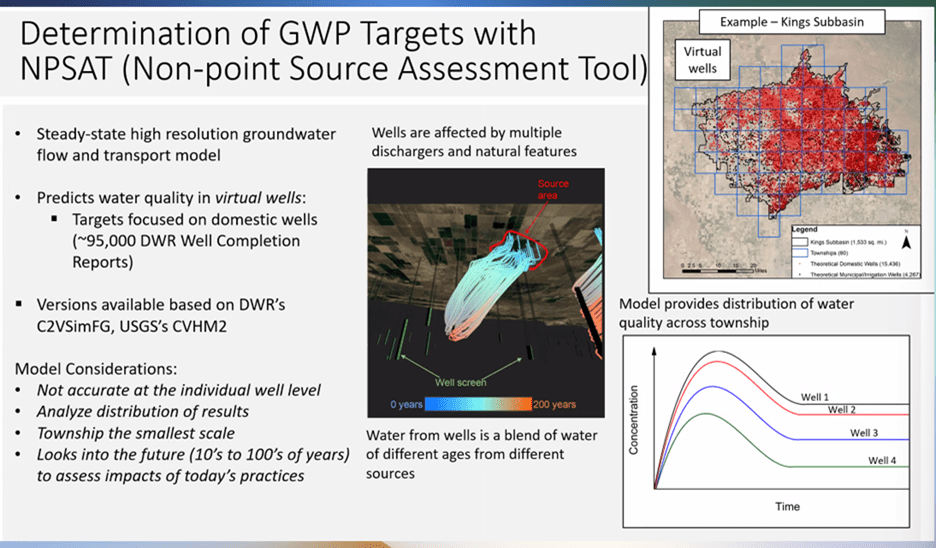
Coalitions in the Central Valley region use grower-reported data and the CV-SWAT (Soil and Water Assessment Tool) model to estimate current N loading from the root zone of each field. These N loading estimates are fed into another model, the Central Valley Nonpoint Source Assessment Tool (CV-NPSAT) to develop target N loading rates that will maintain discharges at or below the Maximum Contaminant Level (MCL) for nitrate of 10 mg nitrate-N/L. Warren presented a slide indicating that many townships in the region are meeting the 30-60 lbs N/acre load target.
Warren summarized by stating this procedure works for the Central Valley region and that many growers are focused on reducing their A/R ratio, which reflects improved nutrient use efficiency. Warren said that the region has “demonstrated success addressing water quality issues without use of enforceable limits” and stated that N application limits would be “premature.”
Coalition Perspective on Setting Targets
Ken Miller of Formation Environmental and Tess Dunham with Kahn, Soares, and Conway presented information on key performance metrics in the Central Valley Irrigated Lands Program from the coalition perspective.
Miller reiterated a number of the points mentioned by Warren including the precedential requirement to develop a GWP formula, values, and targets. The GWP formula uses grower-reported INMP data fed into the CV-SWAT model to generate township-level leaching estimates. Two categories of “ILRP performance metrics” are generated in the Central Valley: crop-specific A/R acceptable ranges, with the lower end based on scientific literature and the upper end determined by multi-year percentiles of grower-reported values; and GWP values and targets set at the township level. The current discharge levels or “values” are tracked against the targets over time to assess progress in reducing discharges.

Noting that the Central Valley region is “enormous and heterogeneous,” Miller explained that modeling is a good tool for analyzing INMP data because it isn’t feasible to measure nitrate leaching from the 6 million + acres in the region nor to monitor groundwater under every field. Also, the model can account for other factors that impact water quality such as discharges from non-ag sources. Miller stated that while the A-R value can be a risk indicator, it is not necessarily an accurate measure of N leaching. As some panelists have observed, Miller said that A-R is a simplification of a full accounting of N dynamics. He then presented a detailed explanation of CV-SWAT, a model that considers both water and N cycles. He noted that the region had worked closely with Dr. Tim Hartz of UC Davis to calibrate the crop models.
Miller shared a slide that visualized how the GWP calculation is done for each parcel in a township and examples of GWP value summary tables. He went through how the GWP values are run through another model, the NPSAT, to determine GWP targets. Miller noted that NPSAT results are accurate at the township level but not at the individual well level. NPSAT can predict future water quality under various loading scenarios and can determine if current GWP values meet water quality objectives. If not, it can simulate alternative scenarios to determine the amount of load reduction needed to meet water quality goals. If the values already meet GWP targets, no change is needed.
Tess Dunham next presented how GWP targets have been integrated into the Central Valley region’s ILRP order. She shared a map showing priority areas for the nitrate control program based on nitrate concentrations in groundwater, noting that most of the San Joaquin Valley is in a priority area. Dunham presented data on interim solutions being implemented in priority areas 1 and 2, including delivery of free bottled water to 2,189 households and establishment of seven water fill stations with more being developed. She presented a slide showing a timeline for meeting nitrate reduction milestones, with 100% of growers achieving acceptable A/R ratios for each crop in 20 years, and 100% of growers reaching groundwater protection targets in 35 years.

Dunham described how coalitions in the Central Valley educate growers who are not within the crop-specific acceptable A/R range or not meeting GWP targets by sending them written materials, calling and talking with them, and conducting one-on-one trainings.
Discussion of Panel Charge Questions
Areas of tension and agreement began to emerge as the meeting moved into panelist discussion of charge questions, particularly questions 1 and 2 having to do with setting N-related limits. Panelists Hannah Waterhouse and Richard Smith were assigned to draft responses to these questions. (Draft responses to questions are posted on the expert panel’s Table of Documents. Click here and then enter Username: agpaneldocs-ftp and Password: AgriculturalExpertPanel2! to access.)
Question 1 (summarized: see charge questions for full text)
Is there enough data and scientific research to set crop-specific nitrogen-related limits (e.g., A/R, A-R, or other limits) that are protective of groundwater quality?
Question 2 (summarized: see charge questions for full text)
Based on the data and scientific research that is currently available, what series of increasingly protective interim nitrogen-related limits can be set now?
Lingering Questions on Setting Targets Versus Limits
Waterhouse stated that the panel seems to have consensus on ratcheting down targets. Ngodoo Atume noted that the language in the draft responses seems to be moving away from setting N application limits and asked for clarification on setting discharge targets and limits versus setting application targets and limits. While Waterhouse agreed that there are application levels that are excessive, Smith pushed back on setting application limits because of the many factors growers must consider in determining N application rates. Smith also noted that the draft response to questions 1 and 2 acknowledges that “growers in the highest 80th or 90th percentile of A-R may be subject to initial limits.” Michael Cahn agreed that the panel can set enforceable limits that are phased in over time by setting targets. Moderator Sam Magill pointed out that it’s ultimately up to the State Water Board to determine if targets or limits will be set.
Additional differences in opinion arose when the panel discussed whether limits or targets should be set on a crop-specific or field-specific basis. Daniel Geisseler argued that they should be set on a per crop by region basis so that growers could compare their A-R or A/R values with others growing the same crop. Thomas Harter stated that from a hydrological perspective, it’s the land area that’s relevant, not the specific crop. Cahn stated that targets or limits should be set on a cropping system basis because it would be difficult to develop crop-specific values for intensive vegetable production. Smith observed that “this discussion is showing the difference between the different regions. Region 5 [Central Valley] is crop-based and Region 3 [Central Coast] is land-based. We want to indicate that there should be flexibility for each region.”
Possible Incentives
The conversation also touched on providing incentives to growers who meet or exceed N discharge targets. Geisseler presented an idea that the ILRP fee structure incentivize growers to maintain A-R values within the target range by reducing fees for those who meet the target.
Identifying Outliers
Geisseler also reiterated his concern about the Central Valley’s approach to identifying outliers, which only looks at land on which the same crop has been grown for 3 years by the same grower and excludes land that has had crop rotation or has been managed by a different grower over the 3-year time frame. “Every field needs to have a chance to be included,” said Geisseler.
Question 3 (summarized: see charge questions for full text)
Are there any scientific or technical considerations or advances related to the factors discussed in the First Agricultural Expert Panel’s 2014 Report that the State Water Board should take into account in future policy decisions?
Atume and Ruth Dahlquist-Willard requested input on their response to question 3. Geisseler, who chairs the panel, shared a slide clarifying that the “factors discussed in the First Agricultural Expert Panel’s 2014 Report” were found in Appendix C of that report and include additional elements of N mass balance audits including N transformation rates and volatilization. Panelists mused about the need for additional crop coefficients, better understanding of denitrification and volatilization, N carryover between crops, credits, and incentives.
Question 4 (summarized: see charge questions for full text)
Is A-R a scientifically appropriate metric to evaluate and quantify nitrogen discharges to groundwater (either on its own or used in conjunction with A/R)?
Geisseler and Cahn were assigned to draft the response to question 4. Geisseler commented that much of question 4 had been addressed in the answer to question 1 and that the answer is “yes,” though modeling could supplement A-R. Harter stated that he wouldn’t claim A-R is the answer and that more general language such as “Any method that approximates discharge to groundwater” should be used, pointing out that the output from the CV-SWAT model “could be reconstructed as A-R.” Smith reiterated that A-R is a model to estimate how much N loading is occurring and that its precision could be improved by including discount factors for high carbon inputs, which the Central Coast region did in its Ag Order 4.0. Cahn agreed with Smith and noted that A-R is not “directly scientific but more of a guideline for growers to understand how they are managing their nitrogen.”
Public comment
The meeting ended with a brief round of public comment. Comments centered on
- The need for the Central Valley region to publicly release acreage data
- The need to set interim N application limits on the largest polluters and to set final limits for all producers
- Focusing regulations on outliers means that most growers won’t need to make any changes in their fertilization practices, thus it may be worthwhile to focus on specific crops and regions that have the largest N discharge problems.
Working Group Meeting 4, November 19, 2025
The November 19 meeting was devoted to panelist discussion of draft responses to charge questions 3, 4, and 5 accompanied by public comment. Much of the conversation revolved around wordsmithing and concepts discussed previously. Highlights of the discussion included:
- General consensus that if a grower has obstacles to calculating nitrogen removed (R) due to lack of a coefficient for that crop or difficulty estimating yield, it would be sufficient for them to report nitrogen applied (A)
- Ali Montazar stated that limits should not be put in place until after implementing targets over a period of at least 3 years.
- Dahlquist-Willard reiterated the approach taken in the Central Coast region for developing a reference crop coefficient for mixed flower production and suggested similar reference coefficients be developed for other crop mixtures including diverse vegetable production.
- Montazar advocated that soil type also be reported by growers because of its importance in nutrient management.
- Sarah Lopez of the Central Coast region’s third party, Preservation, Inc., provided information on their extensive attempts to calibrate the SWAT model for the region and ultimately not succeeding because SWAT relies on subsets of data including root zone libraries and subsurface hydrogeologic models that aren’t available in the Central Coast region.
The Panel’s Process
As a refresher on the process, California’s Bagley-Keene Open Meeting Act requires that the expert panel conduct all of its deliberations in public sessions–except that groups of two may meet to coordinate responses without being subject to Bagley-Keene. As noted in our article on the panel’s October 22 Working Group Meeting, because Bagley-Keene prohibits “serial meetings” of more than two panelists, the two-person teams must work together on all their assigned questions and cannot be “mixed and matched.”
Background on the Second Statewide Agricultural Expert Panel
The expert panel was convened by the State Water Board to provide technical expertise to the water board on the Irrigated Lands Regulatory Program (ILRP). ILRP is the state’s legal framework to regulate pollutant discharges from irrigated agriculture. The expert panel specifically is tasked with formulating answers to nine charge questions regarding the scientific basis for establishing nitrogen (N) discharge and/or application targets or limits and what data reporting and metrics are best to assess farmer nutrient management efficiency.

