

Excess sediment in the South Delta puts the water supply and the ecosystem at risk
by Robin Meadows
In 1962, when Mary Hildebrand was 10 years old, her family moved to their farm between the communities of Vernalis and Mossdale in the southern tip of California’s Sacramento-San Joaquin Delta. The 140-acre farm sits on the banks of the San Joaquin River, which squiggles north through the flat expanse of the South Delta toward its confluence with the Sacramento River.
Together, these two mighty rivers funnel much of the state’s rainfall and snowmelt into the Delta that bears their names. The Delta ecosystem—including salmon and other imperiled species—as well as two-thirds of Californians and millions of acres of farmland depend on this increasingly contentious flow of freshwater.
But to Hildebrand, the South Delta was simply a magical place to grow up. Before living on their farm full-time, her family went there as often as they could. “I always felt it was where I belonged,” Hildebrand says, adding that her most vivid early memories are of the landscape she holds dear.
“It was wild and wonderful,” says Hildebrand, who still lives in her family home. She and her sister spent summers swimming and sailing in the slough that connected to the San Joaquin River mainstem, and often spied weasels, muskrats, meadowlarks and other wildlife.

Today Hildebrand rarely sees wildlife apart from the raccoons and coyotes that thrive even in heavily degraded ecosystems. Invasive plants like water hyacinth and Egeria densa infest nearby sloughs and channels. Her farm, which she worked with her mom and dad and now leases to a neighbor, is also at risk.
In wet years, Hildebrand worries that the water bordering her land will rise and inundate the fields. In dry years, she worries that the water will drop below the pumps that irrigate the rows of sweet corn and lima beans.
In both types of water extremes, the culprit is the same: build up of sediment that chokes South Delta channels. Silt and sandbars diminish channel capacity, causing floods and blocking water from reaching irrigation pumps.
Hildebrand’s farm includes a 40-acre island that can no longer be cultivated because so much silt has built up around the pump intake. Likewise, the slough where she and her sister swam and sailed is so full of silt that it only connects with the river when flows are quite high.

“We’ve been trying to solve this problem for a long time,” says Hildebrand, who like her father before her serves on the South Delta Water Agency, which is charged with protecting the quality and quantity of the region’s water supply. “It’s gotten so bad, it’s reached a really critical point.”
Now Hildebrand sees hope for a solution to excess sediment in the South Delta. State, federal and local agencies recently established a workgroup to explore creating a dredging program for the South Delta’s clogged channels. Hildebrand is part of a surprising new coalition called the Great Valley Farm Water Partnership that aims to nudge the South Delta dredging program along.
The Great Valley Farm Water Partnership brings together growers from the Delta and the San Joaquin Valley, which have historically clashed over water, to find common ground. The Partnership identified seven joint problems, including modernizing levees in the Delta and boosting water exports from the Delta during wet years, and prioritized tackling the build up of South Delta sediment.
“It’s a problem for everyone—farmers, the ecology, and water exporters,” says Randy Fiorini, a tree fruit and wine grape farmer in Turlock who founded the Great Valley Farm Water Partnership in 2023.
SEDIMENT WOES

Besides flooding fields and impeding irrigation, excess sediment devastates the environment. Over time, silted channel bottoms become so shallow that the water is warm and still, favoring bright green algae blooms as well as invasive plants that blanket the surface. Warm, stagnant water also holds less of the dissolved oxygen that fish and other aquatic creatures need. Temperatures can be so high in South Delta channels that the water “feels like a bathtub,” Hildebrand says.
Sediment also obstructs the tides that would otherwise circulate freshwater through the region’s channels. Without this tidal flushing, the water gets too salty for people to drink or grow crops. “When I was young and the channel that connects through to the main San Joaquin River was open, we had tidal flushing twice a day,” Hildebrand says. “We don’t anymore.”
Local farmers like Hildebrand currently bear the brunt of dwindling water diversions driven by too much sediment in the South Delta. “It’s not a sexy issue and impacts are limited to a few,” says Fiorini.

But eventually, South Delta sediment build up could also curtail the water supply for San Joaquin Valley farmers. South Delta diverters have such senior water rights that if they can’t pump enough, the Central Valley Project and State Water Project—which export water from the Delta primarily to the San Joaquin Valley and Southern California—can be required to reduce pumping.
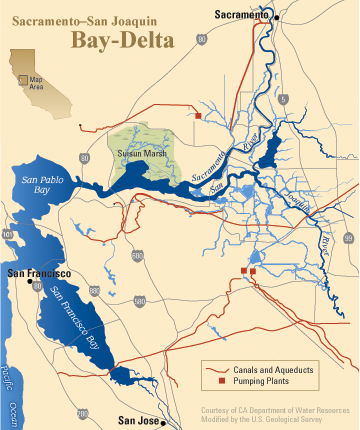
The root of excess sediment in the South Delta lies in the unconventional configuration of the delta formed by the Sacramento and San Joaquin rivers, which carry silt and gravel from the Sierra Nevada. Most river deltas fan out as they reach the sea, forming broad mouths that distribute sediment across a large area. The Sacramento-San Joaquin Delta is one of the few worldwide that does the opposite: it’s widest inland and narrows to a single waterway—the Carquinez Strait—that carries water to the San Francisco Bay and then the Pacific Ocean.
“It’s a perfect settling basin,” says Delta Watermaster Jay Ziegler.
Another factor in South Delta sediment build up is the towering rim dams on the Sacramento and San Joaquin river systems. Dam operators prioritize flood control during the rainy season, which means releasing enormous flows ahead of big storms to free up reservoir capacity.
“In big wet years, lots of sediment is pushed down the system. Then all that flow smashes into the tidal inflow at the confluence, loses energy, and the sediment settles out,” Ziegler says. “It’s a nature-caused problem exacerbated by human needs.”
This overabundance of sediment fills in South Delta channels, leaving some reaches eight feet shallower than they were in the 1960s. The silt is so high in some South Delta waterways that, at very low tides, “you could imagine walking across them,” Ziegler says. Excess sediment also forms gigantic sandbars as long as two football fields. These massive mounds then become magnets for the sediment that keeps washing down from the mountains, and the sandbars keep piling ever higher.
South Delta channels were historically cleared of excess sediment to accommodate boat traffic but have not been dredged regularly for decades. Reasons include that no one is accountable for maintaining channels in the region, and no one really wants to pay for it. Dredging the massive amounts of sediment that have built up in the South Delta over decades would likely cost billions of dollars.
But, says Ziegler, “It’s a simple hydrological reality that everyone needs to confront—the sediment needs to be managed or we will lose the system.”
COOPERATION PROBLEM
Game theorists call the dilemma posed by South Delta sediment a cooperation problem. The Delta is rife with such predicaments where no single party has the responsibility or the resources for a remedy. When asked for other examples of cooperation problems in the region, Lubell says, “Pretty much all of it: Wetlands restoration, overfishing, invasive species, climate change adaptation—all of them require cooperation among multiple actors to define and achieve policy goals.”

“There’s no one ring to rule them all, no one has the power to fix them on their own,” says Mark Lubell, a University of California, Davis professor who studies the role of cooperative governance in advancing environmental policy.
Cooperation problems are tricky because the potential for gaming the system is high. Waiting for others to act lets shirkers enjoy the benefits without paying for them. This can result in paralysis.
“There’s a misalignment between the welfare of the group and of individuals, who have an incentive to look out for themselves,” Lubell says. “If everybody says we’re going to free ride, then nothing gets done.”
A first step in solving a cooperation problem is inviting all parties to help. “It needs to be inclusive, everybody needs to be represented in the room,” Lubell says, adding that finding solutions also requires leadership, trust, and identifying common ground. “It takes time to get all the pieces together—everybody wants it to be fair.”
Headway has been made on a number of other cooperation problems in the Bay-Delta. A regional plan for managing sediment in the San Francisco Bay aims to repurpose dredge material from shipping channels to restore wetlands along the shore. An effort called Bay Adapt, which Lubell advises on, is working to coordinate preparation for rising seas in the San Francisco Bay Area.
FLEDGLING DREDGING PROGRAM
Likewise, the beginnings of a fix for South Delta sediment, called the South Delta Channel Depth Restoration Program, is underway. The program’s working group includes, among others, the U.S. Bureau of Reclamation, which operates the federal Central Valley Project; the California Department of Water Resources, which operates the State Water Project; the South Delta Water Agency that Hildebrand serves on; and Delta Watermaster Ziegler.
The group has a plan. They want to start with dredging 75 miles of South Delta channels that are critical to water exports. These channels, which convey flows from the San Joaquin and Sacramento river systems to the state and federal water projects, include parts of Old and Middle rivers.

Now the group has to find a way to pay for it. The cost of dredging the initial 75 miles of channels is estimated at between $500 million and one billion dollars, which averages to just over $10 million for each mile of channel. The average amount of sediment to be removed per mile is estimated at 100,000 cubic yards, enough to fill 30 Olympic size swimming pools. While the group negotiates who will contribute how much to implement a formal dredging program, they are asking the state for about $100 million to clear the first 10 miles.
FARMER COALITION
The Great Valley Farm Water Partnership (GVFWP) hopes to build on the momentum toward a South Delta dredging program by presenting a united front of Delta and San Joaquin Valley growers.
“These two groups have historically not been in agreement—but now they are,” says GVFWP founder Fiorini, who made it his mission to bring them together after his 11 years as Chair and Vice Chair of the Delta Stewardship Council beginning in 2010. Fiorini grew up in the San Joaquin Valley farming peaches, and met pear and tomato growers in the Delta in the late 1970s. “I realized how similar the issues we face are,” he says.
Fiorini credits cooperative governance expert Lubell with helping him come to this realization. “He taught me that one of the biggest impediments to policy is the perception of the other side—but there is no other side, we’re all on the same side.”

The coalition of Delta and San Joaquin Valley growers that Fiorini brought together in the GVFWP is unusual in the California water world, which is infamously litigious. “Our coalition is peaceful but it doesn’t make it faster,” Fiorini says. But the coalition could make achieving common goals more likely.
GVFWP facilitator Amy Wolfe explains the coalition’s potential for effectiveness this way: “So much of how sausage gets made is relationships and political capital, and our delegates lean into that.” For example, instead of doing battle or just advocating for their own interests, GVFWP delegates from the Delta and the San Joaquin Valley pay decision-makers joint visits to make the case for dredging the South Delta.
“Our philosophy is if it helps you and it doesn’t harm me, I’m for it,” Fiorini says. “You can’t fix everything—but this way you can fix the things you can.”
South Delta farmer and GVFWP delegate Hildebrand says the coalition also hopes to find allies for South Delta dredging within the environmental community. “I don’t believe the Delta can heal itself without our help—in this case, less is not more,” she says, adding that the Delta is so altered and engineered that letting nature take its course can be disastrous.
“I would love to see a healthy environment while we continue to provide food for people,” Hildebrand continues. “That was the case here for a very long time, back when the Delta was being routinely dredged.”

