
Several news sources featured in the Daily Digest may limit the number of articles you can access without a subscription. However, gift articles and open-access links are provided when available. For more open access California water news articles, explore the main page at MavensNotebook.com.
On the calendar today …
- MEETING: State Water Resources Control Board beginning at 9am. Agenda items include Current Hydrologic Conditions and Response, Consideration of a proposed Resolution adopting a regulation to adjust Water Right Civil Penalties in Water Code Sections 1052, 1845, 1846, 1846.5, 1847, and 5107 for inflation under AB 460; and Consideration of a proposed Resolution to return the Kaweah Groundwater Subbasin to the jurisdiction of the Department of Water Resources. Click here for the full agenda.
- MEETING: Department of Food and Ag from 10am to 12:30pm. Agenda items include a panel discussion on food assistance and a board & committee discussion and update. Click here for the full agenda and remote access instructions.
In California water news today …
Winter storms blanket the East, while the U.S. West is wondering: Where’s the snow?

“Ski season is here, but while the eastern half of the U.S. digs out from winter storms, the western U.S. snow season has been off to a very slow start. The snowpack was far below normal across most of the West on Dec. 1, 2025. Denver didn’t see its first measurable snowfall until Nov. 29 – more than a month past normal, and its latest first-snow date on record. But a late start isn’t necessarily reason to worry about the snow season ahead. Adrienne Marshall, a hydrologist in Colorado who studies how snowfall is changing in the West, explains what forecasters are watching and how rising temperatures are affecting the future of the West’s beloved snow. … ” Read more from The Conversation.
DWR Announces initial State Water Project allocation of 10% for 2026
“Today, the Department of Water Resources (DWR) announced an initial State Water Project (SWP) allocation of 10 percent of requested supplies for the new water year. This allocation represents the first water supply forecast of the season for the 29 public water agencies served by the SWP which provides water to 27 million Californians and 750,000 acres of farmland. The SWP is contractually required to make an initial allocation forecast by December 1 each year. Since it is so early in the season, the initial allocation typically reflects current hydrological conditions, existing reservoir storage, and an assumption of dry conditions through the rest of the year. So far, the wet season is off to a good start with beneficial rain falling in Northern California and Southern California already seeing significant rainfall following a dry year last year. “Recent history has shown us that anything can happen during a California winter, so it’s important that our early season allocation for the State Water Project is conservative,” said DWR Director Karla Nemeth. “Traditionally our wettest months are yet to come. With improvements to forecasting and science, we are better prepared to capture water supply during wet periods if Mother Nature delivers.” … ” Read more from the Department of Water Resources.
SEE ALSO:
- Metropolitan Issues Statement on State’s Initial State Water Project Allocation, press release from MWD
- California announces 10% water supply to start the new water year, from the Sacramento Bee
Anglers catch salmon for science as tracking reveals risks facing adult fall chinook

“Many thousands of fall-run Chinook salmon migrated beneath the Golden Gate Bridge into the upper Sacramento River to spawn this fall. About 100 of the adult fish carried small tags that signaled their location as they went. A monitoring network tracked the fish, showing their progress online in real time as part of a joint project by scientists at NOAA Fisheries and UC Santa Cruz. They followed adult salmon through the Sacramento-San Joaquin River Delta into Central Valley Rivers and their tributaries. The scientists want to know what affects salmon survival and how many fish reach their spawning grounds. “Are the salmon burning too much energy, and what factors affect this?” asked Miles Daniels, who leads the project for NOAA Fisheries’ Southwest Fisheries Science Center. The center operates a research laboratory adjacent to UC Santa Cruz, focusing on salmon. Adult salmon need cold water; they may stop if they hit water that is too warm. Since they do not eat on the way back upriver, delays could deplete the energy they need to complete their migration and spawn. … ” Read more from NOAA Fisheries.
New UC Davis research center will help central valley provide food sustainably
“UC Davis researchers have made important findings about farming in recent years, providing insight into how to grow almonds with less groundwater and fewer pesticides, among other discoveries. Now, agricultural research is about to get supercharged at the school, thanks to a $50 million donation from the co-owners of one of the biggest names in almonds, The Wonderful Company. The gift, the largest ever from individual donors to UC Davis, will go toward construction of the Lynda and Stewart Resnick Center for Agricultural Innovation and fund annual competitive research grants. The center’s research will address “today’s most pressing challenges in agriculture and environmental sustainability,” the university says, and focus on agricultural byproducts, water and energy efficiency, technology development, crop resiliency and sustainability, and access to nutritious food. … ” Read more from Comstock’s.
Are new PFAS pesticides coming to California? Here’s what to know
“The U.S. Environmental Project Agency recently approved the use of pesticide products that some experts say contain harmful “forever chemicals.” The agency approved cyclobutrifluram for use on romaine lettuce, cotton and soybeans, as well as turf and ornamental plants. Isocycloseram was approved for a wide range of agricultural crops, including brassica vegetables like cabbage, broccoli and Brussels sprouts. The two chemicals are currently undergoing review by California state officials. The pesticides won’t be sprayed on California crops until the review process is complete and the chemicals are approved, which could take months, even years. But scientists and advocates are raising concerns that the chemicals could have harmful environmental and health consequences, adding to a bevy of per- and polyfluoroalkyl substances, or PFAS pesticides, already routinely used by growers in California. … ” Read more from the San Francisco Chronicle. | Read via Yahoo News.
California’s environmental board approved hazardous waste plan that critics say could weaken protections
“A California environmental oversight board approved a state plan outlining strategies to safely reduce hazardous waste — despite sharp criticism from environmental groups who say several aspects of the plan could invite deregulation. A 2021 state law directed the California Department of Toxic Substances Control (DTSC) to publish a plan every three years, outlining the state’s approach to minimize the generation, disposal and incineration of hazardous waste. In March, the state agency released a draft of the first-ever hazardous waste management plan, drawing opposition for a controversial recommendation to consider allowing more contaminated soil to be dumped at nonhazardous landfills. Eight months later, after four public meetings, a revised plan was discussed during a hearing in mid-November at the CalEPA headquarters in Sacramento. Many environmentalists remained wary, noting the plan still recommends reviewing federal exemptions for hazardous materials that can be recycled and a broader reassessment of California’s standards. Their fear is that this could lead the state to roll back its protocols — widely considered among the most strict in the country. … ” Read more from the LA Times. | Read via AOL News.
In commentary today …
Response to Jay Lund’s “Nine California Water Rites”
Deirdre Des Jardins, California Water Research, writes, “Jay Lund published a clever satire of California water rhetoric today, and he’s right that policy-based evidence-making occurs in our water debates. I worked with Jay and other Delta Independent Science Board members in 2021 to save the Delta Independent Science Board from defunding, and I value his truthtelling. But Jay’s framing misses something critical happening at the Department of Water Resources. There’s a difference between rhetoric and documenting actual methodological failures in climate risk assessment. … ” Continue reading at California Water Research.
More collaborative operational solutions for affordable water
Adan Ortega, Executive Director of CalMutuals, writes, “California is unique in that our state policy recognizes the human right to water – a principle that every resident deserves safe, clean, affordable and accessible water. Yet affordability, the ability for families to pay their utility bills without sacrificing other basic needs like rent, food or medicine is increasingly strained. Increasing costs for infrastructure development, regulatory and environmental compliance and climate resilience have made essential services such as water, energy and wastewater more expensive than ever. In many communities, utility rates are increasing faster than inflation, leaving even middle-class California families struggling to keep up. These rising operational costs inevitably trickle down to ratepayers, which disproportionately impacts those least able to pay. From small, rural regions to low-income urban communities, those with the fewest resources are supported by some of the smallest water systems with limited resources. … ” Read more from Capitol Weekly.
In regional water news and commentary today …
NORTH COAST
Klamath Tribes challenge orders based on secret agreement between irrigator group and state
“On November 19, 2025, the Klamath Tribes filed a motion to amend their petition in the Circuit Court of Klamath County. The amended petition seeks to reverse recent illegal orders that replaced a long-time administrative law judge in the Klamath Basin Adjudication (KBA) on the heels of a secret deal cut between the Oregon State Office of Administrative Hearings and certain water users in the Upper Klamath Basin. In August 2025, Chief Administrative Law Judge Jeffrey Rhoades removed long-time presiding Administrative Law Judge Joe Allen from continuing to handle the KBA cases. The removal disregarded two administrative decisions in the past year (in November 2024 and March 2025) that had specifically rejected challenges to Judge Allen from a water users group called the Upper Basin Irrigators and concluded that Judge Allen should continue to preside over the KBA cases. … ” Read more from the Native American Rights Fund.
MOUNTAIN COUNTIES
No snow in sight: Tahoe faces another 10-day dry spell
“Tahoe’s early-season snow outlook is off to a disappointing start, with no measurable snowfall in the past 10 days — and no relief expected for at least another 10. As of Monday morning, nearly every forecast model shows dry weather through at least Friday, Dec. 12. Still, ski areas are making the most of what they can. “The good news is that temperatures dropped just enough overnight that it is near to below freezing from top to bottom for most mountains,” said OpenSnow forecaster Bryan Allegretto. “Looking around the lake at ski area cams, it looks like they are blasting away, trying to make as much snow as possible.” …, ” Read more from the Tahoe Daily Tribune.
SACRAMENTO VALLEY
Before-and-after images from space: Tule fog smothers a huge swath of California
“California’s Central Valley has been enshrouded in mist for more than a week thanks to the area’s infamous tule fog. The image below shows California as seen from space by a National Aeronautic and Space Administration satellite system. On the left is what the state looked like on Oct. 29, 2025 — before a major storm brought record-setting rainfall — and on the right is the same view on Nov. 27, in the middle of the days-long stretch of tule fog. Technically known as radiation fog, the weather phenomenon is the result of a combination of “a cool, moist layer of air from the Pacific close to the surface, clear skies above and light winds,” according to the National Weather Service. Most persistent in valleys where the wind can’t sweep it away, the tule fog has been a main character in California for decades. It causes pileups, traps airborne pollutants and has even inspired poetry about its haunting beauty. … ” Read more from the LA Times. | Read via Yahoo News.
FEMA releases preliminary flood maps for Butte County
“The Federal Emergency Management Agency (FEMA) has unveiled preliminary flood maps for Butte County and the City of Chico, highlighting revised flood hazards along various sources in the region. These maps aim to assist building officials, contractors and homeowners in making informed mitigation decisions, fostering safer and more disaster-resilient communities. Before the new Flood Insurance Rate Maps (FIRMs) take effect, a 90-day appeal period will run from Dec. 3, 2025, to March 3, 2026. During this time, residents or businesses with technical and scientific data, such as detailed hydraulic or hydrologic information, can challenge the flood risk details on the preliminary maps. … ” Read more from KRCR.
Water Forum receives $333,000 state grant to plan new salmon habitat on the American River
“The Water Forum has received a $333,000 grant from the Wildlife Conservation Board (WCB) to plan the next generation of rearing habitat improvements for young salmon and steelhead on the lower American River. The funding will help the Water Forum, in partnership with the Bureau of Reclamation and Sacramento County Regional Parks, identify and design up to 10 new habitat sites—covering roughly 30 acres—within the American River Parkway. These future projects will focus on creating side channels and seasonally inundated shaded areas where juvenile salmonids can rest, feed, and grow before migrating to the ocean. These sites are essential for helping Chinook salmon and Central Valley steelheadsurvive increasingly challenging river conditions. … ” Read more from the Water Forum.
NAPA/SONOMA
A queer climate movement takes root along the Russian River
“There’s a certain kind of queer magic that thrives along the Russian River. For more than a century, queer people have sought refuge in rural Sonoma County, leaving the stress of city life for the peace — and parties — of the sprawling river valley and redwood forests. Artists, hippies, nude sun bathers, cruisers and even disco legends like Sylvester have all flocked there over the decades. Now, two groups, Shelterwood Collective and Solar Punk Farms, are actively calling queer people back to the land, and not only to party. They’re creating a different type of magic: Shelterwood is restoring acres of forest through Indigenous practices like controlled burns, and Solar Punk advocates for environmental policy and farms the land — all while making space for queer community-building, joy and self-expression. … ” Read more from KQED.
BAY AREA
How fog built the Bay Area
“Fog is a quintessential part of the Bay Area, a seemingly simple suspension of water in air that has shaped our culture and ecology since time immemorial. For us, it is the ghostly embodiment of cold weather — and maybe our only chance at a white Christmas. At its core, it only needs two ingredients – cool temperatures and humid air — and it forms when moisture condenses to form a cloud close to the surface of the Earth. But beyond that, its formation is still not fully understood, shaped by a variety of forces around the globe. Which might be why it is not only the stuff of song and poetry, but also of serious scientific research. “I think one of the reasons why fog is so cool to look at and study – beyond its absolute stunning beauty – is that it’s just so multi-dimensional,” says Alicia Torregrosa, a physical scientist who led years of research on how fog develops in the Bay Area. “Our coastline is perfectly situated to be a barrier or a gate to this floating water.” … ” Read more from the San Jose Mercury News.
The king tide is coming — here’s what you can do about it
“The National Weather Service warned today that king tides are coming to Bay Area beaches this week. King tides are exceptionally large and cause the sea to rise more than usual. It’s a predictable phenomenon that takes place when gravitational conditions between the earth and the moon are just right. But even though they are expected, they can still bring more dangerous conditions to coastal areas. Waves during a king tide can get up to 10-to-14 feet. Beachgoers should be cautious of strong rip currents and sneaker waves. Surrounding areas are also at risk of flooding. These tides can push water levels up almost a foot and a half above ground in some low-lying areas. … ” Read more from KALW.
Quality of groundwater used for domestic supply in the Gilroy-Hollister basin and surrounding areas, California, 2022
“More than 2 million Californians rely on groundwater from domestic wells for drinking-water supply. This report summarizes a 2022 California Groundwater Ambient Monitoring and Assessment Priority Basin Project (GAMA-PBP) water-quality survey of 33 domestic and small-system drinking-water supply wells in the Gilroy-Hollister Valley groundwater basin and the surrounding areas, where more than 20,000 residents are estimated to utilize privately owned domestic wells. The study area includes the Llagas subbasin in the north, the North San Benito subbasin in the south, and the surrounding uplands. The study was focused on groundwater resources used for domestic drinking-water supply, which are mostly drawn from shallower parts of aquifer systems rather than those of groundwater resources used for public drinking-water supply in the same area. This assessment characterized the quality of ambient groundwater in the aquifer before filtration or treatment, rather than the quality of drinking water delivered to the tap. … ” Read more from the USGS.
CENTRAL COAST
California American Water prepares for Aquifer Storage and Recovery Program
“California American Water has prepared critical infrastructure to help ensure optimal success of the Aquifer Storage and Recovery (ASR) program in its Monterey Peninsula water system. During winter storms, California American Water, along with Monterey Peninsula Water Management District, captures and treats excess rainfall from the Carmel River and stores the water for future use during dry months. “Proactively enhancing ASR well infrastructure prepares us for the winter season,” said Oliver Bell, Project Engineer, California American Water. “Without proper planning, we could potentially lose essential winter rainfall.” An important early step in ASR preparation is the sterilization and inspection of seasonal wells to maximize ASR production. This effort often includes the installation of new or rehabilitated equipment including column pipe, pump, pump shaft and motors. Equipment rehabilitation is followed by disinfection of the well along with the installation of any submersible components within the well, all of which helps to ensure optimal operation and water quality assurance. … ” Read more from PR Newswire.
With no water tax, Paso Basin managers look elsewhere for funding. Here’s where
“The Paso Robles Area Groundwater Authority needs help funding its operating costs next year. On Monday, the agency’s Board of Directors approved a budget of $944,952 for fiscal year 2025-26 — with a $300,000 shortfall for costs planned for January to June of next year. The agency’s Board of Directors was forced to abandon water use fees after a majority of property owners objected to them this year. Now, the agency is looking for other ways to cover its operating costs, from paying consultants to preparing the state-mandated annual report. … On Monday, the board voted unanimously to ask the four participating Groundwater Sustainability Agencies to contribute a combined total of $300,000 to bridge the funding gap. … ” Read more from the San Luis Obispo Tribune.
King Tides about to slam Santa Barbara Coast
“Water pounded Santa Barbara’s coastline on November 6 for the first king tides of the year — flooding beaches and parking lots and jumping the walls of usually dry lookouts at places like Butterfly Beach and Campus Point. This weekend marks round two of these extraordinarily high tides, which occur when the sun, moon, and Earth align, pulling the surf to extreme highs and lows. They are typically at least one foot above the average high tide, according to the California Coastal Commission. Santa Barbara is expected to see tides up to 7.23 feet high each morning from Thursday, December 4, through Saturday, December 7. The royally high tides will inundate beaches from Goleta to Ventura and have the potential to damage property and other infrastructure. It’s a glimpse of the future, says the commission and Santa Barbara environmental groups. Scientists project ocean levels in California will rise as much as 1.2 feet by 2050 and up to 6.6 feet by the end of the century due to the planet’s warming climate. … ” Read more from the Santa Barbara Independent.
SAN JOAQUIN VALLEY
EASTERN SIERRA
Death Valley just had its rainiest November in 115 years
“The driest place on Earth just had its wettest November on record. Furnace Creek in Death Valley picked up just over 1 ¾ inches of rain last month, the most on record in the station’s 115-year history and nearly the amount of rain that the desert typically sees in an entire year. That record was part of a much larger wet November trend across Southern California. Downtown Los Angeles collected 5.5 inches, its fourth-wettest tally on record and its biggest since 1967. Santa Barbara Airport was soaked with 10.6 inches, an all-time high, while Paso Robles logged its fourth-wettest November. … ” Read more from the San Francisco Chronicle.
SOUTHERN CALIFORNIA
Life of the L.A. River
“When the expedition of the Spaniard Don Gaspar de Portolá stumbled through Southern California in 1769, it found what Tongva Indians had discovered long before: “a very spacious valley, well grown with cottonwoods and alders, among which ran a beautiful river.” Bivouacked where downtown would rise a century later, the explorers called the waterway “the Porciúncula.” Without the Los Angeles River, there would be no Los Angeles. But those who lived near its banks inevitably learned the same lesson: Paradise was a floodplain. Shallow and unassuming most of the year, the Los Angeles could transform into a feral beast during the rainy season. In the winter of 1884—the city’s wettest on record—three straight weeks of rain tore out bridges, sending homes, people, and livestock into the turbid current. By 1938, after several other floods, the U.S. Army Corps of Engineers began plans to dig out and pave the waterway, transforming most of its 51 miles into what many regard as a massive drainage ditch. But it’s our massive drainage ditch, and through the efforts of groups like Friends of the Los Angeles River, the flood control channel is being transformed again—if not to its original state, then to something less severe and more a part of the city. … ” Read more from Los Angeles Magazine.
Water, sewage fees could go up in Inglewood next month
“People who live in Inglewood could see their water and sewage bills increase next month without having a lot of time to prepare. The city of Inglewood has proposed a rate hike for water and sewer fees. Under the plan, the average single-family home with a ¾ inch meter, using 900-cubic feet of water would see a monthly bill go from $60.13 to $78.38, a 30% increase. “It was shocking to me. Just like everything else, everything else is going up,” Faith Tubi, who lives in Inglewood said, explaining the current water and sewer rates are already unaffordable. “We’ve already had to cut off our grass in our front house just to cut down because the water bill was so high,” Tubi said. … ” Read more from NBC LA.
IMPERIAL/COACHELLA VALLEYS
Rep. Calvert introduces the Agua Caliente Band of Cahuilla Indians Water Rights Settlement Act
“Congressman Ken Calvert introduced the Agua Caliente Band of Cahuilla Indians Water Rights Settlement Act, or H.R. 5935, on Monday. According to Calvert’s office, the legislation facilitates the execution of the water settlement agreement reached by the Agua Caliente Band of Cahuilla Indians (Tribe), Coachella Valley Water District (CVWD), and Desert Water Agency (DWA). “One of the many ways we recognize and protect the tribal sovereignty of tribes, like the Agua Caliente Band of Cahuilla Indians, is to protect and honor their water rights. I want to thank the Tribe as well as the Coachella Valley Water District and Desert Water Agency for reaching this water settlement. I look forward to working with them and the Department of Interior to pass this bill and fully execute the settlement,” said Rep. Calvert. … ” Read more from Channel 3.
Imperial County advances grading for massive data center; City, IID sound alerts
“Residents are concerned about a massive industrial data center being proposed at the southeast corner of Aten and Clark Roads, in unincorporated Imperial County, just outside the City of Imperial. According to documents filed with Imperial County, the project would occupy about 74 acres and include a 950,000-square-foot data facility, a 330-megawatt backup generator building, and an 862-megawatt-hour energy storage system. The City of Imperial said it issued a public notice after learning the County had approved or was finalizing early approvals for the project. Because of its size and location near residential areas, city officials said the project is “unprecedented in its magnitude and use” and that it was “critical to notify our residents,” according to a statement posted on the City’s official Facebook page Nov. 26. … ” Read more from the Desert Review.
SAN DIEGO
Restoration and parks approved for degraded piece of Oceanside creek
“A 1,600-foot stretch of Buena Vista Creek clogged by invasive weeds and littered with trash left by the homeless will be restored with two small parks, walking paths, benches and interpretive nature signs. The degraded waterway is just west of Thunder Drive and north of Lake Boulevard, between Oceanside’s Fire Station No. 4, a CarMax dealership and the state DMV office on Marron Road. The restoration is funded by a $275,800 grant from the California Department of Water Resources in 2020. “It sounds like a needed … and great project for the community,” said Commissioner Tom Rosales, at an Oceanside Planning Commission meeting where the project was unanimously approved last month. … ” Read more from the San Diego Union-Tribune.
Santa Fe Irrigation District customers to see rate increases in January
“At its Nov. 20 meeting, the Santa Fe Irrigation District Board of Directors unanimously approved rate increases for its potable and recycled customers that will take effect at the start of the new year, Jan. 1, 2026. Customers will receive a notification by mail with more details about the impact on their bills and when they can expect the increase to be reflected in their statements, according to a district news release. Potable water customers will see a 5% rate increase, a full pass-through of costs from the San Diego County Water Authority (SDCWA), the region’s wholesale water provider. “Rate increases are always a difficult decision for our board to pass on to our communities,” said SFID Board President Michael Hogan in the news release. … ” Read more from the San Diego Union-Tribune.
Community garden in Tijuana River Valley thrives despite environmental ‘disasters’
“Deep in the heart of the Tijuana River Valley is a small commune of growers who thrive despite being in an area that has been described as “an environmental disaster.” The site is known as the Tijuana River Valley Community Garden, which is owned by the County of San Diego and managed by a private contractor. One of the growers in Ed Whited, a Navy veteran. “It’s kind of a hidden gem,” he said. “Most people in San Diego County don’t really realize we’re here.” … ” Read more from the Border Report.
Along the Colorado River …
Arizona opinion: Colorado River talks, desert style — blame, posturing as the clock ticks
Rusty Childress writes, “At a western governors’ meeting, Katie Hobbs of Arizona pointed at the Upper Basin states and accused them of running out the clock, refusing to take real cuts, while Arizona has already worn the austerity belt. Meanwhile, Spencer Cox of Utah said he understands Arizona’s position “if I were in the Lower Basin,” and then quietly added that Utah isn’t ready to simply surrender water quotas yet. The spectacle is predictable. The long-expiring operating guidelines for the Colorado River system finally throw their papers out at the end of 2026. The federal “deadline” of Nov. 11, 2025, passed without a new deal. Now the federal government is warming its “intervention” engines. Still, the storyline out of Arizona politics is comfort. “We’re leading on conservation,” says Hobbs. “We won’t accept a deal that dumps all cuts on Arizona.” The sub-text: “We’ve done our share; you do yours.” It’s the state’s greatest hits playlist: leafy greens, national chip manufacturing, tribal claims. Powerful. Passionate. Politically spun. But it won’t change the hydrology. … ” Read more from the Arizona Daily Star.
Why Arizona needs decentralized water and wastewater solutions
“Arizona is no stranger to water scarcity, but a historic megadrought—combined with declining Colorado River inflows and groundwater depletion—is pushing the state toward crisis. Fast-growing counties like Pinal, Maricopa, and Yavapai are placing even greater demand on already overstressed resources. To sustain growth and protect aquifers, Arizona needs decentralized water and wastewater solutions that deliver capacity faster, reduce dependence on groundwater, and align with the state’s complex regulatory framework. As surface water allocations shrink, communities increasingly rely on groundwater, which is a short-term fix with long-term costs. Overpumping has caused land subsidence, depleted wells, and growing tension among water users. Traditional centralized systems can be slow and capital-intensive, making it hard to keep pace with Arizona’s rapid growth or local water realities. … ” Read more from the Arizona Star.
University of Arizona researchers test new ways to grow lettuce with less water
“University of Arizona researchers are testing natural plant additives called biostimulants to help lettuce farms in Yuma grow more crops with less water during the peak growing season. The research comes as drought threatens the Colorado River, Arizona’s primary water source. Yuma County supplies about 90% of the leafy greens Americans eat from November through March. Assistant Professor Ali Mohammed at the University of Arizona’s Yuma Agricultural Center has been examining the impact of biostimulants, which are natural additives like seaweed extracts or beneficial bacteria designed to make plants hardier or use nutrients more efficiently. Mohammed found that pairing biostimulants with smart irrigation sensors and organic farming techniques significantly boosted crop yields. He estimates this combination could allow Yuma’s organic farms to skip a few watering cycles during the growing season, potentially saving 1 to 2 inches of water per acre. … ” Read more from Arizona Family.
Charting a shared groundwater future in rural, southern Arizona with the community
“In the small town of Patagonia, Arizona, nestled in the rolling hills south of Tucson, water has long been both a defining feature and a pressing concern. Established as a railroad and mining hub in the late 1800s, Patagonia has transformed over time into a community prized for its unique character, rich ecology and abundant birding opportunities. However, pressures including mining and drought are reshaping the local landscape, and the area faces new challenges in sustaining its most vital resource. Those challenges, and the opportunities to meet them, were at the heart of a recent rural groundwater resilience workshop organized by Impact Water – Arizona, a pillar of the Arizona Water Innovation Initiative, a statewide project led by Arizona State University’s Julie Ann Wrigley Global Futures Laboratory in collaboration with the Ira A. Fulton Schools of Engineering. … ” Read more from Arizona State University.
Colorado Springs Utilities stores some of its Colorado River Basin supplies in reservoirs on Hoosier Pass
“A major November deadline for Colorado River negotiations passed without resolution, though hope remains for an agreement to avoid federal intervention. The seven Colorado River Basin states were expected to submit broad parameters for managing Lake Powell and Lake Mead by Nov. 11, but failed to find consensus. However, enough progress was made to warrant an extension, according to a joint statement from federal officials and the states’ representatives. Continued discussions — and the deadline for them –—were set to an urgent timeline of mid-February 2026. Current guidelines are expiring, and a new finalized agreement must be in place by October 2026, the start of the 2027 water year. What’s being negotiated are the future operating guidelines for the two large storage reservoirs. The guidelines must be realistic and resilient and not allow one reservoir to be drained to shore up the other, as has happened in recent years. Both reservoirs have hovered near critical levels for a few years. … ” Read more from the Southern Colorado Business Forum.
Inside Wyoming’s fight against cheatgrass, the ‘most existential, sweeping threat’ to western ecosystems
“Brian Mealor scanned the prairie east of Buffalo, but his mind drifted west to a haunting scene in northern Nevada. In the burn scar of the Roosters Comb Fire, a single unwelcomed species had taken over, choking out all competitors. Mealor saw few native grasses or shrubs, scarcely a wildflower. Not even other weeds. “Literally everything you see is cheatgrass,” Mealor recalled of his June tour of the scar. “I just stood there, depressed.” Mealor already knew plenty about the Eurasian species’ capacity to decimate North American ecosystems since he leads the University of Wyoming’s Institute for Managing Annual Grasses Invading Natural Ecosystems. But he was still shocked walking through the endless cheatgrass monoculture taking over the 220,000 once-charred acres northwest of Elko. The same noxious species, he knew, is steadily spreading in Wyoming. The ecological scourge made Silver State officials so desperate that they were planting another nonnative, forage kochia, because it competes with less nutritious cheatgrass and offers some nourishment for native wildlife, like mule deer. “They’ll just die, because there’s nothing there,” Mealor said. “That’s why we have to do stuff. Because we could turn into that.” … ” Read more from WyoFile.
In national water news today …
WOTUS ‘wet season’ test would further shrink US regulatory reach
“A Trump administration proposal to reduce the scope of the Clean Water Act would exclude more waters than at any other point in the past 50 years. But it also left open the possibility of going even further. Administration officials last week unveiled their plan to define “waters of the U.S.,” a frequently litigated term that delineates which waters and wetlands are regulated by the 1972 law. In the proposal, EPA and the Army Corps of Engineers sought to establish a bright-line test for determining how often rivers and streams must flow in order to be covered. It suggests including only rivers, streams and other waterways that flow at least for the duration of the “wet season.” The proposal also floats an alternative approach: exclusively regulating perennial waters and wetlands. … ” Read more from E&E News.
Shifting water infrastructure decisions to local governments could accelerate housing, advocates say
“The Environmental Protection Agency and the U.S. Army Corps of Engineers’ proposed new rule redefining “waters of the United States” as a framework for Clean Water Act permitting narrows which wetlands and tributaries fall under federal jurisdiction, adds several exclusions and supports states and tribes as primary regulators of their own water resources, according to the EPA. Under the new rule, counties would be responsible for essential water infrastructure, including public safety water conveyances, municipal separate stormwater sewer systems, green infrastructure projects and water reuse systems, according to the National Association of Counties. “The detailed definitions of many terms offered by the 2025 Proposed rule aligns with county needs for consistency,” NACo stated in a Nov. 20 news post. … ” Read more from Construction Dive.
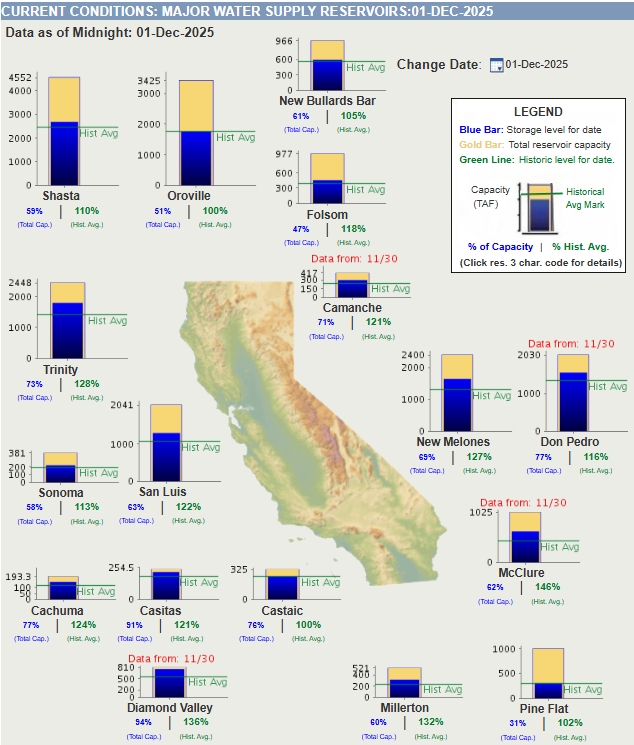
Reservoir conditions …
Also on Maven’s Notebook today …
DELTA CONVEYANCE PROJECT: Procedural Ruling on Evidentiary Motions, DWR Case in Chief

