
A wrap-up of posts published on Maven’s Notebook this week …
Note to readers: Sign up for weekly email service and you will receive notification of this post on Friday mornings. Readers on daily email service can add weekly email service by updating their subscription preferences. Click here to sign up!
In California water news this week …
A stratospheric disruption is occurring — and the impact on California is becoming clearer
“For weeks, meteorologists have been watching the upper atmosphere flirt with something extraordinary — the earliest recorded sudden stratospheric warming (SSW) on record. It looked imminent, with upward ripples in the jet stream weakening the polar vortex, a band of strong, cold winds high above the Arctic, and hinting at a massive disruption to the weather pattern in December. But the atmosphere had other plans. New data now confirms the atmosphere never crossed the threshold into a major sudden stratospheric warming event. To qualify, the band of strong winds about 55,000 feet up — the ring that normally circles the pole from west to east — has to fully reverse direction. Models suggest it may briefly flip later this week, but the reversal looks weak, short-lived, and not strong enough to count as a true breakdown of the polar vortex. … ” Read more from the San Francisco Chronicle.
New DWR conveyance study finds groundwater stabilization key to protecting San Joaquin Valley water supplies

“The Department of Water Resources (DWR) has released a comprehensive new assessment of water conveyance in the San Joaquin Valley – home to more than 4 million Californians and one of the nation’s most important agricultural regions. The San Joaquin Valley Conveyance Study examines the effects of land subsidence on the systems that move water across the region and evaluates the need for infrastructure improvements or expansions to support long-term water reliability. The study, an action in Governor Newsom’s 2020 Water Resilience Portfolio, finds that the top priority for improving conveyance in the San Joaquin Valley is stopping or minimizing land subsidence, especially near State Water Project and Central Valley Project conveyance facilities. This can only be achieved over the long term by raising groundwater levels above critical thresholds. The study also finds that repair of existing conveyance infrastructure is more important than expanding or building new conveyance because the region has limited surface water supplies. “This study makes the picture unmistakably clear: the most effective path forward is stabilizing groundwater levels and repairing the major canals that bring surface water to the San Joaquin Valley,” said Joel Metzger, Deputy Director of Statewide Water Resources Planning and Enterprise Project Management. “Taking action to support these goals is essential if we want to protect the Valley’s communities, support its agricultural economy, and maintain a functioning water system in a hotter, more extreme future.” … ” Read more from the Department of Water Resources.
Rep. Adam Gray says Los Banos water project proves California’s infrastructure system is broken
“California’s political debate over water, climate resilience, and infrastructure delays took a sharp turn this week after Rep. Adam Gray (D-Calif.) pointed to a local Los Banos project as evidence that the state’s bureaucracy is slowing down the very investments communities need to survive. In a newly published opinion column in The Hill, Gray warns that California’s permitting system has become so slow, repetitive, and expensive that even basic upgrades are now taking longer to approve than to build. The problem, he argues, isn’t opposition from residents or environmental safety- it’s a process so tangled that even widely supported projects spend years in “paperwork purgatory.” … ” Read more from the Los Banos Enterprise.
Solar-panel-covered canals have their day in the sun in California
“California is taking the first steps in realizing an idea to save billions of gallons of water each year and produce enough clean energy to power a city the size of Los Angeles for nine months annually. The simple but brilliant concept? Cover as much of California’s roughly 4,000 miles of irrigation canals with solar canopies as possible. Brandi McKuin, the lead University of California researcher on the project, says dozens of people have told her they had the idea of covering canals with solar panels decades ago. UC Merced’s Roger Bales, a hydrologist and distinguished professor of engineering who helped launch the project, has been hearing “why didn’t I think of that” about solar canals since the 1970s. … ” Read more from UC California.
DWR launches operations at Big Notch Project, expanding critical salmon habitat

Andrew Nixon / DWR
“Operations have officially begun for the Big Notch Project, one of the largest floodplain salmon-rearing habitat projects in California history. The Department of Water Resources (DWR) held a ribbon cutting ceremony today in Yolo County to kick off the first operational season of the Big Notch Project. The project includes three seasonally operated gates at the Fremont Weir, making it easier for juvenile salmon and sturgeon to move into the Yolo Bypass — a critical floodplain habitat that plays a key role in the recovery of these threatened and endangered species. The Big Notch Project is one of the key actions highlighted in Governor Newsom’s California Salmon Strategy for a Hotter, Drier Future which aims to restore populations of salmon as the state experiences increased temperatures as a result of a changing climate. The project was designed with cutting edge science and a highly public process that incorporated decades of fisheries research and land-use knowledge. Big Notch will be operated to benefit fish in a way that protects existing land-uses like agriculture, recreation, and flood protection. … ” Read more from DWR.
There’s a path forward in the San Joaquin Valley to benefit farmers, communities, and nature — but only if we plan . . . and plant
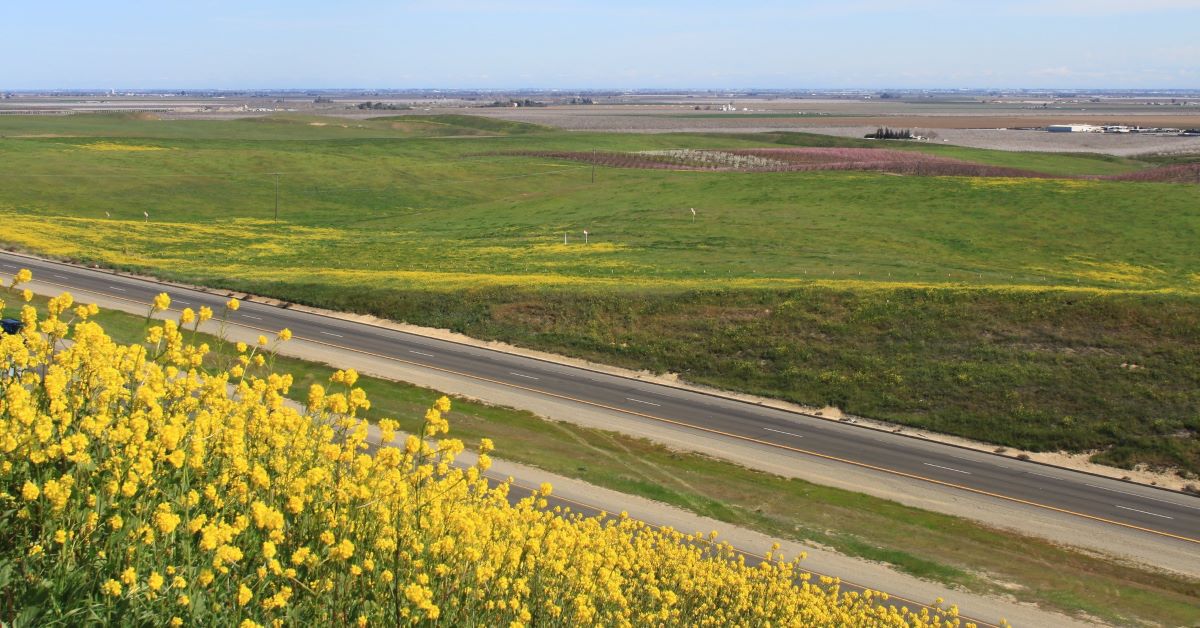 “For most of its history, California treated groundwater and surface water as legally distinct. Unlike surface water diversions, groundwater pumping was largely unrestricted until 2014 when the state passed the Sustainable Groundwater Management Act (SGMA), which requires the parts of the state where groundwater is pumped more quickly than it is replenished to set limits on current and future groundwater pumping. In the San Joaquin Valley alone, pumping exceeded replenishment by 2 million acre-feet per year for the three decades prior to 2014. To meet the goals of SGMA in the San Joaquin Valley, it is estimated that more than 500,000 acres of irrigated agricultural land will need to be retired by 2040 (Hanak et al. 2023). Repurposing land at this scale is a daunting challenge that requires strategic planning and tactical implementation. Without doing so, the negative aspects of abandoned or fallowed lands — such as worsening air quality, economic losses to farmers, and uninhabitable lands — are likely to be more severe, and we could miss this once-in-a-lifetime opportunity to restore wildlife habitat in the valley. The good news is that conservation organizations, water agencies, local communities, and others have been planning and preparing for this transition — and our early efforts to demonstrate how land can be repurposed strategically and at scale to support groundwater sustainability and the recovery of imperiled species are bearing fruit. … ” Read more from California Agriculture.
CV-SALTS Progress Report: Addressing nitrate and salt contamination in the Central Valley

“In 2006, the Central Valley Regional Water Board launched the Central Valley Salinity Alternatives for Long-Term Sustainability (CV-SALTS) program to tackle the growing issue of nitrate and salt contamination in groundwater and wells across the region. This collaborative initiative brings together regulators, agricultural and industrial dischargers, municipal wastewater agencies, and environmental and environmental justice organizations to develop and implement sustainable solutions. The program’s overarching goals are to support the San Joaquin Valley’s agricultural economy, ensure access to safe drinking water, and protect the environment. CV-SALTS focuses on two critical areas: long-term salinity management and nitrate management. A key emphasis is placed on providing safe drinking water to communities in high-priority areas of the San Joaquin Valley, where nitrate contamination poses significant health risks. On October 21, representatives from the Central Valley Regional Water Board and the Central Valley Salinity Coalition presented the sixth annual progress report to the State Water Board, offering updates on the program’s advancements and ongoing efforts. … ” Continue reading from Maven’s Notebook.
Forget turkey, we’re thankful about salmon. How California is helping salmon bounce back.
“In just the last week, California approved seven new salmon restoration projects in the Central Valley, marked significant progress in bringing salmon back to the Klamath River, and celebrated the completion of a major fish passageway along the Sacramento River. It’s all proof that the California Salmon Strategy for a Hotter, Drier Future — combined with its Healthy Rivers and Landscapes program — is paying dividends nearly two years since Governor Gavin Newsom first announced the plan. “Salmon are an integral part of our shared history in California,” said Governor Gavin Newsom. “We’re doubling down to make sure this species not only adapts in the face of extreme weather but remains a fixture of California’s natural beauty and ecosystems for generations to come.” … ” Read more from the Office of the Governor.
Public hearing scheduled regarding the appeals filed for the Delta Conveyance Project Certification of Consistency with the Delta Plan
“The Delta Stewardship Council will conduct a public hearing on February 26 and 27, 2026, regarding appeals of the California Department of Water Resources’ certification of consistency with the Delta Plan for the Delta Conveyance Project (C20257). Please visit our “Delta Conveyance Project” web page to access documents related to the certification of consistency and appeals.” Read the notice here.
California data center health impacts tripled in 4 years
“Researchers from the University of California, Riverside, found that health impacts from pollution associated with California’s computer processing data centers tripled from 2019 to 2023 — and could rise by another 72% by 2028 unless mitigation policies are enacted. The greater health consequences came with a near doubling of electricity consumed by California data centers in the same time period, said a report by UCR computer engineering scholars and produced by the nonpartisan think tank Next 10. Meanwhile, projections show that demand could rise to more than three times 2019 levels by 2028. At the high end, data centers could consume 25.3 terawatt-hours of electricity annually, the equivalent of the annual electricity consumption of 2.4 million average American households. … ” Read more from UC Riverside.
How to make data centers less thirsty
“Data centers are notoriously thirsty. Researchers at Lawrence Berkeley National Laboratory have found that, in 2023, the facilities consumed roughly 17 billion gallons of water for their operations in the U.S. alone. But that’s only a small part of the picture: A much, much larger share of data center water-intensity is indirect, a byproduct of the facilities’ enormous appetites for energy. That’s because most power plants themselves require huge amounts of water to operate. This off-site, indirect water consumption amounted to a whopping 211 billion gallons in the Berkeley lab’s 2023 tally — well over 10 times the direct on-site usage. As Silicon Valley continues to pour hundreds of billions of dollars into artificial intelligence and demand for data centers grows, these water needs are only going to grow in tandem. However, new research from Cornell University shows that there’s a way to mitigate both the climate and water footprints of these facilities: build them in places with lots of wind and solar energy. “Location really matters,” said Fengqi You, an energy systems engineering professor at Cornell and co-author of the new study. Where companies choose to locate their data centers could alter their combined environmental footprints by a factor of up to 100. … ” Read more from Grist.
Beer made from bath and laundry water hits shelves: eww or brew?
“A San Francisco startup is putting a new spin on the shower beat … serving up a cold one from recycled shower and laundry water. Epic Cleantec, a cleantech firm specializing in on-site wastewater purification, has launched two brews crafted from recycled graywater, the San Francisco Business Times reported. The lineup includes the “Shower Hour IPA,” a crisp, juicy take on the classic IPA, and the “Laundry Club Kölsch,” a light, smooth golden ale. Both are brewed with water captured from residential buildings and purified until, as the company claims, it’s “better than tap water in most cities in America.” “These beers aren’t a gimmick. They’re brewed with purpose, using ultra-clean recycled water and premium sustainable ingredients,” the company said on its YouTube channel. … ” Read more from the New York Post.
California’s coastal waters are transforming at a surprising rate. Here’s what the future could look like
“Waters off the California coast, part of one of Earth’s richest marine ecosystems, have acidified faster than most of the rest of the world’s oceans over the past century, according to a new study. The authors report that the broad swath of coastal water that flows southward from British Columbia to the Baja California peninsula, known as the California Current system, and the adjacent Salish Sea along the border of the U.S. and Canada, could also become far less supportive of marine life in the coming decades, based on modeling using a worst-case climate change scenario. The region is “sitting at the leading edge of ocean acidification impacts,” said Mary Margaret Stoll, who recently earned a doctorate in oceanography from the University of Washington and co-authored the study in Nature Communications. “It provides a window into future conditions predicted in the coming decades for the rest of the ocean.” … ” Read more from the San Francisco Chronicle.
In commentary this week …
Need for speed: Why permitting reform can’t come soon enough
Congressman Adam Gray writes, “A sentiment I consistently hear from constituents is that they no longer believe in government’s ability to do big things — not just to stake out bold ideas but to implement and deliver on them. On the major issues we face, from housing to energy production, there is growing consensus that we lack the ability to move quickly and at the scale needed to address the problems before us. They are not wrong. In my district in California’s Central Valley, we see the need for massive investments in new water infrastructure to meet the needs of our growers and disadvantaged communities, yet we seem incapable of moving beyond the endless planning and discussion phases. This was not always the case. The Central Valley as it exists today was built on a series of ambitious federal and state infrastructure projects that transformed the way water is transported throughout the state. … ” Continue reading at The Hill.
Politically viable water supply projects
Edward Ring, Director of Water and Energy Policy at the California Policy Center, writes, “A few years ago I was involved in an effort to qualify a ballot initiative, the “Water Infrastructure Funding Act.” While we failed to gather sufficient signatures to get it onto the November 2022 state ballot, if it had been approved by voters, water scarcity in California would have been eliminated forever. Unfortunately, certain provisions in that measure attracted immediate, forceful opposition which put potential major supporters into an impossible position: Donate about $5 million to qualify the initiative, then spend another $50 million or so on a campaign for votes, and risk losing. The allegedly toxic provisions we’d included are no secret. The initiative named seawater desalination and surface reservoirs as among the projects eligible for funding, and was neutral on the Delta Tunnel. Any one of those three attracts apoplectic opposition from a critical mass of powerful players. The failure of our effort invites a worthwhile question. What combination of water supply projects might be assembled that would not invite apoplectic opposition, but together could still eliminate water scarcity? … ” Continue reading this commentary.
In regional water news this week …
Residents pack Ukiah workshop on Potter Valley Project decommissioning
“On Monday, the Mendocino County Inland Water and Power Commission held a three-hour workshop at the Ukiah Valley Conference Center to discuss the decommissioning of the Potter Valley Project and answer questions from community members about how it will impact the local economy, residents, and natural resources. For more than 100 years, the Potter Valley Project has diverted water from the Eel River to the Russian River watershed through two dams — the Scott Dam at Lake Pillsbury and Cape Horn Dam at Lake Van Arsdale. The two lakes have supplied water to communities throughout Mendocino and Sonoma counties. This water source has been crucial for agricultural, municipal, and environmental uses. As soon as 2028, PG&E plans on decommissioning the Potter Valley Project, which could help fish restoration on the Eel River but could also decrease water availability and negatively impact local communities. … ” Read more from the Mendocino Voice.
Tahoe Fund launches ‘A Million For The Marsh’ campaign to bring major improvements to former Motel 6 site
“Now that the former Motel 6 building, restaurant, and parking lot have been demolished from the Upper Truckee Marsh in South Lake Tahoe, planning is underway to bring this wetland back to life. To support the next phase of this project, the Tahoe Fund announced “A Million for the Marsh” campaign to raise the first $1 million of private funds to help secure the public funds the California Tahoe Conservancy will need to revive this area and bring significant improvements to Lake Tahoe’s clarity. “California Natural Resources Secretary Wade Crowfoot called the acquisition and demolition of this site ‘the most important in a generation to protect Lake Tahoe,’ and we couldn’t agree more,” said Amy Berry, Tahoe Fund CEO. “That’s why we’re launching this campaign—so that our donors can show that taking the next step to restore this marsh matters to our community and to the future health of Lake Tahoe.” … ” Read more from the Tahoe Daily Tribune.
Judge pauses razing 100s of trees on a Sacramento river, finding ‘irreparable harm’
“A Sacramento federal judge granted a preliminary injunction late Thursday to pause razing more than 650 trees clustered along the American River Parkway, citing “irreparable harm” for recreationists who will lose access to the area. The U.S. Army Corps of Engineers began installing flood protection measures on the Sacramento River, Natomas East Main Drainage Canal, Arcade Creek, Magpie Creek, the lower American River after Congress approved funding in 2016 for these projects. The judge’s order temporarily halts construction on the lower American River, about 3.3 miles of riparian forest rooted around Howe and Watt avenues. Federal officials planned cutting at least 675 trees and trimming thousands of others to install riprap, or rocks, to strengthen banks. Sacramento and national nonprofits filed a lawsuit against the U.S. Army Corps of Engineers and others to find less destructive alternatives to flood protection. … ” Read more from the Sacramento Bee.
Sacramento Weir: Guardian of the Valley’s Past and Future
“Discover the untold story of the Sacramento Weir, an engineering marvel that has safeguarded California’s Central Valley for over a century. From Native tribal stewardship to Gold Rush levees, to modern flood control innovations, this video explores how history, ingenuity, and community continue to shape the future of flood management in the Sacramento Valley.”
Politics, law and reality collide in pursuit of relief on Peninsula water woes.
“Say you want to install a new water meter on the Monterey Peninsula – no can do. Since 1995, the region’s water utility, California American Water, has been under a cease-and-desist order from the State Water Resources Control Board to stop illegally overpumping the Carmel River. That order led to a ban in 2009 on new water meters, making it difficult to impossible to build needed housing since then. In this mess, some real water supply projects have advanced, chiefly a recycled water project called Pure Water Monterey. It means Cal Am is within its legal pumping limit – yet the cease-and-desist order is still in effect. Everything in local water is a proxy for something else, and in this mess of public agencies and projects, one recurring storyline is that Cal Am is a villain – in some tellings, it is a hero thwarted in its efforts to develop an alternate water supply. … ” Read more from Monterey Now.
Nearly 5.5 billion gallons of water captured from recent storms, LADWP says
“Nearly 5.5 billion gallons of water were captured during one of the wettest Novembers on record in Los Angeles, the LADWP said. After a dry start to the water year, November brought several days of rain. The city captures water through its stormwater system, residential rain barrels and cisterns, and expansive spreading grounds where water collects to recharge underground aquifers. That groundwater can be pumped and treated to meet water quality standards for homes and businesses. The LADWP’s stormwater system has the capacity to capture more than 27 billion gallons under average conditions, the agency said. Stormwater runoff that can’t be captured is discharged into the ocean. … ” Read more from NBC 4.
Landfill trash could help power Doheny Ocean Desalination Project
“You know how the saying goes — one person’s trash is another’s treasure. In this case, gas created by trash at the Prima Deshecha Landfill could be turned into renewable energy to help power the Doheny Ocean Desalination Project in south Orange County. The Orange County Board of Supervisors, earlier this month, approved a memorandum of understanding between OC Waste & Recycling and South Coast Water District to explore delivering renewable electricity to the project, which hopes to create a locally-controlled drinking water supply for south Orange County in the coming years. The county’s MOU allows for the formation of a task force to explore and evaluate technology, grid delivery, funding, governance and a schedule for the collaboration. … ” Read more from the OC Register.
Even a full Santa Ynez reservoir wouldn’t have kept Palisades hydrants working, state report finds
“As the Palisades Fire was still burning in January, residents saw an eye-grabbing headline: the Santa Ynez reservoir, perched directly above the Palisades, was offline for repairs and empty. The reservoir’s closure frustrated residents and spurred Gov. Gavin Newsom to announce a state investigation into whether the reservoir being full of water would have made a difference fighting the deadly fire. After months of analysis, California agencies including the state’s EPA, Cal Fire and the Department of Water Resources issued a report confirming the explanations given by local officials and experts in the aftermath of the fire: the water supply was too slow, not too low — and even a functioning reservoir likely wouldn’t have done much in the face of an unprecedented natural disaster. … ” Read more from the LAist.
Cadiz inks $51 million deal with Tribe
“Downtown-based water infrastructure developer Cadiz Inc. has turned to an unusual source to help fund the development of a groundwater bank under its Mojave Desert holdings: a Northern California Native American tribe. On Oct. 28, Cadiz announced that it had executed an agreement with the Santa Rosa-based Lytton Rancheria of California Native American tribe for the tribe to provide an investment of up to $51 million for the construction and development of the Mojave Groundwater Bank. It’s the first tribal investment in the Cadiz water infrastructure project. The groundwater bank is the latest iteration of Cadiz’ decades-long effort to win approvals to pump and transfer water from its Mojave Desert aquifer to water customers in Southern California and throughout the state. … ” Read more from the LA Business Journal.
Board of Supervisors hears that the Salton Sea can be cleaned
“Tom Sephton, the president of Sephton Water Technology, gave a presentation about water quality restoration at the Salton Sea during the Board of Supervisors meeting on Tuesday, Nov. 25. “The reason we have a challenge at the Salton Sea is that water, as you know, has been moved away to other places. Almost half a million acre-feet of water every year is going to San Diego, Metropolitan Water District and the Coachella Valley Water District,” Sephton said. To increase the availability of local distilled water, Sephton proposed purifying and selling salt from the Salton Sea to reduce the water’s salinity. “We would propose to use the technology we’ve developed over 20 years of work at Cal Energy to purify Salton Sea water to cleaner water and pure salt for sale,” Sephton said. “We have proven using geothermal heat that we can purify Salton Sea water into drinking-quality distilled water. We have also proven at Cal Energy that we can get pure salt out of the process.” … ” Read more from the Desert Review.
Announcements, notices, and funding opportunities …
YOUR INPUT WANTED: Recharge Incentives Survey Re-Opened Until December 5th
YOUR INPUT WANTED: Winter-run Chinook Salmon Annual Loss Independent Peer Review

